
Build a Personal Brand From Your Expertise and Prove It With an Ebook


Expertise becomes a brand the moment a stranger can repeat your claim and check that it is true. An ebook does both jobs at once. Picking the claim, scoping the book and deciding what gets printed are the three moves below.
A personal brand is one narrow claim, said the same way every time, backed by proof a stranger can check without asking you. An ebook is the fastest proof to build, because writing a table of contents forces you to commit to the claim. Write it for one reader with one problem, keep it in the twenty to sixty four page band so it actually ships, and print a short run only for the rooms a PDF cannot follow you into.
Quick answer
One claim, one book, one short print run
Pick a claim narrow enough that a stranger can repeat it, then prove it in a book short enough to finish. The table of contents is the test: eight headings you can fill from real work means you have a position, and drifting into subjects you have never been paid for means you do not. Twenty to sixty four pages is the band where these books ship, because a saddle stitched booklet binds in multiples of four and loses its grip past roughly sixty four pages. Give it away to grow a list, price it to filter for buyers, and print it only for the rooms you are already standing in.
Find the One Claim Your Expertise Can Defend
Start with the sentence, not the book. A personal brand is one claim, said the same way every time, that a stranger can repeat accurately after hearing it once. Everything else, the typeface, the headshot, the color, is decoration on top of that sentence.
Three places to look for it. First, the questions people already send you without being asked. Second, the fix you have made enough times that you no longer think about the steps. Third, the task that takes you twenty minutes and takes a competent generalist most of a day. Where those three overlap is your claim, and it is usually narrower and less glamorous than the one you wanted.
Then narrow it until it sounds slightly too small. "Email marketing" is a category anyone can enter. "Win back sequences for subscription boxes that ship every eight weeks" is a position, and the person with that exact problem will stop scrolling. The trade off is real: every word you add to the claim removes people from the audience. You are trading reach for referral, and referral is what actually fills a solo calendar.
Nobody says that limit out loud. A claim you cannot support with work from the last twelve months is a plan, not a position, and an ebook built on it reads hollow because there are no real examples to put in it. If that is where you are, go and do the work first. When you have the claim, our brand voice guide covers saying it consistently, and the brand identity guide covers the visual layer you build afterwards, in that order.
Scope the Ebook So It Actually Ships

Write the table of contents before the first chapter. Eight to twelve headings, each one a question your reader has actually asked. If you cannot fill them without wandering into a subject you have never been paid for, the claim is still too wide and no amount of writing will fix that.
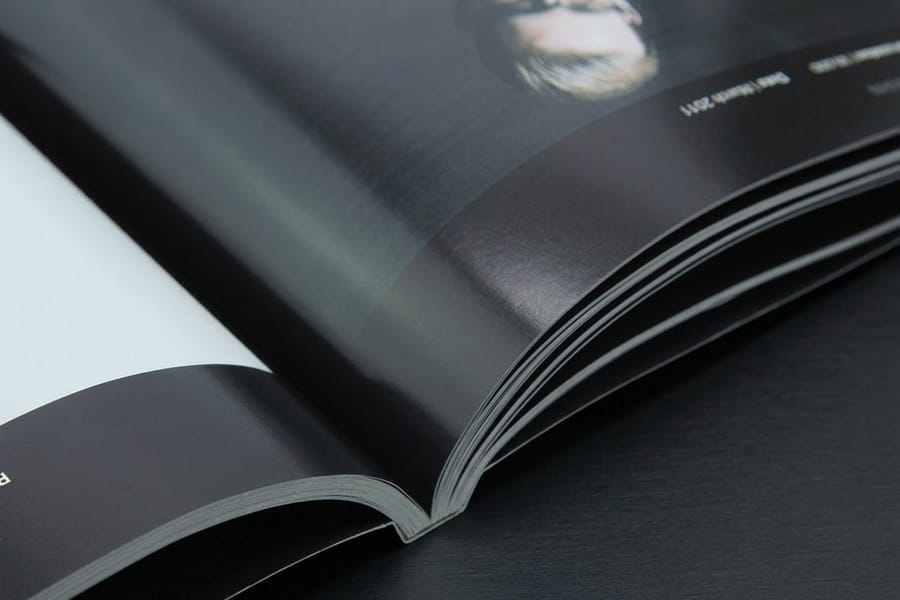
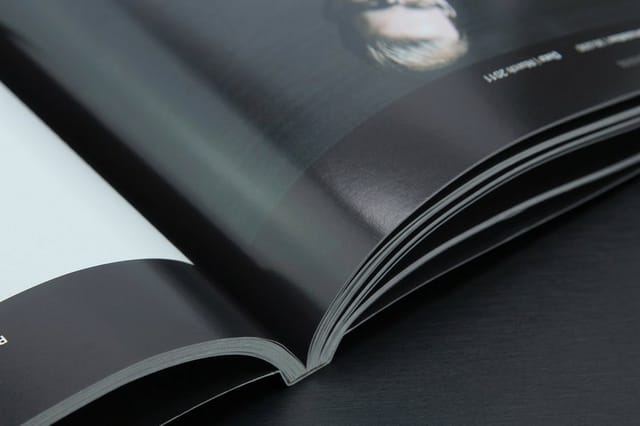
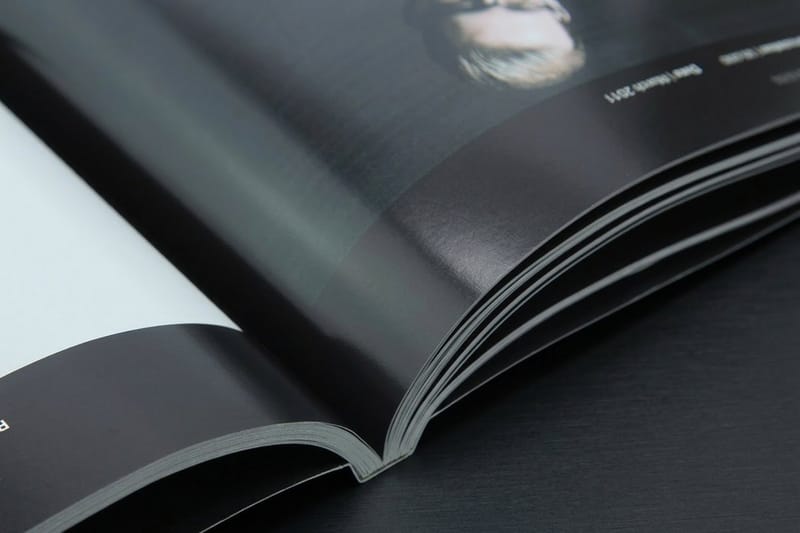
Length is a binding decision before it is a writing decision, and most people get this backwards. Every folded sheet in a booklet makes four pages, so a saddle stitched book always finishes on a multiple of four. Sixteen, twenty four, forty eight. Past roughly sixty four pages on text weight paper the stitch loses its grip, creep pushes the inner margins outward, and the printer moves you to perfect binding with a spine you can print on.
| Length | How it binds | What it buys you | What it costs you |
|---|---|---|---|
| 8 to 16 pages | Saddle stitched, no spine. | Finished in a two weeks. Read in one sitting. Easy to give away at scale. | Reads as a sample. Nothing on a shelf edge to remember you by. |
| 20 to 64 pages | Saddle stitched, always a multiple of four. | Enough room to prove one claim properly, with examples. Still ships this quarter. | A real writing project. Two to three months if you already have the material. |
| 64 pages and up | Perfect bound with a printed spine. | Stands on a shelf, carries a higher price, reads as a book rather than a download. | Months of writing, a bigger print budget, and far more that can go stale. |
The middle row is where a specialist ebook belongs, and the temptation to climb into the third row is what kills most of these projects. Nobody has ever bought your thinking because it was long. If you want the full picture of how each binding behaves, the binding types guide lays them side by side, and standard booklets start at $240.55 when you are ready to put the middle row on paper.
Free, Paid, or Printed, and What Each One Costs You

The same manuscript does three different jobs depending on how you release it, and picking the wrong job wastes the writing rather than the money.
Free grows a list. A download in exchange for an email address moves fastest and gets forwarded, which is how a claim spreads beyond the people who already follow you. The cost is attention: most people who take a free file never open it, so the download number tells you almost nothing about whether the argument landed.
Paid grows a filter. Charging even nine dollars cuts the download count sharply and leaves you with readers who have already decided your thinking is worth money. That group replies to emails, books calls, and shows up to workshops. The cost is reach, and at a small list size the email address is often worth more than the margin, which is why many people start free and add a price once the list can absorb the drop.
Print buys commitment. A printed copy is the only version that survives a closed laptop, and handing one over changes the conversation in a way a link does not. It is also the version that freezes your text. Booklets start at $240.55 and a perfect bound book starts at $375.05, so a reprint after a late edit costs the whole run. Finish the file, read it once more on paper, then order.
Most people who do this well run all three in sequence: a free two chapter sample that ends on the question the book answers, a paid digital edition, and a short print run for the rooms they are physically in. That last one is the subject of the next section, and the faceless creator guide covers the digital pricing side in more depth if you are selling without a public face.
Put the Book in Hands, Not Just in Inboxes
Print does not scale, and that is exactly the point. A file goes to thousands of people who owe you nothing. A printed copy goes to forty people you have met, and it stays on a desk where it keeps working after you leave the building.
Three moments justify the run. A talk or a workshop, where the book is the thing people carry out and the reason they remember which speaker you were. A client pitch, where handing over something you wrote about their exact problem ends the credentials part of the meeting early. And a conference table, where a stack of books does what a stand of leaflets never manages. If speaking is where you are heading, the workshop day guide covers pricing the room the book gets you into.
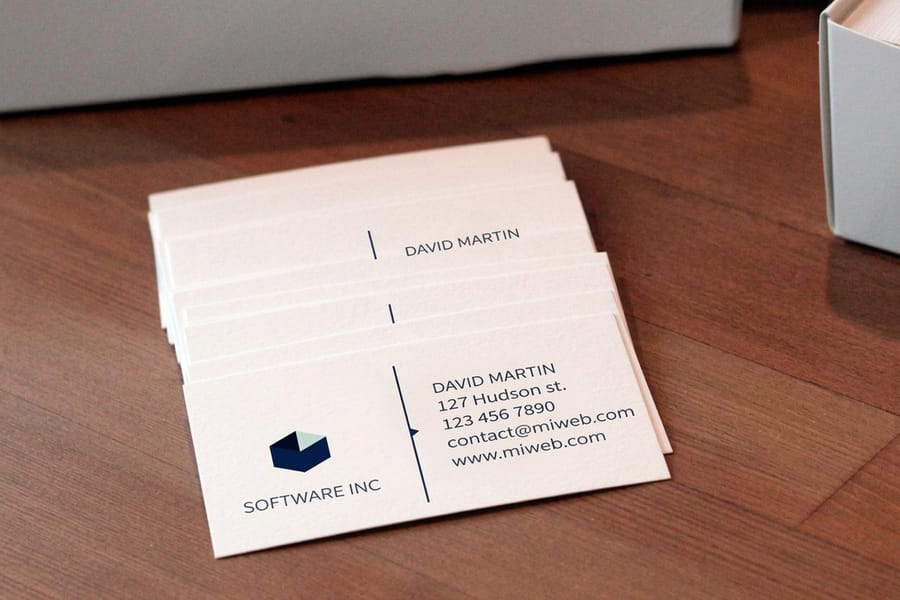
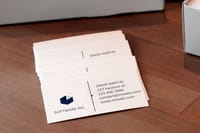
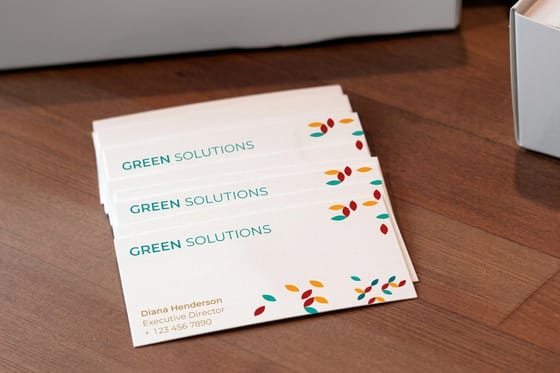
Two small pieces do the connecting work. Put your claim on the card, not your job title: standard business cards start at $17.57, and a card that says what you fix outlasts one that says Senior Consultant. Then follow up on paper. Standard postcards start at $16.48 and a card that arrives a week after a talk, with one line about what the reader said to you, gets answered far more often than the third email. The personal brand print pack bundles the pieces a solo expert genuinely uses.
Now the honest limit. Do not print five hundred copies for an audience of forty. Count the hands you will actually shake in six months, add a small margin for the people who ask afterwards, and order that. A box of unread books in a hallway is not a personal brand, it is storage. Everything else in the book printing range prices by page count, so you can test the number before you commit to it.
The Expertise to Ebook Checklist
Work down it in order. Each step is cheap to undo until the one after it, and the whole point of the sequence is that nothing expensive happens before the claim is settled.
- Write the claim in one sentence. Who, what problem, what result. If it needs a comma splice and a second clause, keep cutting.
- Test it out loud on three people who do not know your work. Ask them to say it back a day later. What comes back is your real brand, not what you wrote.
- List every question you have been asked about it. Pull from your sent mail, not from memory. Memory keeps the flattering ones.
- Turn the eight best questions into chapter headings. If two of them are really the same question, you have six chapters and a shorter book.
- Attach a real example to each heading. A job, a number, a mistake you fixed. A chapter with no example is a chapter you are guessing at.
- Set the page target before you write. Pick a multiple of four in the twenty to sixty four band and write to it, rather than discovering the length afterwards.
- Decide free or paid now. It changes the ending of every chapter, and retrofitting a sales argument into a finished manuscript never reads well.
- Build the delivery before the book is done. The page, the email that sends it, the reply that arrives an hour later. Half finished funnels sit behind most half finished books.
- Read the whole thing on paper once. Errors that hide on a screen surface immediately in print, and this pass is free compared with reprinting.
- Then order the short run. Only after the file has stopped changing, and only for rooms already in your calendar.
Step nine is the one people skip and the one that saves the most money. Proof the file, then bring it to the booklet and catalog printing range with a page count that is already a multiple of four.
Wally explains the expertise ebook
One sentence first, then the pages, then the print run
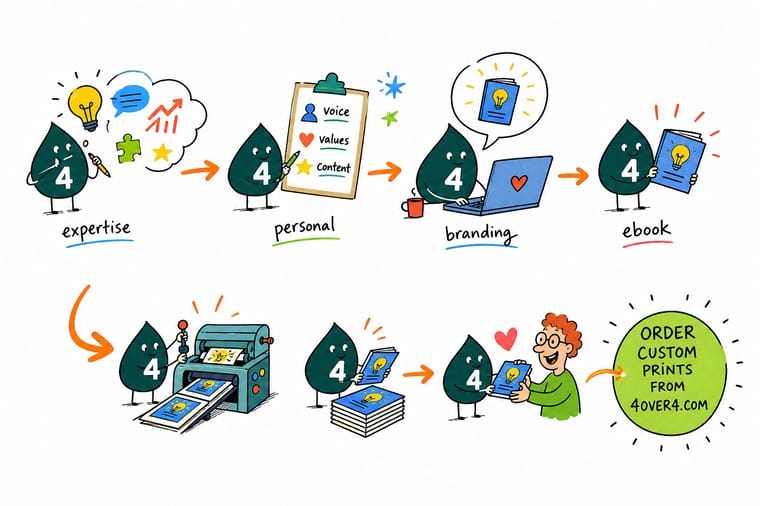
Wally writes his claim on a card before he writes a word of the book, because a claim a stranger cannot repeat will not survive eight chapters. Then he lists the questions people already ask him and turns the best eight into headings. He picks a page count that is a multiple of four and stops at sixty four, so the booklet still saddle stitches. Last, once nothing in the file is changing, he prints a small run for the talks and meetings in his calendar. Not one copy more.
Print your expert booklet →Specs and pricing
Page counts, bindings, and starting prices
The three pieces a personal brand book actually needs, with live configuration choices and starting prices straight from the 4OVER4.COM configurator.


Print it
Put your expertise on paper

Explore more
Where to go next




By the numbers
Booklets and perfect bound books in short runs
Common Questions
Your personal branding ebook questions, answered
How long should a personal branding ebook be?
Between twenty and sixty four finished pages for almost everyone. That band is long enough to prove you know the subject in depth and short enough that you finish it while the idea is still hot. It also matches how booklets are made: every folded sheet produces four pages, so a saddle stitched book always lands on a multiple of four. Past roughly sixty four pages on text weight paper the stitch starts to lose its grip and creep pushes the inner margins out, which is the point where a printer moves you to perfect binding and a printed spine.
Should I give the ebook away or charge for it?
It depends on which you are short of, readers or qualified conversations. A free download grows an email list quickly and gets forwarded, but most people who take it never open it. A price of nine to twenty nine dollars cuts the download count hard and leaves you with a smaller group who already spent money on your thinking, which is the group worth emailing. A common middle path is a free sample of two chapters that ends on the question the paid book answers.
Do I need a personal logo for this?
No. A consistent name, one typeface and one color will carry a personal brand further than a mark you commissioned before you had a position. Logos matter when several products need to be recognized as coming from the same place. Early on, the recognisable thing is the claim and the way you say it. If you do want a mark later, our guide to building a brand identity covers the order to do it in.
My expertise overlaps with hundreds of other people. Is that a problem?
Only if you describe it at the same altitude they do. Overlap disappears at the specific level. Twenty people teach email marketing; almost nobody teaches the win back sequence for a subscription box that ships every eight weeks. Narrow until the sentence sounds slightly too small, then check that you have done the work at least a handful of times. If you have not, you have picked a plan rather than a position.
How many copies should I print, and what does it cost?
Count the hands you will actually put it into over the next six months, then add a small margin for the people who ask afterwards. Standard booklets start at $240.55 at 4OVER4.COM and a perfect bound book starts at $375.05, so the first run is a real decision rather than an afterthought. Printing five hundred copies for an audience of forty is the most common way this money gets wasted.
How do I know the personal brand is working?
Listen for your own sentence coming back at you. The signal is not follower count, it is an inbound message that describes your claim in words you did not write in that email, from someone you have never met. When that starts happening, the claim has travelled. Until it does, the answer is usually that the claim is too broad to repeat, not that you need more posts.
Get Started
A 25 copy booklet run costs $240.55, or $9.62 a copy
Set your page count, pick saddle stitch or a perfect bound spine, and we print a short run you can carry into the next room.
Legal Disclaimer
Gold Standard guarantees apply to all standard orders placed through 4over4.com. Price match requires verifiable proof of a competitor's published price for an equivalent product with matching specifications and turnaround time. Satisfaction guarantee covers manufacturing defects and print quality issues. Contact support with order number and documentation. On-time delivery rate based on tracked orders 1999 to 2026. Individual results may vary based on shipping carrier performance.
