
Medical Brochure Template Layout and the Sections Every Clinic Needs


A clinic brochure has six panels and six jobs. Here is what belongs on each one, the panel widths that make it close flat, and the copy rules that keep a practice out of trouble.
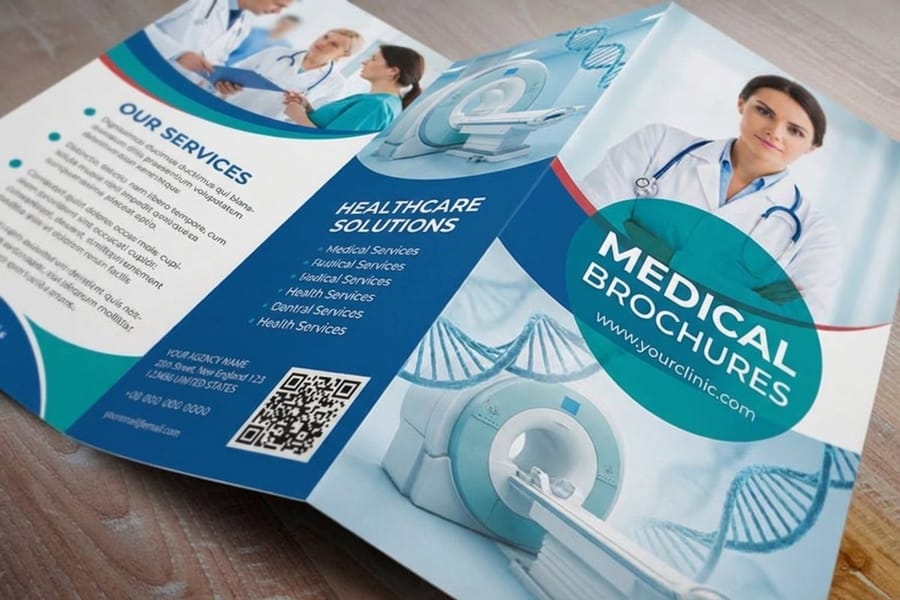
A medical brochure template is a letter trifold, 11 by 8.5 inches flat, with six panels: cover, back panel, tuck-in flap, services, insurance and billing, and what happens at a first visit. The cover carries the practice name, one line on what you treat, and the phone number. The panel that folds inward measures 3.625 inches while the other two measure 3.6875 inches, which is what lets the brochure close flat and sit in a rack.
Quick answer
Six panels, six jobs, and one panel that has to be narrower
Assign one job per panel before you design anything. Cover, back panel and tuck-in flap sit on the outside face. Services, insurance and billing, and the first-visit walkthrough fill the inside spread. Set the tuck-in panel to 3.625 inches and the other two to 3.6875 inches so the folded piece lies flat at 3.6875 by 8.5 inches, the size a waiting-room rack pocket takes. Keep patient names, photographs and treatment stories off the sheet unless you hold a signed authorization.
Map the Six Panels Before You Open a Design File

A letter trifold is 11 by 8.5 inches flat and gives you six faces to fill. Two of them sit on the outside of the folded piece, one hides behind the cover, and three form the spread a patient sees when the brochure opens flat. Deciding what each face carries takes ten minutes and saves the redesign that happens when the services list runs past its panel.
| Panel | Width | What belongs on it |
|---|---|---|
| Front cover | 3.6875 in | Practice name, one line naming what you treat, phone number. Nothing else. |
| Back panel | 3.6875 in | Address, hours, parking or nearest train, portal QR code, license or NPI line if your state requires it. |
| Tuck-in flap | 3.625 in | A short welcome, or one provider bio with a headshot. It is the first thing seen on opening. |
| Inside left | 3.6875 in | Services, in plain language, grouped rather than alphabetized. |
| Inside center | 3.6875 in | Insurance accepted, self-pay policy, the date the list was checked. |
| Inside right | 3.625 in | What happens at a first visit: arrival time, documents to bring, forms. |
The width column is the part people get wrong. On a roll fold the panel that tucks inside has to be about a sixteenth of an inch narrower than its neighbours, or the closed brochure bows along the second crease and will not lie flat in a stack. Divide 11 by three and you get 3.6667 for all three, which is exactly the setup that produces a bulge. The trifold sizes guide works through the same math for legal and A4 sheets.
Keep type at least 0.25 inch away from every fold. A heading that straddles a crease reads as a mistake even when the fold lands within tolerance, and folding tolerance on a production run sits around a thirty-second of an inch either way.
Write the Sections a Patient Reads, Not the Ones You Own

Front-desk staff will tell you the same three questions come up every day: do you take my plan, what do I bring, and how long will I be here. Those three answers earn the inside spread. Everything else competes for what is left.
Services. Write what a patient would say, not what you bill. Sports injuries beats musculoskeletal rehabilitation, and neither of them needs a CPT code. Group five or six headings with one line under each. A list of twenty-two procedures reads as a menu nobody can choose from.
Insurance and billing. Name the plans, then print the month you verified them and the number to call. A brochure that says we accept most major insurance tells a patient nothing and still generates the phone call. Add one line on self-pay and one on payment plans if you offer them.
The first visit. Arrival time, photo identification, insurance card, medication list, referral if the plan requires one, and how long to expect. This is the panel that reduces no-shows, because it converts an unfamiliar appointment into a sequence someone can picture.
The back panel. Address, hours, parking, and one QR code to the patient portal or the booking page. Test that code printed at final size before the run, because a code sized under 0.8 inch square with a dense URL fails on older phone cameras. Our guide to QR codes on print covers the size and contrast that scan reliably.
What to leave out: a paragraph on the practice history, a full staff roster with photographs, and stock imagery of smiling strangers. Give the space to medical brochures content that answers a question instead.
Privacy-Safe Copy, and the Line Most Clinics Cross

The moment a brochure leaves your building it is out of your control, so the safe assumption is that anything printed on it becomes public. That single test filters most of the risk.
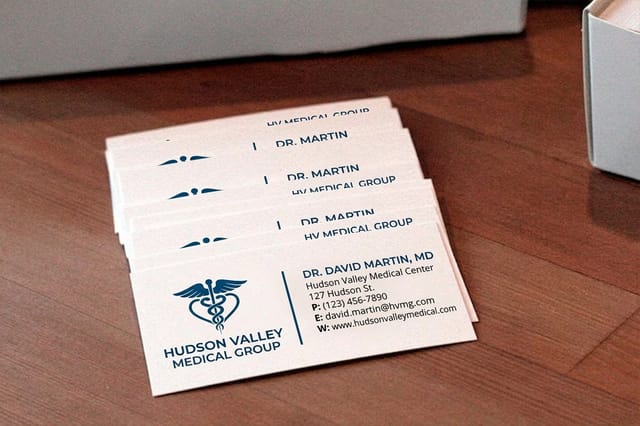
Protected health information is broader than a name. A photograph that identifies a patient, a first name next to a condition, a treatment story, a visible chart or monitor in the background of a room shot, and a written account of one patient's treatment all qualify. Using any of them in marketing needs a signed HIPAA authorization from that individual covering marketing use, kept on file. Most clinics skip the paperwork and photograph staff, the building, the empty waiting room and the equipment, which is why our medical business cards and brochure samples use exactly those subjects.
Two more traps. First, outcome claims. Painless, guaranteed results, and best in the city invite a complaint to the state board and, for a fee-for-service claim, a look from the FTC. Describe what you do and who you treat, and let the results stay in the notes. Second, the fine print your state actually requires: many states want the supervising physician named on marketing material, and some professions must show a licence number. Check the advertising rules your state board publishes before the file goes to press, because that requirement changes by state and by profession.
One practical habit: put an as-of date on any panel that could go stale. Insurance lists, hours and provider names all change faster than a print run, and a printed date turns an out-of-date brochure into an old brochure rather than a wrong one.
Size, Paper, Fold and What a Run Actually Costs
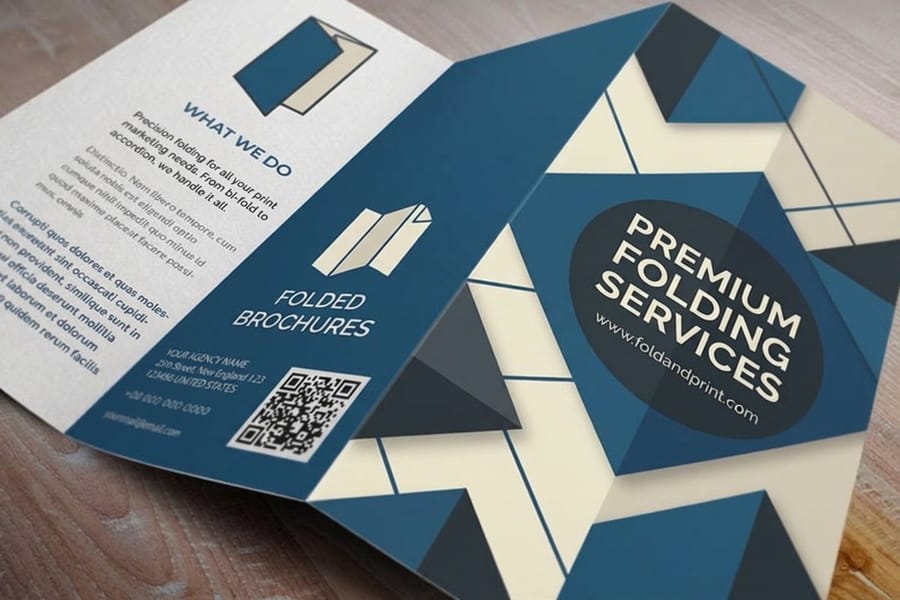
Start the file at 11 by 8.5 inches with a 0.125 inch bleed, keep live copy 0.25 inch inside the trim, and set fold guides at 3.625 and 7.3125 inches from the left on the outside face. Export a flat PDF with fonts outlined and images at 300 ppi at final size. Download a correctly sized layout from the blank template library rather than building panel guides by hand, and read the bleed, cut line and safety checklist once before you export.
Paper decides how the piece survives a waiting room. A 100 lb gloss text folds without cracking and shrugs off finger oil, which matters on a brochure handed over a counter several hundred times. A 100 lb matte text reads better under ceiling fluorescents and takes a pen, so choose it when a panel doubles as a form. Cover weight feels expensive and needs scoring before it folds, which adds a production step. The brochure paper guide lays the weights out side by side.
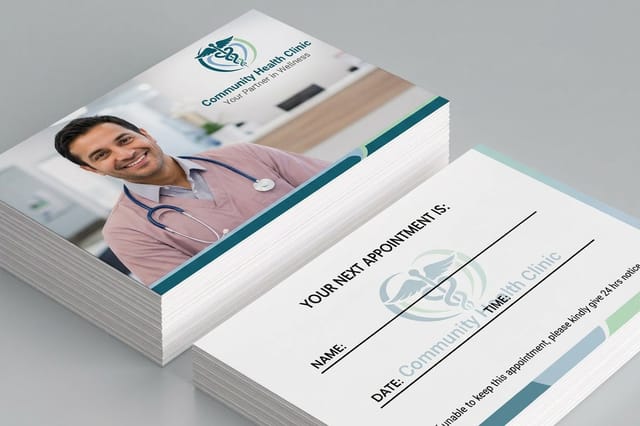
On price, medical brochures start at $57.11 and folded brochures start at the same $57.11, so the choice between them is about the artwork rather than the budget. A clinic that hands a brochure to every new patient usually pairs it with something smaller for the return visit: medical appointment cards start at $17.57 and carry the date, the arrival window and the cancellation policy. Browse the full range under brochure printing, or see everything a practice orders together in the medical printing collection.
One last check before you approve: fold a printed proof by hand. A brochure that reads correctly on screen can still open onto the wrong panel, and the only reliable way to catch it is to hold the folded sheet the way a patient will.
Wally maps a clinic brochure
One job per panel, and one panel cut narrower
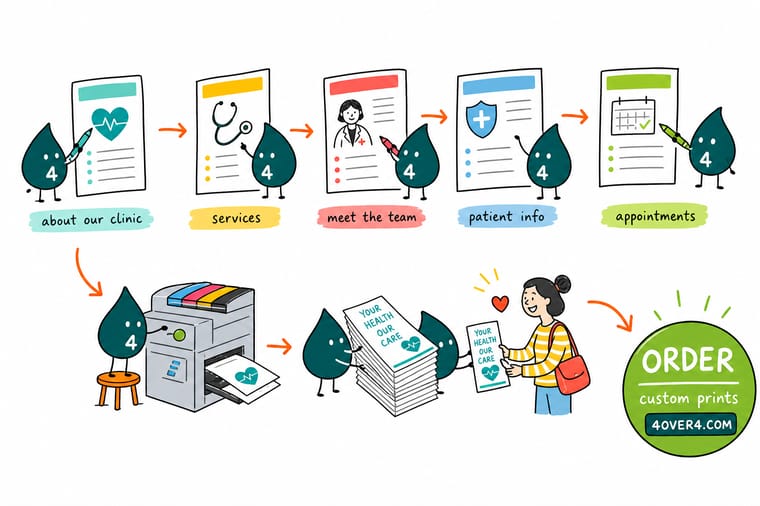
Wally lays the sheet flat and writes a job on every face before he draws a thing. Cover, back panel, tuck-in flap on one side. Services, insurance, first visit on the other. Then he trims the panel that folds inward to 3.625 inches while the other two stay at 3.6875, so the brochure closes flat instead of bowing. Last, he crosses out the patient photo, because that needs a signed authorization and a staff shot does not.
Order medical brochures →Specs and pricing
Sizes, folds and starting prices for a clinic run
Compare the brochure and appointment-card options side by side, with live configuration choices and starting prices straight from the 4OVER4.COM configurator.


Print it
What a practice orders together

Explore more
Where to go next
By the numbers
Healthcare printing you can count on at 4OVER4
Common Questions
Your clinic brochure questions, answered
What size is a standard medical brochure template?
Letter trifold. The sheet is 11 by 8.5 inches flat and folds down to 3.6875 by 8.5 inches, which is the size a waiting-room rack pocket expects. Set the document to 11 by 8.5 inches with a 0.125 inch bleed on all four sides, then place your fold guides so the panel that tucks inside measures 3.625 inches and the other two measure 3.6875 inches each. A legal trifold at 14 by 8.5 inches gives you wider panels for a long services list, but it will not sit in a standard rack.
Which sections does a clinic brochure actually need?
Six, one per panel. Front cover with the practice name, one line on what you treat and the phone number. Back panel with the address, hours, parking or transit, and a portal QR code. Tuck-in flap for a short welcome or a provider bio. Then the three inside panels carry services, insurance and billing, and what happens at a first visit. Anything else, including a full staff roster or a history of the practice, belongs on the website rather than on paper you reprint every year.
Can we put patient photos or testimonials in a medical brochure?
Only with a signed HIPAA authorization from that patient covering marketing use. A photograph that identifies someone, a first name paired with a condition, a treatment story, or a background shot with a chart or screen legible in frame all count as protected health information. Most clinics avoid the paperwork by photographing staff, the building, the waiting area emptied of patients, and equipment. If you do use a patient image, keep the signed authorization on file for the life of the print run.
What paper works best for a waiting-room brochure?
A 100 lb gloss text folds cleanly and resists the finger oil that dulls a matte sheet after a few hundred handoffs. Choose 100 lb matte instead when the brochure carries dense body copy or a form patients fill in, because gloss under fluorescent ceiling lights bounces glare straight into the reading angle. A cover-weight sheet feels more substantial but needs scoring before folding, which adds a step. The trade-off is real: gloss survives handling, matte reads better.
How many brochures should a small clinic order?
Enough to cover the reprint trigger rather than the calendar. A two-provider practice that hands one to every new patient and keeps two racks stocked usually moves 500 to 1,000 a year. Order the quantity that carries you to the next known change, which is normally an insurance renewal or a provider joining. Printing 5,000 to chase the unit price is a false saving when a single plan change makes the whole box wrong.
Can a medical brochure be mailed on its own?
Yes, if you tab it. A folded self-mailer has to be sealed with wafer tabs on the open edge or the USPS machinery will chew it, and the piece has to meet the current thickness and aspect ratio rules for the rate you want. Many clinics find it easier to send a postcard that drives to the website and hand the brochure over the counter instead. If you want the brochure in the mail, our guide to mailing brochures covers the tabbing and the address-panel placement.
Get Started
Ready to print the brochure your front desk keeps reaching for?
Pick the fold, choose gloss or matte text stock, and we print clinic brochures that fold flat and drop straight into a rack pocket.
Legal Disclaimer
Gold Standard guarantees apply to all standard orders placed through 4over4.com. Price match requires verifiable proof of a competitor's published price for an equivalent product with matching specifications and turnaround time. Satisfaction guarantee covers manufacturing defects and print quality issues. Contact support with order number and documentation. On-time delivery rate based on tracked orders 1999 to 2026. Individual results may vary based on shipping carrier performance.
