
Matte Posters vs Laminated Posters, Which Finish Wins Where


One is a stock, the other is a layer bonded on top of it. The film buys you scuff resistance, costs you a little depth, and one question tells you which side of the line your poster sits on.
A matte poster is a coated sheet with nothing over the ink, so it scatters light, reads from any angle and takes a pencil. A laminated poster is that same print with a plastic film bonded on top, which makes it wipeable, water resistant and much harder to damage. Order matte for framed work, gallery walls, camera work and short campaigns. Order laminated for anything handled daily, wiped down, or hung somewhere damp. The catch is the trim: the film seals the face but not a flush cut edge, so a damp room needs a sealed border.

Quick answer
A surface you can read, or a surface you can wipe
Matte wins on glare, honesty of color and the ability to write on it. Laminate wins on handling, moisture and lifespan. The film does not change the ink at all, only the surface the world touches, so the question is never which finish is better in the abstract. It is whether your poster gets touched, wiped, moved and kept, or whether it hangs quietly under lights for a season and comes down again. And if it is going into a frame behind glass, the answer is matte every time.
What the Film Adds, and What It Quietly Takes Away
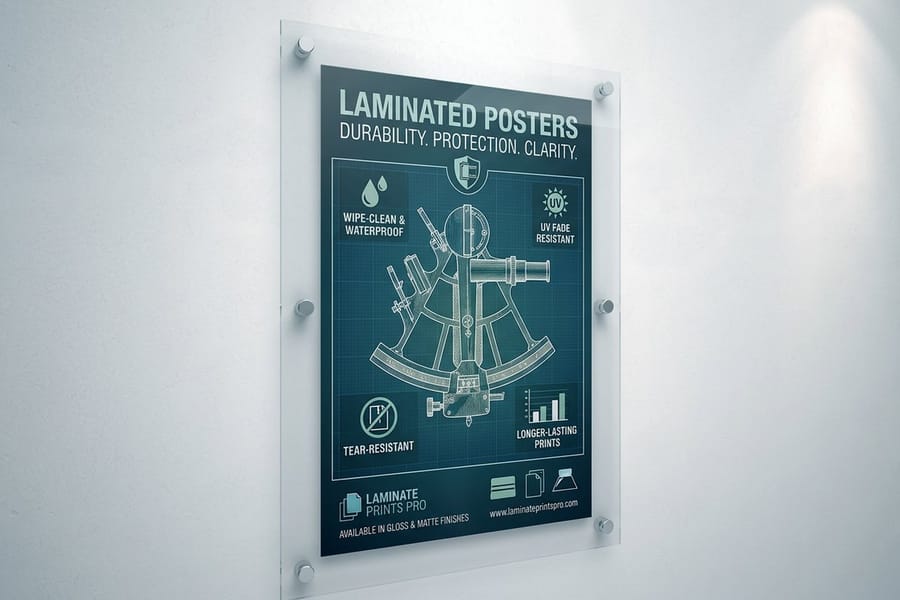
Lamination is a thin plastic film, polyester or polypropylene, run over the printed sheet between heated rollers until the adhesive grips. The ink underneath is untouched. Only the surface the world meets has changed.
Four things get better. Liquid no longer reaches the print. Scuffs, fingernails and pushpin tears land on the film instead of the paper. The sheet stiffens, and the heavier the film the more it stops behaving like paper and starts behaving like a board. And you can wipe it, which is the single reason gyms, clinics, workshops and kitchens buy laminated work at all.
Three things get worse, and nobody mentions them in the product description. A laminated poster cannot go in paper recycling, because no mill process separates bonded film from fiber. Film on one face only contracts as it cools and pulls the sheet toward the laminated side, so a large one sided laminate curls unless it is mounted or laminated both ways. And if the print goes into the laminator before the ink has fully dried, trapped solvent shows up days later as a fine haze of bubbles across the darkest areas. The trade calls it silvering, there is no repair, and the sheet gets reprinted.
Then there is the edge. The film protects the face, not the cut. A flush trim runs the blade through paper and film in one pass and leaves the paper core open on all four sides, which is exactly where water gets in and starts lifting. Anywhere damp, ask for a sealed border: about an eighth of an inch of film bonded to film all the way round, so the paper never meets air. Laminated posters start at $25 at 4OVER4.COM, the same entry price as matte posters, so this is a decision about where the poster lives rather than a budget decision.
Matte Stock, Gloss Laminate and Matte Laminate, Side by Side

There are three surfaces in play, not two, because laminate comes in gloss and matte as well. People compare matte paper against gloss film, decide gloss is too shiny, and never learn that matte film exists.
| Finish | Under spotlights | Color and contrast | Cleaning and writing | Where it belongs |
|---|---|---|---|---|
| Matte poster, no film | Scatters light, readable from any angle, photographs cleanly. | Truest and quietest rendering, least punch in the blacks. | Takes pencil and pen. A damp cloth marks it. | Framed art, galleries, offices, short campaigns, anything to be photographed. |
| Gloss laminate | One bright specular reflection that can blank out a whole area. | Deepest blacks, highest saturation, best for photography. | Wipes clean. Dry erase marker works. No pencil. | Menus, price boards, sales floors, anything handled daily. |
| Matte laminate | Diffuse like plain matte, with the film protection intact. | Slightly flatter contrast than gloss, a little richer than bare stock. | Wipes clean. Marker ghosts more than on gloss. | Trade show graphics, museum panels, anything shot on camera but still touched. |
Read the first column first, because glare is the complaint that comes back after delivery, not color. If the poster hangs under downlights, faces a window, or is going to appear in photographs, matte film buys you the protection without the hot spot. If the piece lives on a counter and gets read from directly above, gloss is the better looking option and the reflection never lands in anyone's eye line. Our gloss and matte poster paper guide covers the stock choice underneath all three, and lamination against UV coating explains the cheaper liquid alternative to a bonded film.
Which One Your Poster Actually Needs

Sort it by what happens to the poster after it goes up. Two questions settle almost every job: does a human touch it, and does anything wet get near it.
Choose matte when the piece goes behind glass in a frame, when it hangs in an office or gallery for a season and then comes down, when somebody has to write on it, when it has to be photographed for a catalog or a social post, or when the campaign is short enough that recyclability matters more than lifespan. A matte poster under track lighting still reads from the door. A gloss laminated one, at the wrong angle, does not.
Choose laminated when the poster is handled every day, wiped down, propped near food, hung in a humid room, moved between venues in a car, or expected to look presentable a year from now. Restaurant specials, clinic instructions, machine shop procedures, school schedules and trade show panels all belong here. The film is cheap next to reprinting the same sheet three times.
There is a third answer that people miss: leave the poster matte and make it rigid instead. A poster that fails because it flaps, dents at the corners and curls off the wall does not need a plastic film, it needs a backing. Mounted posters start at $39.99 and foam core posters at $49.99 at 4OVER4.COM, and either one solves rigidity while keeping the glare free surface. Our comparison of foam core, mounted and framed posters works through the cost of each. If the poster is going outside at all, neither finish is really the answer and the weatherproof poster guide should be the next thing you read.
Setting the File Up So the Finish Does Not Bite You

Both finishes take the same artwork, but a laminated order has two extra things to get right before you upload.
- Leave room for a sealed border. If you order the sealed edge, the film border sits outside the printed area and eats into what the eye reads as the poster. Keep headlines and logos at least a quarter inch inside the trim so nothing important sits against the seal.
- Do not build a full bleed dark background you cannot afford to lose. A solid black flood is where silvering and roller marks show first, and where a fractional trim shift is most visible. A lighter margin hides both.
- Match resolution to reading distance, not to a rule. A poster read from three feet wants a full 300 ppi at final size. One read from ten feet across a lobby is fine at 150. Enlarging a 72 ppi web image will look soft whichever finish you pick, and lamination makes soft detail look softer because the film adds its own faint diffusion.
- Decide the size before the finish. A heavy film changes how the poster ships and hangs, so lock the dimensions first with the common poster sizes guide and start the layout from a correctly built file in the blank template library.
Everything else is a normal print file. Convert type to outlines, supply artwork at full size in CMYK, and check the effective resolution rather than the pixel count. The poster resolution guide shows how to work that out for a size you have not printed before, and the full range of stocks and sizes sits on the poster printing page.
Wally explains matte and laminated
One reads under any light, one survives being touched

Wally holds a matte poster up to a spotlight and nothing glares back, because the rough coated surface throws light everywhere at once. Then he tips coffee across a laminated one and wipes it off with his sleeve. Both came off the same press with the same ink. The film only changed what happens after the poster goes up. Watch the edge though: Wally trims one flush and water walks straight into the paper, which is why he asks for a sealed border on anything near a sink.
Order laminated posters →Specs and pricing
Poster finishes, sizes and starting prices
Matte, laminated and rigid foam core side by side, with the live configuration choices and starting prices straight from the 4OVER4.COM configurator.



Print it
Order the finish your wall actually needs


Explore more
Where to go next


By the numbers
Matte, laminated and mounted posters on one press
Common Questions
Your poster finish questions, answered
Are laminated posters waterproof?
Water resistant, not waterproof, and the difference is the edge. The film keeps liquid off the printed face, so you can wipe a spill or a smear of grease straight off. What it does not do is protect the trim. If the laminator runs the sheet and the cutter then trims through paper and film together, all four edges are open paper, and moisture wicks in from there and lifts the film from the inside. For a kitchen, a locker room, a poolside board, or anywhere that gets mopped, ask for a sealed border of roughly an eighth of an inch, so film bonds to film around the outside and the paper core never meets air.
Does lamination change the colors of a poster?
Slightly, and in a predictable direction. Gloss film deepens the blacks and lifts saturation, so a photo poster often looks better laminated than it did coming off the press. Matte film goes the other way and takes a little bite out of contrast, which is the price of killing the glare. A plain matte stock with no film sits between them: the truest, quietest rendering of the file, with the least punch. If the exact tone matters, order the same file on a matte poster and a laminated poster and judge them under the light the poster will actually hang in.
Can you write on a laminated poster?
Not with a pencil or a ballpoint, which is the trade off people discover after the delivery. The film has no tooth. A dry erase marker works well on gloss laminate, which is why schedule boards, price lists, and sports draws get laminated on purpose, though older dry erase inks ghost if they sit for weeks. A permanent marker writes but does not come off. If people need to write on the poster in pen, keep it matte and unlaminated, or leave one panel unlaminated on the layout.
Should I laminate a poster I am going to frame?
No. Behind glass the film has nothing to protect it from, and you end up with two reflective surfaces about a millimeter apart, which produces a faint double reflection that is more distracting than the glass alone. Framed work is the clearest case for matte. Save the lamination for anything that hangs bare on a wall, sits on an easel, gets carried between venues, or goes anywhere it will be touched.
Can laminated posters be rolled and shipped in a tube?
A light film can, a heavy one cannot. Around 1.5 to 3 mil the sheet still behaves like paper and rolls into a tube without cracking the film. From about 5 mil up it is stiff enough that rolling it tight leaves a memory curl or crazes the surface, and 10 mil is effectively a board. There is a second effect worth knowing: film applied to one side only shrinks a little as it cools and pulls the sheet toward the laminated face, so a large single sided laminate wants either a second pass on the back or a rigid support. Mounted Posters start at $39.99 and Foam Core Posters at $49.99 at 4OVER4.COM, and both solve the curl outright.
Are laminated posters recyclable?
No, not through an ordinary paper stream. The film is bonded to the fiber, and standard mill pulping has no way to separate the two, so a laminated poster goes in general waste. A matte poster is plain coated paper and recycles normally. If a campaign is short, the poster is indoors, and nobody is going to touch it, matte is the honest choice on that ground alone. Lamination earns its footprint when it stops you reprinting the same poster four times in a year.
Get Started
Choose matte or laminated in the poster configurator
Pick your size, choose a matte sheet or a laminated one, and we print it sharp, trim it square, and ship it flat or rolled to suit the finish.
Legal Disclaimer
Gold Standard guarantees apply to all standard orders placed through 4over4.com. Price match requires verifiable proof of a competitor's published price for an equivalent product with matching specifications and turnaround time. Satisfaction guarantee covers manufacturing defects and print quality issues. Contact support with order number and documentation. On-time delivery rate based on tracked orders 1999 to 2026. Individual results may vary based on shipping carrier performance.
