
Foam Core vs Mounted vs Framed Posters, and Which One to Print


The same printed sheet, three different things behind it. Each backing does something different, each ships at its own cost, and each fails its own way.
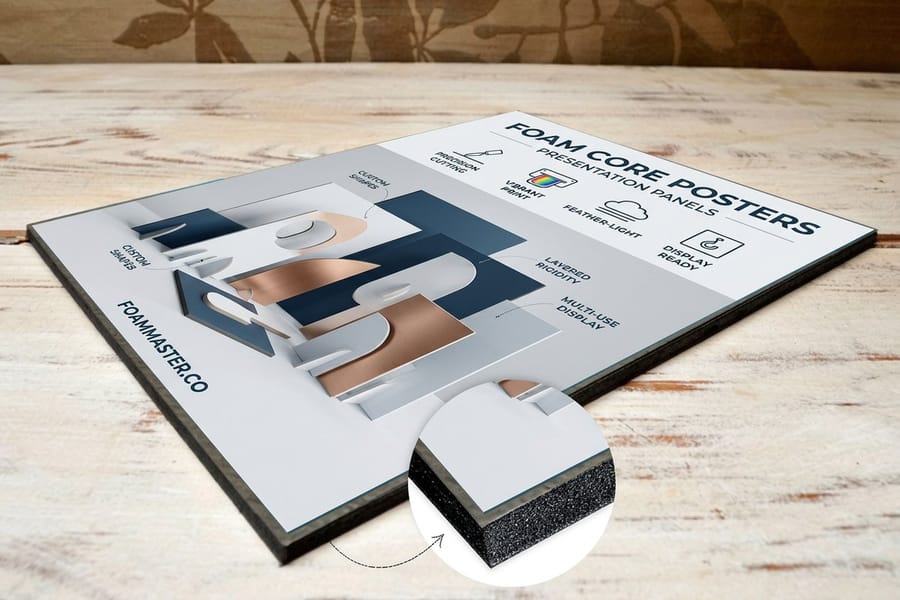
Foam core and mounted posters are the same idea: your print bonded to a rigid board so it stands without a frame, with foam core being the lightest board of the set. A framed poster adds glazing, a backing and hanging hardware, so it is the only one that protects the print itself. A plain poster is paper alone, the cheapest to reprint and the only one that ships rolled in a tube. Mounted posters start at $39.99, foam core at $49.99, framed at $87.86 and standard posters at $108.75 at 4OVER4.COM.
Quick answer
Rigidity is the decision, everything else follows it
A poster has no rigidity, a mount supplies it, and a frame supplies it plus a sheet of glazing over the artwork. Foam core is simply the lightest board we mount to, which is why it wins on easels and loses on anything that gets knocked. Rigid pieces ship flat in cartons rather than rolled in tubes, so freight climbs the moment you leave paper behind. Match the backing to the handling: foam core for events, framed for walls people touch, plain paper for anything you plan to replace.
What Foam Core, Mounted and Framed Actually Mean

Three names, but only two real ideas underneath them. Mounting bonds your printed sheet to a rigid board. Framing surrounds it with a moulding and covers it with glazing. Everything else follows from that.
A standard poster is the print and nothing else. It rolls into a tube, it arrives with a memory of that roll, and it needs tape, magnetic rails or a frame to sit flat on a wall. Standard posters are the cheapest way to put a large image somewhere and the only one of the four you can mail in a tube.
A mounted poster is that same print laminated face up onto a board so it holds its own shape. Mounted posters start at $39.99 and are what you want on an easel, a lobby stand or a trade show table.
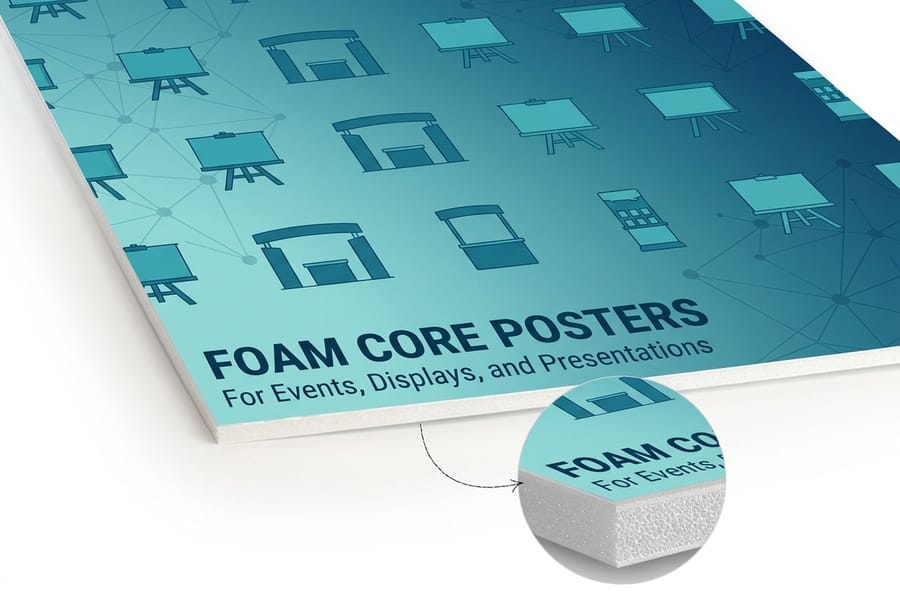
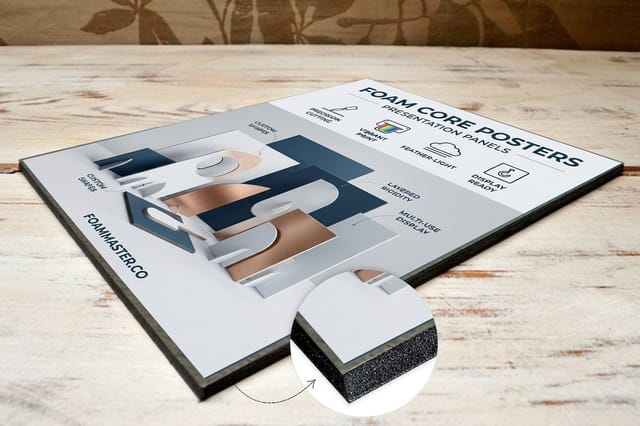
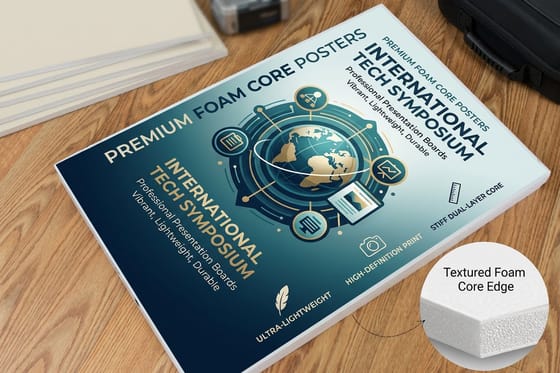
A foam core poster is a mounted poster where the board is foam core: a sheet of polystyrene foam sandwiched between two paper liners. It is the lightest rigid board in normal use, which is why foam core posters at $49.99 are the default for anything a person has to carry into a room and set up alone.
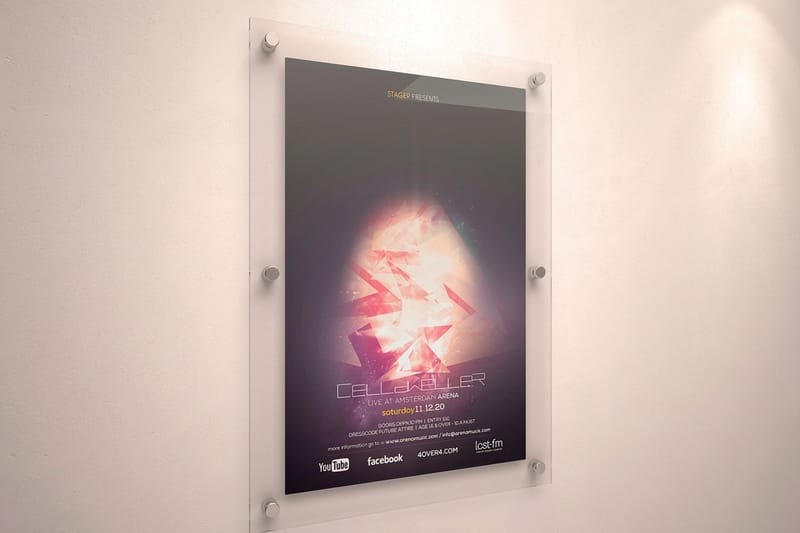
A framed poster adds a moulding around the edge, a glazing sheet over the face, a backing board behind and hanging hardware. Framed posters start at $87.86 and are the only version of the four where the print itself is protected from the room.
If the substrate question is the one you are really asking, the practical breakdown of poster materials covers what each board and paper does under load, heat and weather.
The Four Options Side by Side

Read the rigidity column first. It predicts almost everything else in the row, including what the piece costs to ship and how it fails.
| Option | What it is | Rigidity | How it goes up | Starts at |
|---|---|---|---|---|
| Standard poster | Printed sheet, nothing behind it. | None. It curls. | Tape, putty, rails, or a frame you already own. | $108.75 |
| Mounted poster | Print bonded to a rigid board. | Holds its own shape. | Easel, foam strips, or a shelf lean. | $39.99 |
| Foam core poster | Print bonded to lightweight foam board. | Rigid and very light. | Easel or corner strips. One person, no tools. | $49.99 |
| Framed poster | Print, glazing, backing and moulding. | Rigid and protected. | Wall hook rated for the weight. | $87.86 |
Those starting prices are entry points on four different products with four different minimum quantities, so they are not a per piece ranking. Open each configurator, set the size and the quantity you actually need, and compare the totals. A stack of rolled posters gets cheap per unit very quickly. A single mounted board never does, because every one of them gets laminated and trimmed by hand.
Sizes matter more than most people expect here too. Standard sizes cost less and drop into off the shelf frames, and our poster size guide lists the ones worth staying inside.
Shipping, Damage and How Long Each One Survives

This is the part quotes leave out, and it is usually what decides the job.
Freight. A rolled poster goes in a tube. Everything rigid goes in a flat carton, and once a 24 by 36 board is boxed with corner protection, the carrier prices the box, not the print. Sending one piece to one place, the difference is small. Sending twenty pieces to twenty branch offices, it stops being small. Ship tubes and mount locally, or ship tubes and let each site drop the print into a frame it already owns.
Damage. Each option fails in its own way. Paper creases, and a crease across a face is fatal on a photograph and invisible on a text block. Foam core crushes: a dropped corner leaves a dent that no amount of pressing brings back, because the cells inside are gone. Glazing cracks, and cracked glazing over an intact print is the one failure you can repair without reprinting.
Warping. Bonding paper to one face of a board and leaving the other face bare sets up a slow tug of war as humidity changes. On small pieces you never see it. At 24 by 36 and up, a single sided mount can take on a gentle bow over a damp season. If a mounted piece is going to live somewhere humid for a year, a frame or a heavier board is the safer buy.
Lifespan. Framed lasts longest because the glazing takes the abuse. Mounted lasts through a season of events if it is handled with two hands. Plain paper is a consumable, and treating it as one is a strategy rather than a compromise. Hanging it well helps, which our guide to damage free poster hanging covers properly.
Which One to Print, Job by Job
Match the piece to how it will be handled, not to how nice it looks in a photo.
- Trade show table, conference easel, open house sign. Foam core. It stands unsupported, one person carries three of them, and if the show ruins one you reprint it without regret. Browse the foam core printing collection for the rest of the family.
- Lobby, clinic wall, permanent office display. Framed. It is going to be looked at for years by people who will touch it, and glazing is the only thing on this list that stops fingerprints reaching the ink.
- Retail promotion that changes monthly. Standard poster into a frame you buy once. The frame is the asset, the print is the consumable, and the monthly cost drops to paper.
- Photo enlargement or artwork for a wall. Mounted, if you like the clean borderless edge, or framed if the room is formal. Our comparison of canvas, framed prints and posters takes that decision further.
- Directional signage, wayfinding, anything read at a glance. A rigid substrate, not paper, and often not foam either. The differences are laid out in poster signs vs rigid signs.
Whichever way you go, build the file at full size with the right proportions before you choose a backing, because a mount and a frame both crop to the board rather than to your intent. Start from a correctly sized layout in the blank template library, and see the whole range in poster printing or the mounted prints category.
Wally explains the three backings
Paper curls, board stands, frame protects
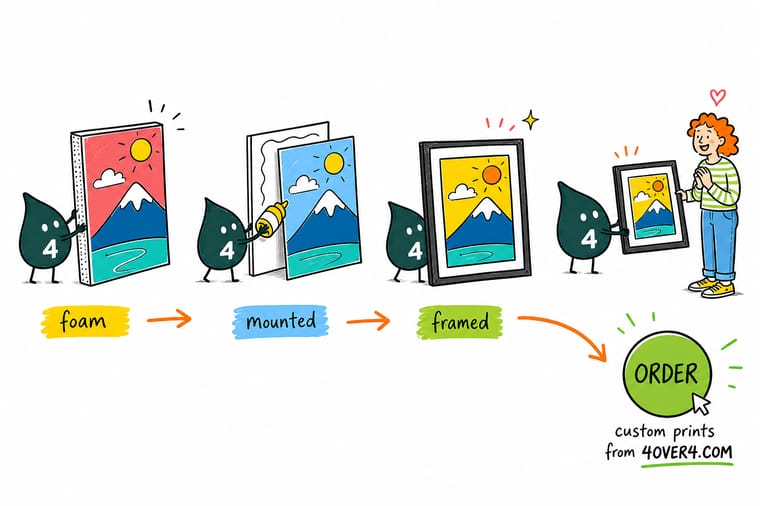
Wally prints one design three times. The paper version rolls into a tube, ships cheap, and flops the moment he lets go of a corner. The foam core version stands on an easel by itself and weighs almost nothing, right up until someone bumps a corner and dents it for good. The framed version survives everything, costs the most, and needs a proper hook in the wall. Same artwork every time. The backing is the whole choice.
Order foam core posters →Specs and pricing
Sizes, options and starting prices for all three
Set your size and quantity on each one and compare the real totals, not the entry prices. The configurators below pull live options straight from 4OVER4.COM.


Print it
Pick the backing your display needs


Explore more
Where to go next

By the numbers
Mounted, framed or plain, one press runs the poster
Common Questions
Your poster backing questions, answered
Is a foam core poster the same as a mounted poster?
Foam core is one of the boards a poster gets mounted to, so every foam core poster is a mounted poster, but not every mounted poster is foam core. Mounting simply means the printed sheet is bonded face up to a rigid substrate. Foam core is the lightest common choice and the one people reach for when a print has to stand on an easel. Heavier boards exist for pieces that get handled hard or hang outdoors. At 4OVER4.COM you order the board you want directly: foam core posters start at $49.99 and mounted posters start at $39.99.
Can foam core posters be used outdoors?
Keep them inside. The core is polystyrene foam between two paper liners, and both parts fail outside: the paper face absorbs moisture and buckles, the edges wick water, and sunlight yellows the exposed foam at the trimmed edge. A day under a tent is survivable. A week on a fence is not. For anything that lives outside, print on a weatherproof substrate instead and read our breakdown of poster materials before you choose.
How do you hang a mounted poster without a frame?
Command strips or double sided foam tape on the four corners and one in the middle hold a 18 by 24 mount on a smooth wall without hardware. Bigger than that, add strips along the top edge so the weight is carried in a line rather than at two points. Easels are the other route, and the reason mounted prints dominate trade show tables and lobby signage: the piece stands on its own with nothing touching the wall.
Do framed posters cost more to ship than rolled posters?
Considerably more, and the reason is volume rather than weight. A rolled poster travels in a tube that carriers price cheaply. A framed piece needs a flat carton, corner protection and a glazing sheet that has to survive the trip, so the box is large, the packing is heavy, and the dimensional weight rules kick in. If your artwork is going to five offices, shipping five tubes and framing locally usually beats shipping five frames.
Which of the three lasts the longest?
Framed, and it is not close. Glazing takes the fingerprints, the dust and most of the UV, and the print underneath stays sealed away from all of it. A mounted poster is exposed at the surface, so it collects scuffs, and a plain poster on a wall picks up tape marks, pin holes and curling within a season. The trade off is money and weight: a frame is the heaviest and most expensive option on the list.
Can I keep a frame and just reprint the poster?
Yes, and it is the smartest way to run a wall that changes. Buy the frame once at a standard size, then reprint the paper poster whenever the promotion changes. That is the one case where the plain poster wins on cost, because you are only paying for ink and paper each cycle. Print to a standard size so the reprint drops straight in, and start the artwork from a correctly proportioned file rather than scaling one up.
Get Started
50 standard posters cost $108.75 before any backing
Choose your size, pick paper, a rigid mount or a finished frame, and we print it sharp and ship it protected.
Legal Disclaimer
Gold Standard guarantees apply to all standard orders placed through 4over4.com. Price match requires verifiable proof of a competitor's published price for an equivalent product with matching specifications and turnaround time. Satisfaction guarantee covers manufacturing defects and print quality issues. Contact support with order number and documentation. On-time delivery rate based on tracked orders 1999 to 2026. Individual results may vary based on shipping carrier performance.
