
Large Sticker Printing Sizes, Materials and Outdoor Durability


Everything that changes once a sticker gets bigger than a sheet: roll-fed vinyl, laminate, the resolution you actually need, and the surfaces where a big decal will not hold.
Large sticker printing means anything past roughly a foot on the long side, printed on wide-format adhesive vinyl off a roll, contour cut, and usually laminated. Choose the face film for the surface, the adhesive for how long it stays, and the laminate for the weather. Build the file at full size with an eighth inch of bleed, and stop worrying about 300 dpi: at that size, 150 dpi at final dimensions is sharp and 100 is fine on a wall.
Quick answer
Roll-fed vinyl, a laminate, and a surface that is genuinely smooth
Size changes the process, not just the number. Past about a foot, stickers print on wide-format adhesive vinyl off a roll and get contour cut rather than die cut on a sheet. The face film decides how well the graphic conforms to the surface, the adhesive decides whether you can take it off cleanly, and the laminate is what carries the sun and the rain. The one thing no material fixes is texture: brick and stucco will shed a large sticker no matter what you spend on it.
What Counts as a Large Sticker, and What Changes at That Size

There is no official cutoff, but the production line draws one at roughly twelve inches on the long side. Below that, a sticker runs through a sheet-fed digital press and gets cut on a small plotter or a steel die. Above it, the job moves to wide-format: adhesive vinyl fed off a roll, printed in one pass, contour cut on a roll cutter, then rolled into a tube for shipping.
That switch changes four practical things. Pricing stops behaving like a per-piece number and starts behaving like area times run length. Material choice widens, because roll stock comes in cast and calendered vinyl, clear film, reflective and static cling rather than the handful of paper and vinyl sheets. Shipping changes, since a large sticker arrives rolled and needs an hour flat before you apply it. And the resolution bar drops sharply.
That last one surprises people. Print resolution is only meaningful next to viewing distance. A die-cut sticker held in the hand wants detail. A 24 by 36 inch decal read from across a shop floor is comfortable at 150 dpi at final size, and a wall graphic seen from ten feet is fine at 100. Do the arithmetic in your layout file at the finished dimensions, not on the original photo, and a picture you would never put on a business card often turns out to be plenty. Our large format printing guide covers what else the wide-format process changes about a file.
The Face Film, the Adhesive, and the Laminate
A large sticker is three decisions stacked on top of each other, and most disappointing orders come from getting one of them wrong while agonising over another.
| Face material | Where it belongs | How it holds on | The limit |
|---|---|---|---|
| White adhesive vinyl | The default for large exterior and interior graphics on smooth surfaces. | Permanent acrylic adhesive. | Needs a laminate outdoors, and it will lift paint on removal. |
| Clear vinyl | Glass doors and windows where you want the surface to disappear. | Permanent acrylic adhesive. | Colours look washed out unless a white ink layer is printed behind them. |
| Static cling | Interior glass, seasonal displays, anything you want to move and reuse. | No adhesive at all, just surface tension. | Fails on textured glass and in real heat. Indoors only, in practice. |
| Coated paper | Indoor promo, event walls, short runs where cost decides. | Permanent adhesive on a paper face. | One rainstorm and it is over. No outdoor use, no wet rooms. |
| Holographic and metallic | Product and merch pieces where the surface effect is the point. | Permanent adhesive. | The effect fights busy artwork, so keep the design simple and bold. |
Read the last column first, then pick. Vinyl stickers start at $25 and premium stickers at $29.16, so the material step is rarely what makes a job expensive. Size and quantity are.
Under the face film sits the adhesive, and the only question that matters is permanent or removable. Permanent is the default and it earns its name. Removable costs slightly more per square foot and is the correct answer for anything seasonal, rented, or stuck to a wall someone else owns. On top sits the laminate, gloss or matte, which is not decoration: it takes the abrasion and the UV so the ink underneath does not. Our full material breakdown goes deeper on each face stock.
Outdoor Use, and the Four Ways Large Stickers Fail
Nearly every failed large-format sticker traces back to the same short list, and none of the four is a printing fault.
- Texture. Vinyl bonds to a continuous smooth plane. On brick, stucco or bare concrete it touches only the high points, holds for days, then releases from the edges inward. If the wall is rough, a vinyl banner from $79 fixed with grommets is the honest alternative.
- Contamination. Household glass cleaner leaves a silicone film that adhesive cannot grip through. Clean with isopropyl alcohol and a lint-free cloth, then let it flash off before the liner comes away.
- Temperature. Most vinyl adhesives want a surface somewhere between about 50 and 90 degrees Fahrenheit while you apply. Too cold and the adhesive never fully wets out, so the edges lift a week later. Too hot and the film stretches while you squeegee and then tries to shrink back.
- Fresh paint. Emulsion keeps curing for weeks after it stops feeling wet, and a permanent adhesive applied over it will take the paint with it. Give a new wall a few weeks, or use removable.
Curves are the fifth thing, and they are a material question rather than a technique one. Calendered film is thicker and has a memory, so it lies down beautifully on a flat door and pulls back off a rivet or a compound curve. Cast film is thinner, relaxes under heat, and stays where you put it on a van panel. If your graphic wraps anything, say so when you order.
Application on anything above about two feet is a two-person job with a hinge. Tape a line down the middle of the positioned decal, peel one half of the liner, squeegee from the hinge outward, then repeat. The step-by-step is in our vinyl decal application guide, including how to work a trapped bubble out with a pin instead of lifting the whole panel.
Setting Up the File and Ordering the Right Size

Set the file up at full size. Scaling a document to fifty percent to keep it manageable is where half of all bleed problems begin, because the bleed and margin numbers scale with it and nobody notices.
Give the artwork an eighth of an inch of bleed past the cut on every edge. Keep type and logos at least a quarter inch inside the cut on small pieces, and push that to half an inch on anything above about eighteen inches, because contour cutting tolerance grows with the length of the path. Supply the cut line as a vector path on its own layer, named so it is unmistakable, not as a drawn black outline in the artwork. Correctly sized starting files are in the blank template library.
Decide the cut style before you build the file rather than after. A die cut follows the outline of the artwork, a kiss cut leaves the sticker on a square backing for easy peeling, and a cut-to-size square or rectangle is cheapest of all. Kiss cut versus die cut lays out which one suits which job, and the standard size guide is a fast way to find a dimension that already exists rather than inventing one.
Ordering is dimensions plus quantity plus material. Standard decals start at $39.61, clear window clings at $30, and bumper stickers at $38.44 for the long narrow format that fits a rear panel. Die-cut stickers start at $93.37 because the custom cut path is priced in. Run one piece first when the graphic is going somewhere you cannot easily redo. The whole range sits in the sticker printing collection and the wider large format catalogue.
Wally explains big stickers
Roll-fed vinyl, a laminate on top, and a hinge down the middle
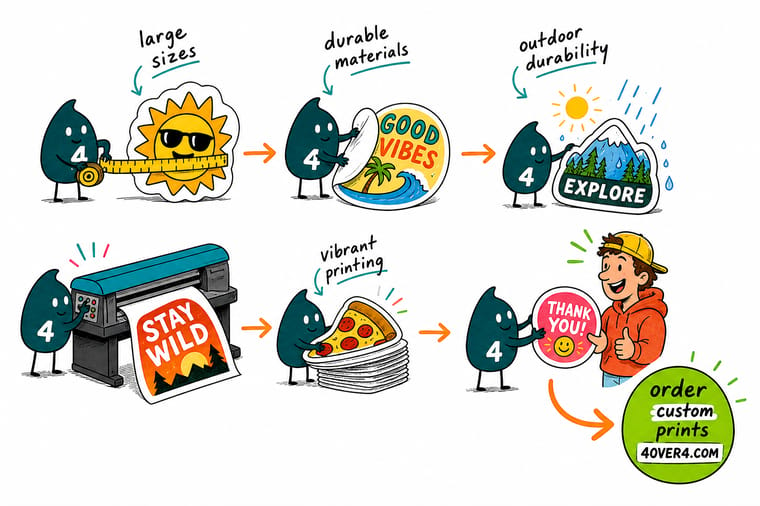
Wally prints your graphic on a roll of adhesive vinyl, lays a laminate over it so the sun has something to chew on other than the ink, and cuts it to shape. Then he tapes a hinge down the centre, peels half the liner, and squeegees from the middle outward so the air has somewhere to go. He will happily do six square feet. He will not stick it to your brick wall, because vinyl only touches the high points and it will curl back within the week.
Order large die-cut stickers →Specs and pricing
Sizes, materials and starting prices
Set the dimensions, material and quantity and the configurator prices the run live. These are the three products most large-format sticker jobs land on.


Print it
Order stickers big enough to read across a room

Explore more
Where to go next




By the numbers
Large-format printing you can count on at 4OVER4
Common Questions
Your large sticker questions, answered
How big can a custom sticker actually be printed?
The practical ceiling is the width of the vinyl roll, and most wide-format material runs to 54 inches. Length is far less constrained, because the roll keeps feeding, so a 30 inch by 10 foot graphic is a normal job while a single seamless 8 foot square is not. Anything wider than the roll gets split into panels that overlap by about half an inch and butt together on the wall. Panelling is invisible on a textured background and obvious across a flat corporate colour, so if the artwork is a solid field, plan the seam to fall on a design line rather than through a logo.
What resolution does artwork need for a large sticker?
Work backwards from viewing distance rather than chasing 300 dpi. At arm length, 150 dpi at final printed size looks clean. On a wall graphic people read from ten feet, 100 dpi is enough and nobody will see the difference. Vector artwork sidesteps the question entirely, which is why logo-led designs scale to any size for free and photo-led ones need checking first. Enlarge the photo to the finished dimensions in your layout software and look at the pixel count there, not at the file on your desktop.
How long will a large outdoor sticker last?
It depends on three things and none of them are the printer: whether it is laminated, how much direct sun the surface takes, and what the surface is. A laminated vinyl decal on a north-facing door has an easy life. The same decal on a south-facing van panel that gets pressure washed weekly works much harder. Ask for the face film and laminate spec on any job you expect to leave up for years, and if the piece is seasonal, order removable adhesive instead of paying for durability you will not use.
Can I put a large sticker on a brick or stucco wall?
No, and it is the most common wasted order in large-format stickers. Adhesive vinyl bonds to a continuous smooth surface. On brick, stucco or rough concrete it only touches the high points, so it holds for a few days and then peels back from the edges as the adhesive fails on all the air gaps between. For a rough exterior wall, print a hemmed and grommeted vinyl banner and fix it mechanically, or mount a rigid sign. Save the sticker for glass, painted metal, sealed wood and vehicle panels.
Will removing a big decal damage the paint underneath?
Permanent acrylic adhesive on a wall painted with cheap or uncured emulsion can absolutely pull the paint off. Two ways to avoid it. Order removable adhesive if the piece is temporary, which costs a little more per square foot and saves the repaint. If it is already up, warm the vinyl with a heat gun on low and pull it back on itself at a shallow angle rather than straight out, then clear the residue with an adhesive remover instead of a blade. Give freshly painted walls a few weeks to cure before sticking anything on them.
Are large stickers cheaper per piece in bulk?
Yes, and the drop is steeper than on small print because the cut path and setup are paid once and then spread across the run. The material cost per square foot stays roughly flat, so the curve flattens out at higher quantities rather than falling forever. The configurator prices real quantities live, so put in the size you actually want and step the quantity up to see where your run stops getting cheaper. That break point is usually where you should stop ordering more than you need.
Get Started
Ready to print something people can read across the lot?
Set your dimensions, pick a vinyl and a laminate, and we contour cut it and ship it rolled so it goes up flat.
Legal Disclaimer
Gold Standard guarantees apply to all standard orders placed through 4over4.com. Price match requires verifiable proof of a competitor's published price for an equivalent product with matching specifications and turnaround time. Satisfaction guarantee covers manufacturing defects and print quality issues. Contact support with order number and documentation. On-time delivery rate based on tracked orders 1999 to 2026. Individual results may vary based on shipping carrier performance.
