
How to Start a T-Shirt Printing Business


Jordan is our labels, packaging and sustainability voice, built from the knowledge of our production team, with over 20 years in printing.
Pick a niche, design a shirt people want, print a small test run, then sell and reinvest. A single shirt costs $21.96 here, so the test run is the cheapest part of the whole plan.
To start a t-shirt printing business, work in this order: count your real startup costs, pick a specific niche, choose a print method that fits your order size, design print-ready art at the right size, source blanks and a print partner, price for profit, brand it with tags and packaging, then launch and reinvest. Starting print-on-demand keeps risk low, since custom shirts begin at $21.96 each and you only print what sells.
Quick tips
Quick tips before you print your first shirt
Start print-on-demand and prove demand before you buy any equipment. Choose a niche you understand, order a small test batch instead of a giant run, such as 8 shirts for $123.02 rather than a box of 100, and match the print method to each order rather than forcing every design through one process. Price every shirt to cover its full cost with real margin, then reinvest. Build the art for the 8.5 by 11 inch print area and allow 5 business days for a standard run.
First, decide what kind of t-shirt business you actually want

Before you sketch a single design, get clear on the model, because it decides how much money you need and how much risk you carry: a print on demand start runs a few hundred dollars, while your own screen-printing or DTG setup runs into the thousands. You have three paths. Print on demand means you only order a shirt once a customer has paid, so you never sit on unsold stock. In-house printing means you buy the machines and print everything yourself, which lowers your per-shirt cost but demands real upfront capital. The hybrid sits between them: you outsource printing while you find your bestsellers, then bring the high-volume ones in-house later.
For almost everyone starting out, print on demand is the sane first move. It lets you test whether people will actually pay for your idea before you spend a cent on equipment. You focus your energy on the design and the audience, and a print partner handles production. If you want the full selling playbook alongside this, our guide on how to sell custom t-shirts covers channels, pricing, and fulfillment in depth.
A quick reality check: you are building a brand, and the printing is the easy part. The hard part, and the fun part, is building something a specific group of people wants to wear. If you plan to sell more than tees down the line, browse the full branded merchandise range so your first product fits a bigger picture.
Step 1: Count the real startup costs
The honest answer to "how much does it cost to start a t-shirt printing business" is: it depends entirely on your model. Print on demand can start for a few hundred dollars. Buying your own screen-printing or direct-to-garment setup pushes it into the thousands. The breakdown below shows what goes into the number.
- Blank or printed shirts. At 4OVER4.COM, custom shirts start at $21.96 each and drop toward $15 per shirt as your run grows, so a small test batch is cheap to float.
- Design. Either your own time, a freelance designer, or the online designer if you are building the art yourself.
- Samples. Always order a few shirts before a real run so you can feel the fabric and check the print. A pack of free paper samples helps for tags and inserts too.
- Fees. If you sell on a marketplace or your own store, factor in platform and payment fees before you set a price.
Map those four buckets and you have your break-even. The whole point of starting lean is that step four, selling and reinvesting, funds everything after it. You do not need the perfect setup on day one. You need enough to print a batch, sell it, and do it again a little bigger. When you are ready to plan a real run, the live custom t-shirt printing configurator shows your exact cost as you build the order.
What a first run needs, with the spec to pick for each piece:
| Piece | What to choose | From |
|---|---|---|
| Custom t-shirts | White or black, S to XXL, full color on an 8.5 by 11 inch area front, back or both, 5 business days | $21.96 for one, $123.02 for 8 |
| Hang tags | 2 by 2 up to 4 by 6 inches, 14pt to 24pt cover, a 1/8 or 3/16 inch hole | $25.27 for 50 |
| Die-cut stickers | Cut to your logo shape, 2 by 2 up to 11 by 11 inches | $93.37 for 25 |
Upload the shirt art as a high resolution file with a transparent background, sized to the print area, and the tag and sticker art at their finished sizes.
Step 2: Find a niche people actually pay for

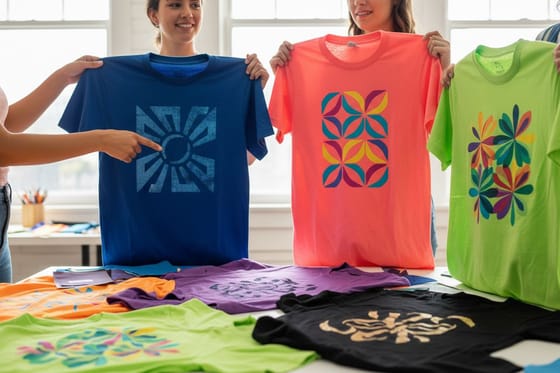
The niche decides whether your first batch sells. A generic logo on a plain shirt competes with every other generic shirt on earth. A design that speaks directly to a specific group, a sport, a profession, a town, a fandom, an inside joke, sells because the buyer sees themselves in it.
Good niches share a few traits. They have a passionate audience that already spends money. They are specific enough that you can speak their language. And they are broad enough to support more than one design. Think "trail runners in the Pacific Northwest" rather than "people who like running." The tighter your focus, the easier your marketing gets, because you know exactly who you are talking to. Test it cheaply: print two or three designs for the same niche in a run of 8 shirts, $123.02 in all, and reorder the one that sells out.
Pay attention to how your audience talks. Slang, references, and visual style are what make a shirt feel made for someone rather than sold to them. Our roundup of Gen Z slang words brands print on merch is a useful lesson in getting the voice right without trying too hard. Once you have a direction, the design templates library gives you a fast, professional starting point instead of a blank canvas.
Step 3: Choose your printing method
There is no single best way to print a shirt. There is only the best way for a given order. The four methods you will hear about most each shine in different situations.
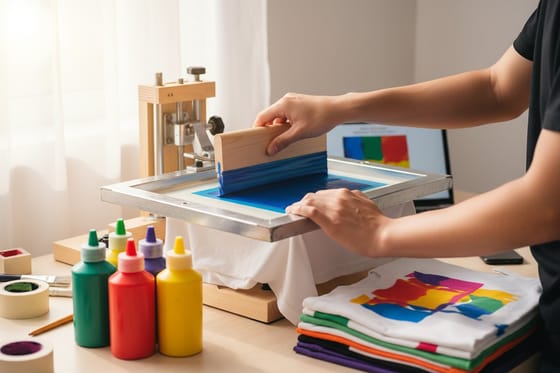
Screen printing pushes ink through a mesh stencil. It is the cheapest per shirt on large runs and gives thick, durable, bright color, but each color needs its own screen, so it is slow and pricey for small or complex jobs. Our explainer on what screen printing is and how it works walks through the whole process.
DTG and vinyl handle the opposite case. They print small, full-color, made-to-order designs with no setup fees, which is what print on demand and one-offs need. Heat transfer is the flexible middle, fast and great for personalization. If you are torn between the two most common choices, screen printing vs vinyl printing lays the trade-offs side by side.
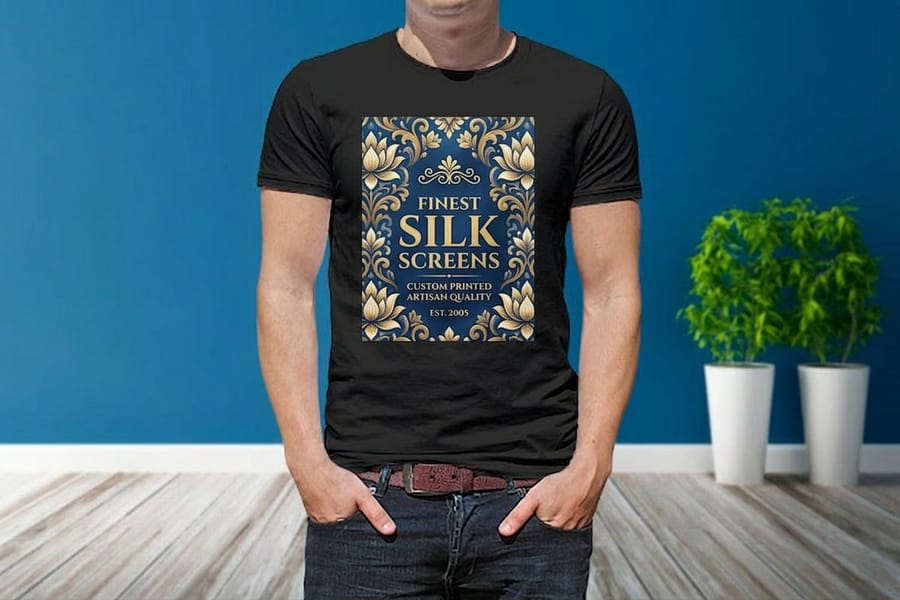
The practical move for a new brand is to partner with a printer that offers several methods, so you can pick the right one per job instead of forcing every design through one process. You can order shirts printed with vinyl, silk screen, or start from heat activated transfer film, all from one place.
Step 4: Nail your design and print size
A strong idea still needs clean execution. Two things separate an amateur shirt from a professional one: the quality of the artwork file and the size and placement of the print. On our custom tees the print area is 8.5 by 11 inches, front, back or both, on a white or black shirt, so build the full front design at that size and scale smaller chest marks down from it.
Build your art at high resolution, in the right color mode, with a transparent background so it drops cleanly onto any shirt color. If you are making the art yourself, the online designer keeps your file print-ready, and our guide on how to make custom t-shirts covers the setup end to end. Print placement matters more than beginners expect. A logo that is too small looks cheap, and one that is too large looks like a billboard. If you plan to make custom t-shirts through Vistaprint rather than in house, compare the factory-direct tee page first.
Get the dimensions right the first time with our t-shirt print size guide, which gives standard front, back, and pocket sizes you can trust. Order a proof or a single sample before a full run. Seeing the print on real fabric catches problems a screen never will. If a printing term trips you up along the way, the printing terms glossary keeps things plain.
Step 5: Source your blanks and a print partner

The blank is the product. A great design on a thin, scratchy shirt gets returned and never reordered. Feel the fabric before you commit: our tees come in white or black in sizes S to XXL, and a single sample costs $21.96. Softness, weight, and fit are what turn a one-time buyer into a repeat customer.
Start with a small test batch rather than a giant order. Print a handful of your top design on a premium blank, wear it, wash it a few times, and see how the print holds. If you are selling to families, sample the kids sizing too, since fit expectations differ. This tiny upfront step saves you from ordering a hundred shirts you cannot sell.
Choose a print partner the same way you would choose a supplier for any product: consistency, turnaround, and quality per shirt. 4OVER4.COM prints custom apparel in its own Queens, New York facility, so you are ordering from the printer, not a middleman. Explore the full t-shirts printing range to see the styles and fits available, and remember that the per-shirt price drops as your quantity climbs.
Step 6: Price your shirts for real profit
Pricing is where good intentions meet arithmetic. Add up every cost per shirt: the printed shirt itself, packaging, shipping, and any platform or payment fees. That total is your floor. Your price has to clear it with enough room left over to count as profit and to fund the next batch.
One lever works in your favor. At 4OVER4.COM a single custom shirt is $21.96, but the per-shirt price steps down toward $15 as your order grows. So the more you sell, the wider your margin gets on every future run. Many brands start on demand to find their winners, then reorder those proven designs in bulk to reach that lower cost.
Watch the daily deals for a chance to lower your input cost even further, which flows straight to your bottom line.
Step 7: Brand it beyond the shirt
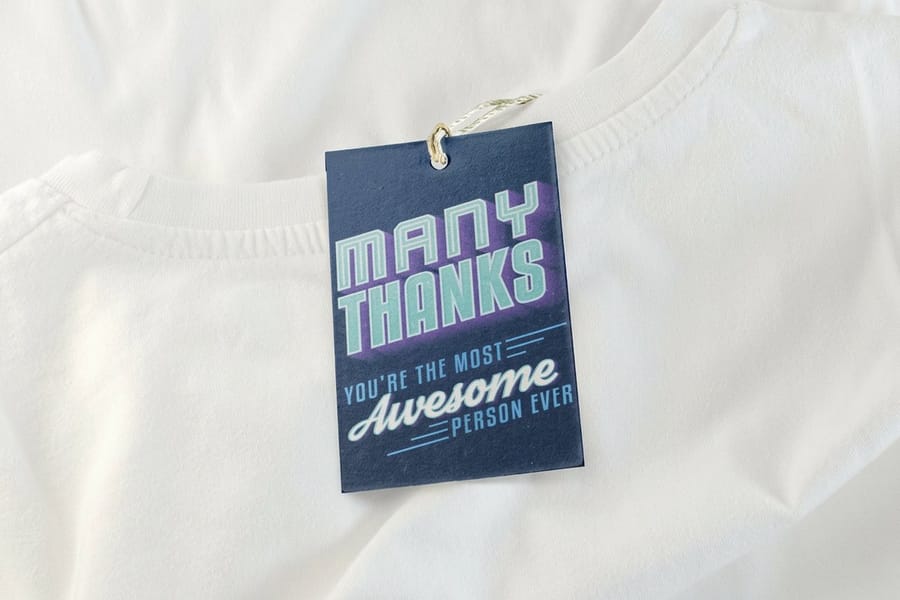
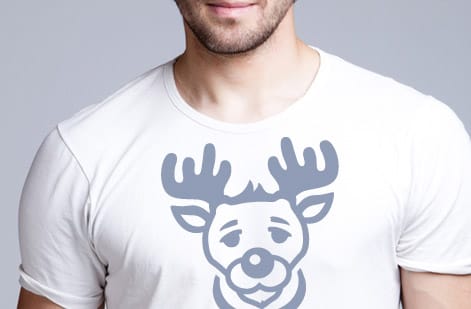
A loose tee in a poly bag feels like a hobby. The same shirt with a printed hang tag, a branded sticker, and clean packaging feels like a label. That difference is what earns higher prices and the photos customers post for free.
Start with hang tags for clothing. They carry your logo, size, care instructions, and price, and they signal quality the moment someone picks up the shirt. If you want the reasoning behind them, why hang tags still matter for businesses makes the case, and the full hang tags printing range covers every shape and stock. For a recycled stock, the recycled hang tags video overview shows the tags on real garments.
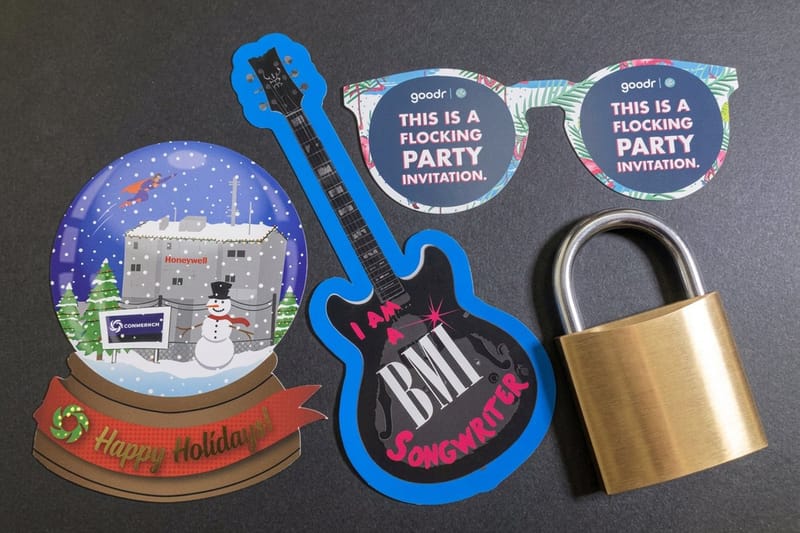
From there, build out the kit. Toss a die-cut logo sticker in every order, upgrade the packaging and labels so unboxing feels intentional, and hand out business cards at markets and pop-ups. Printed on the same 60-plus paper stocks and finishes as your tags, these small touches make a two-person operation read like an established brand.
Step 8: Launch, sell, and keep buyers coming back
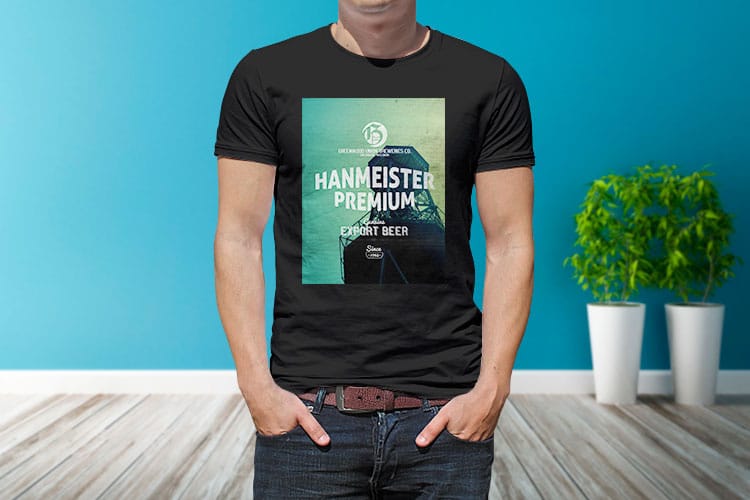
Launch is a loop, not a finish line. Plan each drop at least a week out, since a standard shirt run takes 5 business days, then open your shop, whether that is a marketplace listing, your own site, or a booth at a local market, and put your shirts in front of the exact niche you chose in step two. Marketing to a specific audience is far cheaper and far more effective than shouting at everyone.
Treat every order as a chance to earn the next one. Ship fast, package it like it matters, and follow up. Photos of real people wearing your shirts are the best advertising you will ever get, so make it easy and worth their while to share. Pair your tees with matching marketing materials, flyers, postcards, and posters, to promote drops and pop-ups.
Keep experimenting with designs. Some will flop and some will fly, and the only way to know is to print and test. If you want to prototype a concept before committing to a run, our article on DIY custom t-shirts without transfer paper shows quick at-home methods to see an idea on fabric first.
Mistakes that sink new t-shirt brands

Even people who nail the design make these errors. Avoid them and you skip most of the pain that ends new apparel brands early.
Buying equipment before you have sales. A press and a stack of blanks in your garage is not a business, it is inventory risk. Prove demand first, then bring printing in-house if the volume justifies it.
Trying to sell to everyone. A shirt for everyone is a shirt for no one. Pick a niche and own it.
Skipping the sample. Ordering a full run off a screen mockup is how you end up with a hundred shirts whose print or fit is wrong. One sample is cheap insurance.
Underpricing. Setting a price that barely covers cost leaves nothing to reinvest and no cushion for returns. Know your numbers, then price with real margin.
Forgetting the brand kit. No tag, no sticker, no packaging, and your premium shirt reads like a giveaway. The finishing touches are what let you charge what the shirt is worth. When you are ready, start a run at 4OVER4.COM t-shirts printing and build the rest of the kit alongside it.
Wally explains the lean start
Prove the idea first, buy the machines later
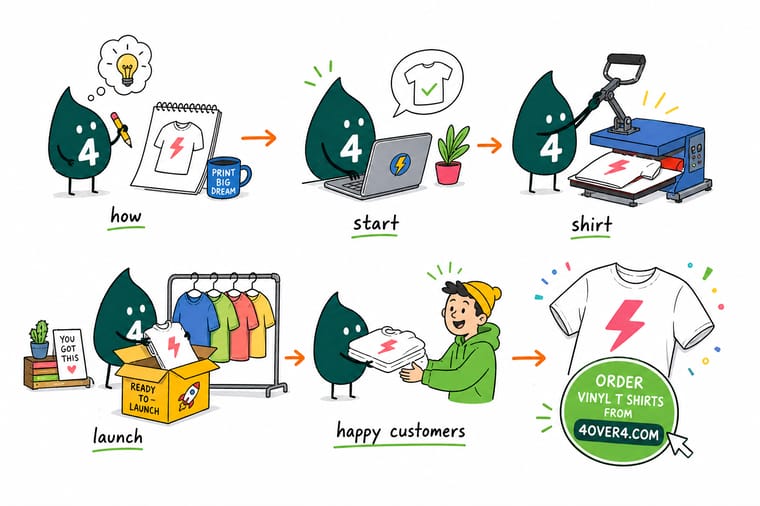
Wally has seen plenty of would-be t-shirt brands blow their budget on a press before a single shirt sold. His advice is simple: pick a niche, print a small batch, sell it, and let the profit buy the next run. Start print-on-demand, keep your risk tiny, and only bring printing in-house once the demand is real. When you are ready to test your first design, order custom tees built to your art at 4OVER4.
Order custom t-shirts →
Specs and pricing
Custom t-shirt specs and pricing
When you are ready to print your first run, the vinyl t-shirt below prints full color on an 8.5 by 11 inch area, front, back or both, on white or black shirts in S to XXL, with a 5 business day standard. One shirt is $21.96 and 8 come to $123.02, so the per-shirt price drops as your quantity grows.

| Quantity | Price Per Unit | Total |
|---|---|---|
| 1 | $21.96 | $21.96 |
| 2 | $16.47 | $32.93 |
| 3 | $16.46 | $49.39 |
| 4 | $15.93 | $63.71 |
| 5 | $15.93 | $79.63 |
| 6 | $15.93 | $95.56 |
| 7 | $15.85 | $110.94 |
| 8 | $15.38 | $123.02 |
Print it
Blank tees to launch your first collection
See it in use
First runs we printed for new labels



Explore more
Where to go next

By the numbers
A print partner you can build a brand on
Common Questions
Common questions about starting a t-shirt business
How much does it cost to start a t-shirt printing business?
You can start for a few hundred dollars if you print on demand and skip buying equipment. Order a small batch of custom shirts, which start at $21.96 each at 4OVER4.COM and drop toward $15 per shirt as your run grows, then reinvest the profit. Buying your own screen-printing or DTG setup pushes the startup cost into the thousands, so most people begin by outsourcing the printing and only bring it in-house once demand is proven.
What is the cheapest way to start a t-shirt business?
Print on demand. Instead of buying a printer, a heat press, and boxes of blanks, you upload a design, order shirts only when a customer buys, and let a print partner handle production. Your only real upfront costs are a few sample shirts to check quality and a small design budget. It is the lowest-risk way to test whether a niche actually sells before you commit any serious money.
Do I need to buy a printer to start a t-shirt business?
No. Plenty of profitable t-shirt brands never own a single machine. They design the art, send it to a printer, and focus their energy on the niche, the marketing, and the customer experience. Owning equipment makes sense later, when your volume is high enough that in-house printing is cheaper per shirt than outsourcing. Start by proving the idea, then decide.
How many shirts before screen printing beats transfers?
Match the method to the order. Screen printing is cheapest per shirt on large runs of one or two colors. DTG and vinyl handle small, full-color, made-to-order designs without setup fees. Heat transfer is fast and flexible for one-offs and personalization. If your orders vary a lot, a print partner that offers several methods lets you pick the best one for each job instead of forcing every design through the same process.
How do print-on-demand and bulk ordering compare?
Print on demand costs more per shirt but carries almost no risk, since you only print what sells and never sit on unsold stock. Bulk ordering lowers your per-shirt price, at 4OVER4.COM the price falls from $21.96 for one shirt toward $15 as quantities climb, but you pay upfront and have to sell through the batch. Many brands start on demand to find their winners, then order those proven designs in bulk to widen the margin.
How are custom t-shirt prices set at 4OVER4.COM?
Price is built from your choices in the configurator: the shirt style, size, color, ink, and quantity. Custom t-shirts start at $21.96 for a single shirt, and the per-shirt price steps down as your order size increases, so a run of a few dozen costs noticeably less each. You see the live price update as you build the order, which makes it easy to plan your margin before you check out.
Get Started
Order a kids t-shirt at $21.96 and test the fit
Pick your style and size, drop in your design, and we print crisp, durable custom tees from $21.96 with the per-shirt price dropping as your order grows.
Legal Disclaimer
Gold Standard guarantees apply to all standard orders placed through 4over4.com. Price match requires verifiable proof of a competitor's published price for an equivalent product with matching specifications and turnaround time. Satisfaction guarantee covers manufacturing defects and print quality issues. Contact support with order number and documentation.
