
How to Print Gold Stickers That Actually Look Like Gold


Stamped foil or metallic ink. One mirrors and needs a die, the other prints gradients and costs a third as much. Here is how each is made and how to set the file up.
Gold stickers are printed one of two ways: hot foil stamping, where a heated die bonds a metallised layer onto the sticker, or metallic gold ink, where aluminium flakes are printed in a normal press pass. Foil is opaque and mirror bright but takes a die and only holds solid shapes. Metallic ink costs less, prints gradients, small type and photographs, and reads as a warm sheen instead of a mirror. A third option, gold sticker paper, is a metallised face stock that shines across its whole surface.
Quick answer
A bonded metal layer, or metal flakes in an ink film
Foil stamping and metallic ink are not two grades of the same finish. They are different materials behaving differently. Foil transfers a solid aluminium layer off a carrier film wherever a heated die presses, so it mirrors, covers any background, and refuses to hold a halftone. Metallic ink carries aluminium flakes lying at scattered angles inside an ordinary ink film, so it shimmers rather than mirrors, and it prints gradients and small type without complaint. Pick by artwork first, budget second, and the look takes care of itself.
The Three Ways a Sticker Actually Gets Gold
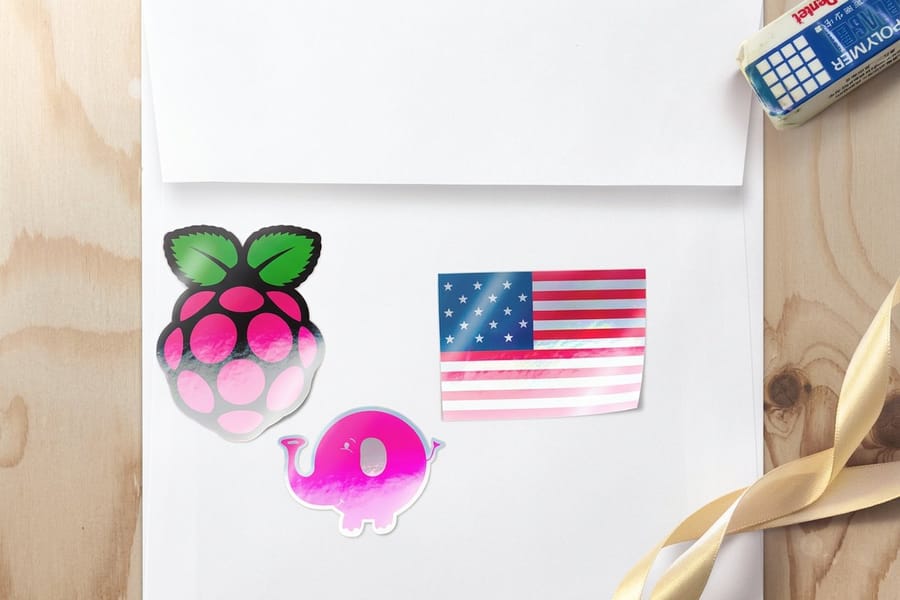
Before choosing a process, kill the assumption that gold is a colour you can mix. Process printing lays cyan, magenta, yellow and black, none of which contain metal, so a gold built in CMYK arrives as mustard or tan. Every genuine gold on a sticker is a metal being added to the job in one of three ways.
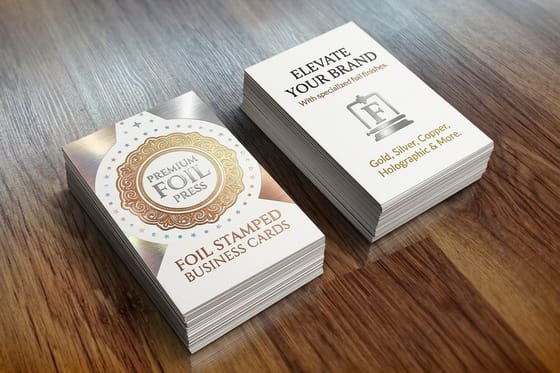
Hot foil stamping. The gold arrives on a roll of carrier film that holds a vacuum-metallised aluminium layer and a heat-activated adhesive. A metal die, cut to the shape of your artwork and heated, presses the film against the sticker face. Where the die touches, the adhesive fires and the metal layer releases onto the sheet. Everywhere else it stays on the film. Lift the film and you have a solid, opaque, mirror-bright shape.
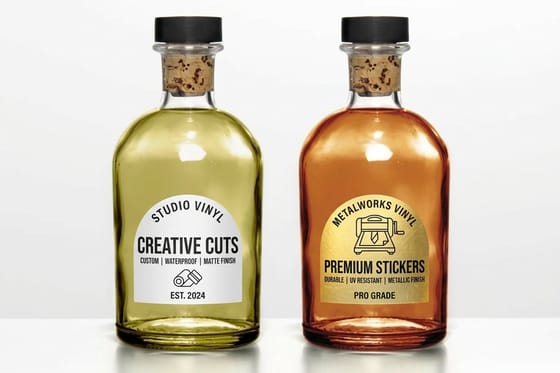
Metallic ink. The gold is a printing ink carrying fine aluminium flakes in the pigment. It runs through a press unit like any other colour, in the same pass as the rest of the design. The flakes settle at scattered angles inside the ink film, so instead of a mirror you get a sheen that appears when the sticker tilts into the light and fades when it does not. Metallic stickers work this way, and so do metallic labels.
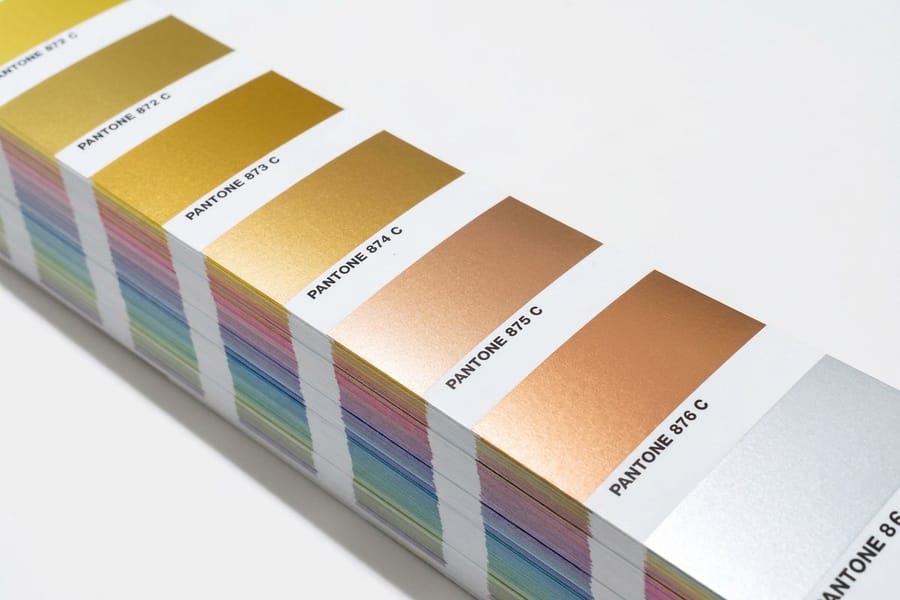
Metallised face stock, the thing people mean by gold sticker paper. Here the sticker material itself is metal-coated before anything prints. The whole surface shines, including the parts you leave blank, and any ink printed on top sits over a mirror. It gives the strongest overall gold of the three and the least control, because you cannot have a plain white area unless you print opaque white first.
Foil is a bonded sheet of metal. Metallic ink is metal dust in a liquid. Metallised stock is metal underneath everything. Almost every decision below follows from that one distinction.
Foil, Metallic Ink and Gold Stock Compared
Designers usually pick by look and then discover the artwork constraint. Read the fourth column first, because it eliminates options faster than the third one does.
| Method | How the gold gets there | The look | Artwork it accepts | Where it belongs |
|---|---|---|---|---|
| Foil stamping | A heated die transfers a metallised layer off a carrier film onto the sticker. | Mirror bright, fully opaque, reads as gold from across a room. | Solid vector shapes only. No gradients, no halftones, no photographs. | Seals, certificate marks, packaging closures, logos that repeat for years. |
| Metallic ink | Aluminium flakes suspended in ink, printed in the same pass as the CMYK. | A warm sheen that shifts with the viewing angle rather than a mirror. | Anything. Gradients, small type, fine rules, gold inside an image. | Detailed designs, short runs, anywhere the gold is one part of a busy sticker. |
| Metallised stock | The face material is metal-coated before printing, so gold is the base layer. | The entire sticker shines, unprinted areas included. | Anything, but needs opaque white underprint wherever you want a non-metallic area. | Wine and spirit necks, cosmetics, anything that should read as a metal tag. |
| CMYK gold build | No metal at all. Yellow, a touch of magenta and black faking a metallic tone. | Flat mustard. Convincing in a photograph, disappointing in the hand. | Anything, including full photographic imagery. | High-volume giveaway stickers where the budget rules, starting at $25 for vinyl stickers. |
One combination is worth knowing about: foil and metallic ink on the same sticker. Stamp the mark in foil so it mirrors, print the surrounding wash or the fine legal text in metallic gold, and the eye reads the whole thing as gold while the die only has to cover the simple shape.
How to Set Up a Gold Sticker File, Step by Step
Foil files fail in predictable ways, and all of them are fixable before you upload. Work through these in order.
- Decide which elements are gold, and be ruthless. Foil is loudest when it is scarce. A stamped monogram on a plain stock outperforms a sticker where four separate things are trying to shine at once.
- Put the foil on its own layer as a single spot colour. Name it clearly, fill every foil element at 100 percent of that swatch, and set it to overprint nothing. The layer is a stencil, not a design: it tells the die cutter exactly what shape to make.
- Convert all foil artwork to vector outlines. Live type and placed raster images cannot be turned into a die. Outline the fonts and expand the strokes before you export.
- Check the minimums. Rules of at least half a point, type from roughly six to eight point up, and no hairlines. Thin strokes break along their length and stamp speckled rather than solid.
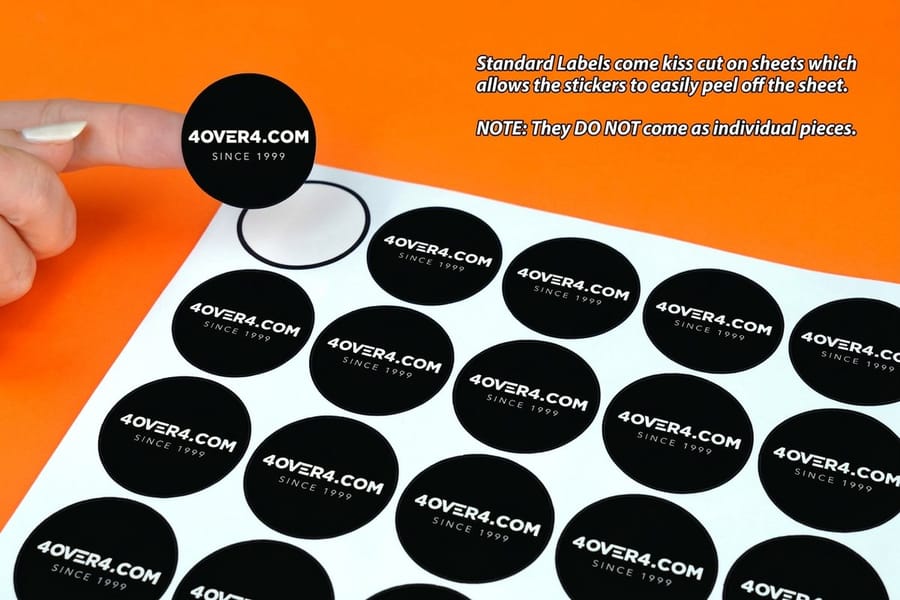
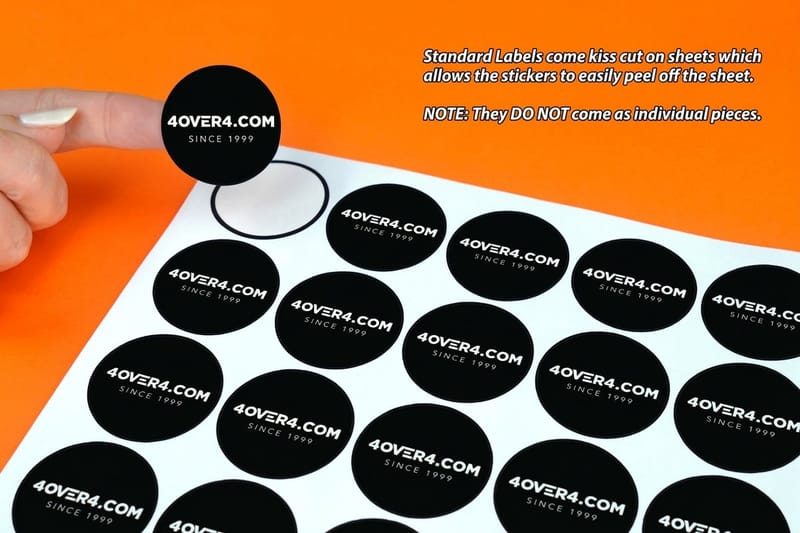
- Pull the foil back from the cut. Keep stamped areas a comfortable margin inside the trim so the blade does not shear through a foil edge and start it lifting. This matters most on kiss-cut sheets, where the liner stays intact and the sticker gets peeled by hand.
- Give the foil breathing room from itself. Two heavy shapes very close together can bridge, and the foil pulls across the gap. A little extra spacing costs nothing and saves a reprint.
- Build the CMYK layer to work without the gold. Registration between a printed pass and a stamped pass is close but not perfect, so a design that only reads correctly when the foil lands within a hair is a design that will disappoint on some sheets. Avoid thin printed outlines around foil shapes.
Metallic ink is far more forgiving. Build it as a spot metallic with your CMYK over or beside it, keep in mind that the ink is semi-opaque so the stock colour influences the final tone, and proof it on the actual material rather than judging it on screen. Start from a correctly sized layout in our blank template library, and check dimensions against the standard sticker and label size guide before you draw anything.
Seals, Packaging and Awards: Where Gold Earns Its Cost
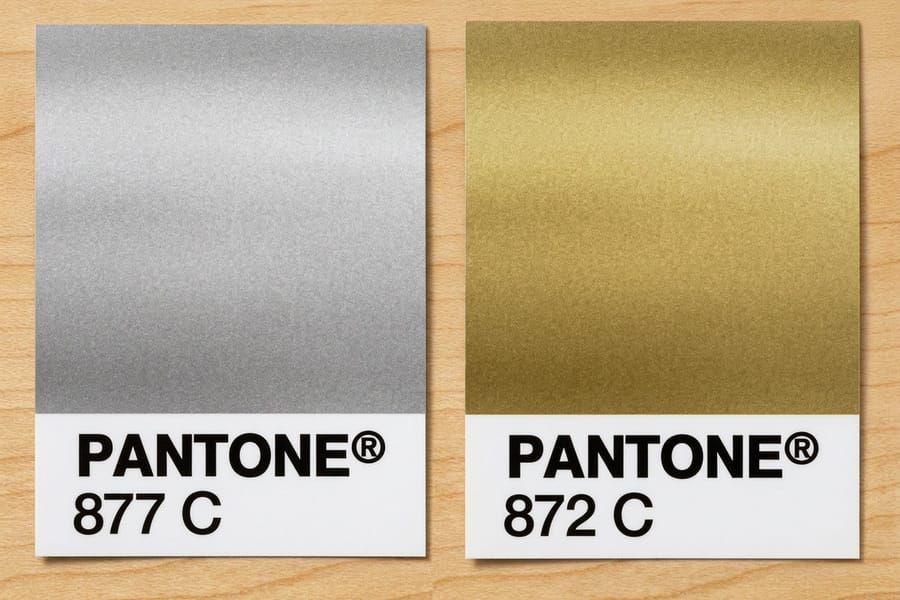
Gold is a signal, and signals only work when the recipient slows down enough to receive one. That rules out most bulk mail and rules in three jobs.
Seals. A round foil seal is the strongest case for stamping there is. The artwork is one simple shape, the die gets reused on every reorder, and the piece is small enough that the foil area stays cheap. Certificate seals, notary marks and award seals all work this way, and a die-cut circle in foil looks like an official object rather than a printed one. If the seal has to be peeled and reapplied cleanly, discuss the adhesive when you order rather than after.
Packaging closures. A gold sticker holding a box flap or a tissue wrap shut is the last thing a customer touches before the product itself. Foil suits a logo-only closure. If the closure carries a full design with a photograph or a gradient, metallic ink on die-cut stickers gives you the shimmer without fighting the process. Anything that will sit on a chilled or wet surface needs a synthetic face stock, not paper.
Awards, invitations and limited runs. These get kept, held and looked at closely, which is exactly where the difference between a mirror and a printed tan becomes obvious. It is also where the die cost is easiest to justify, because the same crest gets stamped every year.
Where gold does not pay: high-volume handouts that get skimmed and dropped, anything running through a laser printer afterward, and designs where the gold is competing with five other loud elements. For those, put the money into the stock or the cut instead. Browse the full range on the stickers printing page, compare label formats under labels printing, and if you are still weighing spend against effect, our guide to what custom stickers actually cost breaks the quote down line by line.
Wally explains gold stickers
One is stamped metal, the other is metal dust in ink
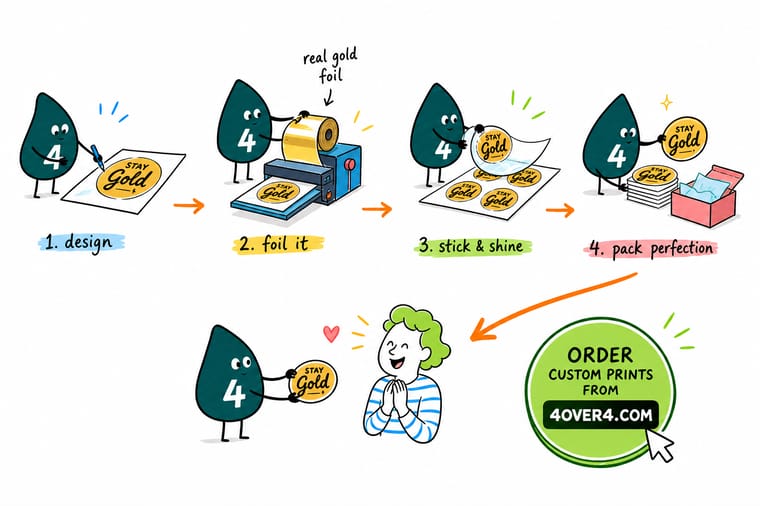
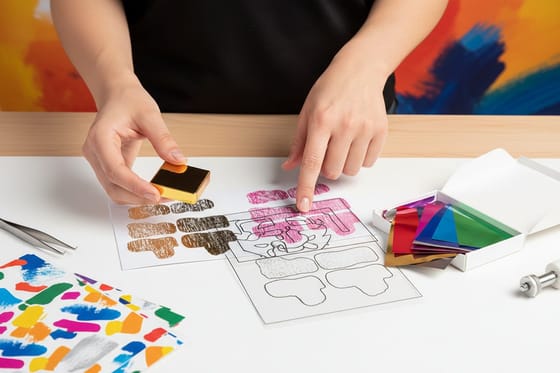
Wally heats a die shaped like your logo, lays a ribbon of gold foil over the sticker, and presses. The metal releases only where the die touched, so the mark comes out mirror bright and the rest of the sticker stays plain. On the other press he runs a gold ink full of tiny aluminium flakes, which shimmers at an angle and happily fades into a gradient. Give him a simple solid shape and he will stamp it. Give him a photograph with gold in it and he will reach for the ink.
Order gold foil stickers →Specs and pricing
Gold sticker options, sizes and starting prices
Compare the stamped and printed routes side by side, with live size, stock and quantity choices straight from the 4OVER4.COM configurator.
Print it
Order the gold that suits your artwork
Explore more
Where to go next

By the numbers
Sticker printing you can count on at 4OVER4
Common Questions
Your gold sticker questions, answered
What is the difference between gold foil stickers and metallic gold stickers?
Foil is a physical layer of metal transferred onto the sticker by a heated die, so it is opaque and mirror bright over any background. Metallic gold ink is a normal printing ink loaded with fine aluminium flakes, laid down in a press pass like any other colour. Foil looks like jewellery; metallic ink looks like a warm shimmer that shifts as the sticker moves. The practical split is artwork: foil takes solid shapes only, while metallic ink prints gradients, small type and fine detail because it goes through the same screening as every other ink.
Can you print a gold gradient, or gold inside a photograph?
Not with foil. Foil transfers in full or not at all, so a screened area either fills in solid or fails to release and leaves a broken edge. If your gold has to fade, sit inside an image, or vary in strength across a shape, you need metallic ink or a metallised face stock. A common workaround is to split the job: the gold logo stamps in foil, the gold wash behind it prints in metallic ink, and the two sit next to each other on the same sticker.
Is gold sticker paper the same thing as gold foil?
No, and the difference shows up the moment you place your logo. Gold sticker paper is a metallised face stock that is already gold across its whole surface, so every unprinted area shines, including the background and the space inside letterforms. Foil stamping puts metal only where the die touches, so the rest of the sticker stays plain paper or vinyl. If you want a gold mark on a white sticker, that is foil. If you want the whole sticker to look like metal, that is metallised stock.
How small can gold foil type or line work go?
Plan around half a point for rules and roughly six to eight point for type, in a weight that is not a hairline. Thin strokes are the usual failure: the foil breaks along the stroke and leaves a ragged, speckled line rather than a clean one. Keep separate foil elements slightly apart as well, because two heavy shapes close together can bridge and pull the foil between them. Serif faces with fine hairline strokes are the riskiest choice and often look better set in metallic ink.
Do gold stickers survive outdoors, on bottles, or in a fridge?
It depends on the face stock under the gold, not on the gold itself. A gold sticker on paper stock will cockle and stain the first time it gets wet, so anything on a bottle, a cooler, a window or a vehicle needs a vinyl or polypropylene base. Foil itself resists water but scuffs, and a large solid foil area wrapped tightly round a curved bottle can craze. For a wet or chilled application, ask for the sticker on a synthetic stock with a laminate over the foil, and expect the mirror to drop a little under a matte laminate.
At what quantity does foil stop being expensive?
The stamping die is a one-time cost tied to the artwork, not to the run, so it spreads out as the quantity climbs and disappears entirely on a reorder of the same design. That makes foil sensible for a seal, a certificate mark or a packaging closure you will print again and again, and hard to justify on a single small batch of a design you will change next month. If you are printing a one-off, price Metallic Stickers at $108.75 against Foil Stickers at $322.98 before you commit, and read our breakdown of what drives custom sticker pricing.
Get Started
Ready to put real gold on your stickers?
Pick your shape and stock, choose stamped foil for a mirror or metallic ink for detail, and we print stickers that hold their shine long after the box is opened.
Legal Disclaimer
Gold Standard guarantees apply to all standard orders placed through 4over4.com. Price match requires verifiable proof of a competitor's published price for an equivalent product with matching specifications and turnaround time. Satisfaction guarantee covers manufacturing defects and print quality issues. Contact support with order number and documentation. On-time delivery rate based on tracked orders 1999 to 2026. Individual results may vary based on shipping carrier performance.
