
How to Order Custom Paper Placemats for Restaurants and Events


A placemat is a flat printed sheet, so ordering one is a question of size, text weight and run length. Here is what each choice costs you, and where the artwork has to sit once a plate lands on it.
Custom paper placemats are ordered as flat one-sided sheets, most commonly 14 by 10 inches on 70lb to 100lb text stock, in runs sized to a full season. At 4OVER4.COM you configure them through Standard Flyers from $39.54, choosing uncoated if guests will write or color on them and gloss if the food is oily. Lay the artwork out around a 10.5 inch dinner plate, which leaves two 1.75 inch strips at the ends for anything that must stay readable during the meal.
Quick answer
Flat sheet, text weight, season-sized run
Order a placemat the way you order a flyer: one size, one stock, one side, one big run. 14 by 10 inches on 70lb to 100lb text paper covers most dine-in rooms, uncoated when guests write on it and gloss when grease is the enemy. The layout is the part people get wrong, because a 10.5 inch dinner plate takes the whole middle of the mat and leaves 1.75 inches at each end. Put the logo, the phone number and the QR code in those strips, keep dated specials on a table tent, and print enough sheets to last the season in a single pass.
Pick the Size and the Run Before Anything Else
Size decides paper cost, and paper cost decides whether the mat is worth printing at all. Start there, then work backwards to artwork.
| Size | Who uses it | What fits on it | The catch |
|---|---|---|---|
| 14 x 10 in | Most dine-in restaurants | A 10.5 in dinner plate, a glass and flatware | Two sit across a 48 in four-top without overlapping, which is why it became the default. |
| 17 x 11 in | Diners, banquet halls, family tables | A full setting with margin to write or color | Cuts cleanly out of a standard press sheet, so the extra paper costs less than the jump suggests. |
| 12 x 18 in | Steakhouse and buffet covers | Plate, side plate, glass and bread plate | More paper than most kitchens need, and the portrait shape reads oddly across a table edge. |
| 11 x 8.5 in | Kids mats, coffee counters, tray liners | A mug and a pastry plate | Half the paper cost, but a dinner plate covers it completely. |
Quantity is arithmetic, not a guess. Count seats, multiply by turns, multiply by open days. A 60 seat room turning twice at lunch and twice at dinner runs through about 240 mats a day, so a quarter is somewhere north of 20,000 sheets once you allow for the ones servers pull because a busser creased them. Print the season in one go. Every return trip to press pays setup again, and a placemat has no shelf life problem as long as you keep dated content off it.
At 4OVER4.COM the run gets configured as a flat sheet through Standard Flyers, which start at $39.54. Pick your size, choose the text weight, set one-sided printing, and enter the quantity. If you want to see the whole flat-sheet range first, the flyer printing category lists every stock and finish we run.
Gloss Fights Grease, Uncoated Takes a Crayon
This is the only real decision on a placemat, and it comes down to what lands on the sheet during service.
Uncoated text, 70lb to 100lb. The traditional diner mat. It has tooth, so crayon grabs, pen does not skid, and a server can write a table number in the corner. It also drinks up oil, so a drop from a slice of pizza spreads into a dark halo within the meal. On a busy night nobody notices. Under a photographer, they do.
Gloss text, 100lb. Coated, so a grease drop sits on the surface instead of soaking outward, and food photography stays sharp with real contrast. The costs are honest ones: crayon slides off it, and low pendant lighting bounces straight back at whoever is trying to read the specials.
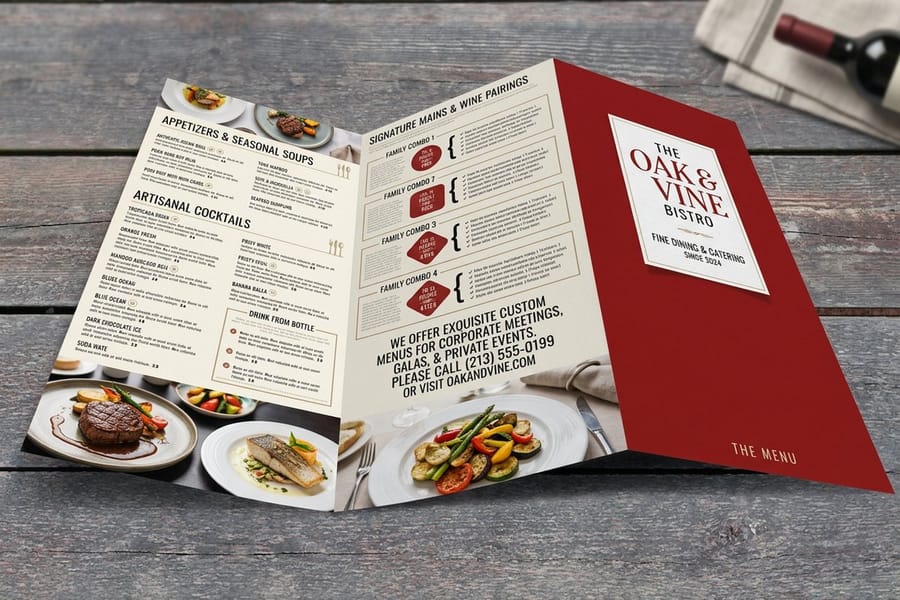
Cover stock and 14pt card. Over-specified for a mat. They feel like a menu rather than something disposable, which quietly tells the guest you expect it back, and a run of several thousand becomes a stack nobody wants to store. If the goal is a substantial feel, order proper restaurant menus from $57.11 and keep the mat cheap.
One thing that matters more than the stock: ink coverage. A heavy dark solid across the whole mat shows every water ring, every scuff from a plate being dragged, and every crease. A light background hides all three and keeps reprints looking new for longer. If the brand needs to be dark, put the dark block in the end strips and leave the middle pale. Kraft menus at $166.04 show what the same artwork does on a brown uncoated sheet, where every ink goes warmer and lighter.
Our flyer paper stocks and weights guide covers how each text weight behaves on press, and 100lb gloss explained is worth reading before you commit to a coated mat.
Lay the Placemat Out Around the Plate, Not the Page
Designers lay out a placemat like a poster, centered and balanced, and then a 10.5 inch plate lands on it and the design disappears. Do the geometry first.
On a 14 by 10 mat, a standard dinner plate is wider than the mat is tall. It takes the full height and leaves 1.75 inches at each end. Those two strips are the only artwork that survives from the moment food arrives to the moment it is cleared, which is most of the visit. Logo, phone number, ordering QR code and social handle go there. The center is not wasted, but it works only in the window before the plate arrives and the window after it is taken away, so it is where you put the thing people read while they wait: the story, the map, the kids maze, the wine list.
- Bleed 0.125 in past the trim on all four sides, because a guillotine cutting a lift of several thousand sheets drifts.
- Safety 0.25 in inside the trim. Nothing you need to read goes closer to the edge than that.
- Perimeter ad band of about 1.25 in if you are selling slots, which keeps eight sponsors legible without crowding the setting.
- One reading direction. The guest sits at a long edge, so the mat reads landscape from that edge. Text rotated for the far side of the table gets read by nobody.
Build the file at final size with fonts outlined and images at 300 dpi, the same handoff any flat sheet needs. Start from a correctly sized layout in our blank template library, and if the file prep is new to you, how online printing works walks the whole handoff from upload to shipping.
The Placemat Is the Only Ad Nobody Can Ignore
A guest looks at a placemat for the length of a meal. No flyer, no mailer and no social post buys that kind of attention, and the mat is already paid for as a table covering. That is the argument for treating it as a marketing surface rather than a napkin substitute.
Three uses earn their space. The full menu printed on the mat suits a counter-service or single-page concept, because the guest orders without waiting for a menu and the kitchen never chases a missing one. A house story and map works for a destination restaurant where people arrive early and read. Sold advertising slots turn the mat from a cost into revenue: local businesses buy a perimeter block, and once the slots are sold the print run is covered. Price your run in the configurator first, then divide by the number of slots, so you know the number you have to beat before you make a single call.
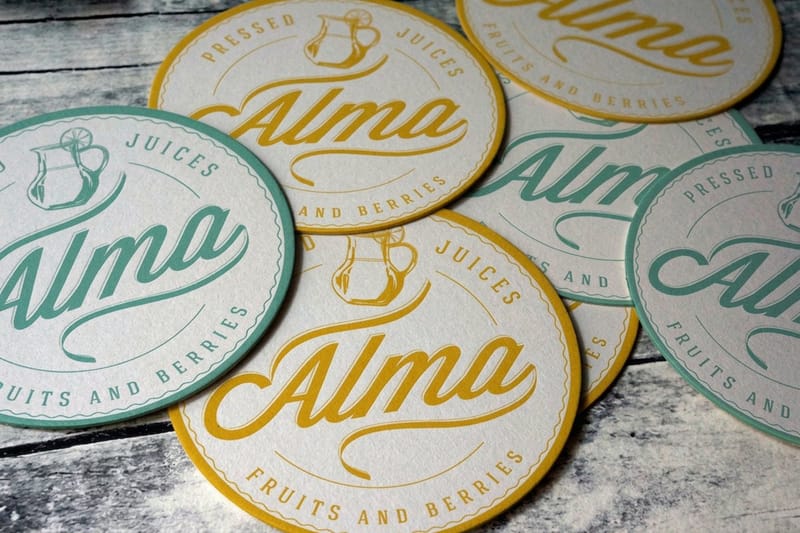
Keep dated content off the mat. The day you print a Christmas special into a 20,000 sheet run is the day you throw 15,000 of them away in January. Evergreen artwork goes on the placemat, and the specials that change weekly go on table tents, which start at $554.39 and get swapped in seconds. Drink coasters from $10.98 do the same job at the bar. Between the three, every surface a guest touches carries something you chose.
If the mat is going to carry your menu, treat it as a menu design problem rather than a placemat problem. Laying out a menu that sells covers where the eye lands and how to set prices, restaurant menu sizes covers the dine-in and takeout formats, and the menu printing category has the stocks and coatings we run for restaurants.
Wally explains placemats
The plate wins, so design around it
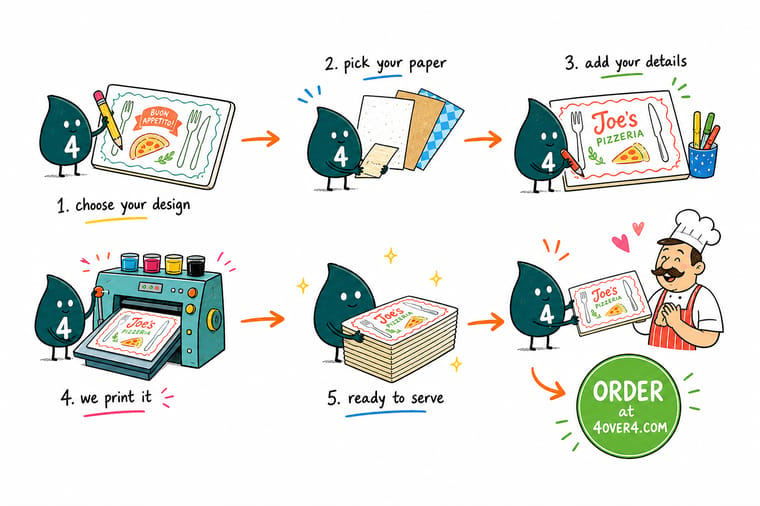
Wally prints the mat 14 by 10 inches on text-weight paper, one side, and then puts a real dinner plate on it. The plate is 10.5 inches across, which is wider than the mat is tall, so the whole middle vanishes and two strips of 1.75 inches survive at the ends. That is where the logo, the phone number and the QR code go. Uncoated paper if kids will color on it, gloss if the food is oily, and nothing dated anywhere on the sheet.
Configure a placemat run →Specs and pricing
Sizes, stocks and starting prices for the tabletop
The flat sheet you print the placemat on, the menu it can replace, and the table tent that carries your dated specials, with live configuration options and starting prices from the 4OVER4.COM configurator.

Print it
Order the pieces that dress a table
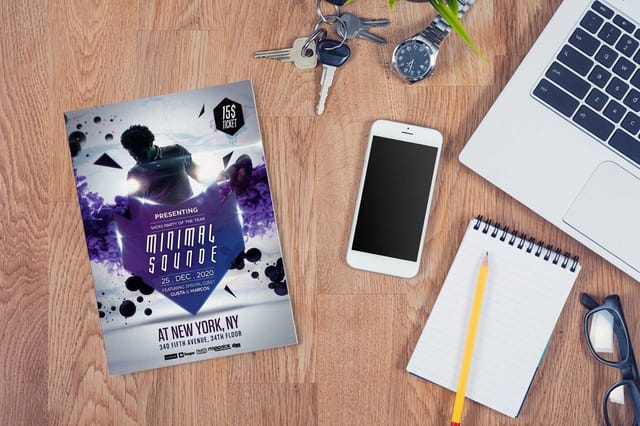
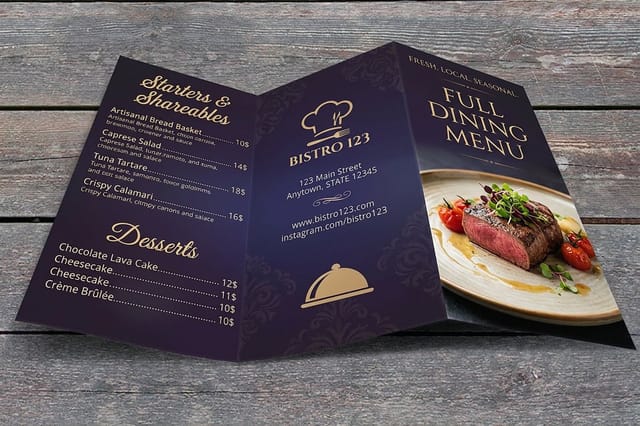
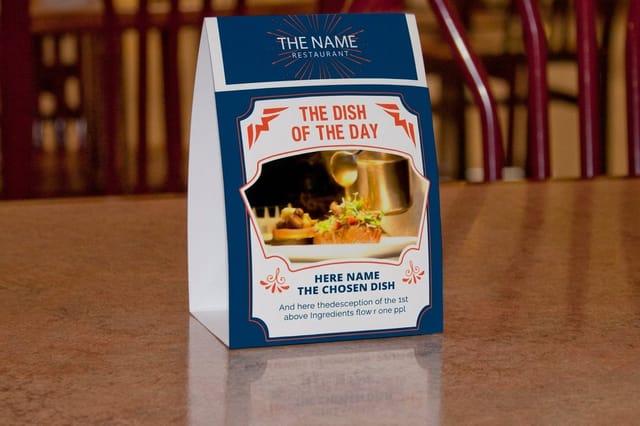
Explore more
Where to go next

By the numbers
Restaurant printing you can count on at 4OVER4
Common Questions
Your paper placemat questions, answered
What size are custom paper placemats?
14 by 10 inches is the standard dine-in size and the one most placemat artwork is drawn to. It holds a 10.5 inch dinner plate plus a glass and flatware, and two of them fit across a 48 inch four-top without touching. 17 by 11 inches suits banquet halls, diners and family tables where guests write or color on the mat. 11 by 8.5 inches is a kids mat, a coffee counter mat or a tray liner, and it is too small to sit under a full dinner plate.
What paper should a paper placemat be printed on?
Text weight, not cover. 70lb to 100lb uncoated text behaves like a traditional diner mat: it takes crayon, pen and a server's scribbled table number, and it costs the least per sheet. 100lb gloss text keeps food photography sharp and stops a grease ring from spreading, but crayon skids on it and pendant lighting bounces off it. Cover stock and 14pt card feel like a menu rather than a mat, cost noticeably more, and turn a run of a few thousand into a heavy stack in the storeroom.
Can paper placemats be printed on both sides?
They can, and it is usually wasted money. The back sits face down on the table for the whole meal and is thrown away unseen. The one case that justifies it is a mat you intend the guest to take home, such as a coloring sheet with a coupon on the reverse, or a mat you flip halfway through service to switch from a lunch layout to a dinner layout. Otherwise print one side and put the saving into paper weight.
How many placemats should a restaurant order at once?
Count covers, not tables. A 60 seat room turning twice at lunch and twice at dinner uses about 240 mats a day, which is roughly 7,000 a month before waste, and waste is real because servers pull damaged mats and hosts double up for messy tables. Order a full season in one run rather than reprinting monthly, because the press setup is charged each time you go back. If the artwork carries dated specials, print the evergreen mat in bulk and keep the dated content on a table tent instead.
Can guests write on a paper placemat with crayons?
Only on uncoated stock. Wax crayon needs tooth to grab, and a gloss or aqueous coated sheet gives it nothing, so the color skips and smears. If the mat is a kids activity sheet, specify uncoated text and keep the drawing area light, because crayon over a dark solid barely shows. Leaving a wide unprinted band across the middle also gives them somewhere to draw once the plate is cleared.
Do paper placemats need to be food safe?
Not for normal service, because the food sits on a plate and never touches the sheet. The moment you plan to put food directly on the paper, such as a basket liner under fries or a tray liner under a burger, you are ordering food contact paper rather than a placemat, and that is a different stock with different ink requirements. Our guide to custom food wrapping paper covers what changes when the paper touches the meal.
Get Started
Ready to put your name under every plate?
Pick the size, choose uncoated or gloss text stock, set the run to cover your season, and we print placemats that still look like yours at closing time.
Legal Disclaimer
Gold Standard guarantees apply to all standard orders placed through 4over4.com. Price match requires verifiable proof of a competitor's published price for an equivalent product with matching specifications and turnaround time. Satisfaction guarantee covers manufacturing defects and print quality issues. Contact support with order number and documentation. On-time delivery rate based on tracked orders 1999 to 2026. Individual results may vary based on shipping carrier performance.
