
How to Make Custom Sports Cards From Your Own Photos


One action photo, a nameplate, a stats back, and the same 2.5 by 3.5 inch stock the hobby shop sells. Here is the whole build, with the numbers that keep it from printing wrong.
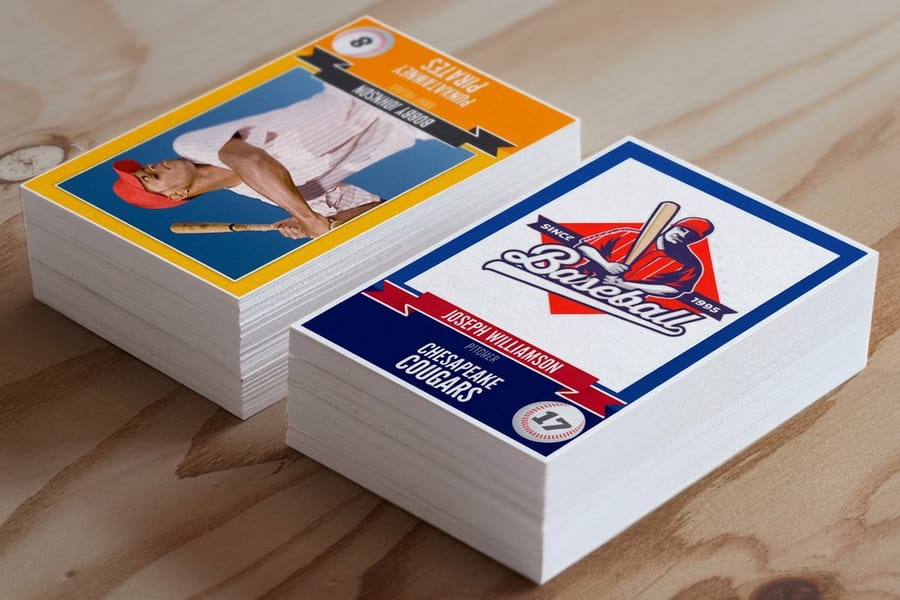
To make a custom sports card, crop a vertical action photo into a 2.75 by 3.75 inch file at 300 dpi, which is 825 by 1125 pixels, keep the name and number an eighth of an inch inside the trim, and print it on 2.5 by 3.5 inch trading-card stock. Choose full color on both sides so the back can carry stats. Sets of 25 start at $11.25 at 4OVER4.COM, and the two decisions that change the result most are the photo you start from and whether the stock is laminated, because laminate will not take an autograph.
Quick answer
The three rectangles that decide whether the card prints right
A sports card is a 2.5 by 3.5 inch print with a photo that runs past the cut line and type that stays well inside it. Build at 2.75 by 3.75 inches, 825 by 1125 pixels at 300 dpi, let the background bleed to all four edges, and hold every name, number and stat inside a 2.25 by 3.25 inch safe area. Pick full color on both sides if the back carries stats, and pick the stock last, based on whether the cards get sleeved, mailed or signed.
Step 1: Get a Photo That Survives the Crop
The card is 2.5 by 3.5 inches and vertical, so the photo has to work as a portrait crop with the player roughly centered and room above the head. Almost every weak sports card traces back to the shot, not the printing.
Shoot from the fence or the sideline rather than the stands. A 12 megapixel phone frame is 4032 by 3024 pixels, and a vertical card crop out of that still leaves about 2160 by 3024 pixels, far more than the 825 by 1125 the file needs. Pinch to zoom from the top row and the phone has already thrown those pixels away before you touch the crop tool. Walk closer instead.
Light matters more than gear. Late afternoon under lights or heavy shade forces a slower shutter, and a slightly blurred arm reads as sharp on a phone screen and mushy at 2.5 inches wide. Overcast midday is the friendliest condition a parent gets. Burst mode through the swing or the shot, then pick the frame where the face is visible and the ball is still in play.
Watch the background. A chain-link fence and a parking lot behind the player fight the type you are about to put on top. A crowd, an outfield wall or open sky separates the subject cleanly. If you plan to cut the player out and drop a color field behind, shoot against the sky and the edge work takes minutes instead of an evening. Our guide to resolution for printing covers when a file is genuinely too small, and the photography basics guide applies to a dugout as well as a product table.
Step 2: Lay Out the Front Without Losing the Corners
Three rectangles run the front of a sports card, and the whole layout is a matter of knowing which one each element belongs to.
| Rectangle | Size | At 300 dpi | What belongs there |
|---|---|---|---|
| Bleed | 2.75 x 3.75 in | 825 x 1125 px | The photo and any background color, running past the cut line. |
| Trim | 2.5 x 3.5 in | 750 x 1050 px | Nothing specific. This is where the blade lands, give or take a hair. |
| Safety | 2.25 x 3.25 in | 675 x 975 px | Name, jersey number, team, position, logo, year. Every piece of type. |
Set the document to the bleed size and pull the photo out to all four edges. If the background stops at the trim line, a normal cutting tolerance leaves a white sliver down one side of some cards in the stack, and that sliver is the difference between a card that looks printed and a card that looks made at home.
The nameplate is the piece people get wrong. A bar across the lower third holding the name and number reads instantly and gives the type a solid background so it stays legible over a busy photo. Keep that bar inside the safety line. If you order the 3/8 inch rounded corner, the die takes 112 pixels out of each corner at 300 dpi, so a logo tucked into a corner comes back with a bite out of it. Start from a correctly sized layout in the blank template library and read bleed and trim explained once before you export.
Step 3: Put Real Stats on the Back
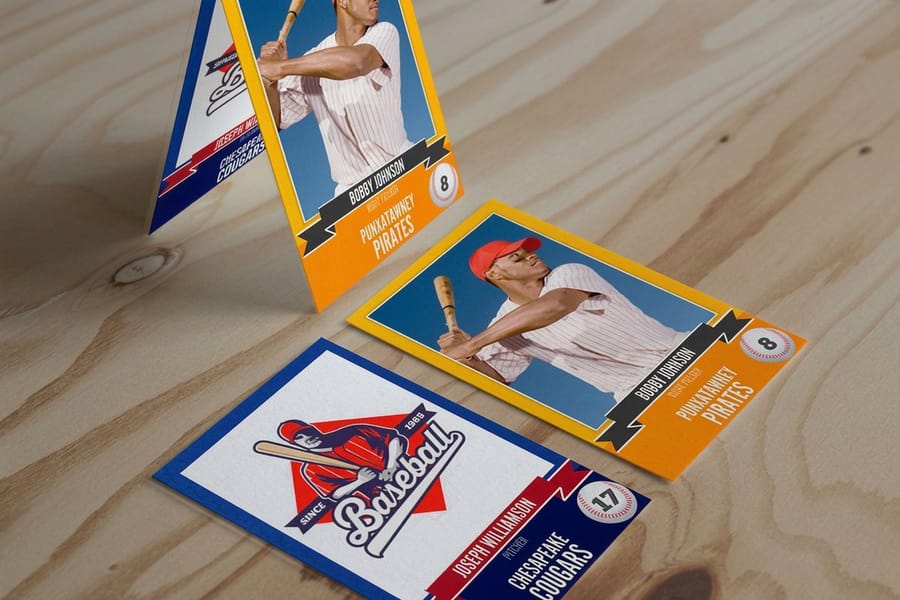
A blank back is what separates a photo card from a sports card. The back is also where the ink choice costs you money if you skip past it: trading cards print full color on the front with a blank or black back, or full color on both sides, and a stats panel needs the both-sides option selected before checkout.
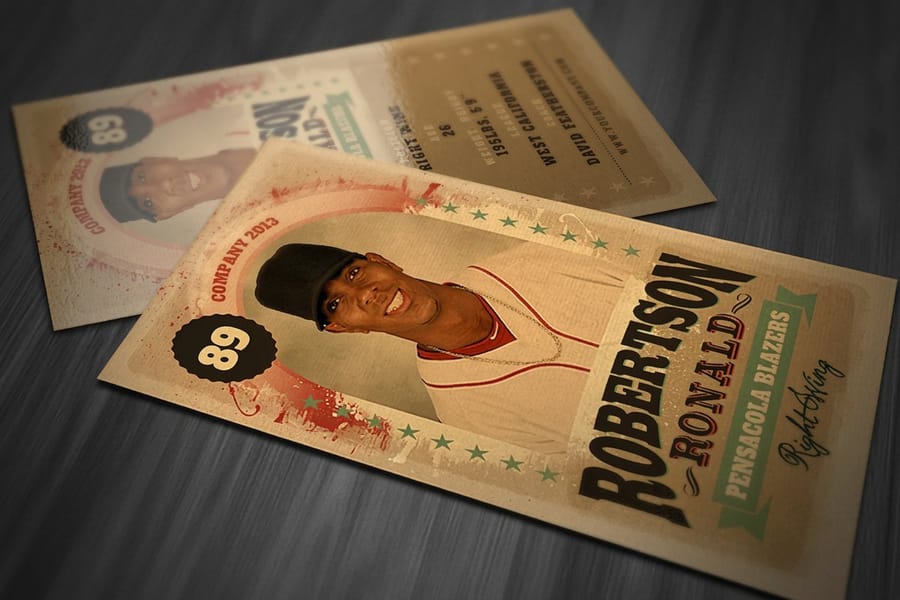
What earns its space on a 2.5 by 3.5 inch back: the player name and number again, position, height and grade or age, the season, a short stat grid, and one line about the team or the sponsor who paid for the run. A small secondary photo, a portrait or a candid from the bench, breaks up the grid and gives collectors a second image to look at.
Set that type at 7 point or larger and keep it dark on a light panel. Reversed white type at 6 point over a dark field is the most common back-of-card mistake, because the ink spreads slightly into the paper fibers and the counters of letters close up. A QR code linking to a highlight reel works well here, at half an inch square or bigger, and our QR code walkthrough covers building one that scans after it is printed. Export the whole thing as a print-ready PDF with fonts outlined, which the print-ready PDF guide walks through, and convert your art to CMYK first using the RGB to CMYK steps so team colors do not shift on press.
Step 4: Choose the Stock for How the Card Gets Handled

Thickness and surface decide whether the card feels like the real thing. Trading cards run on 18 stocks, from everyday 14pt and 16pt gloss cover up to a heavy 24pt, plus uncoated and recycled covers, white linen, metallic pearl, synthetic plastic and rigid vinyl. For a set that gets sorted and traded, 16pt is the sensible floor and 24pt feels like a premium insert.
Laminates are the upgrade that changes the card in hand. Gloss laminated trading cards seal a 16pt stock front and back under a glossy film that resists water, tearing and scuffing, and they start at $94.74 for 250. Silk laminated trading cards and suede trading cards are the same price and thickness with a soft matte film that feels like brushed velvet and hides fingerprints, which matters on a card that gets passed around a dugout.
Here is the limit nobody mentions until the cards arrive. Laminate is a sealed plastic film, so a ballpoint skates across it and a marker sits wet on the surface. If the point of the set is autographs at a team night, order the standard uncoated stock, or kraft trading cards at $48.61 for 100, printed on 18pt kraft made from 100 percent post-consumer fiber. Kraft takes pen instantly. The trade-off there runs the other way: the brown sheet mutes light artwork, so kraft cards use a CMYK plus white ink setup to keep pale jerseys and white type readable. If you want to compare surfaces before committing, the matte, gloss and soft touch comparison holds for card stock the same way it does for business cards.
Step 5: Price a Team Set Before You Design Twelve of Them
A set of 25 trading cards starts at $11.25, and the per-card price slides down across 41 quantity tiers to 100,000. That reads cheap until you multiply it by a roster.
Every player is a different design, so a twelve player team is twelve separate print jobs at the smallest tier, not one 300-card run. The math surprises parents every season. Two ways out: print a single team card at a higher quantity so everyone gets the same design at the low per-card price, or accept one 25-count set per player and treat the individual cards as the keepsake while the team card is the giveaway. Many clubs do both, a team card for the sponsor to hand out and player cards for the families.
Plan the calendar too. Standard turnaround on trading cards is 3 business days, laminated versions run 4, and kraft runs 5, with 2-day, Next-Day and Same-Day rush available on most of them. Photos usually arrive the week the season ends and the banquet is ten days later, which is exactly the window where a rush charge becomes the whole savings. Order at the standard turnaround and you keep the money in the print.
If this is your first set, read the broader trading card build guide next, then browse the full range on trading card printing to see every stock and laminate priced side by side.
Wally builds a sports card
Photo past the cut line, type well inside it
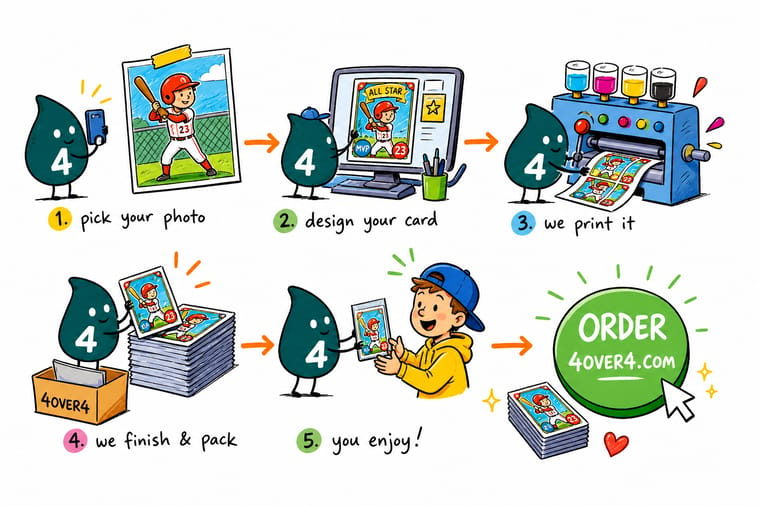
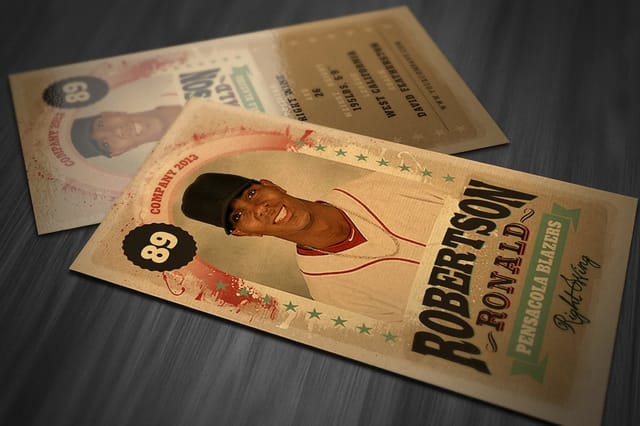
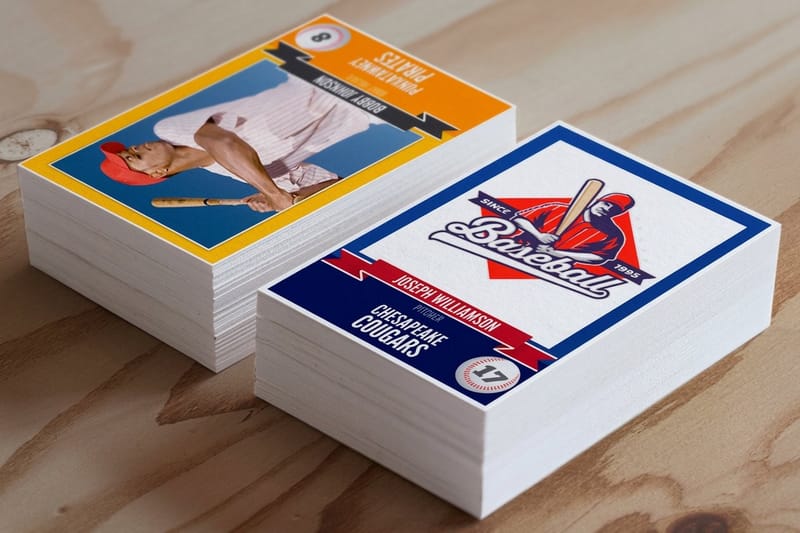
Wally starts with one vertical action shot, drops it into a file that is a little larger than the card so the blade has something to cut into, then pulls the name and the number back from the edge where the trim cannot reach them. He flips the card over and fills the back with the season stats, because that is what turns a photo into a sports card. Last decision is the stock. Laminate for cards that get handled and sleeved, plain uncoated or kraft if the whole point is getting them signed.
Order trading cards →Specs and pricing
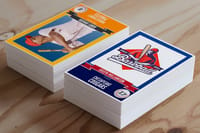
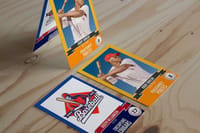
Sports card stocks, sizes and starting prices
Every option here trims to the same 2.5 by 3.5 inches. What changes is the stock, the laminate and the turnaround, with live configuration and starting prices straight from the 4OVER4.COM configurator.

Print it
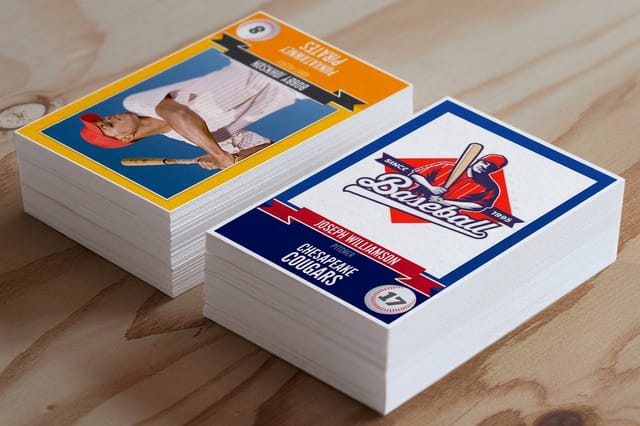
Print the set your players will keep
Explore more
Where to go next

By the numbers
Card printing you can count on at 4OVER4
Common Questions
Your sports card questions, answered
What size is a custom sports card?
The same 2.5 by 3.5 inches as every trading card sold in a hobby shop, which is why standard sleeves, top loaders and nine-pocket binder pages fit it. Build the file at 2.75 by 3.75 inches to carry an eighth of an inch of bleed on each edge, which is 825 by 1125 pixels at 300 dpi. The trim itself is 750 by 1050 pixels, and the safe area for type is 675 by 975 pixels.
Can I use a phone photo for a sports card?
Yes, if you shot it close and in decent light. A 12 megapixel phone frame is 4032 by 3024 pixels, and cropping a vertical card shape out of it still leaves roughly 2160 by 3024 pixels, well above the 825 by 1125 the card needs. Resolution is rarely the problem. Motion blur and heavy digital zoom are. A pinch-zoomed shot from the top row is already an upscale before you crop it, and no print process puts that detail back.
Do I need permission to use a team or league logo?
For anything beyond your own team, usually yes. School names, mascots, league marks and pro team logos are trademarks, and the rights sit with the school, the league or the franchise, not with the printer. We print the file you upload and you confirm you have the right to use what is in it. For a rec league or a travel team, ask the club before you put its crest on a card you plan to sell.
How many sports cards should I order for a team?
Trading cards start at a set of 25 for $11.25, and the price per card keeps dropping across 41 quantity tiers up to 100,000. The catch on a roster set is that each player is a different design, so twelve players means twelve orders at the small tier rather than one cheap run of 300. If the budget is tight, print one team card at a higher quantity and give every kid the same card, or hold the individual cards to a single 25-count set each.
Square corners or rounded corners?
Rounded reads more like a modern sports card and survives a pocket better, since a square corner is the first thing to fray. Trading cards offer square, a 1/8 inch radius or a 3/8 inch radius. The larger radius is the one that looks like a game card, and it also removes about 112 pixels from each corner of your artwork at 300 dpi, so keep the jersey number and the logo away from the corners if you pick it.
Which finish holds up best when cards get handled?
A laminated card. Gloss laminated trading cards seal a 16 point stock front and back with a film that resists water, tearing and scuffing, and silk or suede laminate does the same with a soft matte surface that hides fingerprints. The trade-off is ink adhesion: a ballpoint will not bite into laminate. For an autograph set, order the standard uncoated stock or kraft, which take pen and hold it.
Get Started
Ready to print the team set?
Upload the photo, pick your stock and corner radius, and we print 2.5 by 3.5 inch cards that fit every sleeve and binder page on the shelf.
Legal Disclaimer
Gold Standard guarantees apply to all standard orders placed through 4over4.com. Price match requires verifiable proof of a competitor's published price for an equivalent product with matching specifications and turnaround time. Satisfaction guarantee covers manufacturing defects and print quality issues. Contact support with order number and documentation. On-time delivery rate based on tracked orders 1999 to 2026. Individual results may vary based on shipping carrier performance.
