
How to Make a Poster for School That Reads From Across the Room


Set the size first, size the type for the person standing furthest away, then pick paper or board based on whether the poster has to stand up by itself. Here is the whole sequence, with the numbers.
Build a school poster at its final size in inches, use 18 by 24 for a classroom and 24 by 36 for a hallway or a fair, and size the title at about one inch of letter height per ten feet of viewing distance. Keep every image at 100 to 150 ppi at that final size, add 0.125 inch of bleed, and print on foam board rather than paper whenever the poster has to stand on a table without a wall behind it.
Quick answer
Size, type height, then material
A school poster works when the title is readable from the furthest point in the room and the file was built at print size from the start. Set the document in inches, use 18 by 24 for a classroom wall and 24 by 36 for a hallway or an easel, allow about one inch of letter height for every ten feet of viewing distance, and keep placed images at 100 to 150 ppi at final size. Paper is right on a wall. Foam board is right on a table, because a paper sheet curls the moment it has nothing behind it.
Pick the Size and the Surface Before You Open a Design Tool

The size decision is not a design preference. It sets the pixel count you need, the type sizes that will read, and whether the poster can even be displayed where the assignment says it goes.
Three questions settle it. How far away will the furthest person be standing? Does the poster have to stand up on its own, or will it be attached to a wall? And how many copies does the project need? A single hallway poster and a set of thirty desk posters are different jobs with different economics.
| Size | Reads well from | Typical school use | Watch out for |
|---|---|---|---|
| 11 x 17 in | About 6 ft | One poster per student, book reports, classroom door displays. | Too small for a hallway. A title on this sheet disappears past 10 feet. |
| 18 x 24 in | About 10 ft | Club recruiting, classroom walls, spelling bee and election posters. | Needs a real title size. Body copy under 24 pt is wasted at this scale. |
| 24 x 36 in | About 20 ft | Hallways, gym announcements, science fair boards on an easel. | Paper this large curls. Mount it or expect to tape all four corners. |
| 36 x 48 in | About 25 ft | Stage backdrops, spirit signs, the largest display most fairs allow. | Check the fair rules first. Many cap the display footprint at this size. |
For most school work, large format posters at 18 by 24 or 24 by 36 cover it, and they start at $25 for a single copy. If the poster has to stand on a table without a wall behind it, skip paper and go straight to board. The full poster size guide lists the rest of the standard sizes if the assignment specifies something unusual.
Type Sizes and Layout That Survive the Back of the Room

Most school posters fail for one reason: the type was sized on a laptop screen at 60 percent zoom, where 48 point looks like a headline. Printed at 24 by 36 inches, 48 point is a little over half an inch tall and vanishes from ten feet away.
The working rule in signage is roughly one inch of letter height for every ten feet of viewing distance. Note that letter height is not point size. Capital letters occupy around 70 percent of the point size in most typefaces, so one inch of cap height means setting type near 100 point, not 72. For a hallway poster read from twenty feet, the title wants two inch capitals, which is close to 200 point.
Build the poster in three tiers and check each one against the distance it serves. The title carries the whole message from across the room, so it gets one line and no more than about seven words. The subheads carry the structure for someone who has stopped in front of it. The body copy exists for the person standing at the table, usually a teacher or a judge, and 28 to 32 point is plenty there.
Contrast decides the rest. Dark type on a light field beats light type on a photo every time, especially under the mixed fluorescent and daylight you get in a school corridor. Keep the background behind text plain, leave generous margins so nothing important sits within an inch of the trim, and pick a typeface with open counters. Our poster font roundup covers which families hold up when blown up, and the eight step poster design guide takes the layout further.
Setting Up the File So It Prints Sharp

Set the document to the finished poster size in inches before you place a single element. That one habit prevents nearly every quality problem that turns up at the print stage.
- Resolution. Target 150 ppi at final size, and do not go below 100. A 24 by 36 inch poster at 150 ppi is 3600 by 5400 pixels. Check placed photos at 100 percent zoom, because a 1200 pixel image stretched across 36 inches lands at 33 ppi and prints mushy.
- Bleed and safety. Add 0.125 inch of bleed on every edge if the artwork runs to the edge, and keep text at least 0.25 inch inside the trim line. Our bleed and trim explainer shows what the cutter actually does.
- Color. Design in CMYK if your tool allows it. Screen blues and bright greens are the two colors that shift most when converted, so a school color that glows on a monitor can come back duller. The color profile guide covers the conversion.
- Fonts and export. Export a PDF with fonts embedded or outlined. A missing font substitutes silently and reflows the title.
- Google Slides and Canva. Both work if you set a custom page size in inches at the start. In Slides that is File, Page setup, Custom, units set to inches. Enlarging a default slide at print time is the single most common cause of a soft school poster.
If any of that feels like a lot to get right on a deadline, start from a correctly sized file in the blank template library and drop your content in. Teachers building a set of classroom materials will find more of these setups in our printables and homeschool materials guide.
Paper, Foam Board or Mounted, and What Each One Costs
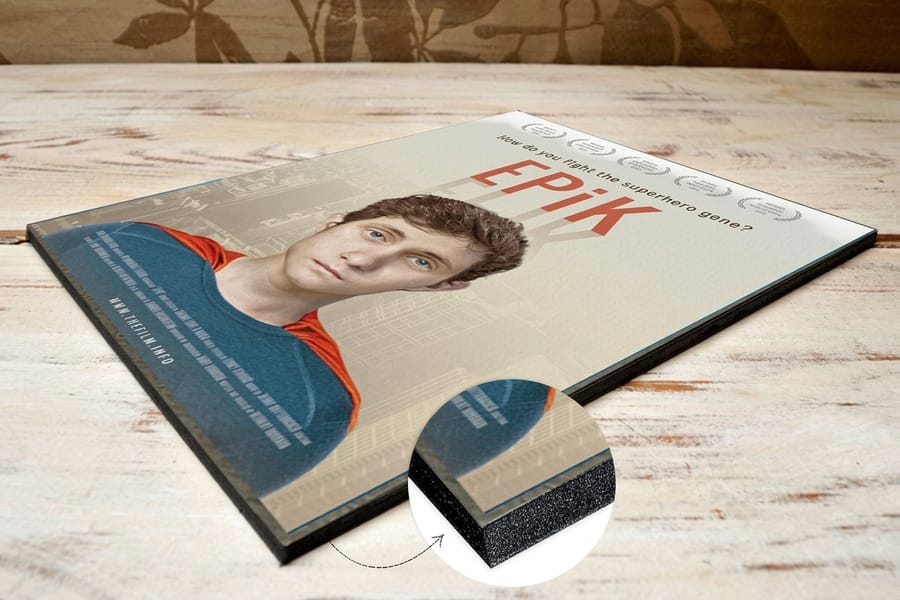
The material matters more than most students expect, because it decides whether the poster stands up, survives the trip to school, and comes home intact.
Paper posters ship rolled and cost the least. They are right for anything going on a wall. Give them a day flat under a stack of books before the display, or the roll memory will fight you. Large format posters start at $25.
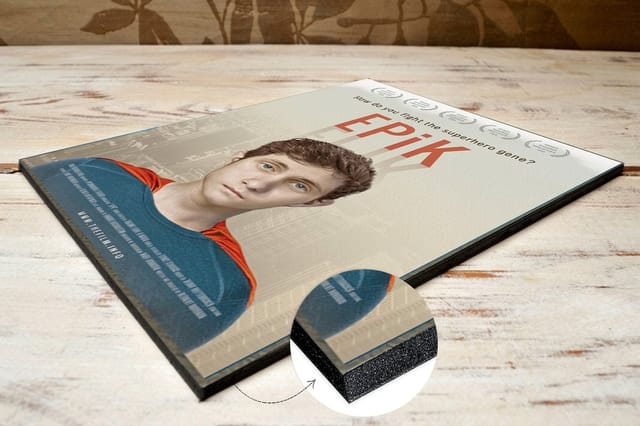
Foam core is a paper skin over a rigid foam center. It stands on an easel by itself, does not curl, and is light enough to carry under one arm on a bus. That makes it the default for science fairs and presentations. Foam core boards start at $49.99. The honest limit is that a crushed corner is permanent, so it wants a corner protector or a flat surface in the car.
Mounted posters are a printed poster bonded to a rigid backing, which gives you the flat finish of board with a smoother face. Mounted posters start at $39.99, sitting between the two. For a display that hangs on a wall all year, that flatness is worth the difference.
One more fork worth naming. If the whole grade needs the same design for an event, the economics flip. Standard posters start at $108.75 because that price buys a bulk offset run rather than a single sheet, so per poster it undercuts everything above once the quantity climbs. And if the message is really a banner rather than a poster, a wall length indoor banner starts at $25 and rolls up for storage between seasons. Browse the whole range on the poster printing category.
Wally explains school posters
Design for the kid at the back, not the laptop screen
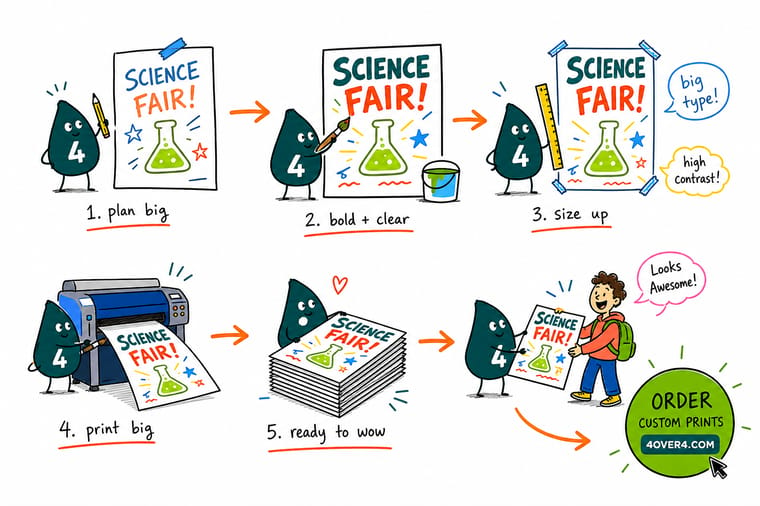
Wally sets the page to 24 by 36 inches before he draws anything, makes the title two inch capitals so it lands from twenty feet, and keeps the body copy near 30 point for whoever walks up to the table. He checks every photo at full zoom so nothing prints soft. Then he asks the only question that decides the material: does this poster have to stand up on its own? If yes, foam board. If it goes on a wall, paper is fine and cheaper.
Print a large format school poster →Specs and pricing
Poster sizes, materials and starting prices
Standard posters start at $108.75 for 50, while foam core and mounted posters print in 4 business days, with sizes set on each product page.



Print it
Order the poster the assignment actually needs

Explore more
Where to go next


By the numbers
Poster stock, foam board and mounting in one order
Common Questions
Your school poster questions, answered
What size should a school poster be?
For a classroom or hallway display, 18 by 24 inches is the size most teachers expect, and it reads comfortably from about ten feet. Go to 24 by 36 when the poster has to compete with lockers and other posters, or when it sits on an easel at a fair. Drop to 11 by 17 when the assignment is one poster per student and the budget matters more than the reach. Science fairs are the exception: they usually specify a display no wider than 36 inches and no taller than 48, so measure against the rules sheet before you set the document size.
What resolution do I need for a school poster?
Aim for 150 ppi at the final printed size, and treat 100 ppi as the floor. A 24 by 36 inch poster at 150 ppi is 3600 by 5400 pixels. That sounds enormous next to a screen image, but large format is viewed from several feet away, so the eye forgives a lower pixel density than a business card would need. The number that actually breaks posters is a small image stretched wide. Check every placed photo at 100 percent zoom in your layout before exporting.
Can I make a school poster in Google Slides or Canva?
Yes, if you set the page size in inches before you start. In Google Slides, open File then Page setup, choose Custom, switch the units to inches and enter 24 by 36. In Canva, create a custom size in inches rather than resizing a default presentation. Both export a usable PDF. The failure people hit is designing on a default 10 by 7.5 inch slide and enlarging it at the print stage, which multiplies every soft edge by three. Starting from a correctly sized layout in our blank template library removes the guesswork.
Poster paper or foam board for a science fair?
Foam board, in almost every case. A paper poster has to be taped to something, and school easels are rarely the right width, so the sheet ends up curling forward under the gym lights. Foam core is rigid enough to stand on its own edge in a display stand and light enough for a student to carry. The trade off is cost and damage: foam core starts at $49.99 against $25 for a large format paper poster, and a dented corner cannot be flattened out the way a rolled paper poster can.
How do I hang a school poster without wrecking the wall?
Painted cinder block and drywall both give up paint when tape comes off, which is why many schools ban tape outright. Removable poster strips applied to the four corners and the middle of the long edges hold a 24 by 36 sheet without pulling paint, provided you press them for the full thirty seconds the instructions ask for. For a poster that gets moved between rooms, a hanger frame or a mounted board saves the corners. Our damage free hanging guide walks through the options surface by surface.
How much does printing a school poster cost?
A single large format poster starts at $25, a mounted poster starts at $39.99, and foam core starts at $49.99. Those are one off prices, which is what most school projects need. Offset printed standard posters start at $108.75 because the price covers a bulk run, so they only make sense when the whole grade needs the same design for an event. If you need one poster this week, order the large format version. If you need two hundred for a fundraiser, the offset run is cheaper per piece.
Get Started
Order a large format school poster, ready in 2 business days
Pick the size in inches, upload the PDF, and choose paper for a wall or foam board for a table. Single copies print just as fast as a full class set.
Legal Disclaimer
Gold Standard guarantees apply to all standard orders placed through 4over4.com. Price match requires verifiable proof of a competitor's published price for an equivalent product with matching specifications and turnaround time. Satisfaction guarantee covers manufacturing defects and print quality issues. Contact support with order number and documentation. On-time delivery rate based on tracked orders 1999 to 2026. Individual results may vary based on shipping carrier performance.
