
How To Get Envelopes Printed For Invitations That Fit and Mail Cleanly


Which A-size fits your invitation, what goes on the flap, why a square envelope costs extra at the counter, and how many spares to buy before you address a single one.
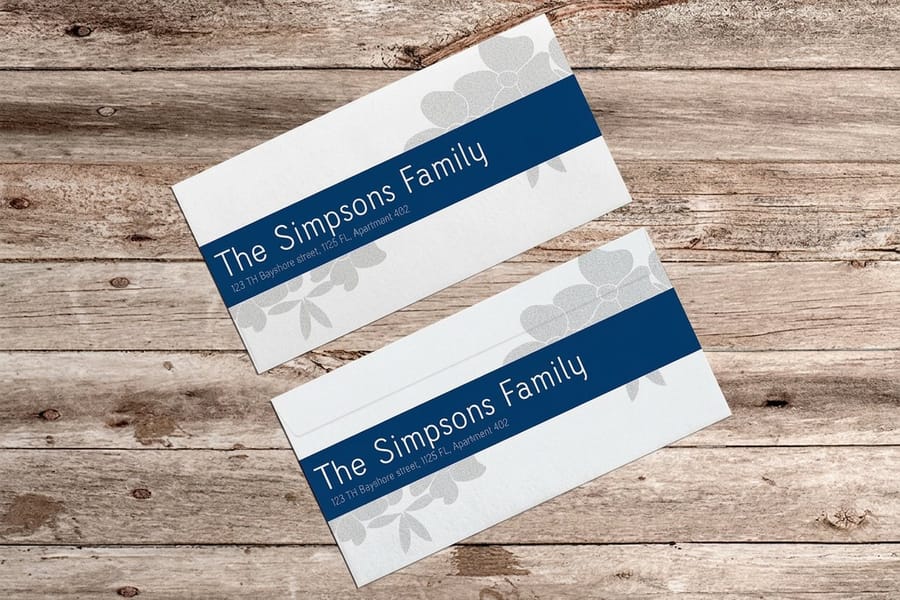
Order the envelope a quarter inch larger than the invitation in both directions, print the return address on the back flap, and leave the front face blank so the guest name can be added once your list is final. A 5 by 7 invitation takes an A7 at 5 1/4 by 7 1/4, which is the wedding default. Keep the shape rectangular, because the USPS charges a nonmachinable surcharge on every square envelope no matter its size, and order about ten percent spares for addressing mistakes.
Quick answer
The card decides the envelope, and the shape decides the postage
Pick the card size first, then take the announcement envelope that runs a quarter inch larger on both dimensions. A 5 by 7 invitation goes in an A7. A 4 1/4 by 5 1/2 reply card goes in an A2. Print your return address on the back flap and keep the front face empty for the guest name. Stay rectangular unless you are willing to pay the square-envelope surcharge on every single piece, and add about ten percent spares because addressing always eats a few.
Size the Envelope From the Card, Not the Other Way Round
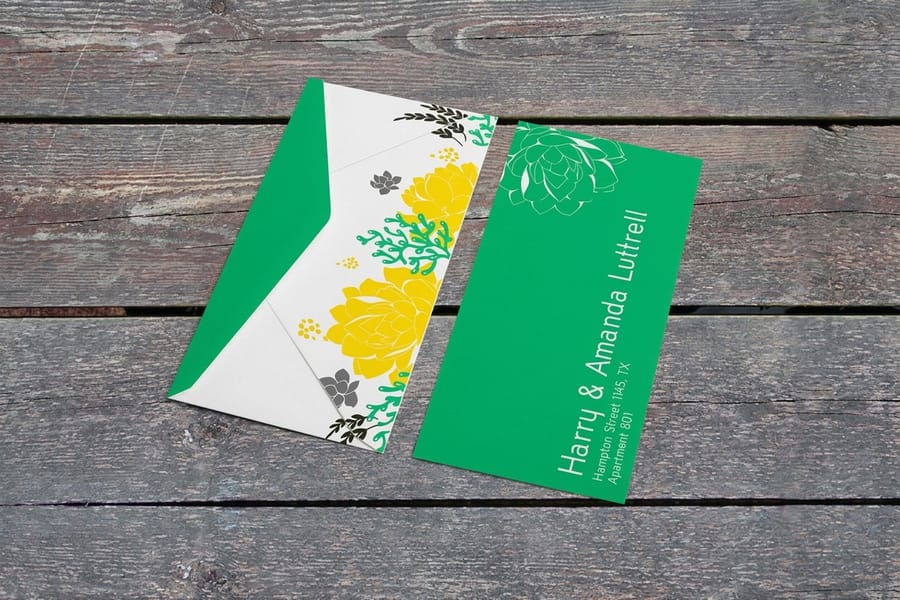
Every envelope problem starts here. People choose an envelope they like, then discover the invitation they already printed is a sixteenth of an inch too wide to slide in without creasing a corner. The order runs card first, envelope second, and the rule connecting them is simple: the envelope is about a quarter inch bigger than the card on both dimensions.
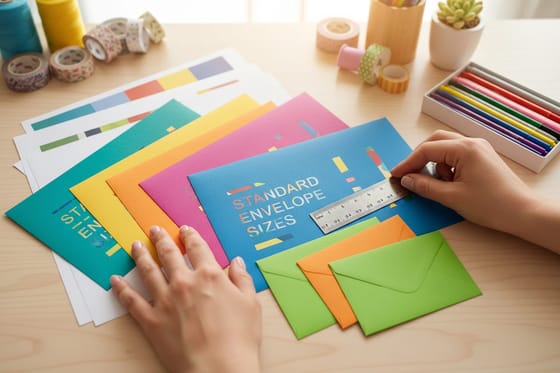
The A-series is the announcement family, and it is what invitation work uses. Commercial sizes like a #10 belong on business mail and look wrong on a wedding. Here is what fits what.
| Envelope | Envelope size | Card it holds | Typical job |
|---|---|---|---|
| A1 (4 Bar) | 3 5/8 x 5 1/8 in | 3 1/2 x 4 7/8 | Reply cards and enclosure cards inside a larger suite. |
| A2 | 4 3/8 x 5 3/4 in | 4 1/4 x 5 1/2 | RSVP cards, thank you notes, small announcements. |
| A6 | 4 3/4 x 6 1/2 in | 4 5/8 x 6 1/4 | Shower and birthday invitations, save the dates. |
| A7 | 5 1/4 x 7 1/4 in | 5 x 7 | The wedding and formal event default. |
| A8 | 5 1/2 x 8 1/8 in | 5 3/8 x 8 | Taller invitations and programs. |
| A9 | 5 3/4 x 8 3/4 in | 5 1/2 x 8 1/2 | Half-sheet invitations and multi-piece suites. |
Two things the chart does not say. A folded invitation is thicker than a flat one at the same trim, so a heavily folded piece plus an RSVP card plus a details card can bind in an A7 that would take the invitation alone with room to spare. Stack your whole suite, measure the thickness, and if it is over about an eighth of an inch, go up a size. And second, a card cut slightly out of square from a home trimmer will not fit a machine-made envelope, which is one more reason to have wedding invitations and RSVP cards trimmed on the same press run.
If you want the full picture beyond the announcement sizes, our standard envelope sizes guide lays out the commercial range as well, and the A7 breakdown goes deeper on the one size most people end up ordering.
What Actually Gets Printed, and What Stays Blank
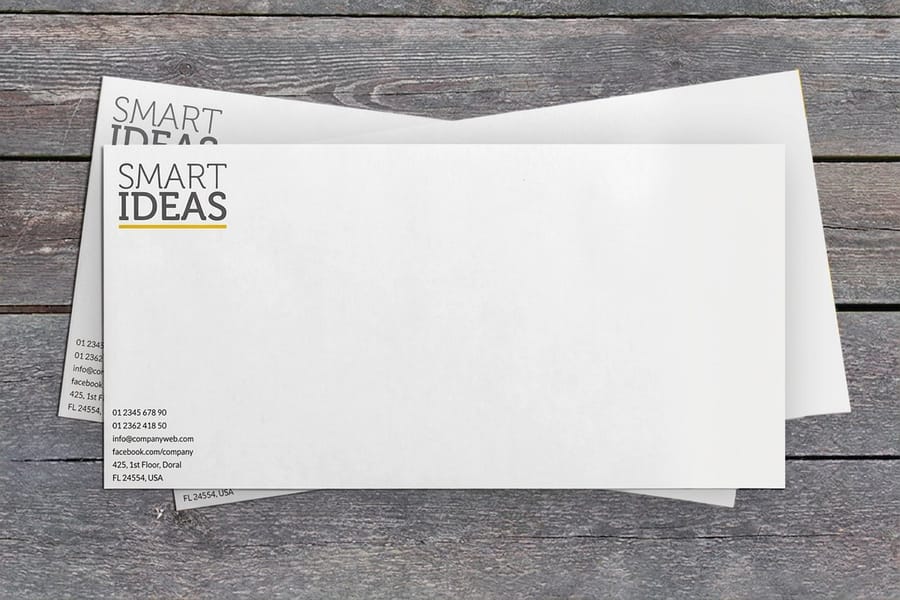
An invitation envelope carries less printing than people expect, and that restraint is deliberate. Two areas matter: the back flap and the front face.
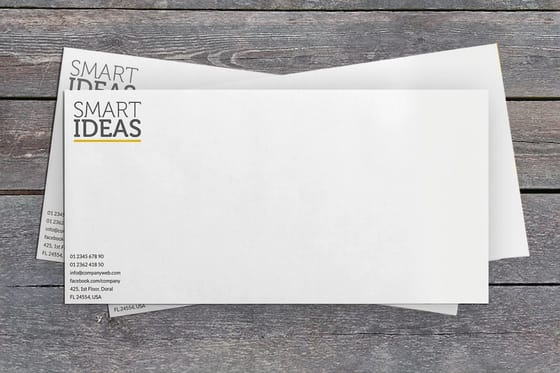
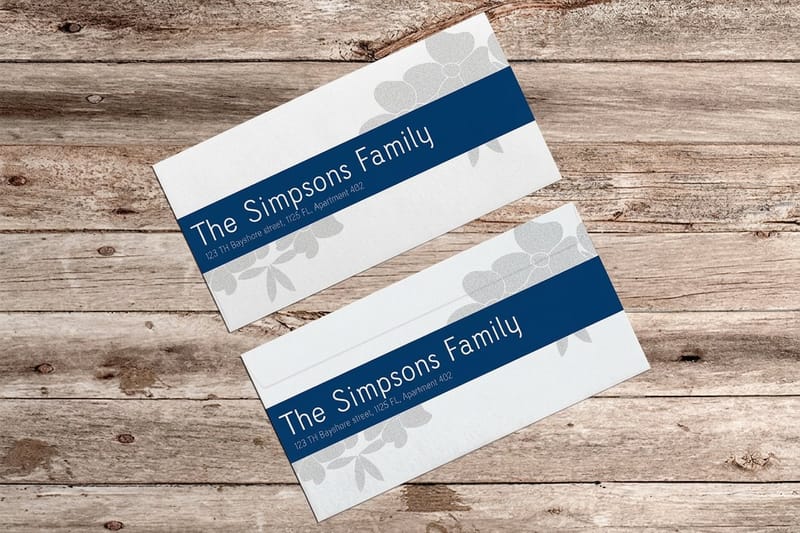
The back flap holds the return address. On social mail this is the convention, and the USPS accepts it without any trouble. Printing it with the envelopes is almost always cheaper than buying return address labels or a rubber stamp for a run of a hundred, and it looks considerably better. Many couples also print a monogram or a pattern on the flap; if you do, keep the type off the gum line, because ink on the adhesive strip stops it sealing properly.
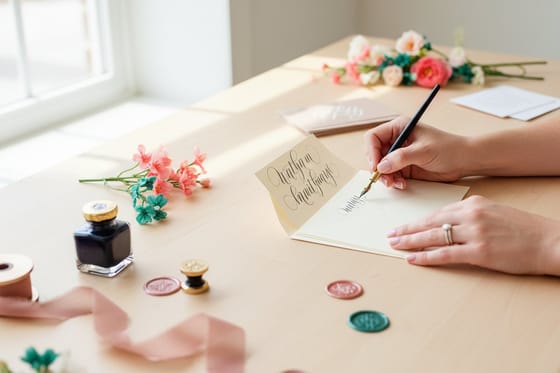
The front face stays blank for the guest name. That is the one piece of information you do not have when the envelopes are printed, because guest lists move until the last week. Order the envelopes with the return address on them, then address the fronts by hand, hire a calligrapher, or run a mail merge through an inkjet. If you go the inkjet route, test two spares before you feed the box: thick, textured, or coated envelope stock is exactly what jams a consumer printer, and a smeared name is not something you can fix.
Dark stock is the trap in this section. A navy or charcoal envelope looks superb and gives postal sorting equipment nothing to read, because the scanners need contrast between the address and the paper. White ink, a light address panel, or a printed label solves it. A silver metallic pen on a black envelope does not, and those pieces come back or get hand-processed. Invitation envelopes start at $170.42, and the configurator carries the stock and size choices side by side so you can see what a color decision costs before you commit.
For the wording itself, including how to handle titles, children, and plus-ones, our guide to addressing wedding invitation envelopes covers the US conventions line by line.
Seams, Bleed and the Limits of a Made-Up Envelope
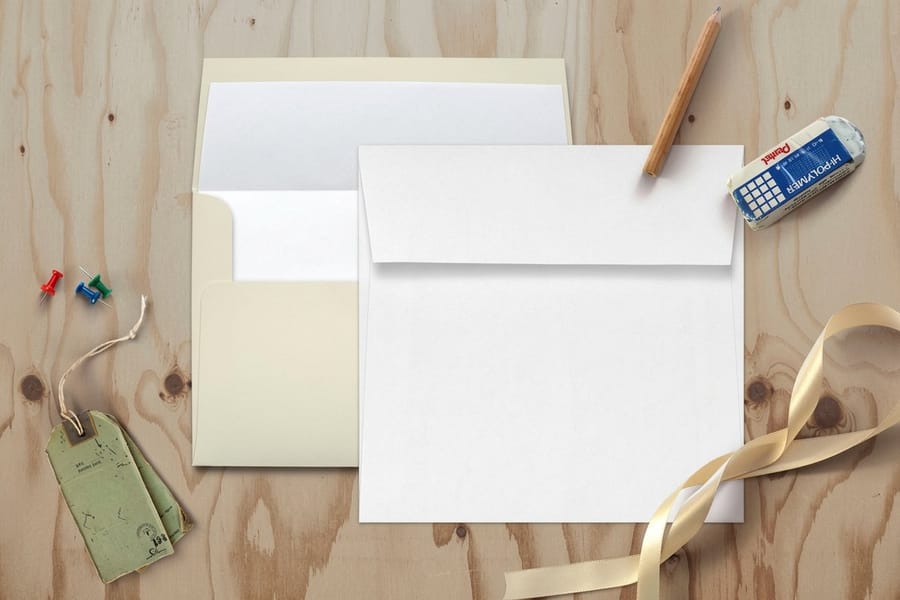
This is the part that surprises people at press time, so it is worth knowing before the artwork is finished. A converted envelope is not a flat sheet. It has side seams, a gummed flap, and regions where three or four layers of paper sit on top of each other. A press running across that surface meets a step change in thickness, and ink laid right at the edge goes down unevenly or skips.
What that means in practice:
- Edge-to-edge color needs a different route. Full bleed is achieved by printing the envelope flat and converting it afterward. It is a real option, it costs more, and it takes longer. Decide early rather than three days before the mail date.
- Keep heavy solids off the seams. A large flood of dark ink across a seam or a fold line can crack when the flap is worked, especially on a coated stock. Backing off to a lighter tint or moving the panel inward avoids it entirely.
- Leave the bottom right corner alone. The USPS wants a clear barcode zone along the bottom right of the front face. Artwork, a pattern, or a heavy border running through it interferes with the spray-on barcode and slows the piece down.
- Respect the gum line. Ink or coating on the adhesive strip means the envelope will not seal. Every envelope template marks it; keep everything clear of it.
Start from a template rather than measuring an envelope with a ruler. The envelope blank templates carry the trim, the flap, the gum line, and the clear zones already positioned, so the file arrives correct the first time. If you want the full ordering sequence, from artwork through proof to quantity, how to order custom printed envelopes walks through it.
Postage, Squares, and How Many to Order
The square envelope is the single most expensive design decision in invitation printing, and almost nobody is warned about it. The USPS applies a nonmachinable surcharge to square envelopes because the automated sorters cannot orient them, and that surcharge lands whatever the envelope weighs and whatever size it is. The same charge hits envelopes that are rigid, clasped, unusually thick, or lumpy from a bulky insert. Across a hundred and fifty guests it is a noticeable line on the budget, and a rectangular A7 carrying the identical invitation avoids it.
Weight is the other postage lever, and a suite adds up faster than you would guess. An invitation, an RSVP card, a reply envelope, and a details card together will usually push past the first postage tier, which is why couples take a finished, sealed, stuffed sample to the post office and have it weighed before buying a single stamp. Do that once and you buy the right stamps in one go.
On quantity, order by household rather than by guest, then add about ten percent. The reasons are unglamorous: names get misspelled during addressing, a few guests are added late, and a short reorder carries a fresh setup charge and fresh shipping, which makes those last twenty envelopes the priciest of the job. Blank envelopes start at $13.17, so spares are cheap next to a second run.
Once the envelopes are settled, the rest of the suite should match them. Folded invitations start at $38.22 and RSVP cards at $19.77, and printing the whole set together keeps the paper and the color consistent across pieces. Browse the full range in invitation printing, the matching envelope options in envelope printing, and the coordinated stationery in the wedding printing collection.
Wally explains invitation envelopes
A quarter inch of room, a flap that carries your name, a front that carries theirs
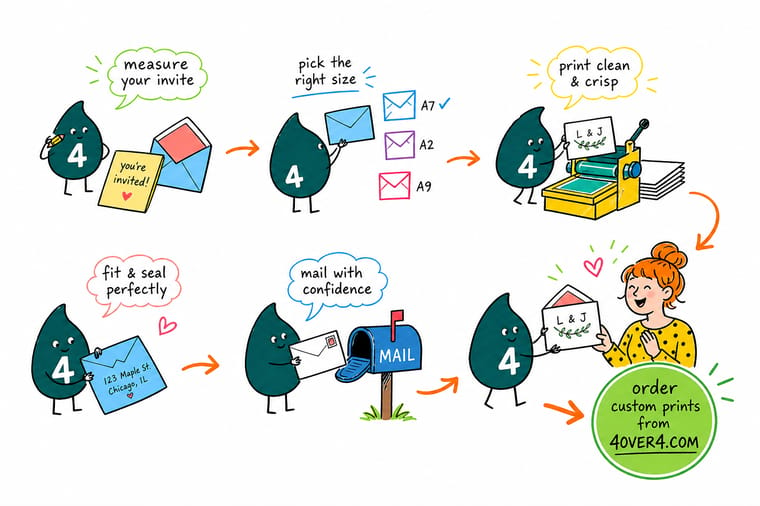
Wally measures the invitation before he touches an envelope. Five by seven card, A7 envelope, a quarter inch of breathing room so the corners never crease. He prints the return address on the back flap and leaves the front blank, because the guest list is still moving. Then he stops you from ordering the square one, because the post office charges extra for every square envelope no matter how light it is. And he adds ten percent spares, since somebody always misspells a name.
Order invitation envelopes →Specs and pricing
Envelope sizes, stocks and starting prices
Compare the invitation, printed and blank envelope options side by side, with live configuration choices and starting prices straight from the 4OVER4.COM configurator.
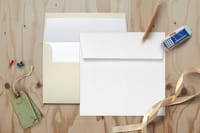
Print it
Order the envelopes and the invitations together
Explore more
Where to go next
By the numbers
Invitation printing you can count on at 4OVER4
Common Questions
Your invitation envelope questions, answered
What size envelope do I need for a 5 by 7 invitation?
An A7, which measures 5 1/4 by 7 1/4 inches. That quarter inch of extra room in both directions is what lets the card slide in without buckling a corner, and it is the reason A7 became the default for wedding and party invitations. If the invitation is 4 1/4 by 5 1/2, drop to an A2 at 4 3/8 by 5 3/4. If it is 5 1/2 by 8 1/2, step up to an A9 at 5 3/4 by 8 3/4.
Should the return address go on the flap or the front?
On invitations, the back flap. It is the social convention, it keeps the front face clean for the guest name, and the USPS reads a flap return address without complaint. Business mail is the opposite case: there the return address sits in the top left of the front, because the piece is being processed rather than presented. If you are printing a large run, having the flap return address printed with the envelopes saves buying stamps or labels later.
Can I have the guest addresses printed on the envelopes too?
That is a separate step from printing the envelope stock, and it depends on your list being final and clean. Most people order the envelopes with the return address printed, then address the fronts themselves by hand, through a calligrapher, or by running the envelopes through an inkjet with a mail merge. Do a test pass on two spare envelopes first, because feeding a thick or textured envelope through a home printer is where jams and smears happen.
Why can my envelope not print all the way to the edge?
Because a finished envelope is not a flat sheet. It has side seams, a gummed flap, and areas where three or four layers of paper overlap, so a press running across it hits a step change in thickness and the ink lays down unevenly at the edge. Edge-to-edge color is done by printing the envelope flat and converting it afterward, which is a genuinely different job with a longer schedule. If your art has a full-bleed panel, raise it before you commit to a date.
Do square invitation envelopes really cost more to mail?
Yes. The USPS applies a nonmachinable surcharge to square envelopes because the automated sorters cannot orient them, and that surcharge applies whatever the size or weight. It also applies to envelopes that are rigid, unusually thick, clasped, or lumpy from an insert. On a hundred invitations the extra postage is real money, so if the budget is tight, keep the shape rectangular and spend the difference on the stock.
How many extra envelopes should I order?
About ten percent over your guest count, and never fewer than ten spares on a small run. Addressing errors are normal, late additions to a guest list are normal, and a short reorder carries its own setup and shipping, which makes the last twenty envelopes the most expensive ones you will ever buy. Blank Envelopes start at $13.17, which makes spares one of the cheapest forms of insurance on the whole job.
Get Started
Ready to get your invitation envelopes printed?
Pick the A-size that matches your card, put your return address on the flap, and we print envelopes that fit the invitation and clear the sorters without a surcharge.
Legal Disclaimer
Gold Standard guarantees apply to all standard orders placed through 4over4.com. Price match requires verifiable proof of a competitor's published price for an equivalent product with matching specifications and turnaround time. Satisfaction guarantee covers manufacturing defects and print quality issues. Contact support with order number and documentation. On-time delivery rate based on tracked orders 1999 to 2026. Individual results may vary based on shipping carrier performance.
