
How to Get Birthday Cards Printed, From Single Boxes to Bulk Client Runs


Sizes, folds, stock, envelopes and postage for birthday cards, plus how to run a client birthday programme on one print job instead of twelve.
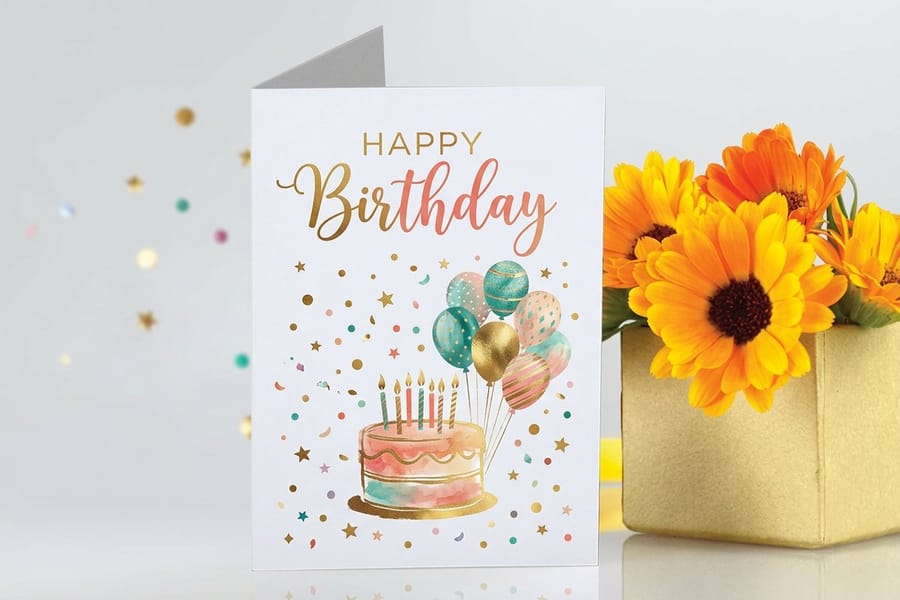
Choose the finished card size, supply the artwork at double that width so it can fold, pick 14pt or 16pt cardstock, and order the quantity in one run. A folded A7 card is 5 by 7 inches closed and prints on a 10 by 7 inch sheet scored down the middle. Leave the inside uncoated or matte if anyone will hand sign it, order matching envelopes in the same job, and keep the front undated so leftover cards carry into next year.
Quick answer
One flat sheet, one score, and the size you actually wanted
Send the artwork at the flat size, not the finished size. A folded card is a single sheet scored down the middle, so an A7 card that measures 5 by 7 inches closed is built on a 10 by 7 inch page. Pick 14pt for everyday cards and 16pt where the card has to feel substantial, keep coating off any panel a pen will touch, and match the envelope to the size so postage stays at the letter rate. For a client list, print the whole year in one run with the inside blank and sign them by hand as the dates come round.
Card Sizes, Flat Sheets and the Fold That Halves Them
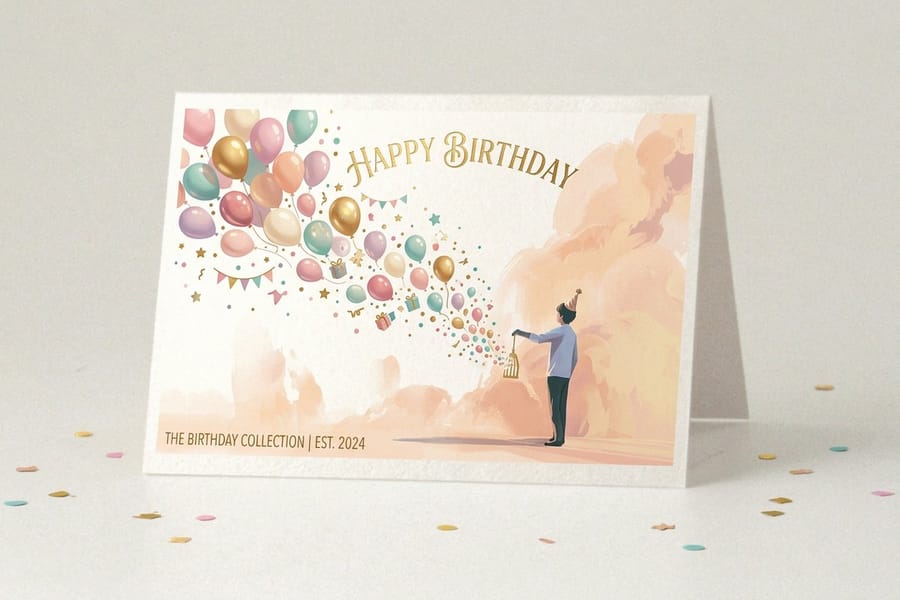
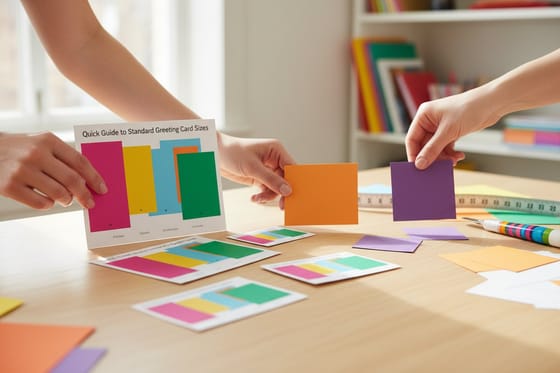
Three sizes cover almost every birthday card printed in the United States, and each one is named after the envelope it goes into rather than the card itself. That naming is where most first orders go wrong.
| Size | Flat sheet before folding | Envelope | Where it fits |
|---|---|---|---|
| A2 | 8.5 x 5.5 in, scored at 4.25 | 4.375 x 5.75 in | Short messages and thank-you notes. Lowest cost per card of the folded sizes. |
| A6 | 9 x 6.25 in, scored at 4.5 | 4.75 x 6.5 in | The default birthday card. Enough front for artwork, enough inside for a real message. |
| A7 | 10 x 7 in, scored at 5 | 5.25 x 7.25 in | Photo cards and client cards. The size that feels deliberate in the hand. |
| 4 x 6 flat | No fold | Optional | One-message cards and office runs. Mails on its own at the postcard rate. |
Read the second column, not the first. A folded card is one sheet with a score down the middle, so the flat artwork is always double the finished width. Send a 5 by 7 inch file for an A7 card and you get a 2.5 by 7 inch card back, which is the single most common reprint on greeting card work.
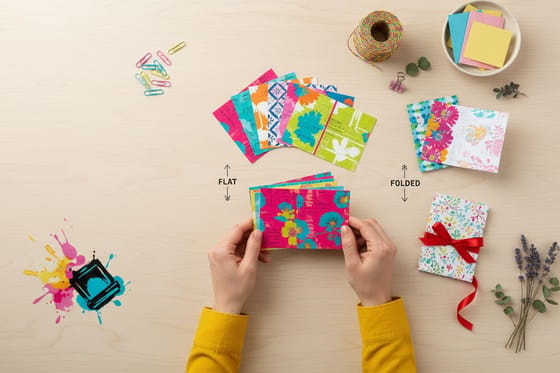
The flat 4 by 6 card is worth a serious look for a large list. It mails without an envelope at the postcard rate as long as it stays rectangular and lands between 0.007 and 0.016 inches thick, which 14pt cardstock does comfortably at 0.014. You lose the inside panels and the envelope moment, and you save on both the fold and the postage. Our breakdown of flat versus folded greeting cards walks through when that trade is worth taking, and the standard greeting card size reference lists the sizes beyond these four.
Stock, Coating, and the Trap That Ruins Hand-Signed Cards

Cardstock for greeting cards sits between 14pt and 16pt for most jobs, or 100lb cover if the printer quotes in paper weight rather than thickness. 14pt is the working default. 16pt is noticeably stiffer in the hand and holds a fold more crisply, and on an A7 card that extra rigidity is the difference between a card that stands on a desk and one that slumps.
Now the part that catches people. A gloss or UV coating sits on top of the fibre rather than in it, so pen ink beads instead of soaking in. A staff member signs fifty client cards, comes back an hour later, and finds every signature smeared. Specify the inside uncoated, or matte across the whole card, on anything a human will write on. If you want gloss on the front artwork, ask for gloss on the outside only. That is a normal request and it costs nothing.
The second trap is the fold itself. Above 14pt, coated stock cracks along an unscored fold, and the crack shows as a white line straight through a dark background. A production score before folding stops it. Any printer folding cardstock scores as standard, but if you are comparing quotes it is worth confirming, because a cheap quote that skips the score is not the same product. Our matte and gloss finish comparison covers how each coating behaves under a pen and under a camera.
Specialty finishes are a separate decision. Foil, raised spot UV and the combined effect on dual raised greeting cards start at $629.00, which prices them as a client programme rather than a box for one party. For a family birthday, spend the money on 16pt stock and a good photo instead. A full rundown of what each finish actually does sits in our print finishing techniques guide.
Bulk Birthday Cards for a Client List
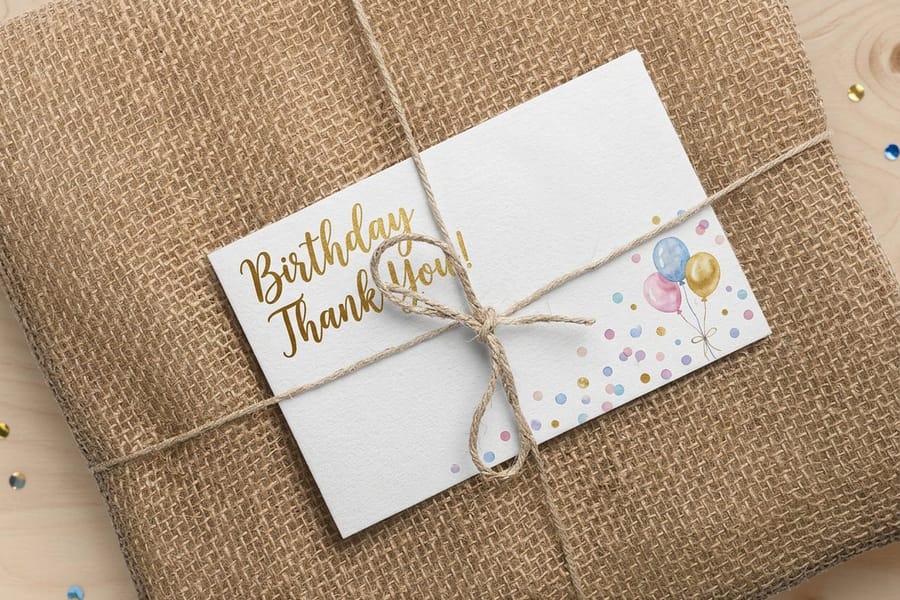
Sending clients a birthday card is one of the few pieces of print that still gets opened, because a birthday envelope does not look like mail from a company. The reason most firms give up on it is scheduling, not cost. Birthdays land across twelve months, so the instinct is to order in small batches, and small batches are exactly where print is expensive.
Do it the other way round. Print one run of birthday greeting cards for the whole year, inside blank, front carrying artwork rather than a dated message. Store them flat in the box they arrived in. Each month, pull the cards you need, sign them by hand, and mail them. The setup cost is paid once, the per-card price drops into a bracket a monthly order never reaches, and the signature stays genuine because a person actually wrote it.
Three details make the difference between a programme that runs and one that stalls after March. Order the envelopes in the same job, because paper white varies between mill batches and a bright envelope beside a warm card looks like a mistake. Add ten to fifteen percent to your headcount for signing errors, new clients and the card you decide to send outside the plan. And keep the front undated, with no year and no birthday number, so leftovers carry into the next cycle instead of going in the bin.
Pricing follows quantity in steps rather than a straight line, and the steps are where the money is. Our guide to how bulk price breaks work explains where those steps fall and why the second hundred costs so much less than the first. If your programme also covers December, the same logic applies to business holiday cards, and printing both in one order splits the setup across two mailings.
Envelopes, Addressing and What the Postage Actually Costs
The envelope, not the card, decides what you pay to mail it. A rectangular envelope up to 11.5 by 6.125 inches and a quarter inch thick goes at the standard letter rate, which covers the A2, A6 and A7 sizes without any thought. Step outside rectangular and the surcharge starts.
Square envelopes are the classic mistake. They look designed, they photograph well, and USPS treats them as nonmachinable because the sorting equipment cannot orient them, so every piece carries an extra charge. On a list of forty cards nobody notices. On a client list of six hundred it is a line item somebody will ask about. Clasps, ribbons, wax seals and anything rigid inside trigger the same treatment.
Print the return address rather than sticking labels on. Printed envelopes start at $142.99 and put your address in the same ink and typeface as the card, which is the detail that separates a sent card from a mailed one. Handwrite the recipient address if the list is small enough to allow it, because a handwritten envelope gets opened first, ahead of everything else in the stack. Envelope sizes and their card pairings are set out in our standard envelope sizes guide.
If the list is large enough that hand addressing is not realistic, compare the card in an envelope against a flat card mailed on its own. A 4 by 6 card printed like a standard postcard, which starts at $16.48, drops the envelope, the stuffing labour and the letter rate all at once. It reads as less personal. For a promotion tied to a birthday rather than a relationship, that is usually the right call.
Setting Up the File and Placing the Order
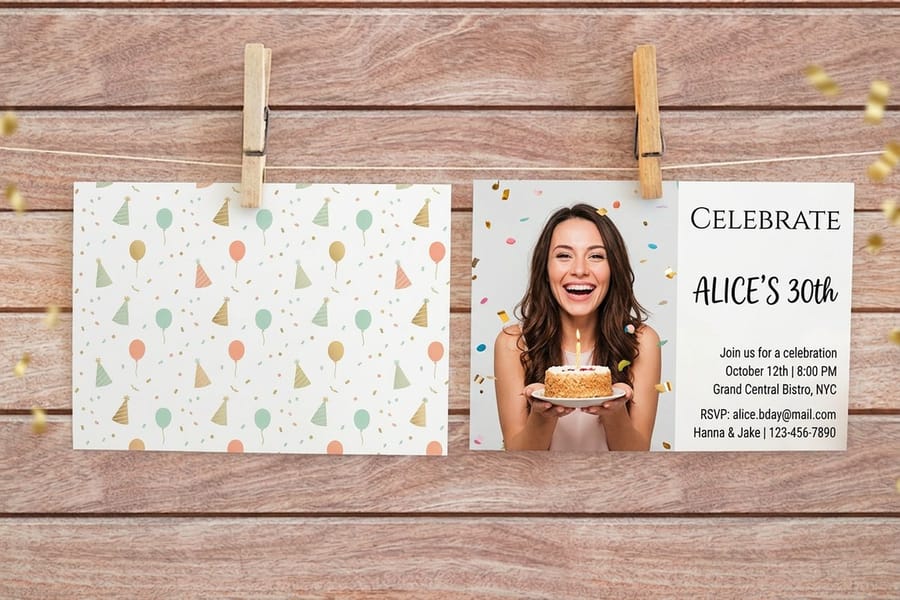
A folded card is two pages, not four panels. Build the outside as one page at the full flat size with the back panel on the left and the front panel on the right, then build the inside as a second page the same way. A 5 by 7 inch A7 card therefore means two pages at 10 by 7 inches. Sending four separate panel files is the fastest way to get an order held for a file query.
The rest is standard print prep. Extend artwork an eighth of an inch past every trim edge for bleed, keep type and anything you care about an eighth of an inch inside the trim, work in CMYK, and place images at 300 dpi at final size. Convert fonts to outlines or embed them. If you would rather start from a file that is already the right shape, the blank template library has correctly sized card layouts with the fold and safety margins already marked.
One thing specific to folded cards: keep heavy ink coverage away from the score line. A solid dark band running across the fold is where cracking shows first, and it is also where two panels of a photo have to line up after folding. Designers who leave a lighter strip either side of the fold get a cleaner card and an easier proof.
When you order, the schedule starts at proof approval rather than at checkout, so a file that comes back with a query costs you the front of the week. Check the proof at full size on screen, read the message text out loud once, and confirm the same day if you can. Our guide to printing turnaround times and order tracking explains what happens after approval, and the full range of cards, from birthday invitations to the follow-up birthday thank you cards, sits in the invitations and cards category.
Wally explains birthday card printing
One wide sheet, one score, one card
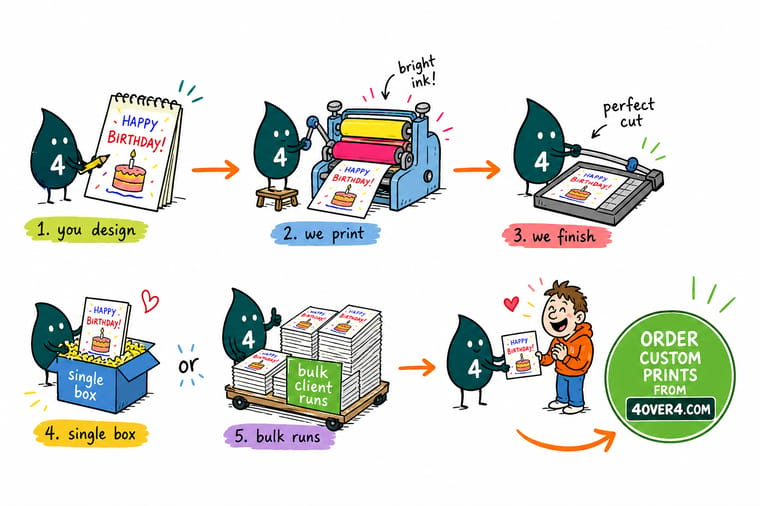
Wally lays the sheet down flat and it looks twice as wide as the card he wants. That is the point. The score runs down the middle, the sheet folds in half, and a 10 by 7 inch page becomes a 5 by 7 inch card. He keeps the coating off the inside so a pen still works, matches the envelope to the size so the postage stays ordinary, and prints the whole year in one go so the price break does the heavy lifting.
Order birthday greeting cards →Specs and pricing
Birthday card sizes, stocks and starting prices
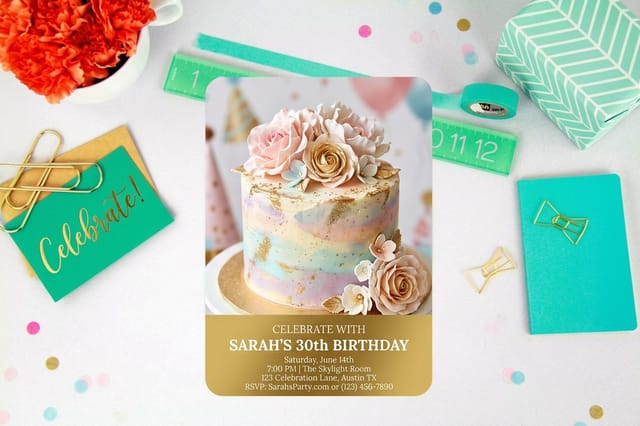
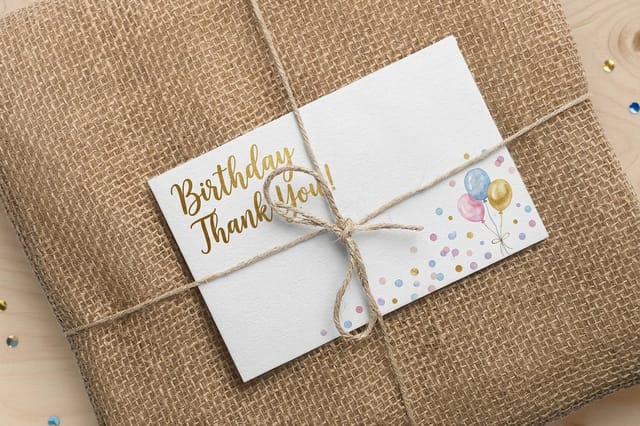
Compare the card, the invitation and the thank you card side by side, with live configuration choices and starting prices straight from the 4OVER4.COM configurator.


Print it
Order birthday cards people keep on the shelf
Explore more
Where to go next

By the numbers
Card printing you can count on at 4OVER4
Common Questions
Your birthday card printing questions, answered
How much does it cost to get birthday cards printed?
It depends far more on quantity than on design. At 4OVER4.COM, birthday greeting cards start at $56.02 and birthday invitations start at $19.77, and both figures are entry prices for the smallest run at a standard size and stock. Adding a specialty finish moves the number a long way: dual raised greeting cards start at $629.00, because that finish is built for a large client run rather than a box for one party. Full colour on both sides usually costs the same as full colour on one, so there is rarely a reason to leave the inside blank on press.
Can I get birthday cards printed with my own photo?
Yes, and the file quality decides whether it looks right. Supply the photo at 300 dpi at the size it will print, which means roughly 1500 by 2100 pixels for a 5 by 7 inch panel. A phone photo usually clears that. A screenshot or a picture pulled off social media usually does not, and it prints soft in a way no press setting can rescue. Extend the image an eighth of an inch past every trim edge so the cut never leaves a white sliver.
What is the cheapest way to print birthday cards in bulk?
Print one run at one size on one stock, with the inside left blank. Every extra size, stock or version is a separate setup, and setup is the part of the price that does not shrink with quantity. A flat card is cheaper again than a folded card because nothing has to be scored and folded, and a 4 by 6 inch flat card can mail without an envelope at the postcard rate. If the cards are for clients, order the envelopes in the same job so the white matches.
Should business birthday cards be signed by hand?
Yes, and it is the one place the effort actually shows. A printed signature reads as a mailing, and a client can tell from across the desk. That is why the practical setup is a printed front, printed brand mark on the back, and an inside left blank on uncoated or matte stock so a pen behaves. It also means one printed design covers the whole year rather than needing a version per name.
Can you print the inside of a birthday card too?
You can, and on a folded card the inside is two panels rather than one. Supply it as a second page at the full flat sheet size, so a 5 by 7 inch folded card gets an inside page built at 10 by 7 inches with the left panel and right panel in one layout. Never send four separate panel files. Keep any printed inside message off centre if people will also write there, and leave the writing area free of heavy ink coverage.
How far ahead should I order birthday cards for a client list?
Order the whole year in one run before the first birthday you need to cover, then work from a box. The part people underestimate is not printing, it is proofing: the schedule starts when the proof is approved, not when the order is placed, so a file that comes back for a fix loses days at the front. Add ten to fifteen percent to the count for signing mistakes, late additions to the list, and the card you will want to send outside the plan.
Get Started
Ready to print this year's birthday cards?
Pick a size, choose a stock that still takes a pen, add matching envelopes, and print the whole list in one run instead of twelve small ones.
Legal Disclaimer
Gold Standard guarantees apply to all standard orders placed through 4over4.com. Price match requires verifiable proof of a competitor's published price for an equivalent product with matching specifications and turnaround time. Satisfaction guarantee covers manufacturing defects and print quality issues. Contact support with order number and documentation. On-time delivery rate based on tracked orders 1999 to 2026. Individual results may vary based on shipping carrier performance.
