
How to Design Political Mailers That Get Read and Stay Legal


Nadia is our customer education voice, built from the knowledge of our production team, with over 20 years in printing.
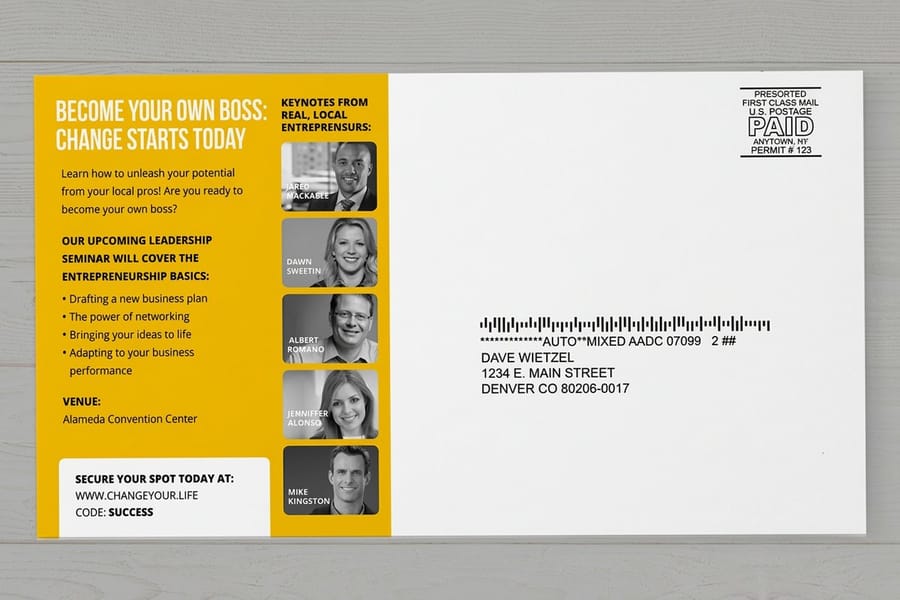
The EDDM address block sits under the indicia in the upper right of the back and reads Local or Postal Customer, so that half of the panel stays clear of art. One claim on the front, the disclaimer in its own box, and a size that USPS will accept as a flat: the design, the legal line and the route selection all fit on a single card.
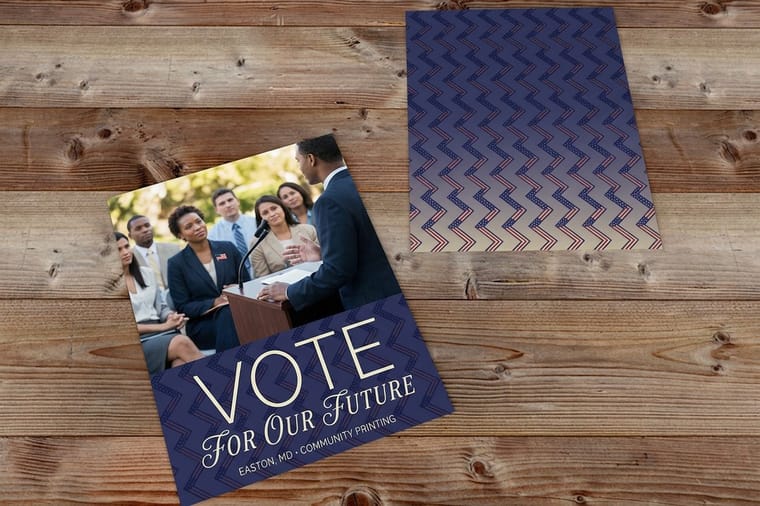
Design a political mailer around one claim, a name readable at arm's length, and a paid for by disclaimer printed inside a box set apart from the rest of the piece in clearly readable type with real color contrast. Size it to 6.5 by 9 inches or larger so it clears a USPS letter maximum and qualifies as a flat, which is the only class EDDM carries. Use EDDM route selection when your district and the carrier routes roughly line up, and an addressed voter list when a boundary cuts through a ZIP Code.
Quick answer
One claim, a boxed disclaimer, and a size that mails as a flat
A political mailer has three jobs at once: say one thing fast, carry a legally correct disclaimer, and satisfy USPS. Put the candidate name and a single claim on the front, the record and the ask on the back, and the paid for by statement in a printed box set apart from everything else, dark on a light panel. Size it so it beats one letter maximum, which in practice means 6.5 by 9 inches or bigger, because EDDM only carries flats. Then choose your reach honestly: carrier routes are cheap and blunt, an addressed voter list is dearer and follows your district line exactly.
EDDM address block
The EDDM address block, and the half of the back it owns
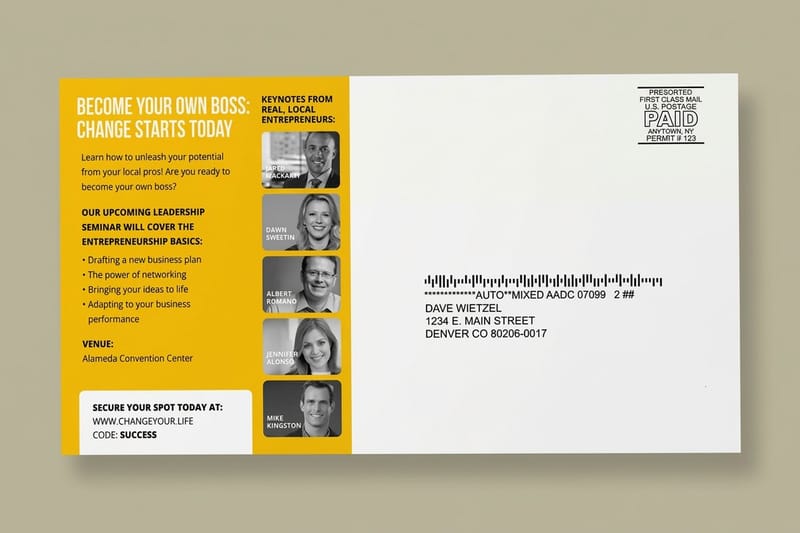
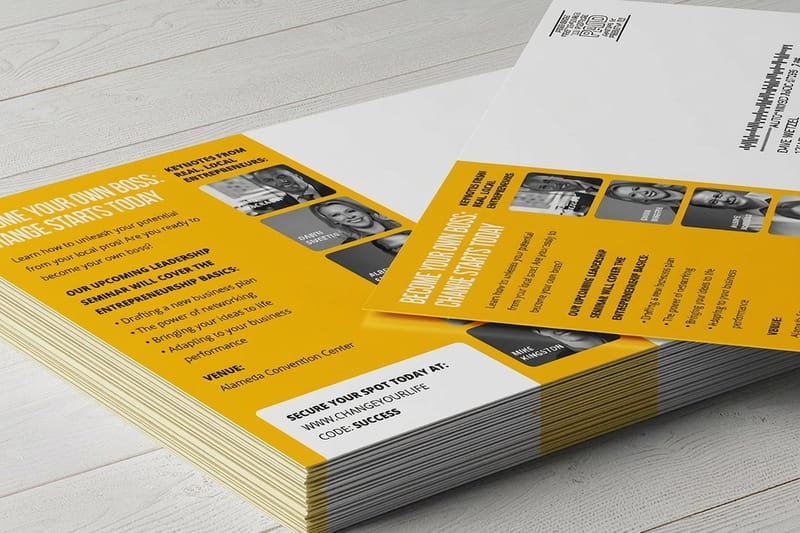
An EDDM piece carries no name and no street address. The postage indicia goes in the upper right of the address side, and the simplified address block sits directly beneath it, reading Local or Postal Customer. Keep photos, color floods and the paid for by box out of that half of the panel, build the file at 6.5 by 9 inches or larger with an eighth inch of bleed, and hold live copy a quarter inch inside the trim so cutting drift never touches the block.
What a Political Mailer Has to Do Before It Reaches the Bin
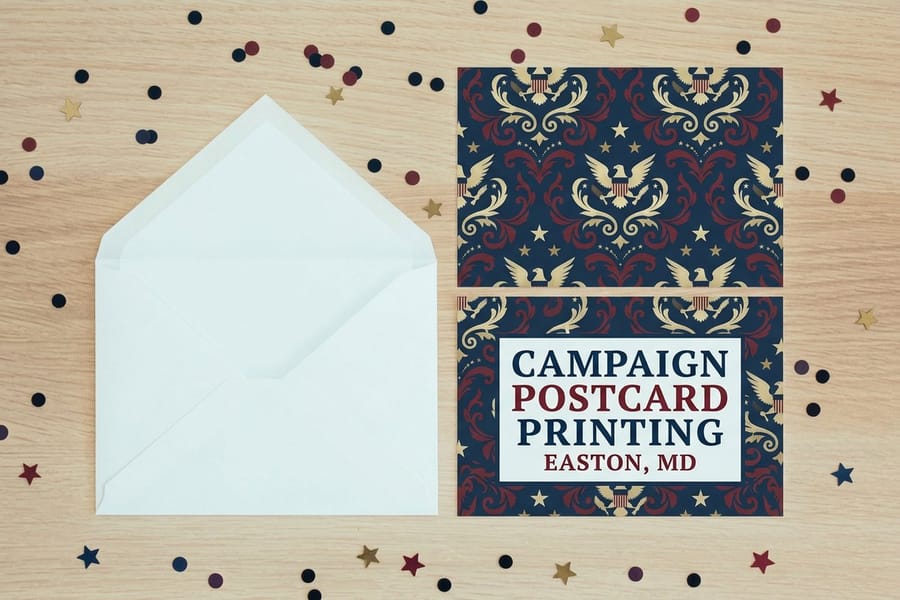
Most political mail is read standing up, on the way from the mailbox to the kitchen, over an open recycling bin. That is the design brief. The candidate name, the office being sought, and one claim have to register before the piece is turned over, and everything that needs a second of thought belongs on the back.
Build the front around a name set large enough to read at arm's length, a face with eye contact, and one line. Not three priorities. One. The back is where a record, a short list of endorsements, and the ask can live, because by then the reader has already decided to look. A 6.5 by 9 card gives you roughly 58 square inches a side, which sounds generous until a photo, a headline, a disclaimer box and an address panel are all on it.
Two production traps come up on almost every campaign. The first is party color. Campaign red and campaign blue are usually heavy four-color builds, and heavy builds drift a little between press runs and a lot between substrates, so a blue that matches beautifully on a coated political postcard will not match the same blue on a coroplast yard sign. Pick one substrate to match against and accept the variance elsewhere. The second is reversed type. Small white text knocked out of a photograph is the first thing to fill in under ink gain, so keep reversed copy bold and above roughly 9 point.
For the file itself, political postcards start on 14pt gloss cover at 50 cards and print one or both sides, with variable data as an option when each card carries a different name or code. Upload a PDF at the finished size with an eighth inch of bleed, live copy a quarter inch inside the trim, and the disclaimer box at 8 point or larger.
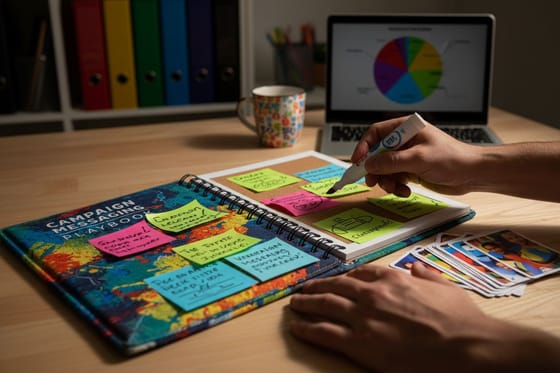
Write the line before you lay anything out. Our guide to campaign messaging for voters covers how to get to a single claim, and the blank template library has correctly sized layouts so you are not guessing at trim and bleed while you do it.
The Disclaimer Box, and Who Actually Needs One
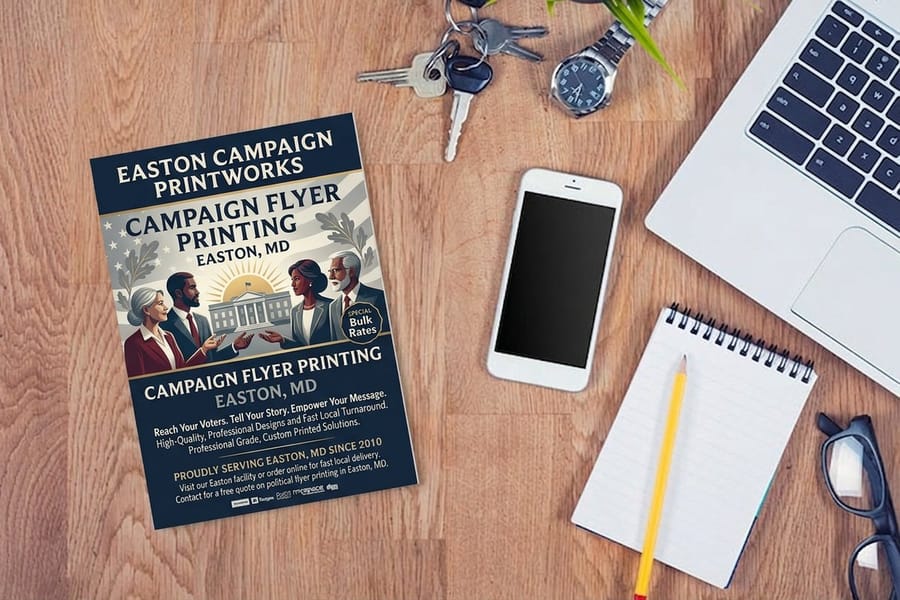
Federal rules do not just require a paid for by statement, they specify how it is printed. A qualifying printed piece has to carry the disclaimer inside a box set apart from the rest of the contents, in a typeface that is clearly readable, with a reasonable degree of color contrast between the text and the background behind it. There is no point size written into the print rule, which trips people up; the specific numeric minimums in FEC regulations apply to television and radio. In practice, set the box at 8 point or larger, keep it dark on a light panel, and never lay it over a photograph.
Which wording you need depends on who paid and whether the candidate signed off.
| Who paid | Candidate authorized | What the box says | Also required |
|---|---|---|---|
| The candidate committee | Yes, by definition | Paid for by the committee name. | Nothing further. |
| Another person or group | Yes | Paid for by the payer and authorized by the candidate committee. | Nothing further. |
| Another person or group | No | Paid for by the payer, and not authorized by any candidate or candidate committee. | The payer street address, telephone number or website. |
State, county and school board races are a separate world. The state election office sets that wording, and it is common for a state to require the committee treasurer name, a specific phrase, or the disclaimer on both sides of the piece. Nothing on this page substitutes for a call to that office, and the call is worth making before the artwork is approved rather than after 10,000 pieces are trimmed.
On the layout itself, put the box at the foot of the message half. Keeping it out of the address panel matters twice over: USPS wants that area clean, and a disclaimer squeezed next to an indicia stops being clearly readable. The same box belongs on political flyers handed out at a door and on political brochures left on a table, and not on mail alone. The political brochures story shows four ways to build the table piece, and our political brochures video overview walks through the policy panels.
EDDM Targeting: What a Carrier Route Actually Buys
Every Door Direct Mail sells you delivery routes instead of names. You open the USPS EDDM tool, draw a ZIP Code, and pick carrier routes off a map that shows the household count on each one along with Census figures for median age and median household income. There is no list to buy, no permit for the Retail version, and no addresses to print. For a town council or school board race, that is often the whole media plan.
Here is the part the cheerful EDDM pages leave out. A carrier route is drawn so one letter carrier can walk it efficiently. It is not drawn around a ward, a precinct, or a district line, and those boundaries cut through routes constantly. If your district takes in two thirds of a ZIP Code, EDDM gives you two bad options: buy the whole route and pay to reach households that cannot vote for you, or drop the route and leave your own streets uncovered. You also mail every household on the route, which includes the other party, unregistered residents, and people who moved in last month.
The alternative is a mailing addressed from a voter list. It costs more per piece and takes longer to set up, but it follows the district exactly and lets you filter. Party registration is on the file in states that register by party, and vote history, meaning which past elections a person turned out for, is public record in most states. That is how a campaign mails only primary voters, or only people who voted in the last two municipal elections. Who a person voted for is never on the file.
| Approach | Who it reaches | Setup | Best for |
|---|---|---|---|
| EDDM Retail | Every household on the routes you select. | No permit, no list, 200 piece minimum, 5,000 per ZIP Code per day. | Local races where the district and the routes roughly line up. |
| EDDM through a permit | Same routes, no daily cap. | Mailing permit through a business mail entry unit. | Large drops, heavier pieces above 3.3 ounces. |
| Addressed voter list | Named registered voters you selected. | List purchase or state file, addressing, higher postage. | Split districts, primaries, targeting by vote history. |
If EDDM fits, the mechanics are in our walkthrough on how to do an EDDM mailing, and the cap question is settled in EDDM Retail versus BMEU. If the district line is the problem, start with building or renting a mailing list, then let us print and mail the job as direct mail postcards, which start at $89.68 with the mailing handled on our end.
Sizes, Weight, and the Address Panel USPS Will Accept
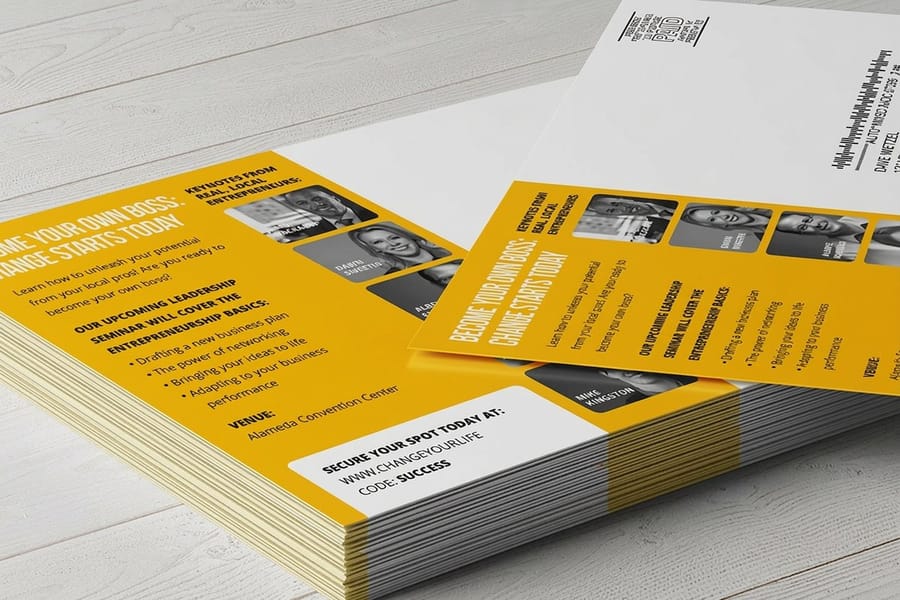
EDDM carries flats and nothing else. USPS treats a mailpiece as a flat when it exceeds any single one of the letter maximums, which are 11.5 inches long, 6-1/8 inches high, and a quarter inch thick, while staying inside 15 by 12 by three quarters of an inch. Beat one limit and you are a flat. Beat none and you are a letter, which cannot go EDDM at all.
That one rule explains the sizes every printer quotes. A 6.5 by 9 card qualifies because 6.5 inches of height clears 6-1/8 by three eighths of an inch, and it is the cheapest qualifying piece to print. A 6 by 9 card looks nearly identical and does not qualify, because 6 inches is under the height limit and 9 inches is under the length limit. Campaigns lose a week to that mistake every cycle.
| Size | Qualifies for EDDM | Why | What it suits |
|---|---|---|---|
| 6 x 9 in | No | Under every letter maximum. | Addressed list mail with postage applied. |
| 6.5 x 9 in | Yes | Height clears 6-1/8 in. | The standard route drop, lowest print cost per piece. |
| 8.5 x 11 in | Yes | Both dimensions clear the limits. | A record, a comparison chart, a longer letter. |
| 9 x 12 in | Yes | Both dimensions clear the limits. | Maximum presence in a stack of mail. |
| 11 x 17 folded to 8.5 x 11 | Yes | Folded size still clears the limits. | Four panels for a full platform piece. |
Weight matters at the counter. EDDM Retail tops out at 3.3 ounces a piece, so a heavy folded piece on thick stock can push you into a permit mailing you did not budget for. Check the finished weight before the quantity is locked.
On the address side, the indicia goes in the upper right and the simplified address block sits beneath it, reading Local or Postal Customer instead of a name. Keep artwork, a photo edge, or a flood of solid color out of that half of the panel. Set up the file with an eighth inch of bleed and hold live copy a quarter inch inside the trim, because a full bleed flood at the panel edge shows every bit of cutting drift. The specifics are in our EDDM file setup guide, the size list is expanded in popular EDDM postcard sizes, and the general trim rules are in the bleed and safety checklist.
Custom Sizes for Political Postcards, Flyers and Brochures
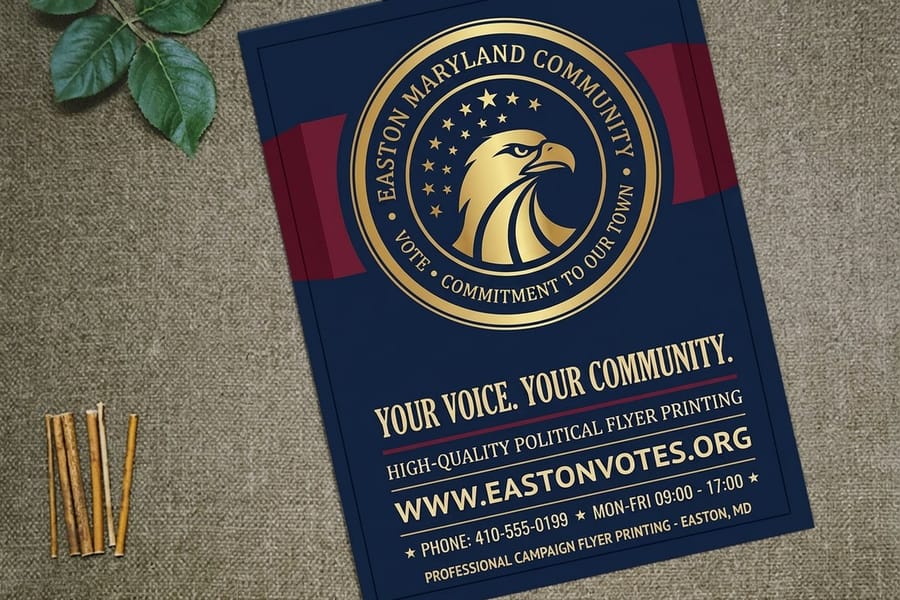
Yes. Political postcards print at any size from a 2.5 inch square up to 6 by 11 inches, on 14pt gloss cover as standard, from 50 cards. That range stays under the 6-1/8 inch letter height, so a postcard on its own never clears the flat rule for EDDM. For a route drop, order the 6.5 by 9 card as a political flyer, which takes any size from 4 by 5.5 up to 11 by 25.5 inches and prints on 80 lb gloss cover or 14pt gloss cover as well as text weights.
| Piece | Sizes | Stock | Starts at |
|---|---|---|---|
| Political postcards | 2.5 x 2.5 to 6 x 11 in, custom sizes | 14pt gloss cover, seven more stocks up to 24pt | 50 for $16.48 |
| Political flyers | 4 x 5.5 to 11 x 25.5 in, custom sizes | 100 lb gloss text, 80 lb or 14pt cover | 50 for $39.54 |
| Political brochures | 5.5 x 8.5 to 11 x 25.5 in, flat or half fold | 100 lb gloss text or 14pt gloss cover | 50 for $57.11 |
| Direct mail postcards | Nine sizes, 4 x 6 to 6 x 11 in | 14pt gloss cover as standard | 500 for $89.68, mailed for you |
At a custom size, type the width and height into the configurator, build the PDF at that finished size with an eighth inch of bleed, and hold the disclaimer box and all live copy a quarter inch inside the trim.
Timing the Drop Around Mail Ballots
The deadline is not Election Day. In states that mail a ballot to every registered voter, or that open early voting weeks ahead, a large share of the electorate has already voted by the final weekend. A contrast piece landing in the last five days of that kind of race reaches people who filled in a ballot at the kitchen table two weeks earlier. Find the date your state begins mailing ballots and count backward from there.
A sequence that holds up: an introduction piece early, while name recognition is still cheap to build; the record or contrast piece timed to arrive in the same week ballots go out; and a get out the vote piece in the final days carrying the polling place, the hours, and nothing else. Three pieces beat one big one, because repetition is what moves recognition.
Build slack into the calendar in two places. Marketing Mail, which is what EDDM travels as, carries no delivery guarantee, so you plan an in home window of several days and ask the receiving post office when carriers will work the routes. And order the final piece before you are certain you need it. Artwork approved early with a gap left for the closing numbers goes to press faster than a rush job assembled the week before.
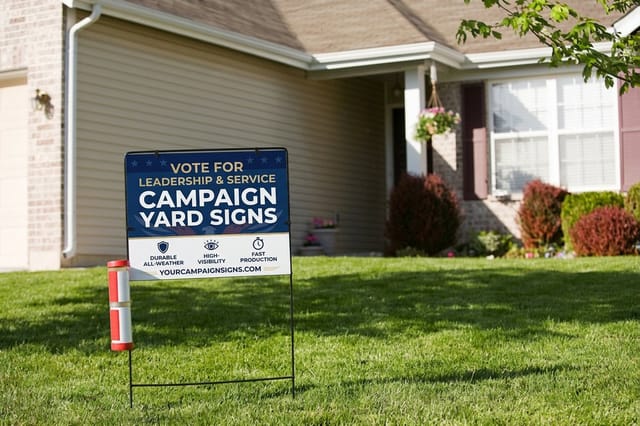
For pricing, political postcards start at $16.48, political flyers at $39.54, and political brochures at $57.11. If the same message needs to stand on a lawn, campaign yard signs start at $25 and use the same name hierarchy scaled up for a distance read. The campaign yard signs story shows three ways to build one. Everything a campaign prints sits together in the political printing collection, and the print plus mail options are in direct mail services.
Wally explains political mailers
One claim, a boxed disclaimer, and a card wide enough to mail as a flat
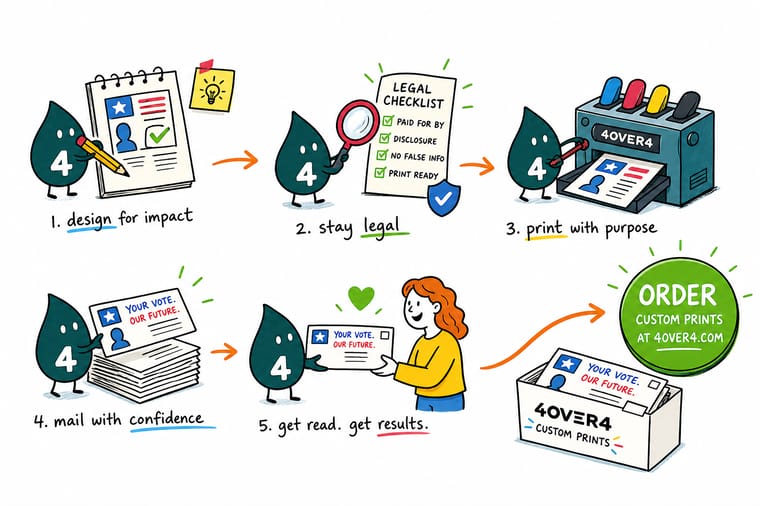
Wally puts the candidate name and one line on the front, keeps the record and the ask for the back, and drops the paid for by statement into its own box at the foot of the message half, dark on a light panel where anyone can read it. He measures before he prints, because a 6 by 9 card mails as a letter and a 6.5 by 9 clears the height limit and mails as a flat, which is the only thing EDDM carries. Then he looks at the map. If the carrier routes match the district, he buys routes. If a ward line cuts through the ZIP Code, he buys a voter list instead and mails by name.
Order political postcards →
Specs and pricing
Campaign print, sizes and starting prices
Political postcards run from a 2.5 inch square to 6 by 11 inches on 14pt gloss cover, political flyers from 4.25 by 5.5 to 11 by 25.5 inches on 100 lb gloss text, and political brochures from 5.5 by 8.5 to 11 by 25.5 inches with a half fold option, all from 50 pieces. Compare the pieces a campaign mails and hands out, with live configuration choices and starting prices straight from the 4OVER4.COM configurator.

Print it
Order the pieces that carry the campaign
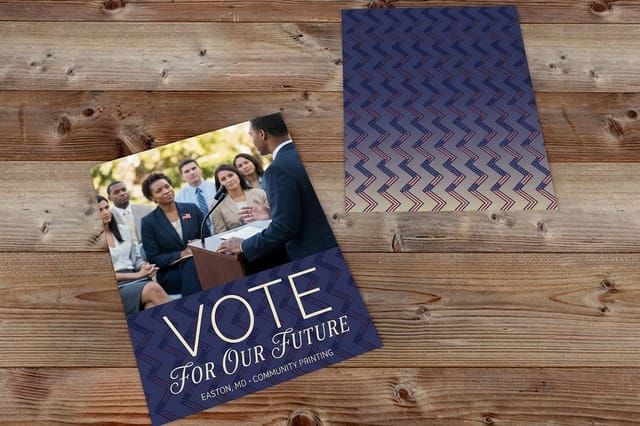
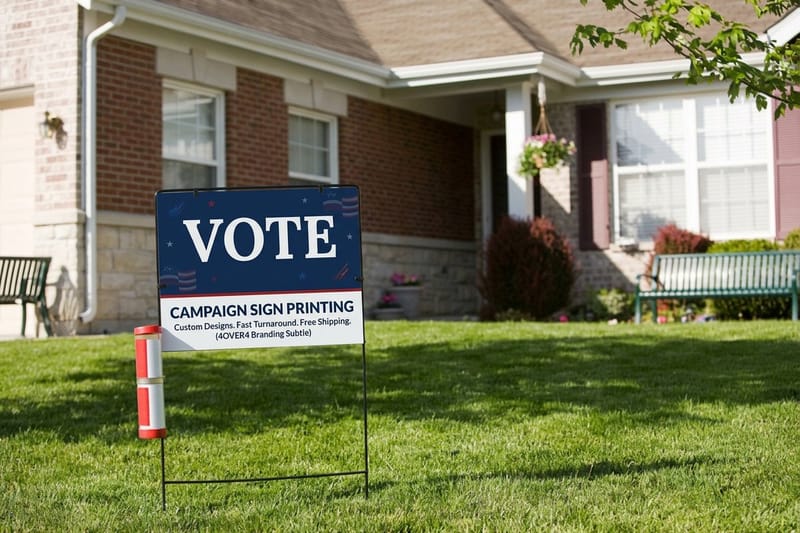
Send the introduction and contrast pieces as political postcards when you mail an addressed list, hand the job to direct mail postcards when you want us to print and mail it from 500 pieces, and put the same name on 4mm coroplast campaign yard signs, 18 by 24 inches with an optional H stake, for the lawns.

Explore more
Where to go next
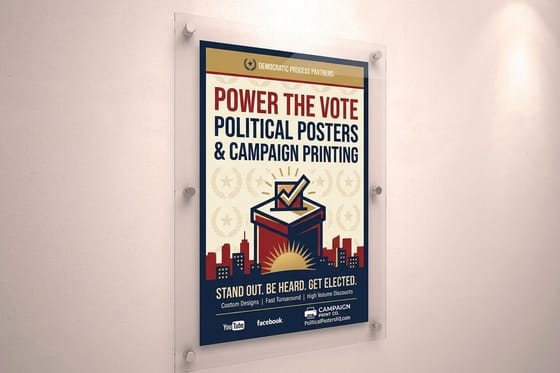
The EDDM walkthrough takes a drop from route selection to the post office counter, and the Retail versus BMEU guide covers the 5,000 piece daily cap. The messaging guide gets you to the one claim on the front, and the poster guide scales the same name hierarchy up for a wall.
By the numbers
Campaign mail printed across 25 years
Common Questions
Your political mailer questions, answered
Do political mailers legally need a disclaimer?
Federal campaigns and political committees do. Under the FEC rules for public communications, a printed piece that expressly advocates the election or defeat of a clearly identified federal candidate, is paid for by a political committee, or solicits contributions has to carry a paid for by statement. The regulation also tells you how to print it: inside a box set apart from the other contents, in a typeface that is clearly readable, with a reasonable degree of color contrast between the text and its background. State, county and municipal races are governed separately by the state election office, and several states require wording the FEC does not. Confirm the exact language with that office before the file goes to press, because a reprint costs far more than the phone call.
What does the paid for by line actually have to say?
It depends on who paid and whether the candidate authorized it. If the candidate committee paid, the box names that committee. If a group paid without the candidate authorizing the piece, the box names the payer, states that no candidate or candidate committee authorized it, and adds the payer street address, telephone number or website. If someone else paid but the candidate authorized the communication, the box names both. Keep the box on the message half of the piece and out of the address panel.
Can you use EDDM for a political campaign?
Yes, and it is the cheapest way to blanket a neighborhood because you buy carrier routes instead of a voter list. Every Door Direct Mail Retail needs no mailing permit, has a 200 piece minimum, caps out at 5,000 pieces per ZIP Code per day, and tops out at 3.3 ounces per piece. The catch is coverage. A carrier route is drawn for delivery efficiency, not for a ward line, so a district that splits a ZIP Code forces you to either pay for households outside the district or leave streets uncovered.
What size should a political mailer be?
For EDDM, 6.5 by 9 inches is the practical floor and the most common choice. USPS treats a piece as a flat only when it exceeds one of the letter maximums of 11.5 inches long, 6-1/8 inches high, or a quarter inch thick, and 6.5 inches of height is the smallest common size that beats that limit. Larger options that also qualify are 8.5 by 11, 9 by 12, and 11 by 17 folded in half. If you are mailing to an addressed voter list rather than by route, a standard 4.25 by 6 or 6 by 9 postcard is fine, since it travels as a letter with postage on it.
How far before Election Day should political mailers land?
Work backward from the day your state starts mailing ballots, not from Election Day. A contrast piece that arrives in the final week reaches voters who filled out a mail ballot two weeks earlier. A sequence that holds up in most races is a name recognition piece early, a contrast or record piece timed to land as ballots go out, and a get out the vote piece in the last few days that carries the polling place and hours. Marketing Mail carries no delivery guarantee either, so plan an in home window of several days rather than a date.
Do you need a mailing permit or a voter list to send political postcards?
Not for EDDM Retail. You bundle the pieces in stacks of 50 to 100, put a facing slip on each bundle, and drop them at the post office that delivers the routes you selected. A permit through a business mail entry unit becomes necessary once you go past 5,000 pieces per ZIP Code per day or past 3.3 ounces per piece. A voter list is a separate decision: you need one only if you want to mail registered voters by name, which lets you filter on party registration and on which past elections a person voted in. That vote history is public record in most states. How someone voted never is.
Get Started
Order 50 political postcards from $16.48
Pick your size, upload the artwork with the disclaimer box already in place, and we print a campaign piece that clears the USPS flat rules and lands in the window you planned.
Legal Disclaimer
Gold Standard guarantees apply to all standard orders placed through 4over4.com. Price match requires verifiable proof of a competitor's published price for an equivalent product with matching specifications and turnaround time. Satisfaction guarantee covers manufacturing defects and print quality issues. Contact support with order number and documentation.
