
How to Do EDDM Mailing and Reach Every Mailbox on Your Route

Nadia is our customer education voice, built from the knowledge of our production team, with over 20 years in printing.
EDDM lets you mail a printed piece to every address on a postal carrier route without buying a list, renting names, or addressing a single envelope. Here is the entire process, from choosing routes on the USPS map to handing your bundles to the clerk.
EDDM mailing, short for Every Door Direct Mail, is a USPS program that delivers one printed piece to every mailbox on the carrier routes you select. You choose routes by ZIP code in the USPS EDDM tool, print a mailer that meets flat-size rules, add the EDDM indicia and a Local Postal Customer address line, band the pieces into bundles of 50 or 100 with facing slips, pay the flat per-piece postage, and drop the bundles at the delivering post office.

Start here
Route map, print, paperwork, drop off
EDDM mailing works in seven moves. Choose a qualifying flat-size format, map the carrier routes you want on the USPS EDDM tool, design the piece with a reserved indicia zone and a generic address line, print the run, band the pieces into bundles of 50 or 100 with facing slips, complete PS Form 3587 and pay the flat per-piece postage, then deliver the bundles to the post office that serves those routes. Retail EDDM allows up to 5,000 pieces per ZIP code per day with no permit.
Why EDDM still beats a list for local businesses
Most small businesses stall on direct mail at the same place, which is the list. Buying names is expensive, the data goes stale within months, and half the households you paid for have already moved. EDDM removes that step entirely. You buy geography instead of people, and the carrier who already walks that street delivers your piece to every door on it.
That trade works beautifully when your customers are defined by distance rather than demographics. A pizzeria, a dentist, a lawn service, a new gym, a hardware store: all of them sell to whoever lives close enough to show up. For those businesses, saturating six carrier routes around the front door is a sharper buy than a rented list scattered across the metro. When you do need names rather than streets, our rundown of new homeowner and local mailing lists by ZIP code shows where targeted data still wins.
The other reason EDDM keeps working is unit economics. Postage is a single flat EDDM rate per piece, and printing a mailing flyer in the thousands pushes the print cost per household down to pennies. A campaign that would be unthinkable at first class rates becomes an ordinary line item in a monthly marketing budget.
What EDDM mailing actually is, in plain terms

Every Door Direct Mail is a USPS saturation program. Instead of addressing individual recipients, you select entire carrier routes, and USPS delivers one copy of your piece to every residential stop on those routes. The address block on your mailer carries a generic line such as Local Postal Customer, so the same printed file serves ten thousand households.
There are two tracks. EDDM Retail is the walk-in version: no permit, no annual fee, up to 5,000 pieces per ZIP code per day, paid at the post office that delivers the routes or online through the USPS Business Customer Gateway. EDDM BMEU is the permit version: it removes the daily cap, allows piece sizes that Retail does not, and lets a mail house drop everything at a bulk mail entry unit on your behalf.
The mechanics are the same either way. Print, bundle, document, drop. What changes is volume, paperwork, and who does the driving. If you would rather skip all of it, our EDDM service handles the routes, the bundling, and the postal drop as one job.
Step one, make sure your mailpiece qualifies

EDDM pieces travel as flats, not letters, and that single rule decides your size before anything else. To be a flat, a piece has to exceed the letter maximums on at least one dimension: longer than 11.5 inches, taller than 6.125 inches, or thicker than 0.25 inches. Anything that fits comfortably inside all three limits is a letter and does not qualify for EDDM Retail.
The outer limits matter too. A piece cannot be larger than 15 inches long by 12 inches high by 0.75 inches thick, and it must weigh 3.5 ounces or less. That weight ceiling is generous for a single card but real once you get into thick stocks at 9 by 12 inches, so confirm the finished weight with your printer before committing to a run.
This is exactly why the standard EDDM card is 6.5 by 9 inches: it clears the height threshold with room to spare and still costs little to print. The full dimension table lives in our guide to popular EDDM postcard sizes and USPS mailing guidelines.
Step two, choose your carrier routes on the USPS map

Open the USPS EDDM online tool and type the address people associate with your business. The map draws every carrier route around it, and clicking a route reveals what you are actually buying: total residential stops, business stops, an average household income band, and an age distribution. Selected routes stack into a cart with a running piece count and postage total.
Route selection is where campaigns are won or lost. Draw the radius around how far your customers realistically travel, not around how much of the map you can afford. A quick service restaurant lives inside a ten minute drive, a specialty clinic can pull from the whole county. Watch for barriers as well, because a highway, a river, or a rail line often marks the point where a neighborhood stops thinking of you as local.
Two practical habits pay off. First, always exclude business-only stops unless you sell to businesses, since including them raises your count without raising your response. Second, plan to mail the same routes at least three times. Saturation mail compounds, and the third drop on a familiar street almost always outperforms a first drop on a new one.
Step three, pick the size, stock and finish
Four sizes cover almost every EDDM campaign. The 6.5 by 9 inch card is the default and the cheapest qualifying format. The 8.5 by 11 flyer gives you room for a menu, a price list, or a full service breakdown. The 6 by 11 card reads like an oversized postcard and shows through a stack of mail. The 9 by 12 is the loudest option and the one to reach for when the offer has to dominate the tray.
On stock, 14pt and 16pt card handle the trip without curling and feel substantial in the hand, which is what you want for anything carrying a coupon. For high volume flyers where the message matters more than the feel, 100lb gloss text keeps the run affordable and still prints rich color. Uncoated stock is worth the small premium when customers need to write on the piece, because a pen will not skate across it.
Finish is a readability decision as much as a look. Gloss makes photography pop and suits food, real estate, and retail. Matte and soft touch reduce glare and make dense copy easier to read on a kitchen counter. Our mailing flyers start at $18.94 and run through every one of these combinations, and if you want to compare formats first, see how the market lines up in best postcard printing services compared.
Step four, design the piece so USPS accepts it
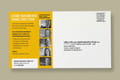
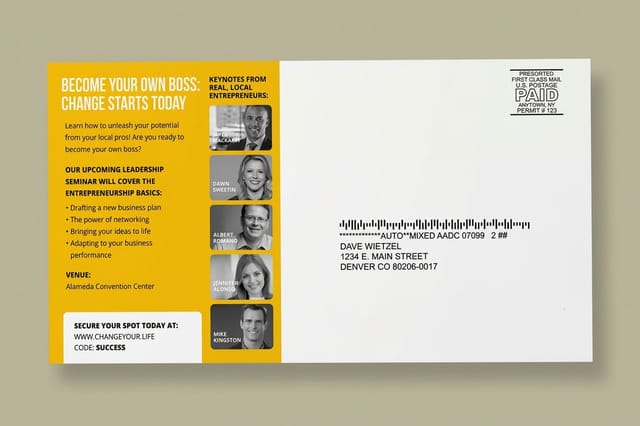
An EDDM mailer has two jobs on one side. The address side must reserve a clean zone for the EDDM indicia, the ECRWSS endorsement, and the generic customer line, and USPS expects that zone to stay free of artwork, folds, and stray text. Put the indicia in the upper right of the address panel, give it breathing room, and never let a background image run through it.
The message side follows ordinary direct mail rules. One offer, one deadline, one action. Lead with the benefit in type large enough to read at arm's length while someone stands over a recycling bin, keep body copy short, and make the phone number or QR code impossible to miss. If you are working out how the panels should be organized, the anatomy of a postcard breaks down what belongs on each side.
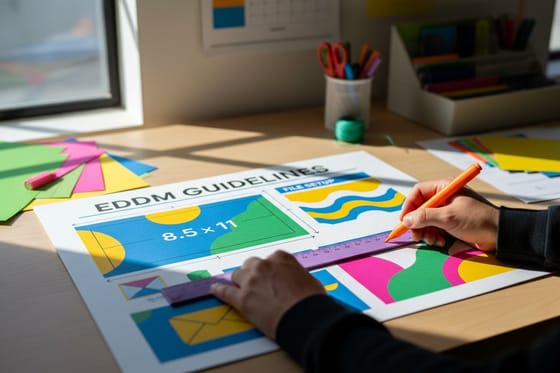
On the production side, build the file at full trim size with 0.125 inch bleed, keep live text at least 0.25 inch inside the trim, and export CMYK at 300 dpi. Our EDDM guidelines for file setup and size requirements covers the specific templates, and the prepress team flags anything that would fail postal review before your job goes on press.
Step five, bundle the pieces and fill out the paperwork
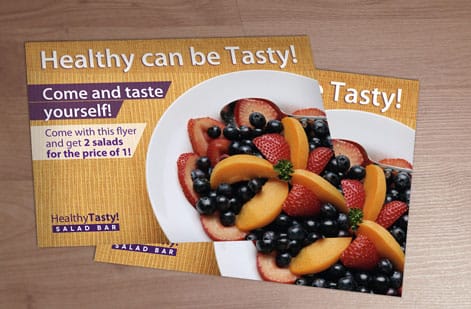
Printed pieces cannot arrive at the post office loose. USPS wants them counted into bundles of 50 or 100, banded, and topped with a facing slip that identifies the route, the ZIP code, and the piece count in that stack. One route never mixes with another inside a bundle, and the facing slip is what tells the clerk which route each stack belongs to.
The paperwork is one form. PS Form 3587 records the total pieces, the routes, and the postage due, and you either fill it out at the counter or generate it in the online EDDM tool and print it with your route selection. Bring the form, the bundles, and payment to the post office that delivers those routes, not to whichever branch is closest to your office.
This step is where do it yourself EDDM stops feeling cheap, because counting and banding twenty thousand pieces eats a full day of somebody's labor. Handing the bundling and the drop to a printer that already does it daily usually costs less than the hours it replaces.
What EDDM mailing costs and how the price is built

Your budget has two independent halves. Postage is a flat EDDM per-piece rate paid to USPS, identical for every qualifying piece regardless of size or stock, and it is the half you cannot negotiate. Printing is the half you control, and it moves with quantity, dimensions, paper weight, finish, and turnaround.
Quantity does the most work. The setup effort behind a print run is nearly the same at 1,000 pieces as at 10,000, so the per-piece cost falls steeply as volume rises. Going from a small test run to a full neighborhood saturation often cuts the print cost per household by more than half, which is why splitting one campaign into four dribbles is usually the most expensive way to mail.
Size and stock come next, then finish and turnaround. A 6.5 by 9 card on 14pt gloss is the cost floor, a 9 by 12 on heavy stock with soft touch is the ceiling. Our mailing flyers start at $18.94, and if you are weighing us against the usual names, see the MOO postcards alternative and the Vistaprint mailing services alternative for a like for like comparison.
EDDM postage per piece, and how to keep the total low
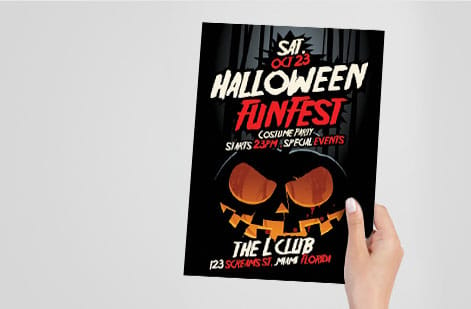
EDDM postage is one flat per-piece rate that USPS sets and you pay straight to the Postal Service, the same for a 6.5 by 9 card on 14pt gloss as for a 9 by 12 flyer, as long as the piece stays a flat at 3.5 ounces or less. The USPS EDDM tool shows the exact figure as a running postage total in your route cart, and PS Form 3587 carries that total to the counter. Which track you mail on changes the paperwork, not the design:
- EDDM Retail. No permit and no annual fee, up to 5,000 pieces per ZIP code per day, paid at the post office that delivers the routes or online through the USPS Business Customer Gateway.
- EDDM BMEU. A permit and an annual mailing fee, no daily cap, piece sizes Retail does not allow, and one drop at a bulk mail entry unit.
The rate stays fixed whatever you print, so the savings sit on your side of the bill. Keep the piece a flat by passing one letter limit, longer than 11.5 inches, taller than 6.125 inches or thicker than 0.25 inches, and stay under the weight ceiling. Then print one full run instead of four small ones, leave the business-only stops out of your routes, and band and drop the bundles yourself at the delivering post office.
Using the postcard design you already have for EDDM

You can keep the design, but most existing postcards need a new size first. A 4 by 6 or 5 by 7 inch card sits inside every letter maximum, so USPS treats it as a letter and EDDM Retail will not take it. Move the artwork onto a flat size: the 6.5 by 9 inch card is the cheapest one, and it clears the 6.125 inch height limit with room to spare.
- Keep the message side. Scale the headline, the offer and the phone number or QR code up to the larger card, still one offer and one deadline.
- Rebuild the address side. Reserve a clean zone in the upper right for the EDDM indicia, the ECRWSS endorsement and the generic customer line, with no background running through it.
- Reset the file. Full trim size, 0.125 inch bleed, live text at least 0.25 inch inside the trim, CMYK at 300 dpi.
If the original postcard printed on 14pt or 16pt card, order the same stock again, so the EDDM run feels like the piece your customers already know.
How long the whole EDDM process takes

Work backward from the date you want the piece in hands. Printing an EDDM run generally takes two to four business days once the file is approved, with heavier stocks and specialty finishes sitting at the longer end. Add shipping to you, or straight to the postal facility if the printer is handling the drop.
After acceptance, USPS moves EDDM as Marketing Mail, which is not overnight service. Plan on roughly two to five days in home once the bundles clear the counter, and expect slower movement in December and around major holidays when mail volume spikes.
The safe rule for anything dated is a two week runway from file approval to the first mailbox. That leaves room for a proof revision, a stock swap, or a postal holiday without your grand opening flyer landing the week after the grand opening.
The mistakes that sink an EDDM campaign
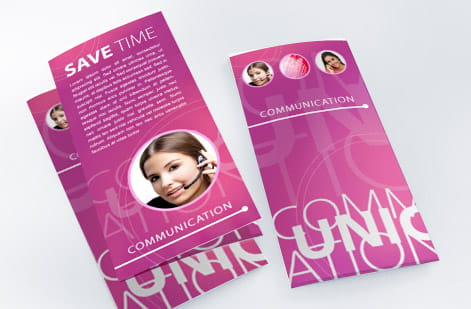
The costly mistakes are boring ones. Designing at letter size and discovering the piece does not qualify as a flat. Burying the indicia zone under a photo. Dropping bundles at the wrong post office. Mixing two routes into one bundle. Every one of these is caught by a five minute check before the job goes to press, and every one of them costs a reprint after.
The strategic mistakes are quieter. Mailing once and calling direct mail dead is the most common, since saturation works on repetition and the second and third drops carry most of the response. Spreading a thin budget across forty routes instead of hitting eight routes four times is the runner-up. And running an offer with no deadline gives a household permission to set the piece down and forget it.
Finally, give the campaign a way to report back. A dedicated phone number, a coupon code, a landing page, or a QR code turns guesswork into a number, and that number is what tells you which routes deserve the next drop. When you want the whole thing handled end to end, the 4OVER4 EDDM service covers routes, print, bundling, and delivery in one order.
Wally explains EDDM
Buy the street, not the stranger
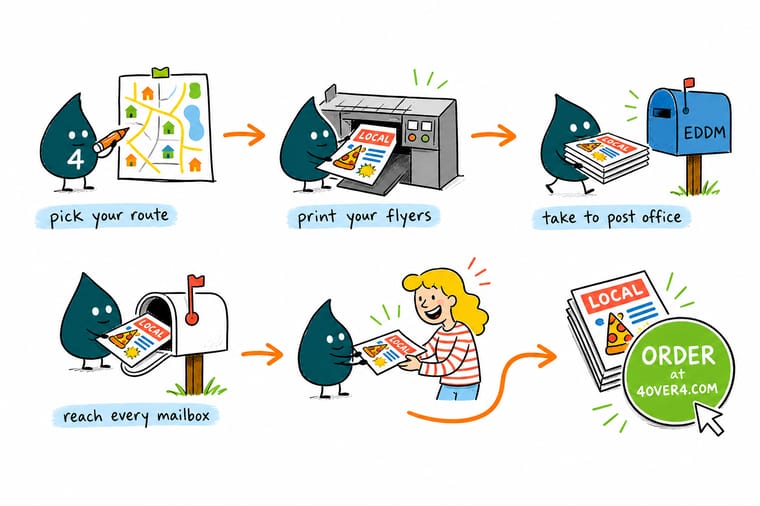
Wally thinks of EDDM as renting a sidewalk instead of renting names. Pick the routes your customers already live on, make the offer worth keeping on the fridge, and mail those same streets three times before you judge it. The bundles and the postal form are twenty minutes of work. The routes you pick are the campaign.
Design and print EDDM mailers →
Infographic
The 7 steps of an EDDM mailing at a glance
One frame, seven steps: a flat-size piece such as the 6.5 by 9 inch card, routes picked on the USPS map, a design with the indicia zone and 0.125 inch bleed, the print run, bundles of 50 or 100 with facing slips, PS Form 3587 with the postage, and the drop at the delivering post office. Keep it open while you build the job so nothing gets discovered at the post office counter.
Steps one through four are print decisions and steps five through seven are postal ones. Most delays happen at the seam between them, so confirm your routes before the job goes on press.
Specs and pricing
Mailing flyer specs and live pricing
Pick the size and stock that clears the USPS flat threshold, then watch the per-piece cost drop as the quantity climbs toward a full route saturation.
| Quantity | Price Per Unit | Total |
|---|---|---|
| 500 | 17.9¢ | $89.68 |
| 1,000 | 17.1¢ | $170.53 |
| 2,000 | 9.35¢ | $186.95 |
| 3,000 | 6.84¢ | $205.13 |
| 4,000 | 5.58¢ | $223.31 |
| 5,000 | 4.83¢ | $241.51 |
| 6,000 | 4.56¢ | $273.85 |
| 7,000 | 4.37¢ | $306.18 |
Print it
Everything your EDDM drop needs, printed in house
See it in use
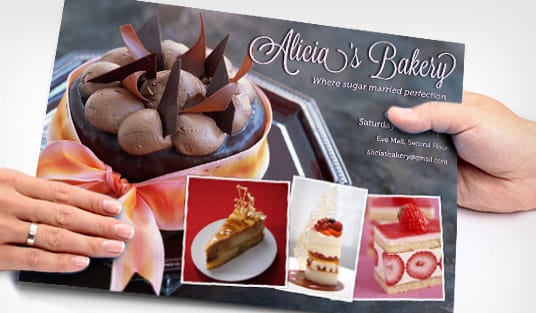
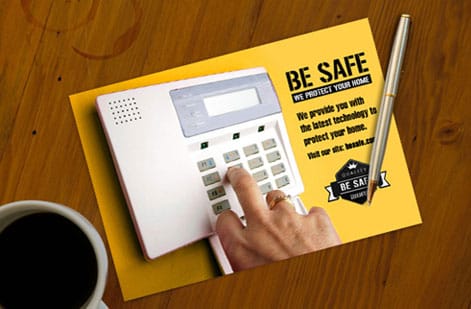
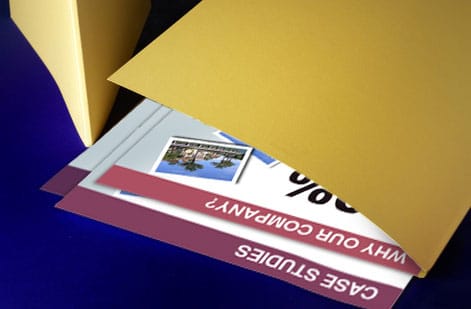
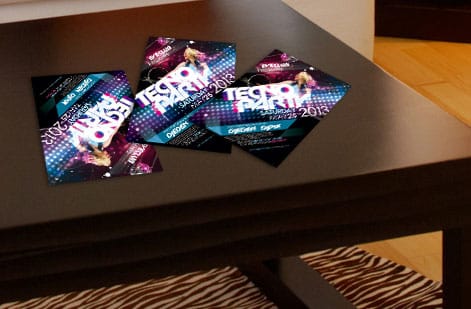
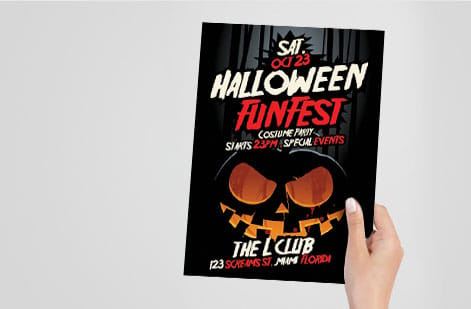
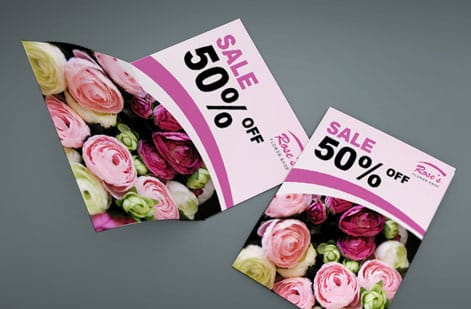
Real mailer designs, printed in house



Explore more
Where to go next
By the numbers
EDDM mail pieces across 1,000+ products
Common Questions
Common questions about EDDM mailing
What is EDDM mailing?
EDDM stands for Every Door Direct Mail, a USPS program that delivers one printed piece to every address on the carrier routes you choose. There is no mailing list, no names, and no individual addressing. You select routes by ZIP code, print a mailer that meets USPS flat-size rules, bundle the pieces with facing slips, pay postage, and drop the bundles at the post office that delivers those routes.
Which routes match how far my customers travel?
Start from the address your customers actually drive to, then open the USPS EDDM route map and work outward. Each route shows a household count, an average household income, and an age spread. Pick routes that match how far people realistically travel for what you sell, keep the drive time short for a restaurant or salon, and stretch wider for a service like roofing or dental care where people will cross town.
What does EDDM mailing cost and how are prices set?
You pay two separate bills. Printing is priced by quantity, size, stock, and finish, and it drops sharply per piece as the run grows. Postage is a flat per-piece EDDM rate set by USPS and paid straight to the Postal Service, the same amount whether your piece is a plain flyer or a heavy gloss card, as long as it stays inside the size and weight limits.
How much is EDDM postage per piece?
One flat USPS rate per piece, the same for a 6.5 by 9 inch card on 14pt gloss as for a 9 by 12 inch flyer, as long as the piece stays a flat at 3.5 ounces or less. You pay it to the Postal Service, not to the printer, and the USPS EDDM tool shows the exact running total as you add routes. Printing is the half of the budget you control.
What sizes, stocks and finishes work for EDDM mailing?
Popular EDDM sizes are 6.5 by 9, 8.5 by 11, 6 by 11, and 9 by 12 inches, all of which clear the flat threshold. Card stocks around 14pt and 16pt hold up best in a mail tray, while 100lb gloss text is the budget option for high volume. Gloss, matte, and uncoated finishes all mail fine, though uncoated is easier to write on for coupon redemption.
How long does EDDM printing and delivery take?
Printing an EDDM run at 4OVER4 typically takes two to four business days depending on stock and finish, plus transit to you or to the post office. Once the bundles are accepted, USPS treats EDDM as Marketing Mail, so plan on roughly two to five more days in home. For a dated promotion, back the drop date up by two weeks so nothing lands after the event.
Do I need a permit to do EDDM mailing?
Not for EDDM Retail. You can walk into the delivery post office with your bundles, PS Form 3587, and payment, and mail up to 5,000 pieces per ZIP code per day. A permit and an annual mailing fee only come into play with EDDM BMEU, which lifts the daily cap, allows smaller piece sizes, and lets you drop everything at a single bulk mail entry unit.
What has to be printed on an EDDM mailpiece?
Every piece needs a clear address block area carrying the EDDM indicia, the ECRWSS endorsement, and a line reading Local Postal Customer or Postal Customer instead of a name. The indicia sits in the upper right of the address side, and USPS wants that whole zone left free of art and text so the carrier can read it at a glance while walking the route.
Get Started
Order 500 mailing flyers from $89.68
Bring your artwork or start from a template, choose the size that qualifies as a flat, and we will print the run so your bundles are ready for the counter.
Legal Disclaimer
Gold Standard guarantees apply to all standard orders placed through 4over4.com. Price match requires verifiable proof of a competitor's published price for an equivalent product with matching specifications and turnaround time. Satisfaction guarantee covers manufacturing defects and print quality issues. Contact support with order number and documentation.
