
How to Choose an Apparel Printing Company That Gets Your Order Right


The method, the blank and the sample decide whether you like the box when it lands. Price is the last question, not the first.
Judge an apparel printing company on three things: which decoration method it runs in house for your quantity, which blank garment it puts under the ink by brand and style number, and whether it will show you a printed sample before the full run. Price, turnaround and minimums all follow from those answers. A shop that quotes a number per shirt without naming the method or the blank has not read your job yet.
Quick answer
Method, blank, sample. In that order
The method decides the price curve, the blank decides whether anyone wears the shirt, and the sample is the only proof either decision was right. Screen printing charges setup per color and gets cheaper as the run grows. Direct to garment and heat transfer vinyl charge per piece and stay flat, which is why they win small orders. Ask which one a printer will run at your exact quantity, ask for the blank brand and style number in writing, and pay for a printed sample on the first order.
Start With the Decoration Method, Not the Price Per Shirt
A quote of nine dollars a shirt tells you nothing until you know how the shirt gets printed. Three methods dominate apparel work, and each one is cheap in a different place.
| Method | How the ink gets there | Where it is cheapest | Where it falls down |
|---|---|---|---|
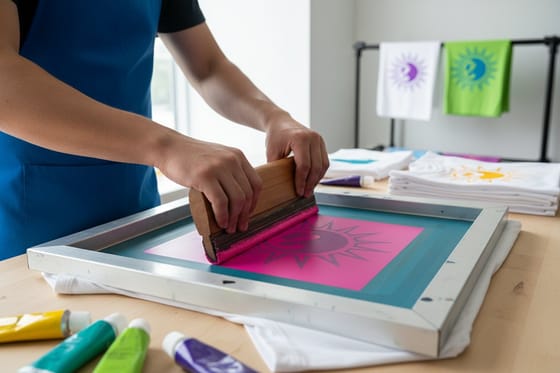
| Screen printing | Ink pushed through a stencilled mesh screen, one screen per color, then cured under a dryer. | Larger runs with few colors, because the screens are made once and spread across the whole order. | Photographs and gradients, which need separations and several screens for a run that may not justify them. |
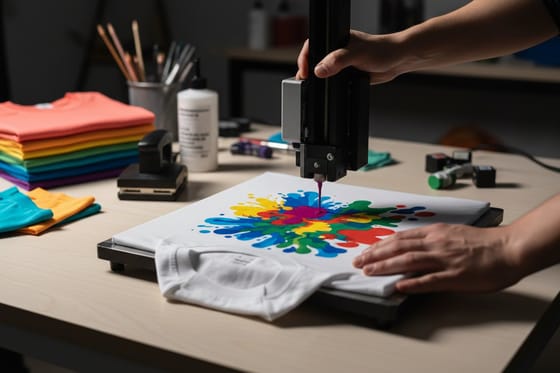
| Direct to garment | Water based ink jetted into the fibres, pretreated first on dark garments so the white underbase holds. | Small runs and full color artwork, since there is no screen setup at all. | Dark garments, where the pretreat and underbase add cost and a slightly heavier hand. |
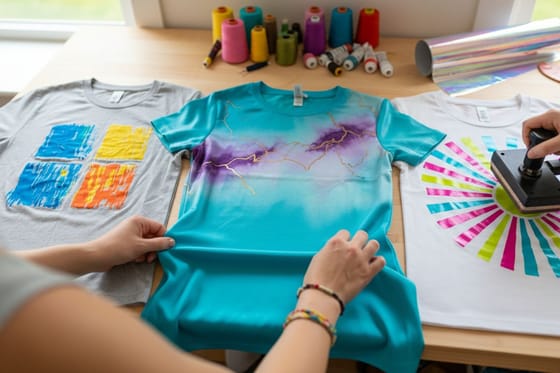
| Heat transfer vinyl | Colored vinyl cut to shape, weeded by hand, then pressed onto the garment with heat. | Names, numbers and one or two color marks in very small quantities. | Detailed artwork, because every enclosed shape has to be weeded out by hand. |
Read the last column first. It is the one a sales quote never mentions, and it is the one that decides whether you are happy with the box when it arrives. If your logo is a flat two color mark and you need 200 shirts, screen printing is the right tool and any shop pushing you toward digital is protecting their own schedule. If you need 15 shirts carrying a photo, the reverse is true, and direct to garment printing is the honest recommendation. Our comparison of vinyl and screen t-shirt printing walks the same decision from the artwork side.
Ask the question plainly: which method, at my quantity, and what changes if I go up or down a hundred pieces. A shop that runs the work in house answers in one sentence.
The Blank Matters More Than the Ink
Nobody rejects a shirt because the ink was slightly off. They reject it because the collar went wavy after two washes, or because the fit ran small and half the staff will not wear it. The blank is the product. The print is the decoration.
Three things about the blank are worth pinning down in writing. Fabric weight, usually quoted in ounces per square yard, tells you whether the shirt is a light summer tee or something with body. Yarn type matters just as much: ring-spun cotton is combed and twisted into a finer, smoother yarn than open-end cotton, which is why it takes fine print detail better and feels softer straight out of the bag. And the blend decides shrinkage, since 100 percent cotton moves in a hot dryer while a cotton polyester blend holds its measurements.
Ask for the brand and the style number, not a description. "Premium heavyweight tee" is marketing. A style number is a specification you can look up, compare and reorder against. If a printer will not give you one, they are buying whatever is cheapest that week, which is exactly why your second run will not match your first.
The finish of the blank also changes what your artwork can do. A silk finish tee has a smoother, slightly lustrous face that holds crisp edges, a suede finish is brushed and softens fine detail, and a standard cotton face sits between them. We break the differences down in premium vs silk vs suede t-shirts. On our side, premium t-shirts and silk t-shirts both start at $21.96, so the choice is about the surface you want your art sitting on rather than about the budget.
The Questions That Separate Printers From Resellers
Plenty of companies selling apparel printing do not own a press. That is not automatically bad, but it changes who is accountable when a run goes wrong, and it always adds days. These questions surface it quickly.
- What is the setup charge, and per what? Screen printing setup is charged per color per location, so a two color front and one color back is three screens, not one job. Get it itemised before you approve anything.
- Do I get a printed sample, and does it cost extra? A digital mockup proves the layout. A printed sample proves the ink opacity, the placement height and the hand feel. On a run large enough to hurt, pay for the sample.
- Does turnaround start at art approval or at blank arrival? This is the single most common reason apparel deadlines slip, and the answer costs a shop nothing to give.
- What happens on a misprint, and what is the spoilage policy? Some loss in a garment run is normal. A shop that prints from its own stock replaces the piece. A shop working from your supplied garments cannot.
- How do you archive the job for a reorder? Screens, ink formula, blank style number, placement measurements. If they cannot describe the record, run two will not match run one.
- Who handles size breakdowns and split shipping? Event orders rarely go to one address, and a printer who treats that as an exception will charge you like it is one.
The same instinct applies to any print supplier, and the wider checklist in our guide on how to choose a print shop covers proofing, file handoff and delivery for the paper side of an order. If you are building a full merchandise range rather than one shirt, how to make merch for your brand is the better starting point.
What Cheap Apparel Printing Actually Costs You
Every corner a low quote cuts shows up somewhere. It is worth knowing where to look before the box arrives rather than after.
Thin ink deposit is the first place. A single pass of ink on a dark garment without a proper underbase looks acceptable in the shop and washes to a ghost within a month. Vinyl has its own version of the same problem: pressed at the wrong temperature or for too short a time, the adhesive never fully bonds and the edges start lifting at the shoulders where the shirt flexes most. Neither failure is visible on delivery day.
Then there is placement drift. A print that sits two inches lower on the extra large than on the small is not a machine defect, it is a shop that did not set a placement standard per size. Ask how they measure down from the collar seam, and whether that measurement changes across the size run. It should.
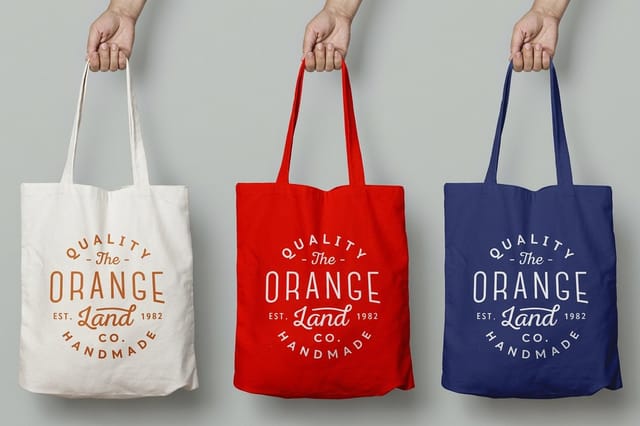
The trade-off worth accepting is the opposite one. Paying for a printed sample and a named blank adds a few days and a small cost to the first order, and removes almost all of the risk from every order after it. If you are ordering for an event with a fixed date, build those days into the schedule instead of hoping. Full color prints, size runs and quantity breaks all price live on our t-shirt printing page, and the wider t-shirt printing category lists every garment we decorate. For merchandise that goes home with the shirt, tote bags start at $22.73 and print from the same artwork.
Wally explains picking an apparel printer
Method first, blank second, sample before the run
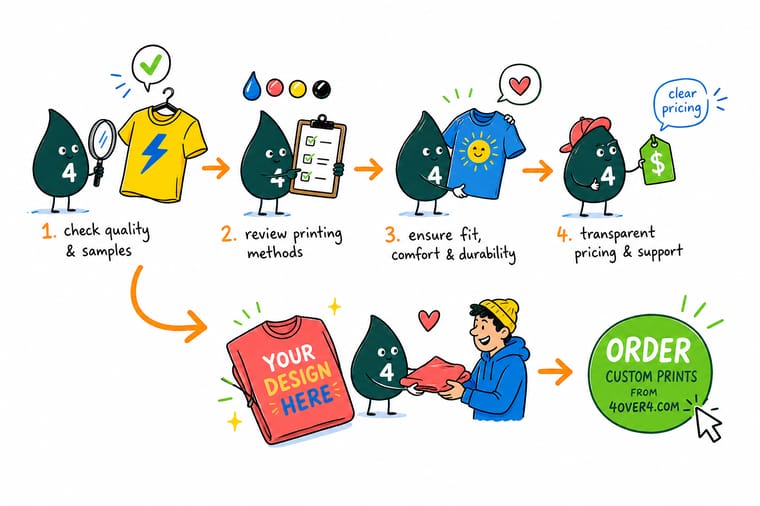
Wally does not start with the price. He asks which method prints the job at that quantity, because screens are paid for once and per piece printing never is. Then he checks the tag for a brand and a style number, since that is the thing you reorder against next year. Last, he presses one sample and washes it, because ink opacity and placement height only tell the truth on a real garment. If a shop will not do those three, the cheap quote is the expensive one.
Configure custom t-shirt printing →Specs and pricing
Shirt options, sizes, and starting prices
Three finishes side by side, with live configuration choices and starting prices straight from the 4OVER4.COM configurator.



Print it
Order apparel that survives the second wash
Explore more
Where to go next
By the numbers
Apparel printing you can count on at 4OVER4
Common Questions
Your apparel printing questions, answered
What should I ask an apparel printing company first?
Ask which decoration method they will run for your quantity and artwork, and why. Screen printing, direct to garment and heat transfer vinyl all put a design on a shirt, but they price differently, feel different under a hand, and hold color differently on dark garments. A printer who answers with the method plus the reason has actually looked at your art. A printer who answers with a price per shirt and nothing else is quoting a job they have not read yet.
Is there a minimum order for custom apparel?
It depends entirely on the method. Screen printing shops usually set a minimum because burning screens and setting registration takes the same labor whether you print 12 shirts or 500. Direct to garment and vinyl have no screen to make, so single pieces are practical. At 4OVER4.COM, t-shirt printing starts at $21.96 and you configure the quantity yourself, which is the same reason we run small internal-team orders and 300 piece event runs on the same order form.
Can an apparel printer match my exact brand color?
On a light 100 percent cotton shirt, a screen printer mixing a Pantone ink gets very close. On a dark garment the same ink sits over a white underbase and reads slightly differently, and on a heather blend the fabric color shows through the ink and shifts it further. Direct to garment matches a digital file rather than a mixed ink, so brand colors land approximately rather than exactly. Send the Pantone number, ask for a printed sample on the actual blank, and judge it in daylight.
How long does a custom apparel order take?
The printing itself is the fast part. What stretches a timeline is sourcing blanks, because a shop that does not hold your size and color in stock has to order it in, and a single backordered size can hold the whole run. When you ask about turnaround, ask specifically whether the quoted days start when the art is approved or when the blanks land on their floor. That one question explains most of the apparel deadlines that slip.
Should I supply my own blanks to a printer?
Usually not worth it. Most shops charge a handling fee on customer supplied garments, will not accept liability for pieces they misprint, and cannot replace a ruined shirt from their own stock. Some spoilage in a run is normal, so a printer working from their own inventory simply prints a replacement, while a printer working from your 24 hand-counted shirts hands you 23. Supply your own only when the specific garment genuinely is not available to them.
Screen printing or direct to garment for 25 shirts?
For 25 shirts with a one or two color design, screen printing usually wins on cost per piece and gives a tougher print. For 25 shirts carrying a photographic image or a heavy gradient, direct to garment is the honest answer, because reproducing that on screens would mean separations and several screens for a run too small to pay them off. The dividing line is not the quantity on its own, it is the quantity together with the color count.
Get Started
Ready to put your logo on a shirt people keep wearing?
Pick the garment, set the quantity, upload the artwork, and we print apparel that still looks right after the wash cycle it was ordered for.
Legal Disclaimer
Gold Standard guarantees apply to all standard orders placed through 4over4.com. Price match requires verifiable proof of a competitor's published price for an equivalent product with matching specifications and turnaround time. Satisfaction guarantee covers manufacturing defects and print quality issues. Contact support with order number and documentation. On-time delivery rate based on tracked orders 1999 to 2026. Individual results may vary based on shipping carrier performance.
