
Door Flyer Template Sizes, Bleed Setup, and a Layout That Gets Calls


Trim sizes with their bleed and safe-area numbers, the layout that survives a two second read at a door frame, and the point where a door hanger is worth the extra money.
Set a door flyer template to the finished size plus 0.125 in of bleed on all four sides, and keep every word 0.125 in inside the trim. An 8.5 by 11 in flyer is built as an 8.75 by 11.25 in file with a safe area of 8.25 by 10.75 in, and 5.5 by 8.5 in is the size most routes actually run. Put the offer in the top 3 to 4 in, because that is the only part visible once the sheet is wedged in a door frame. Choose a die-cut door hanger instead when the piece has to survive weather on a knob.

Quick answer
A quarter inch of bleed, a safe margin, and the offer up top
The template is the finished size plus 0.125 in on every side, with text held 0.125 in inside the cut. 5.5 by 8.5 in is the size most door to door routes run, because it is a letter sheet cut in half and costs the least per piece. Build at 300 dpi in CMYK, outline the fonts, and run the background art all the way to the bleed line so a shifted cut never leaves a white sliver. Then design for the top third only, since the rest of the sheet disappears into the door frame.
Door Flyer Sizes and the Bleed Every Template Needs
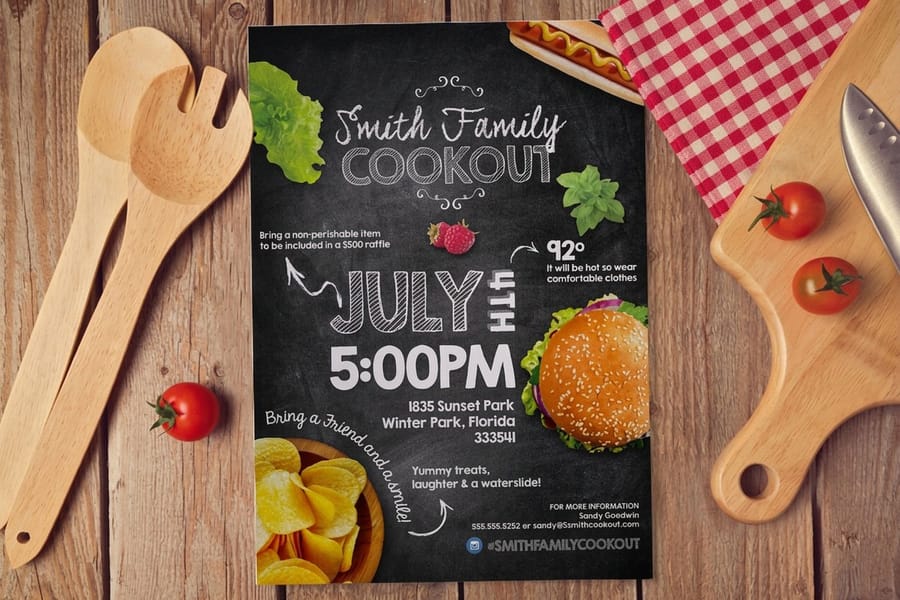
Pick the trim size first, then build the document a quarter inch larger in both directions. Everything else in the template follows from those two numbers.
Bleed exists because a stack of several hundred sheets does not sit perfectly still under a guillotine blade. The cut can wander by up to about a sixteenth of an inch across a lift. If your background stops exactly at the finished size, that wander leaves a white hairline on one edge. If the background runs 0.125 in past it, the wander eats printed color instead and nobody sees the difference.
| Finished size | Document with bleed | Safe area for text | Where it earns its place |
|---|---|---|---|
| 4 x 6 in | 4.25 x 6.25 in | 3.75 x 5.75 in | Dense apartment and condo routes where the crew carries hundreds of pieces on foot. |
| 5.5 x 8.5 in | 5.75 x 8.75 in | 5.25 x 8.25 in | The default. A letter sheet cut in half, cheapest per piece, still readable from the walkway. |
| 6 x 9 in | 6.25 x 9.25 in | 5.75 x 8.75 in | Reads as more substantial than a half sheet without moving into full letter handling. |
| 8.5 x 11 in | 8.75 x 11.25 in | 8.25 x 10.75 in | Coupon blocks, price lists, seasonal service menus that need the room. |
| 4.25 x 11 in hanger | 4.5 x 11.25 in | 4 x 10.75 in | The die-cut alternative when the piece has to survive weather on a knob. |
Three more settings finish the template. Build at 300 dpi at final size, because a 150 dpi photo scaled up looks soft on a coated stock in a way it never does on screen. Work in CMYK, since a screen blue at 100 percent cyan prints duller than it looks. Convert type to outlines before you export, or the press RIP substitutes a font you never chose. Our bleed and trim guide walks through the same setup in a page layout program, and the blank template library already has these dimensions built if you would rather start from a correct file.
One trap worth naming. A thin border running around the outside of a door flyer is the single most fragile thing you can design. Cut shift of a sixteenth of an inch turns a 3 mm frame into 4 mm on one side and 2 mm on the other, and it looks like a printing fault even though the file was the problem. Either make the border thick enough that the shift disappears into it, or drop it.
Door Flyer or Door Hanger, and What Each One Costs You

The difference is one die-cut hole, and it changes the economics of a whole route. A hanger stays where the crew put it. A flyer has to be wedged, and wedged pieces come loose.
| Factor | Door flyer | Door hanger |
|---|---|---|
| Placement | Wedged in the door frame, taped, or left under the mat. | Hangs on the knob at eye level, held by the die-cut hole. |
| Weather | Blows off a porch, curls in damp, slides out of a screen door. | Stays put in wind and light rain on cover stock. |
| Cost | Lowest per piece. Standard flyers start at $39.54. | Higher, because of the die and heavier stock. Door hangers start at $290.41. |
| Setup work | A rectangle with bleed. Any layout program handles it. | Needs the die line on its own layer and art kept clear of the hole. |
| Best use | Wide first sweeps, grand openings, seasonal offers, dense routes. | Follow-up on streets that responded, service reminders, high-ticket trades. |
Those two starting prices sit at different entry quantities, so compare per piece in the configurator rather than by the headline number. The pattern most service businesses land on is a wide flyer sweep to find the streets that answer, then hangers on those streets from then on. The full flyer versus hanger comparison runs the numbers further, and the door hanger campaign guide covers route timing.
One rule applies to both, and breaking it is expensive. A residential mailbox is postal property. Under 18 U.S.C. 1725 anything placed in it, on the flag, or on the post has to carry postage, and the penalty is assessed per piece. The door, the door frame, the screen door and the mat are all fair game. The box is not. The mailbox rules for flyers spell out where the line sits, and if you actually want the mailbox, mail it as a postcard instead.
The Layout That Gets Answered at the Door

A door flyer is read in about two seconds, standing up, often half hidden by a door frame. That single fact decides the layout, and it is why a design that looks balanced on a monitor performs badly on a street.
Work top down. The upper 3 to 4 in is the only part reliably visible when the sheet is wedged, so that band carries the offer and nothing else. Not the logo, not the tagline. The offer: what you do, for whom, and the number that makes them stop. Below it goes the proof, which is a short service list or one line of local reference, then the call to action, then the phone number set large enough to read at arm's length.
- One offer. Two offers on one flyer halves the response to each. Print a second version instead.
- A deadline with a real date. "Offer ends March 31" beats "limited time" because it forces a decision this week.
- A phone number bigger than the logo. Most door flyer calls come from someone standing at the door with the sheet in one hand.
- A QR code at 0.8 in or larger, in a quiet area of the layout with white space around it, pointing at a page that matches the offer rather than the homepage.
- Something to keep. A tear-off coupon, a magnet line, or a seasonal checklist gives the sheet a reason to reach the fridge.
Two things to leave out. Reversed text below about 9 point on a heavy background fills in on a fast press and turns muddy. Long paragraphs are ignored at the door every time, so cut copy until each line earns its place. If you need a fuller layout walk-through, the promotional flyer design guide covers hierarchy in more depth, and the distribution guide covers when to walk the route.
Paper, Sides, and Getting the File to Press

Stock choice is a weather decision more than a taste decision. A door flyer spends hours outdoors before anyone touches it, so pick for the porch, not for the desk.
100 lb gloss text is the light end. It prints color beautifully and it curls once the morning damp gets into it, which is how a wedged flyer ends up in the flowerbed. 14 pt or 100 lb cover keeps its shape in a door frame and takes a rain shower without going limp. Uncoated is the pick when your crew writes an appointment time or a name on each sheet, because a ballpoint skates across gloss and smears. The flyer paper weight guide compares the stocks side by side.
Print both sides. The extra cost across a run of thousands is small, and the back is where the service list, the hours, the map and the coupon terms live, which keeps the front down to one offer. Standard flyers start at $39.54 and cover most routes. Club flyers start at $16.48 and suit heavy-color nightlife and event work on a smaller trim. Business flyers start at $57.11 for a more substantial piece, folded flyers at $68.54 when the offer needs panels, and door hangers at $290.41 when the piece has to stay on the knob.
Send a print-ready PDF with the bleed included, fonts outlined, images at 300 dpi and everything in CMYK. Order a slightly larger quantity than the route needs, because crews always lose a handful to wind and wet steps, and a reprint costs more than the extra hundred did. Browse the full range on the flyer printing category or start from a correctly sized file in the free blank flyer templates guide.
Wally sets up a door flyer
A quarter inch of bleed, and the offer in the top third
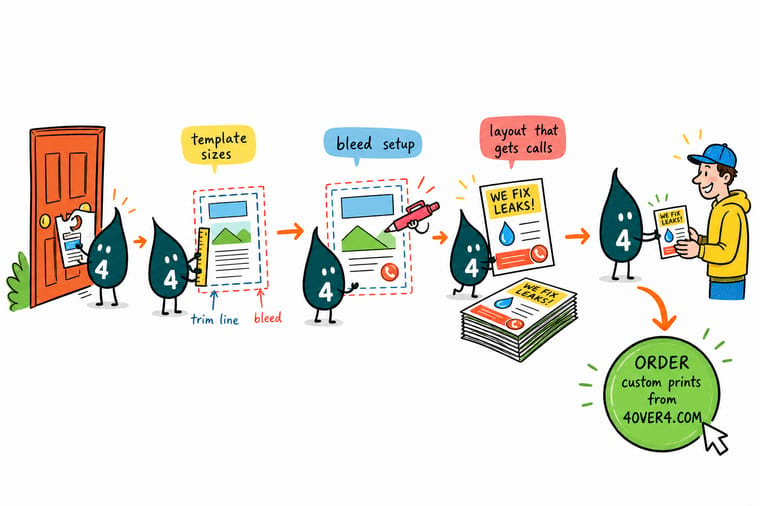
Wally builds the file a quarter inch bigger than the flyer, runs the background art past the cut line, then pulls every word a further eighth of an inch inside it so the blade never clips a letter. Next he walks the route. Wedged in a door frame, only the top of the sheet shows, so that is where the offer and the phone number go. And the mailbox stays shut, because only stamped mail is allowed in there.
Print your door flyers →Specs and pricing
Door flyer sizes, stocks, and starting prices
Compare the flyer and hanger options side by side, with live size and stock choices and starting prices straight from the 4OVER4.COM configurator.



Print it
Order the piece your route actually needs



Explore more
Where to go next



By the numbers
Flyer printing you can count on at 4OVER4
Common Questions
Your door flyer questions, answered
What size should a door flyer be?
5.5 by 8.5 in is the workhorse. It is a letter sheet cut in half, so it costs the least per piece, it fits a door frame without folding, and it still carries a headline you can read from the walkway. Go to 8.5 by 11 in when the offer needs a coupon block or a service list. Drop to 4 by 6 in for a dense apartment route where the crew is covering hundreds of doors on foot and pocket bulk matters. 6 by 9 in sits between the two and reads as more substantial than a half sheet for about the same handling.
How much bleed does a door flyer template need?
A quarter inch total, which is 0.125 in on each of the four sides. Set the document to the finished size plus that quarter inch in both directions, then push the background art, photos and color blocks all the way out to the edge of the larger box. An 8.5 by 11 in flyer becomes an 8.75 by 11.25 in file, a 5.5 by 8.5 in flyer becomes 5.75 by 8.75 in. Keep the text a further 0.125 in inside the trim so nothing sits within reach of the blade.
Is a door flyer or a door hanger better for a route?
A hanger wins on survival, a flyer wins on cost. The die-cut hole means a hanger stays on the knob through wind and rain, and it is the only piece the homeowner sees at eye level. A flyer wedged in the frame can drop, blow into the yard, or get pulled out with the mail and binned unread. Hangers cost more because of the die and the heavier stock, so a large first sweep usually runs on flyers and the follow-up on hangers for the addresses that responded or the streets worth converting.
Can I put a door flyer in the mailbox?
No. A residential mailbox is approved for postal use only, and putting unstamped material in it or on the post breaks 18 U.S.C. 1725, which carries a fine per piece. It applies to the box, the flag and the post, not to the door. Hang it on the knob, wedge it in the door frame or the screen door, or leave it under the mat. If you want the mailbox, the piece has to be mailed, and that is what standard postcards at $16.48 are for.
Should a door flyer print on one side or two?
Two, in almost every case. The second side costs a few dollars more on a run of thousands and it is where the detail goes: the service list, the hours, the map, the terms on the coupon. Keep side one to one offer and one call to action. One exception is worth naming. If the flyer is going under a mat or wedged face out with the back against the door, put the phone number on both sides so it reads either way.
What paper weight holds up on a door?
For a flyer that has to be wedged, 100 lb gloss text is the light end and it curls in humidity. 14 pt or 100 lb cover holds its shape in a door frame and survives a rainy afternoon far better. Uncoated stock is the one to pick when the crew writes a name or a time on the flyer by hand, because a pen skates on gloss. Door hangers come on heavier stock as standard, since a thin one tears at the hole.
Get Started
Ready to walk a route that pays for itself?
Pick the trim size, choose a stock that survives a porch, upload a file with the bleed already in it, and we print flyers your crew can hand out this week.
Legal Disclaimer
Gold Standard guarantees apply to all standard orders placed through 4over4.com. Price match requires verifiable proof of a competitor's published price for an equivalent product with matching specifications and turnaround time. Satisfaction guarantee covers manufacturing defects and print quality issues. Contact support with order number and documentation. On-time delivery rate based on tracked orders 1999 to 2026. Individual results may vary based on shipping carrier performance.
