
Die-Cut Foam Board Explained, From Cut Path to Custom Shape Display


Foam core cut to a shape instead of a rectangle. The cut path is built from your outline, and the tool has limits at a corner, and where a shaped board is worth the extra step.
Die-cut foam board is foam core printed flat and then cut to a custom outline on a flatbed cutting table, following a vector path supplied in your file. No die is made, so the shape adds no tooling cost, but the tool doing the cutting is round and leaves a radius in every inside corner. Ink sits only on the two paper faces, so a shaped edge always shows the white core underneath.
Quick answer
A vector path, a round tool, and an edge that shows the core
The board is ordinary foam core, and the shape comes from a cutting table following a path you drew. Because there is no steel rule die, a single shaped piece costs no more to set up than a hundred of them. Because the cutting tool has a radius, inside corners come back rounded unless you draw the curve yourself. And because ink only lands on the two paper liners, every cut edge exposes white polystyrene, which decides how a dark silhouette is going to read across a room.
What Die-Cut Foam Board Is, and How the Shape Gets Cut
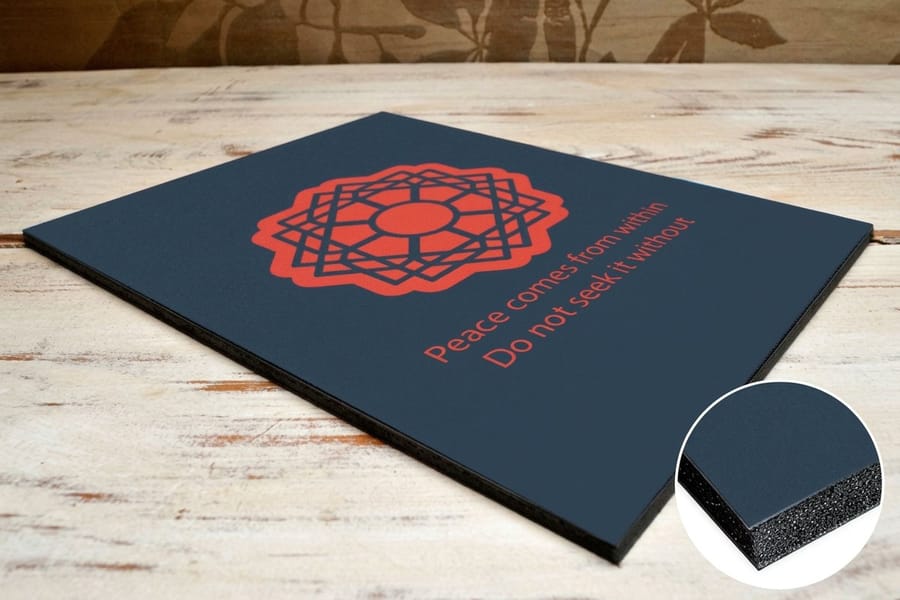
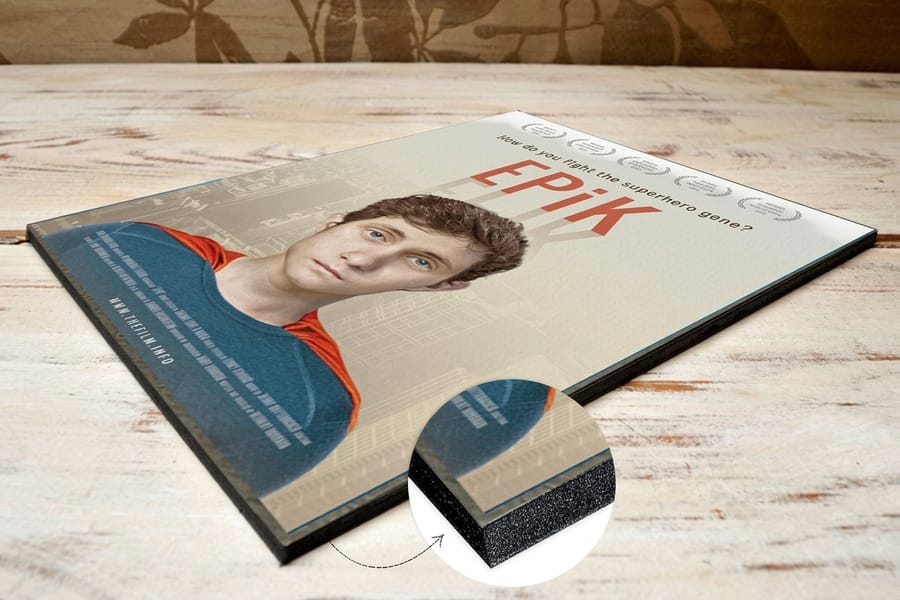
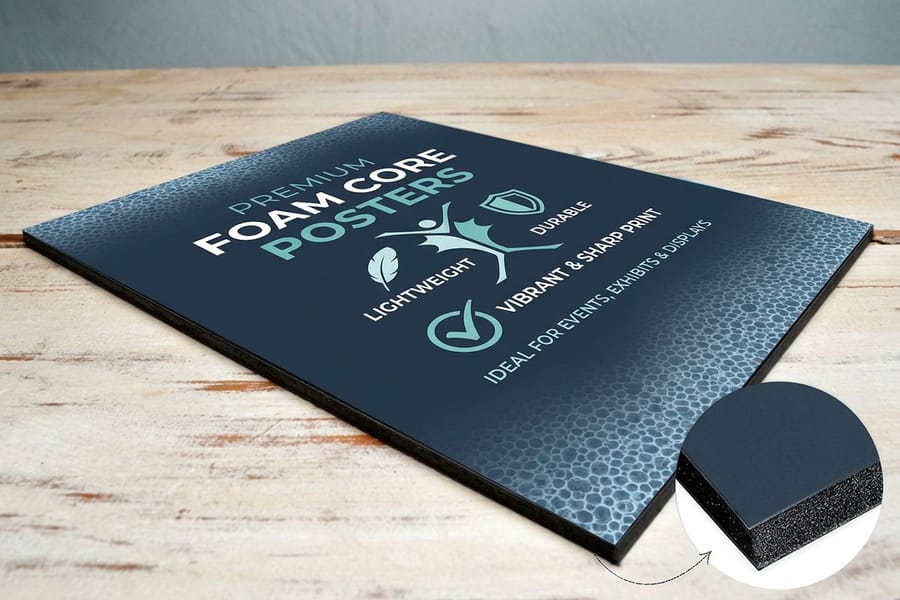
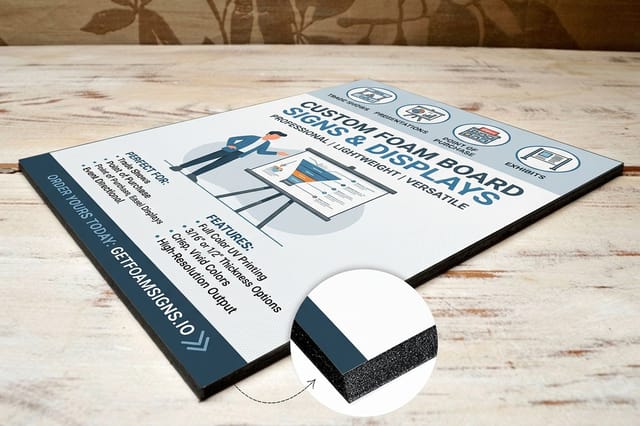
Pick up a piece of foam core and you are holding three layers: a sheet of extruded polystyrene with a clay-coated paper liner glued to each face. The usual thickness is 3/16 of an inch. The liner takes ink from a flatbed UV press the way a heavy poster stock would, and the foam in the middle is what keeps a large print flat without a frame behind it.
Everything up to that point is identical whether you order a rectangle or a shape. The shaped part happens afterward, on a cutting table. The printed sheet is held down by vacuum, and a head carrying either a router bit or an oscillating knife travels along a path taken straight from your file. It is not a die. Nothing is stamped. That distinction is worth holding on to, because it explains most of the rules further down this page.
Two consequences follow immediately. First, there is no tooling to pay for, so a one-off shape costs the same to cut as the hundredth one, which is the opposite of how die cutting on paper stock behaves. Second, the tool doing the cutting is round. A round thing traveling into a corner cannot produce a point, so every inside corner comes back with a radius on it whether you drew one or not.
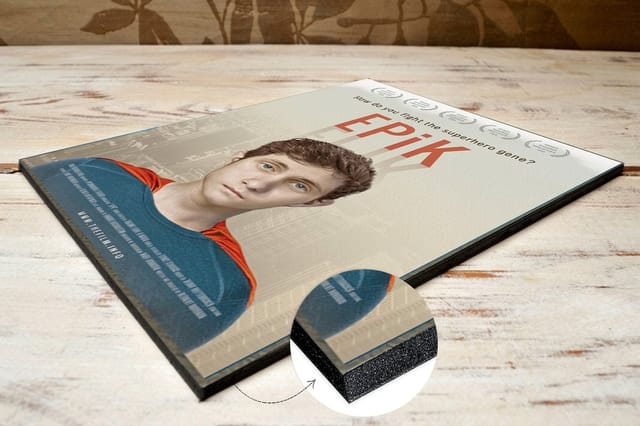
The other thing a shaped cut does is expose the board. Ink sits on the two paper faces and nowhere else, so a cut edge is bare white polystyrene. On a pale design nobody notices. On a black silhouette you get a thin white outline running around the whole shape, and the only real fix is to design as if that outline is deliberate. Order a plain rectangle in foam core first if you want to see the edge in person before committing a shape to it.
Where a Custom Shape Beats a Rectangle

A rectangle is a sign. A shape is an object, and people look at objects. That is the whole argument, and it holds in three places well and nowhere else particularly.
Events. Directional arrows cut as arrows, a logo silhouette above a registration desk, a giant cut-out of the thing being launched. Foam core is the right material here because the crew carries it in one hand, sticks it up with foam tape, and throws it away on Sunday night. Our event signage planning guide covers how the shaped pieces fit into a full signage list.
Retail floors. Shelf-edge shapes, a cut-out bottle at the end of an aisle, a seasonal character beside a display. These live indoors, get moved weekly, and are replaced every campaign, so nobody is trying to make them last three years. Foam core signs start at $49.99 and are the standard build for this.
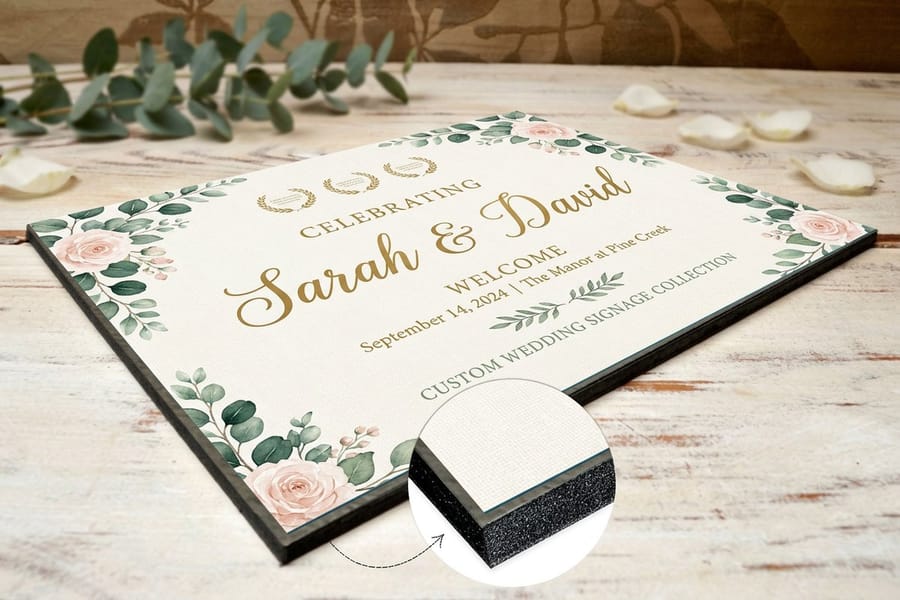
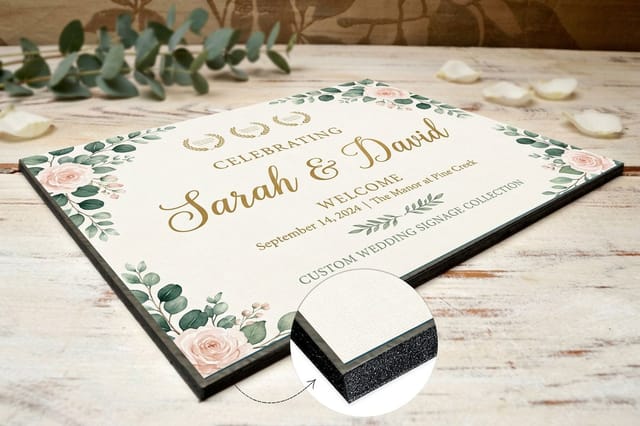
Photo props and celebration pieces. Speech bubbles, oversized frames, monograms, name cut-outs. Weddings drive most of it, and wedding foam core is the same board set up for seating charts, welcome shapes and table displays. Guests hold these, which is another argument for a light board.
Where it does not pay: anything outdoors past a single day, anything that gets handled hundreds of times, and any shape whose whole point is a razor-sharp inside corner. For a shaped piece in paper rather than board, any shape size paper die-cut starts at $87.00 and cuts detail foam core cannot hold.
Making a Custom-Shape Display Actually Stand Up
This is the part that catches people out. A shaped board looks finished on screen and then arrives with no way to hold itself upright, because foam core is buoyant, light, and completely uninterested in staying vertical.
For tabletop work, an easel back glued to the reverse is enough up to roughly 24 inches tall. Above that the weight above the base wins and the piece walks forward. For a floor-standing cut-out, you need a strut running most of the height on the back plus a foot at the base, and the foot has to be wide enough that a person brushing past does not fold the whole thing over. A rented A-frame or a poster stand holding the shape between two arms is often steadier than anything glued to the board itself.
Hanging solves more problems than propping. Foam core weighs so little that two strips of removable foam tape hold a large shape on a wall, and hanging it puts the cut edge at eye level where the silhouette reads properly. A shape suspended on fishing line above a stand is the classic trade show move for the same reason.
| Board | Weight and handling | Outdoors | Best use for a shape |
|---|---|---|---|
| Foam core | Very light, dents under a thumbnail, corners crush in transit. | Hours, not days. Liner absorbs moisture and the board bows. | Events, retail floors, photo props, anything short-lived and carried by hand. |
| Gator board | Heavier, hard wood-fibre faces that resist dents. | Better, still an indoor material at heart. | A shape that gets packed, shipped and reused across several shows. |
| PVC board | Solid plastic, no liner to damage, noticeably heavier. | Handles weather and washing down. | Permanent shaped signage, and anything mounted where it will get touched. |
| Corrugated plastic | Light, hollow flutes, flexes over long spans. | Built for it, including stakes into ground. | Outdoor and lawn shapes on a budget. |
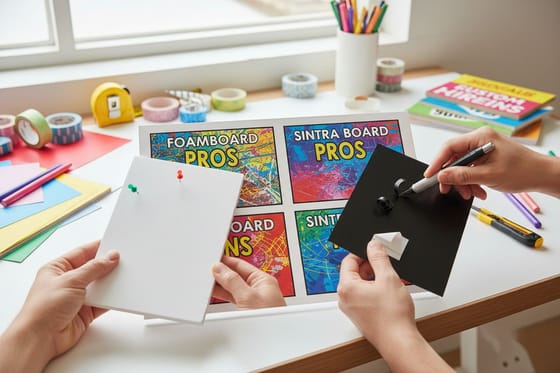
Read the third column before the first. If the answer to "where does this live" is outside, foam core is off the list no matter how good the price looks, and the comparison in foam board versus Sintra is the next thing to read. If it lives indoors and gets carried, foam core wins on weight alone, and gator board is the upgrade when the same shape has to survive repeated shipping.
Setting Up the Cut File So the Shape Comes Back Right
A shaped board is only as good as the path it was cut along, and almost every disappointing one traces back to the file rather than the machine.
- Draw one closed path. A single continuous outline on its own layer, not a pile of overlapping rectangles that happen to look like a shape. Overlaps make the cutter travel over ground it has already cut, which chews the edge.
- Bleed past the cut. Extend the artwork about an eighth of an inch beyond the path on every side. Vacuum hold and board thickness both introduce a little movement, and bleed is what stops that movement from showing as a white sliver.
- Put a radius in every inside corner. If you draw a sharp internal corner, the tool rounds it to its own radius and the result is whatever the machine decided. Draw the curve yourself and the shape looks intentional.
- Keep thin sections thick. Any bridge, neck or leg narrower than about an inch on a 3/16 inch board is a break waiting for a delivery van. Widen it, or fill it in and let the print carry the detail.
- Do not cut small counters. The holes inside letters, the gap in an ampersand, tiny interior windows: print them, do not cut them. Cutting them costs you strength for detail nobody sees from six feet away.
- Supply vectors, not a flattened image. Send a PDF with the cut path intact. A path baked into a JPEG has to be traced by hand, and a traced path is an approximation of your shape rather than your shape.
Build the file at final size with fonts converted to outlines, exactly as you would for any print job. Start from a correct document in the blank template library, and if the shape is going on the wall as a print rather than a sign, ordering custom printed foam board walks through the sizes and mounting choices. When you are ready to price it, the whole family sits in the foam core printing collection.
Wally explains the die-cut foam board
One closed path, a round tool, and an edge you can see
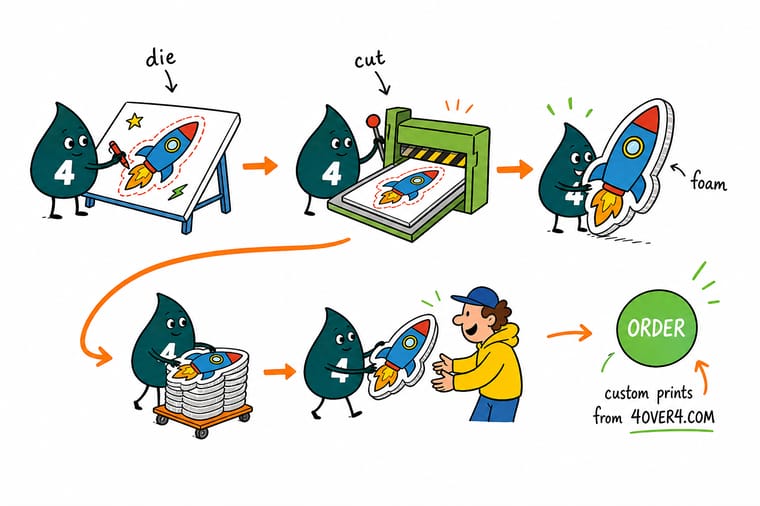
Wally prints the board flat, then hands the cutter the outline he drew. The head travels the path, so the sign comes out shaped like the logo instead of shaped like a rectangle. Watch the corners: his tool is round, so an inside corner always ends up with a curve on it, and it looks much better when Wally drew that curve on purpose. And look at the fresh edge. It is white foam, because only the two paper faces ever saw ink.
Order custom foam core →Specs and pricing
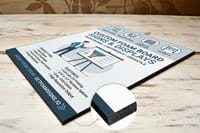
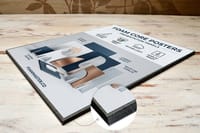
Foam core options, sizes, and starting prices
Compare the foam core products side by side, with live configuration choices and starting prices straight from the 4OVER4.COM configurator.

Print it
Order a board cut to your shape
Explore more
Where to go next

By the numbers
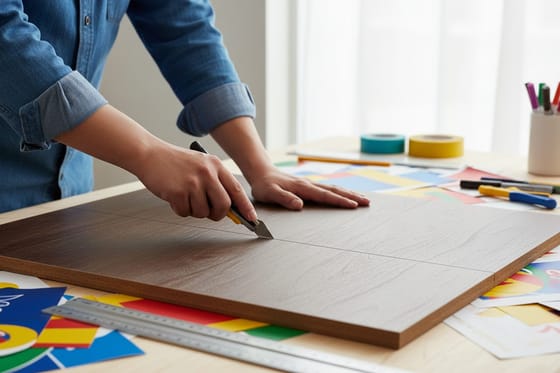
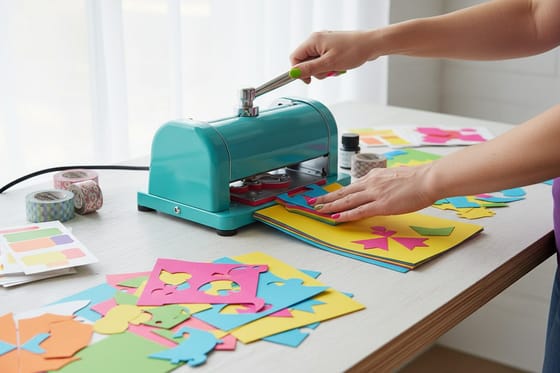
Cutting tables for board shapes like these
Common Questions
Your die-cut foam board questions, answered
What is die-cut foam board?
Die-cut foam board is foam core printed flat and then cut to a custom outline rather than a rectangle. The board itself is a sheet of extruded polystyrene sandwiched between two clay-coated paper liners, usually 3/16 inch thick. It prints on a flatbed UV press, then moves to a cutting table where a router bit or an oscillating knife follows a vector path you supplied in the artwork file. The result is a lightweight rigid shape: a logo silhouette, a product outline, an arrow, a life-size figure. Foam core starts at $49.99 at 4OVER4.COM, and the shaped cut is a step added to that same board.
Is it cut with a steel rule die, like a business card?
No, and the name is a leftover from paper work. Cards and postcards are struck with a steel rule die, a shaped blade pressed through the stock in one hit. Rigid boards go on a flatbed table where a tool travels along a path under computer control. That is why there is no die charge on a foam shape and no minimum quantity tied to making the die, and it is also why the cutting tool has a radius that shows up in every inside corner.
How complicated a shape can you cut?
Outlines with generous curves cut beautifully. What fails is thin material: a narrow neck between two heavy areas, a spindly antenna, a letter cut free from the board with a hairline stem. Foam core has no fiber running through it, so a thin section snaps when someone lifts the piece by the wrong edge or a courier drops the box on a corner. Keep any bridging section at least an inch wide on a 3/16 inch board, and keep small counters, the enclosed holes inside letters like O and A, as printed shapes rather than cut-outs.
Will a die-cut foam board stand up on its own?
Not without help. The board weighs almost nothing, which is the point when you are hanging it and the problem when you want it upright. An easel back holds a shape on a table. A floor-standing figure needs a strut behind it and a foot at the base, and even then a doorway draught will take it down. For anything that must survive an open room with people walking past, either weight the base properly or move the shape to a heavier substrate.
Can a die-cut foam board go outside?
For an afternoon, yes. For a week, no. The paper liner absorbs moisture, the two faces then expand at different rates, and the board bows and delaminates at the edges. A shaped cut makes it worse because every cut edge is raw core with no coating on it. For outdoor shapes use a weather-tolerant rigid board, and for a lawn or a roadside there is the honest cheap answer: yard signs start at $25 and are built for exactly that job.
What do you need in the file for a custom shape?
Three things. A closed vector path on its own layer, drawn as a single continuous outline rather than a stack of overlapping shapes. Artwork extended about an eighth of an inch past that path on every side, so a small cutting shift never leaves a white sliver. And a visible radius drawn into every inside corner. Send the file as a PDF with the cut path preserved as vectors, not flattened into the image. Our blank templates give you a correctly sized starting document if you would rather not build the page from scratch.
Get Started
Foam core signs print in 4 business days at any shape
Send the outline with the artwork, pick your size, and we print the faces flat and cut the board to your path before it ships.
Legal Disclaimer
Gold Standard guarantees apply to all standard orders placed through 4over4.com. Price match requires verifiable proof of a competitor's published price for an equivalent product with matching specifications and turnaround time. Satisfaction guarantee covers manufacturing defects and print quality issues. Contact support with order number and documentation. On-time delivery rate based on tracked orders 1999 to 2026. Individual results may vary based on shipping carrier performance.
