
Creating the Perfect Customer Experience, From First Contact to Reorder


A working method rather than a philosophy: map the journey as it is lived, repair the step that fails most, then decide which moment people will remember and build it on purpose.
A customer experience is close to perfect when every ordinary step does exactly what the customer expected, and one step does more than expected. Get there by writing the journey out in order with the waiting included, fixing the step that fails most often before you spend anything on charm, then choosing one peak moment and one ending and designing both. People remember the best moment and the last moment far more sharply than the average of everything in between.

Quick answer
Reliable in the middle, deliberate at the peak and the ending
Reliability earns you the right to be remembered, and two moments do the remembering. Write the journey out step by step with a timestamp and an owner on each one, and the gaps appear on their own, usually in the handoffs between teams and in the silent stretches. Close those first, because a thoughtful touch added on top of a broken step makes the failure feel personal. Then pick the moment that will be the peak and the moment that will be the last thing the customer touches, and put your budget and your attention into those two while everything else stays boringly consistent.
Map the Journey Your Customers Actually Live

Start with a single sheet and write every point of contact in the order a customer meets them, from the first time they hear your name to the day they buy again. Include the waiting. Most maps skip it, and the waiting is where a good experience quietly turns average.
The common mistake is mapping the business instead of the journey. You end up with a chart of departments, each of which works when you measure it alone. Customers do not experience departments. They experience the seam between them: the question they have to ask twice, the promise sales made that fulfilment never heard, the four silent days between the confirmation email and the tracking number.
Put a timestamp and an owner next to every step. Steps with no owner are where things go wrong, and long steps with no message are where people start telling other people about you for the wrong reason.
| Step | What the customer is deciding | Where it usually breaks | The cheapest fix |
|---|---|---|---|
| Finds you | Are these people real and do they do my kind of work | No proof, stock photography, no address, no phone | Real photos of real work, a phone number that is answered |
| Asks a question | Will they answer before I lose interest | Nobody owns the inbox after 5pm or over the weekend | A named owner per channel and a stated reply window |
| Orders | Is the price the price and is the date the date | Charges and cutoffs revealed at the last screen | Show shipping, tax and the cutoff before payment |
| Waits | Did anything happen or did they forget me | Total silence between confirmation and dispatch | One honest message at the halfway point, even if it says nothing changed |
| Receives | Is this what I pictured | Right product, unclear setup, no idea what to do next | A printed insert in the box that answers the first three questions |
| Hits a problem | How hard will this be to sort out | Front-line staff who have to ask permission | A standing spending limit anyone can use without approval |
Read the third column before the fourth. Nearly every entry is a process gap rather than a spending gap, which is why the work usually starts free. When you do reach the point of buying something, the marketing materials that touch these steps are inserts, cards and boxes, not another advertising campaign aimed at people who already bought.
Repair the Step That Fails Before You Decorate Anything
Order of operations matters more than budget here. A handwritten note tucked inside a package that arrived nine days late does not soften the lateness. It draws attention to it, because now the customer knows you had time to think about them and still missed the date.
So take the three complaints you hear most often over a month, and for each one write the step that produced it rather than the person who reported it. Slow replies are usually a routing problem, not a lazy staff member. Wrong items shipped are usually a picking-label problem. Confusion after delivery is almost always an instruction problem, and it is fixed by a printed sheet that lives in the box, not by a support article nobody searches for.
There is a real trade-off in how far you take this. Fixing failure has a ceiling: a customer whose order simply arrives correctly feels nothing in particular, because that is the deal they paid for. Reliability buys you the right to be considered again, and nothing more. That is exactly why the second half of this guide exists, and why the sequence has to be reliability first, memory second.
One warning about the recovery paradox, the finding that customers who had a problem solved well sometimes end up more loyal than customers who had no problem at all. It is real, and it is not a strategy. It only applies to problems handled fast and generously, most people who hit a problem never bother to complain, and any business that starts treating failure as a loyalty tool ends up with a reputation for failure. Recover brilliantly. Do not manufacture the chance to.
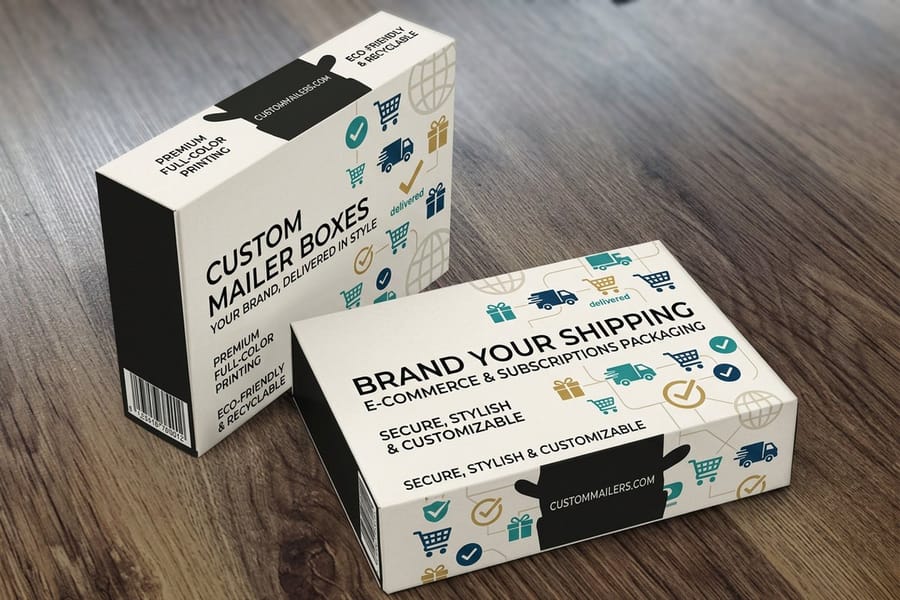
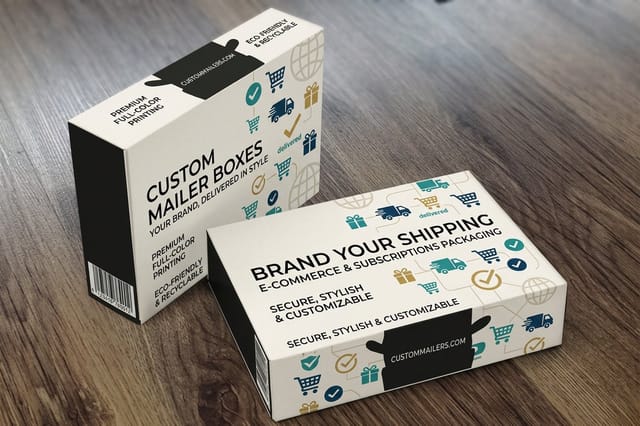
The packaging step is where repair and memory overlap most cleanly. If your product currently arrives in a plain corrugated carton with a shipping label slapped on it, that single step is both a protection question and a first-impression question. Custom mailer boxes start at $711.78, so they are a real commitment and a decision for a business already shipping steady volume, not a first purchase. Below that volume, print the smaller pieces that go inside and keep the carton plain. Our guide to packaging inserts covers what those pieces should say.
Choose the Peak and the Ending, Then Build Them

People do not remember an experience as an average of its parts. They remember its most intense moment and its final moment, and those two carry the story that gets retold. This is the peak-end rule, and it is the most useful idea in this entire guide because it tells you where to concentrate a small budget.
Which means you get to choose. Pick one step to be the peak and one step to be the ending, and treat everything in between as plumbing that should be boring and reliable. Boring is a compliment in the middle of a journey.
For a business that ships things, the peak is nearly always the moment the box opens, and the ending is the last thing the customer touches. That is a printed piece more often than not: a card with a real sentence on it, an insert that explains the next step, a sticker somebody keeps. Business thank you cards start at $19.77, which is small enough that a one-person business can put a signed note in every first order. Sign them by hand and write one specific line about the actual order. A printed signature under a generic sentence reads as bulk mail and is worse than sending nothing.
For a service business, the peak is usually the moment the work is revealed, and the ending is the invoice, which almost nobody designs. An invoice that arrives with a plain summary of what was done, what to expect next, and a card with a direct number on it turns the least loved document in the relationship into the last good impression. Appointment cards start at $17.57 and do the same job for anything booked in advance, because the customer keeps the card and your name sits in a wallet until the next visit.
Small keepable items work as a peak for a reason that has nothing to do with printing: they get taken out of the box and put somewhere. Die-cut stickers start at $93.37 for a run and end up on laptops and water bottles. Choose them because your customers are the kind of people who put stickers on things, and skip them if they are not. Copying somebody else's peak is how you end up with a drawer full of unused branded objects. If you want the whole set of touchpoints in one place, the marketing materials collection and our note on writing a thank you card are the practical starting points.
Give the Front Line Permission, Not a Script
When recovery goes badly, the cause is usually permission rather than attitude. The person on the phone knew exactly what would fix it in the first two minutes and had to ask somebody who was in a meeting. By the time approval came back, the customer had told three people about the wait rather than the problem.
Set a standing limit that any staff member can spend to close a complaint without asking. The number matters less than the fact that it exists and is written down. Pair it with two rules: solve it in the first contact wherever possible, and tell the customer what you are doing rather than asking them to choose from a menu of remedies while they are annoyed.
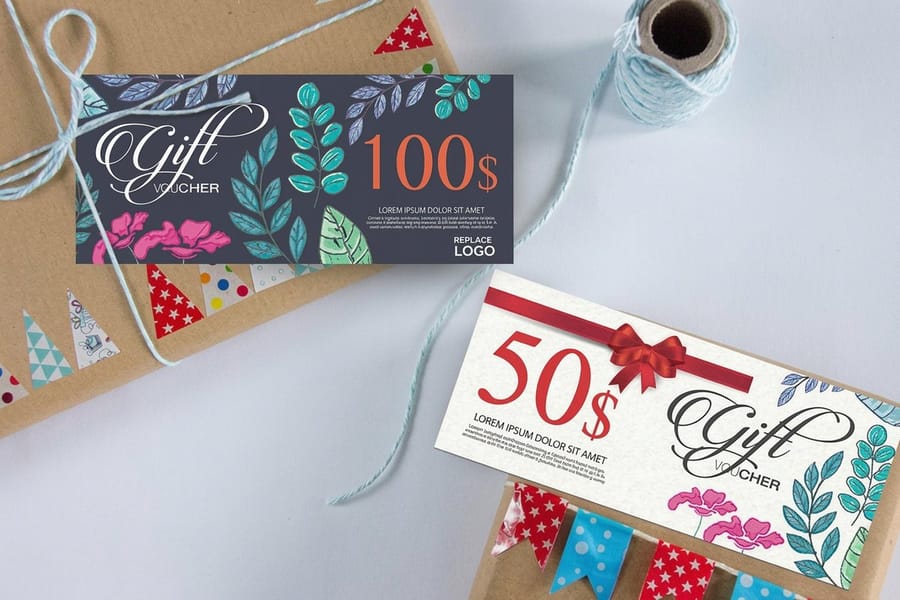
Prefer a remedy over a discount. Discounts train people to wait for the next problem and quietly price your apology at your own margin. A replacement dispatched today, a refunded shipping charge, or a gift certificate at $42.84 that the customer spends on something they chose all read as repair rather than as a bribe. Keep a small stack of printed certificates where the team can reach them, because an object handed over closes a conversation better than a promise of a code by email.
Then close the loop internally. Every remedy spent is a data point about a broken step, so log the reason next to the amount. If the same reason appears five times in a month, you have found the next thing to fix in the map from the first section, and you found it without running a single survey.
Measure Two Things You Will Actually Act On

Pick one relationship measure and one effort measure, give each a named owner, and stop there. A dashboard of nine scores with nobody responsible for any of them changes nothing, and it takes up the meeting time that could have gone to the map.
The measures have honest limits worth knowing before you choose. A recommendation score tells you about the relationship overall but moves slowly and hides which step caused the change, so it is a trend line rather than a diagnosis. A satisfaction score right after one interaction tells you about that interaction and nothing about the relationship. An effort question, meaning how hard the customer had to work to get what they needed, predicts whether somebody comes back better than either of the other two for support and service work, and it points straight at a fixable step. Whichever you choose, the written comment underneath is worth more than the number, so read the comments first.
Timing does more damage than the choice of metric. A review request that goes out while the parcel is still in transit measures your email schedule. Ask a service customer within a day of finishing, while the detail is fresh, and ask a product customer a few days after delivery, once they have used the thing. Once per experience, never twice for the same order.
Watch the sample as well. Surveys are answered by the delighted and the furious, so the quiet middle, which is most of your customers, is missing from every average you look at. Balance it with things people do rather than say: repeat purchase rate, how many contacts it took to close a ticket, how many orders needed any remedy at all. For a business without a large email list, a printed request works well. A postcard from $16.48 in the box, or a QR code on the receipt, catches the customer at the moment they are holding the thing, and our guide to QR codes for Google reviews covers that setup. Feed everything back into the journey map, and treat the map as a living sheet rather than a project that finished.
Wally explains the two moments that stick
The best bit and the last bit, not the average
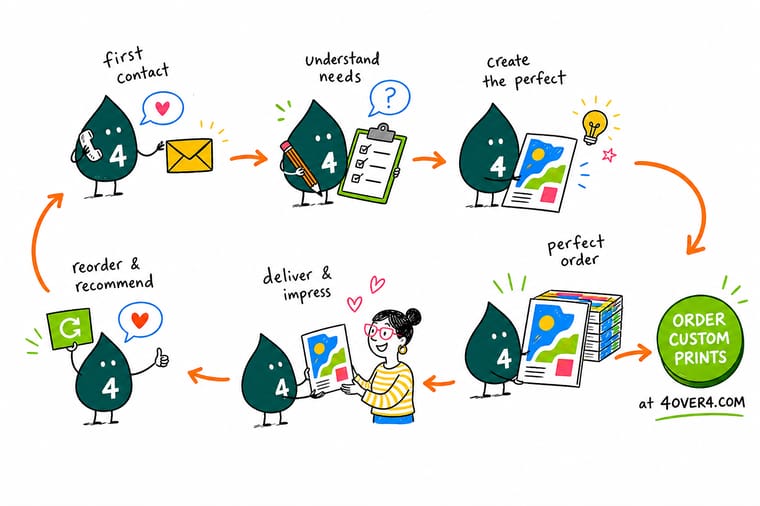
Wally draws the whole journey on one line: found us, ordered, waited, opened the box, hit a snag, came back. He marks two dots. The high point, which for most businesses is the box opening, and the very last thing the customer touches. Those two dots are the story people tell later. Everything between them just has to be dependable and on time, so Wally keeps the middle plain and spends his money on the note inside the box.
Order business thank you cards →Specs and pricing
The printed touchpoints, sizes and starting prices
Configure the pieces that carry the peak and the ending, with live options and starting prices straight from the 4OVER4.COM configurator.



Print it
Print the moment people remember


Explore more
Where to go next






By the numbers
A printing partner your customers never have to think about
Common Questions
Your customer experience questions, answered
What actually makes a customer experience good?
Two things, in this order. Every ordinary step does what the customer expected it to do, and one step does more than expected. The first part is plumbing: the site loads, the price is the price, the order arrives when you said it would, and the reply comes back the same day. The second part is the moment somebody talks about afterwards. Businesses get this backwards constantly, adding a memorable touch on top of a process that still loses orders, and the memorable touch just makes the failure feel more personal.
Where do most customer journeys break?
In the handoffs and in the silence. A customer moves from marketing to sales to fulfilment to support, and each team believes its own part works, because measured alone each part does. What nobody owns is the seam between them, where a question gets re-asked, a promise made in one place is unknown in the next, or the order sits for four days with no message. Map your journey with a timestamp on every step and the empty stretches show up immediately.
Is a physical touch still worth it when everything else is digital?
It is worth it precisely because everything else is digital. A card or a printed insert survives the inbox, it costs a few cents per customer at volume, and it arrives at a moment the customer is already paying attention because the box is open in front of them. Business thank you cards start at $19.77 at 4OVER4.COM, which puts a signed note inside a first order within reach of a very small business. The limit is honesty: it must be genuinely written and genuinely relevant, because a printed signature on a generic sentence reads as bulk mail and does more harm than sending nothing.
How do I fix an experience when the budget is small?
Spend nothing on the fix that costs nothing first. Write down the three complaints you hear most in a month, and for each one find the step that causes it rather than the person who reports it. Slow replies are usually a routing problem. Wrong items are usually a picking-label problem. Confused customers are usually an instruction problem, solved by a printed insert that lives in the box instead of a support article nobody searches for. Only once those are closed does it make sense to buy anything.
Should I say sorry with a discount?
Rarely with a discount, often with something the customer chooses. A discount trains people to wait for the next problem and it prices your apology at whatever margin you gave away. A replacement sent immediately, a shipping refund, or a gift certificate the customer can spend on what they actually want lands better and keeps the relationship on your terms. Gift certificates start at $42.84, which makes a stack of them a practical tool to hand front-line staff.
How often should I ask customers for feedback?
Once per experience, at the moment the value has landed, and never twice for the same order. Asking at the wrong time is the most common self-inflicted wound: a review request sent when the package is still in transit measures your email timing, not your product. Ask a service customer within a day of the job finishing while the detail is fresh, and ask a product customer a few days after delivery, once they have used the thing.
Get Started
25 thank you cards cost $19.77, or 79 cents each
Pick the piece that carries your peak or your ending, sign it yourself, and let the rest of the journey stay quietly on time.
Legal Disclaimer
Gold Standard guarantees apply to all standard orders placed through 4over4.com. Price match requires verifiable proof of a competitor's published price for an equivalent product with matching specifications and turnaround time. Satisfaction guarantee covers manufacturing defects and print quality issues. Contact support with order number and documentation. On-time delivery rate based on tracked orders 1999 to 2026. Individual results may vary based on shipping carrier performance.
