
Clear Stickers vs White Stickers: Which Material Wins


One is transparent film, one is an opaque white face, and the surface you stick them to decides which is right. They behave differently with color, white type, kraft packaging and glass.
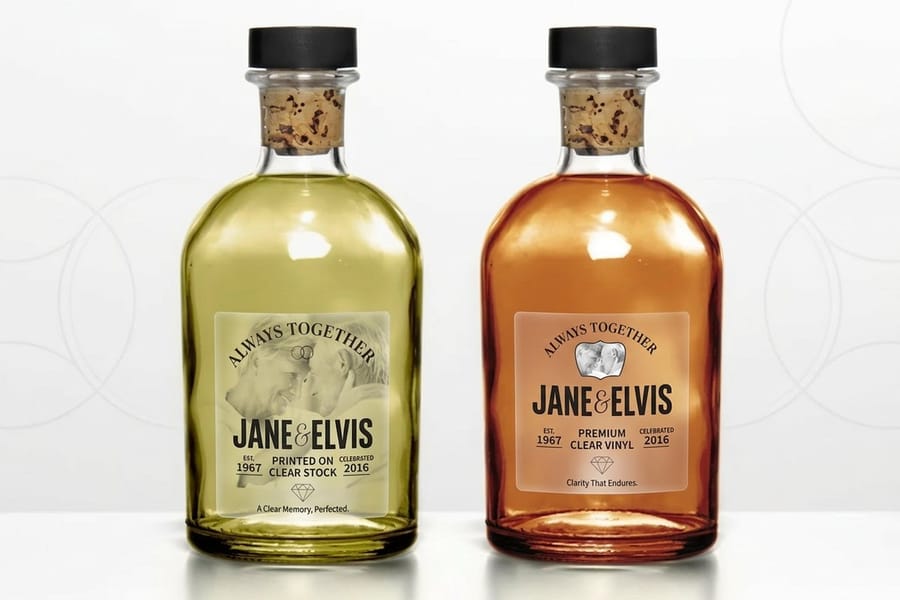
Clear stickers print on transparent film, so whatever they sit on becomes the background and pale colors lose strength. White stickers print on an opaque white face, so the artwork looks the same on every surface. Choose clear for glass, white packaging and the no-label look. Choose white for kraft, dark or unknown surfaces, and for any design with white type, pale tints or a photograph. Both start at $25.00 at 4OVER4.COM, so the surface decides, not the price.
Quick answer
One layer of white is the whole argument
White vinyl carries an opaque face under the ink. Clear vinyl carries nothing, so the product becomes the background. That is why a design proofed on a white screen can go muddy the moment a clear sticker lands on a kraft box, and why white type on clear film prints as bare film unless you pay for a white underbase. Clear rewards glass, pale packaging and a clean surface. White is the safe default everywhere else, and it is the only sensible choice when you do not control what the sticker gets stuck to.
What Actually Changes Between Clear and White Stock
Both stickers start as the same vinyl and go through the same press. The only structural difference is the face material: white stock has an opaque layer under the ink, and clear stock does not.
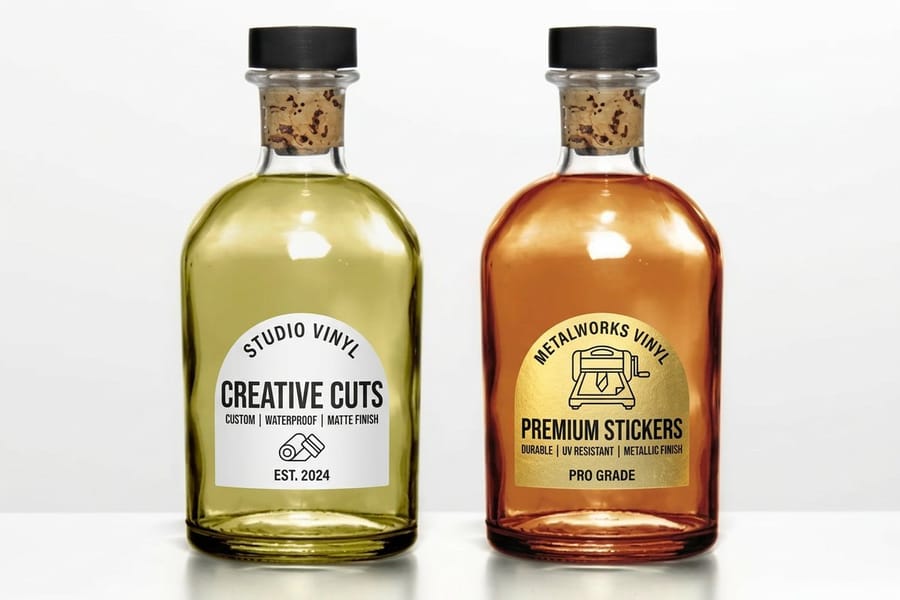
That single layer decides everything else. Ink is not opaque. A 20 percent cyan tint printed on white vinyl reads as pale blue because the white behind it is reflecting light back through the ink. Print the identical tint on clear film and stick it to a kraft box, and the light comes back brown. The color you approved on screen is now a mix of your ink and the box.
Designers usually discover this at the white type stage. There is no white ink in a normal CMYK run, so anything white in your file is simply an instruction to leave the film untouched. On white stock that instruction produces white, because the face material is white. On clear stock it produces a window. Our guide to white stickers and white ink covers the underbase option in detail if you want the clear film and the solid white at the same time.
Everything downstream follows from the face material: how forgiving the application is, which surfaces work, and how much of the design you can trust to survive the jump from screen to product. Both options sit in the same sticker printing range, and clear stickers and vinyl stickers both start at $25.00.
The Surface Decides, Not the Design
Ask what the sticker is going onto before you ask what it should look like. That answer settles the material about eight times out of ten.
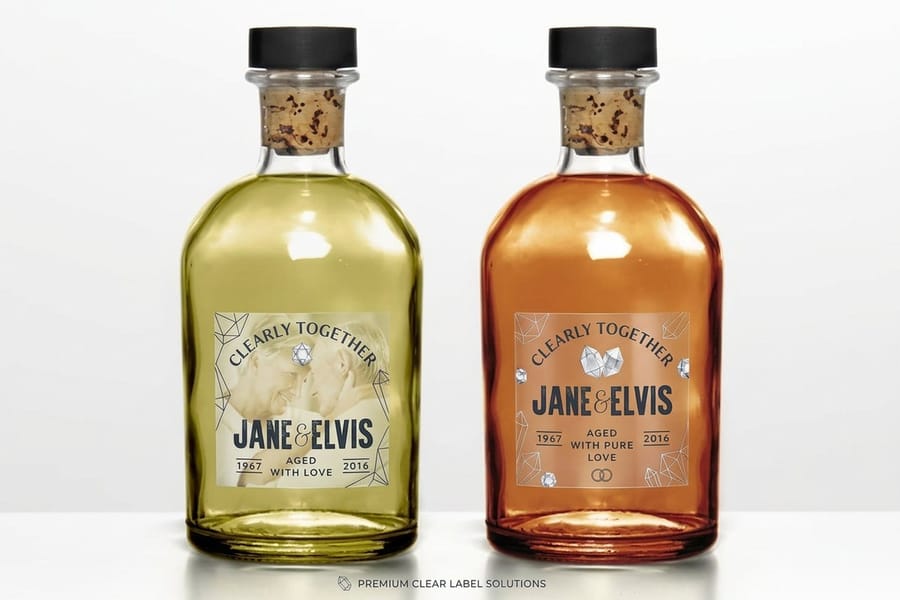
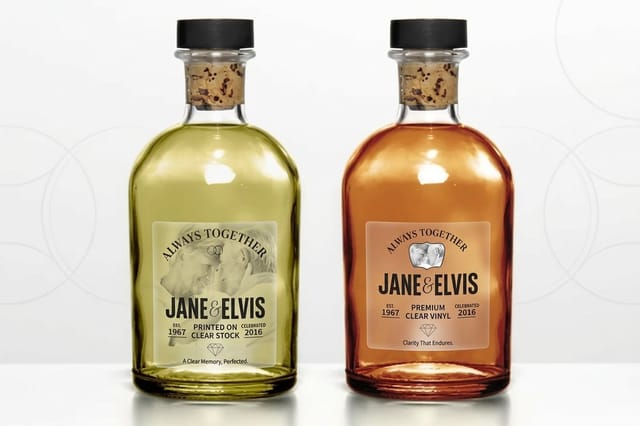
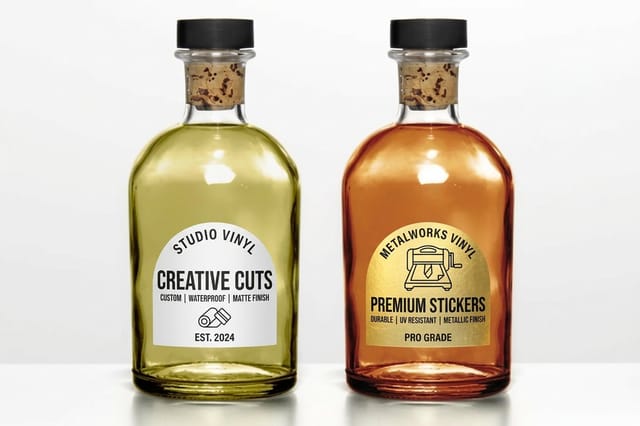
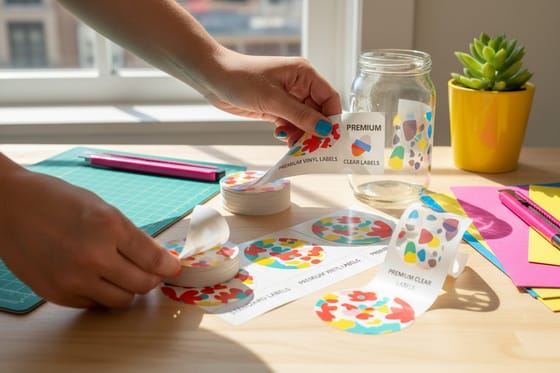
Clear film earns its place on glass, on white or very pale packaging, on acrylic displays and on shop windows. The film vanishes, the printed shapes appear to float on the product, and there is no rectangle of white announcing that a label was applied. It is the reason cosmetics, spirits and premium food brands keep coming back to clear labels for the no-label look.
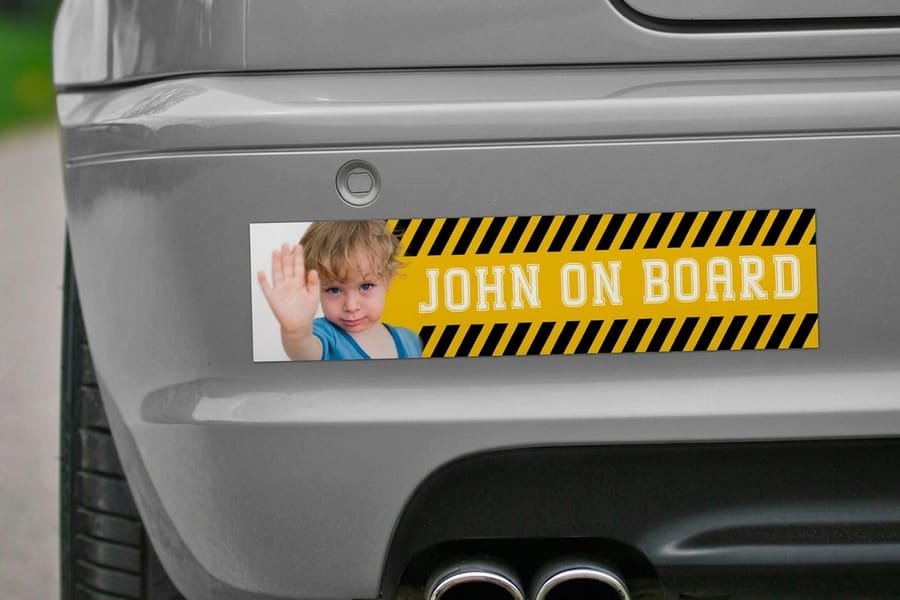
White film is the safer buy on kraft cartons, colored bottles, dark plastic, painted metal, laptop lids and anything textured. It is also the right call whenever you do not control the surface. Handout stickers end up on water bottles, phone cases, notebooks and car bumpers in a dozen colors, so a design that only survives on white is a design that fails most of the time. That is why nearly every bumper sticker is printed on white stock, and why they start at $38.44 rather than at the sticker sheet price.
One more surface detail that costs people a reprint: clear film shows what is underneath it, including dust, lint, fingerprints and scratches in the paint. If the run is going onto secondhand jars or an outdoor window that nobody will clean first, white stock hides the mess. The waterproof sticker guide covers the laminate and adhesive side of the same decision.
Clear vs White Stickers, Side by Side
Six attributes decide most of these jobs. Read the second column first, because color behavior is the one that causes reprints.
| What you are judging | Clear vinyl | White vinyl |
|---|---|---|
| Color accuracy | Shifts with the surface behind it. Pale tints lose most of their strength. | Matches the proof on any surface because the face blocks what is behind it. |
| White in the artwork | Prints as bare film unless you add a white underbase pass. | Prints as the stock itself, at no extra cost. |
| Best surfaces | Glass, acrylic, white and pale packaging, clean windows. | Kraft, dark or colored packaging, textured plastic, painted metal, unknown surfaces. |
| Edge appearance | The cut edge disappears, so shapes look printed onto the product. | A visible white border, which can be used deliberately as a sticker outline. |
| Application tolerance | Unforgiving. Bubbles, lint and misalignment are all on display. | Forgiving. Small flaws hide behind the opaque face. |
| Starting price at 4OVER4.COM | $25.00 for clear stickers. | $25.00 for vinyl stickers, $93.37 for die-cut shapes. |
Note what the price row does not say. The two materials cost the same to start, so anybody choosing clear to save money has misread the quote. The cost only moves when you add a white underbase to clear film, or when you move to a contour cut. Die-cut stickers start at $93.37 and are available on either face, and the same comparison applied to product labels sits in our paper, vinyl and clear label guide.
The Verdict, and How to Set Up Whichever You Pick
White vinyl is the default. Choose it unless you have a specific reason not to, because it prints what you approved, on any surface, with no extra pass and no application anxiety. Clear film is the specialist: pick it when the surface is light and smooth, when you already know exactly what it is, and when the point of the piece is that it should not look like a sticker.
If you go clear, set the file up for it. Place a rectangle in the real surface color on the bottom layer of your artboard so you are proofing against the kraft brown or the amber glass instead of against a white screen. Push tints above roughly 30 percent so they still hold. Keep small type in a dark, saturated color. If one element genuinely must stay white, ask for a spot white layer on that element rather than a full underbase, and name the layer White so it is unambiguous. The transparent sticker setup guide walks through the file build step by step.
If you go white, spend the saved effort on the cut instead. A contour cut on white stock removes the rectangle and gives you a shaped sticker with a clean outline, which is often the look people were chasing when they asked for clear in the first place. Our sticker materials guide compares the faces alongside paper and BOPP.
Still deciding? Order free samples and stick one of each onto the actual product. Ten minutes with a real jar settles an argument that a screen proof never will. When you are ready, the full range sits under sticker printing, and product labels under label printing.
Wally explains clear vs white
Hold it up before you order it
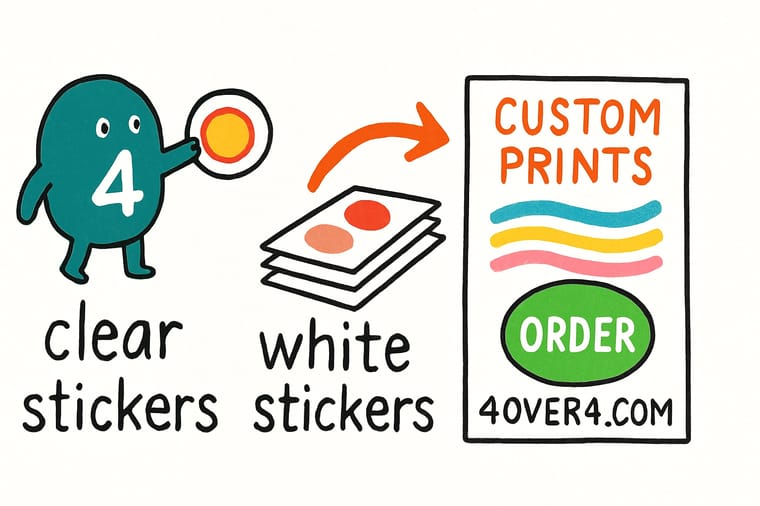
Wally sticks the same artwork on both films and puts them on a kraft box. On the white sticker the colors look exactly like the proof. On the clear one the pale blue turned brownish and the white brand name vanished, because there is no white ink hiding under the color. His rule is short: light, smooth, known surface means clear, and everything else means white.
Compare clear and white sticker pricing →Specs and pricing
Clear, white and die-cut, with live options
Sizes, materials, quantities and starting prices pulled straight from the 4OVER4.COM configurator, so you can price both faces before you commit artwork to one.

Print it
Order the face that suits your surface
Explore more
Where to go next


By the numbers
The sticker printer behind both options, counted
Common Questions
Clear and white sticker questions, answered
Are clear stickers or white stickers better?
Neither is better on its own. Clear stickers win when the surface behind them is light and smooth and you want the artwork to look like it was printed onto the product, which is why they suit glass jars, white boxes and shop windows. White stickers win when color has to stay accurate, when the surface is dark, textured or unpredictable, and whenever the design contains white type, pale tints, gradients or a photograph.
Do clear stickers print white?
Not by default. A standard clear sticker is printed in CMYK on a transparent film, and anything set to white in your file simply comes out as bare film. To get solid white on a clear sticker you have to order a white underbase, which is a separate ink pass laid under the color. If your whole design leans on white, ordering white vinyl stickers is usually simpler and cheaper than paying for the extra pass.
Will a clear sticker look invisible on kraft packaging?
No, and this is the most common misuse we see. Kraft is brown, so every light color in the artwork mixes with brown and the design loses contrast. Two things work instead: keep the design to dark, saturated colors so it still reads against kraft, or order a white sticker and treat the visible white border as part of the label design.
Which one holds up better outdoors?
Both do, because the durability comes from the vinyl and the laminate rather than from the color of the face. A permanent adhesive vinyl sticker with a laminate handles rain, sun and washing on either stock. The practical difference outdoors is that a clear sticker on a dirty or scratched surface will show that surface through the film, so a car window that is not spotless flatters white stock more.
Do I need to design differently for clear stock?
Yes, in three ways. Build the artwork against a background swatch that matches the real surface so you can see what will actually happen, avoid tints under roughly 30 percent because they nearly vanish, and never place small white type over open film. If the design has one small element that must stay white, ask for a spot white layer on that element only rather than under the whole sticker.
What about clear labels on bottles?
Clear labels give the no-label look brands want on drinks, oils and cosmetics, and they start at $25.00 at 4OVER4.COM. The trade-off is that the liquid becomes the background: a clear label on a dark bottle behaves like printing onto black, and a pale amber liquid will tint everything on the label. Order a sample before committing a full run to a colored bottle.
Get Started
25 die-cut stickers cost $93.37, clear stock ships in 3 business days
Pick clear film for glass and pale packaging, white vinyl for everything else, then choose your size, cut and laminate. We print both on the same press with the same turnaround.
Legal Disclaimer
Gold Standard guarantees apply to all standard orders placed through 4over4.com. Price match requires verifiable proof of a competitor's published price for an equivalent product with matching specifications and turnaround time. Satisfaction guarantee covers manufacturing defects and print quality issues. Contact support with order number and documentation. On-time delivery rate based on tracked orders 1999 to 2026. Individual results may vary based on shipping carrier performance.
