
Carrier Package Size and Weight Limits Every Shipper Should Know


Emma is our prepress and print production voice, built from the knowledge of our production team, with over 20 years in printing.
FedEx, UPS and USPS each cap how big and how heavy a parcel can be, then charge extra long before you reach those caps. Here is what each carrier allows, how dimensional weight is calculated, how to size packaging so your rate stays predictable, and how to size the printed inserts, buckslips and labels that ride inside the box at almost no weight.
FedEx and UPS accept parcels up to 150 pounds, 108 inches in length and 165 inches in length plus girth. USPS stops at 70 pounds, with 108 inches length plus girth on Priority Mail and 130 inches on Ground Advantage. Girth is twice the width plus twice the height. Carriers bill the greater of actual weight and dimensional weight, which is length times width times height divided by 139 on most domestic parcel agreements.

Start here
What each carrier actually allows
A parcel is measured by four numbers and priced by two. The four are length, width, height and scale weight. The two are length plus girth, and billable weight. FedEx and UPS accept up to 150 pounds and 165 inches of length plus girth. USPS accepts up to 70 pounds. Surcharges begin well below those ceilings, so the money is saved by choosing a smaller carton, not by arguing about the base rate. The print inside that carton weighs next to nothing: a custom die-cut insert from 50 for $87.00 and a 3.5 by 8.5 inch buckslip from 25 for $27.46 add grams, not pounds.
How carriers measure size and weight before they price anything

Every parcel invoice starts with four measurements: length, width, height and scale weight. Carriers take the longest side as the length, then calculate girth as twice the width plus twice the height. Add the two together and you have length plus girth, the single figure that decides whether your box travels as an ordinary parcel or as an exception.
Measurements are taken at the widest point of the package, including any bulge in the corrugated board, and every dimension is rounded up to the next whole inch. A carton that measures 12.1 inches is billed as 13. Automated dimensioners on sortation lines re-measure parcels in transit, so the numbers on your manifest are checked against reality whether you like it or not.
The same discipline applies to printed pieces that travel inside the box. If you are used to thinking about trim sizes on a press sheet, the logic will feel familiar. Our complete guide to postcard sizes and dimensions covers the same idea at a smaller scale, where a fraction of an inch moves a mailer from one postal category into another.
FedEx size and weight limits

FedEx Ground and FedEx Home Delivery accept parcels up to 150 pounds, up to 108 inches in length, and up to 165 inches in length plus girth. FedEx Express services share the same 150 pound cap and the same 165 inch combined limit, with a slightly longer allowance on the single longest side for certain services.
Anything past those numbers is not simply expensive, it is outside the service. Pieces over the cap are handled by FedEx Freight, which is a different network with its own pickup process and its own transit commitments. Planning a product line that lands at 152 pounds packed is a decision to become a freight shipper, and that is worth knowing before the first carton is ordered.
Packaging inserts, warranty cards and return instructions ride along at almost no weight cost, which is why they are the cheapest brand touch in the whole box. A custom die-cut paper piece starting at $87.00 can be cut to the exact footprint of your carton so it sits flat and adds nothing to your dimensional profile.
UPS size and weight limits
UPS mirrors the ground standard closely: 150 pounds maximum per package, 108 inches maximum length, and 165 inches maximum length plus girth. Cross any one of those and the shipment falls under the over maximum limits treatment, which carries a charge large enough to make splitting the contents across two boxes the obvious answer.
UPS also applies a large package charge well before the hard cap. Once length plus girth passes 130 inches, the parcel is billed at a minimum billable weight regardless of what the scale says, and additional handling can apply on top. That is the trap most shippers walk into, because the box is perfectly acceptable to the network yet priced as if it were far heavier.
Keep a printed reference at the pack bench with the thresholds written out in inches, and keep the unit conversions on it too if you ship internationally. The habit is the same one that keeps print jobs consistent, which our reference on card sizes and dimensions in inches and millimeters was built to support.
USPS size and weight limits

The Postal Service works to a much lower ceiling. Domestic packages max out at 70 pounds. Priority Mail allows up to 108 inches in length plus girth, while USPS Ground Advantage allows up to 130 inches. Girth is measured around the thickest part of the parcel, perpendicular to the length, exactly as the private carriers do it.
Those lower caps are not a weakness. For small, dense, low-value shipments the Postal Service is frequently the cheapest way to reach a residential address, and flat rate packaging removes dimensional weight from the equation entirely as long as the lid closes normally. The rule is simple: heavy and compact goes postal, light and bulky usually does not.
Labels matter more here than anywhere else, because postal handling is rougher on adhesives. If you are deciding between formats for your address and content labels, our breakdown of rolled, cut-to-size and sheet stickers explains which one feeds a thermal applicator cleanly and which one is better hand-applied.
Dimensional weight explained without the math anxiety

Dimensional weight exists because trucks and aircraft run out of space long before they run out of payload. Carriers convert the volume your box occupies into a weight equivalent, then bill you on whichever number is larger, the scale weight or the dimensional weight. That larger figure is called the billable weight.
The formula is short. Multiply length by width by height in inches, rounding each one up first, then divide by your divisor. Domestic parcel agreements commonly use 139, while retail counter and some postal calculations use 166. A box measuring 20 by 16 by 12 inches comes to 3,840 cubic inches, which divides to roughly 28 pounds at a divisor of 139. If the contents weigh nine pounds, you still pay for 28.
Two habits fix most of the damage. First, measure your real cartons rather than trusting the supplier spec, because flute thickness and tape add height. Second, keep a short ladder of box sizes instead of one universal carton. Large-format products such as 2 sided blockout banners at $108.75 ship rolled precisely because a roll carries far less dimensional penalty than a flat crate, and the same thinking applies to custom posters in every size.
Oversize and overweight surcharges that quietly inflate your rate

The base rate is rarely what you pay. Surcharges sit on top of it, and the ones tied to size and weight are the most predictable and the most avoidable. Additional handling applies to pieces that are unusually heavy, unusually long, or packaged in something a conveyor cannot grip, such as a plastic pail, a wooden crate or an unwrapped tube.
- Additional handling by dimension. Triggered when the longest side or the second-longest side passes a published threshold.
- Additional handling by weight. Triggered on single pieces above roughly 50 pounds, well below the network cap.
- Large package or oversize. Triggered when length plus girth passes the published limit, with a minimum billable weight applied.
- Over maximum limits. Triggered when the parcel exceeds the network cap on weight, length or length plus girth.
- Peak and demand. Seasonal versions of all of the above, layered on during the busiest weeks of the year.
Pull one month of invoices, filter for accessorial lines, and sort by frequency. Most operations find that a single SKU in a single carton is responsible for the bulk of the charges. Fixing that one packing configuration usually pays for a full year of printed packaging.
Choosing a box that ships affordably

A good shipping box is the smallest one that protects the product. Measure the item at its widest points, add the cushioning it actually needs rather than the cushioning that makes you feel better, and choose from a short list of stock sizes so your team is never improvising at the bench. Then test the finished pack against the thresholds above before you commit to a purchase order.
Compact, dense products are the easy win. A 3 in 1 foldable wireless charger at $15.00 fits in a carton small enough that dimensional weight never becomes the billable figure, which is why accessories and promotional items ship so cheaply compared with their retail value. The pain begins when a light product is packed in a box chosen for a heavier one.
Fill the empty space with something that earns its place. A thin printed insert costs almost nothing in weight and gives the unboxing a voice, which is the same argument behind printed buckslips, and the buckslips video shows one printed and cut. Void fill protects the product. A printed piece protects the relationship.
Size the printed piece to the carton, in this order:
- Measure the inside floor of the box, then pick an insert size a little smaller so it drops in flat: a 4 by 6 or 5 by 7 inch card for a small mailer, 8.5 by 11 inches for a document carton.
- Pick the stock by the job. 14pt or 16pt cover for a card that has to stay stiff, 100# gloss or silk text for a buckslip that folds into a sleeve, 18pt kraft for a natural look.
- Die-cut only when the shape helps, for example an insert cut to hold the product in place. Our die-cut paper comes in 16 sizes from 2 by 2 to 9 by 9 inches.
- Build the file at size with 0.125 inch of bleed, put the return address or reorder code on it, and order enough for a month of shipments.
Labeling your package correctly so it moves without exceptions
A compliant parcel still gets delayed if the label fails. Place one shipping label on the largest flat face, keep it clear of seams, edges and tape, and never fold a barcode around a corner. Remove or fully cover old labels, because a scanner reading a previous route is the most common cause of a package touring the country before it reaches a customer.
Print thermal labels at full size, check that the barcode has quiet space around it, and avoid glossy coatings on the label face where a scanner beam can bounce. If you apply by hand, press from the center outward so no corner lifts in a humid trailer. Our guide on how to make barcode labels that scan every time covers the quiet zone and the label stock in more depth. Durable adhesive stock is worth the small premium here, the same way it is worth it on the outdoor sticker work that has to survive weather for years.
The outside of the box is brand surface too. Specialty finishes such as 3D lenticular printing belong inside the carton rather than under a scanner, and if you ship internationally it is worth reading up on business etiquette around the world before you decide what goes in the box for a customer in another market.
Wally explains billable weight
Carriers charge for the space your box takes, not just what it holds
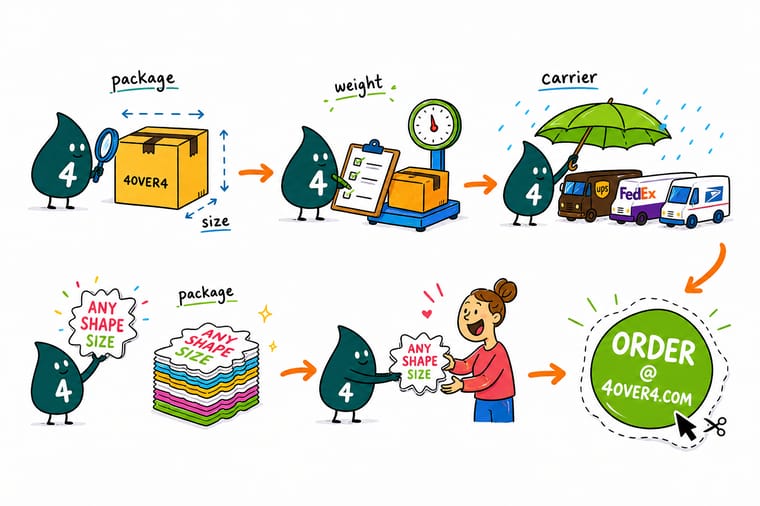
Wally packs the same product twice. In a snug carton it bills at its real nine pounds. In a carton two inches larger on every side, the dimensional math turns it into twenty-eight pounds and the invoice triples. Nothing about the product changed, only the air around it. Measure the item, cushion it properly, then choose the smallest box that still protects it.
Print custom die-cut inserts →
Infographic
Carrier limits at a glance
One frame with the caps (150 pounds and 165 inches of length plus girth for FedEx and UPS, 70 pounds for USPS), the divide by 139 formula and the fee triggers. Save it, print it, and tape it above the pack bench where the box gets chosen.
Carrier tariffs are revised at least once a year, so treat these figures as the working baseline and confirm the current thresholds in your carrier service guide before you order a pallet of cartons.
Specs and pricing
Die-cut insert specs and live pricing
Once the carton is chosen, the printed pieces inside it are the cheapest weight you will ever ship. Custom die-cut paper prints on 32 stocks from 14pt gloss cover to 18pt kraft, in 16 sizes from 2 by 2 to 9 by 9 inches, one or both sides, from 50 for $87.00 in 5 business days.

| Quantity | Price Per Unit | Total |
|---|---|---|
| 50 | $1.74 | $87.00 |
| 100 | 91.0¢ | $91.00 |
| 200 | 51.2¢ | $102.50 |
| 300 | 37.7¢ | $113.00 |
| 400 | 30.9¢ | $123.50 |
| 500 | 26.6¢ | $133.00 |
| 600 | 24.0¢ | $144.00 |
| 700 | 22.1¢ | $155.00 |
Print it
Packaging and promotional print from 4OVER4
Die-cut inserts start at 50 for $87.00. Two sided blockout banners start at $108.75 on 15oz blockout vinyl and ship rolled to keep dimensional weight down. The 3 in 1 foldable wireless charger costs $15.00 and fits a carton small enough that its scale weight stays the billable one.



See it in use
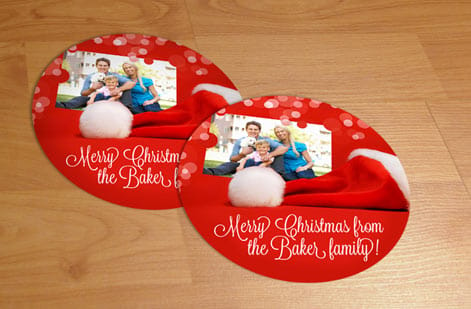
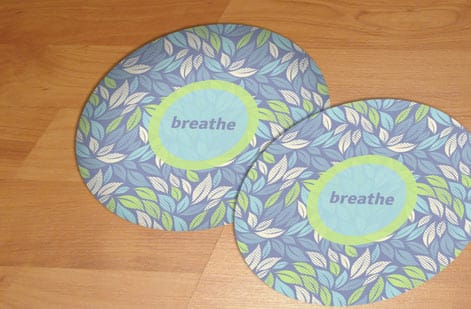
Custom die-cut pieces from customer files







Explore more
Where to go next






By the numbers
One thousand products, sized to fit a carrier limit
Common Questions
Common questions about carrier size and weight limits
What is a carrier weight limit?
A carrier weight limit is the heaviest single parcel a shipping network will move under its standard parcel service. FedEx and UPS both stop at 150 pounds per piece in their ground and express networks, while the Postal Service stops at 70 pounds. Above those thresholds a shipment is no longer a parcel. It becomes freight, which is quoted on a different rate sheet, tendered with a bill of lading, and usually palletized before pickup.
Will a smaller box actually lower my rate?
Start with the product, add the protection it genuinely needs, and stop there. Measure the item, allow enough room for cushioning on all six sides, then pick the smallest stock carton that fits. Once you have candidate dimensions, run the dimensional weight math before you buy pallets of that box. A carton that adds two inches in each direction can push a light shipment into a higher billable weight on every single order for the rest of the year.
What do oversize and overweight shipments cost, and how are those fees set?
Carriers publish surcharge tables rather than a single price. Additional handling applies when a piece is heavy, long, or packaged in something other than corrugated board. Large package and oversize charges apply when length plus girth crosses the published threshold. Over maximum limits charges apply when the parcel exceeds the network cap entirely. Rates change with each annual general rate increase, so price against the current service guide rather than last year figures.
What sizes, stocks and finishes work for shipping labels and package inserts?
Die-cut paper pieces can be produced in any shape and size you specify, which covers everything from a small return-policy card to a full-panel carton wrap. Stocks range from lightweight text weight for inserts to heavier cover stocks for hang tags. Matte, gloss and soft-touch coatings are all available, and matte tends to be the safer choice for anything a courier will scan or a customer will write on.
How long does printing take before my packaging is ready to ship?
Production turnaround is quoted per product and per quantity on the product page, and the timer starts once artwork passes preflight. Build the print lead time into your launch calendar rather than your pick-and-pack week, because a carton that arrives late forces you into whatever box you already have, and that is exactly how oversize surcharges enter a fulfillment operation.
How is dimensional weight calculated?
Multiply length by width by height in inches, rounding each measurement up to the next whole inch, then divide the result by the divisor in your carrier agreement. Domestic parcel rates commonly use 139, while retail and some postal calculations use 166. Compare that figure with the actual scale weight. Whichever is greater becomes the billable weight, and that is the number your invoice is built from.
What happens if my package is over the maximum limit?
It may be refused at pickup, returned to you at your own cost, or delivered with an over maximum limits charge that dwarfs the original rate. Some networks also void service guarantees on pieces that exceed the cap. The safe move is to split the contents across two compliant parcels or to tender the shipment as freight, which is designed for weight that parcel conveyor systems cannot handle.
Get Started
50 die-cut inserts cost $87.00, or $1.74 each
Print custom die-cut inserts, labels and packaging collateral sized to your carton, produced in-house and shipped on schedule by 4OVER4.COM.
Legal Disclaimer
Gold Standard guarantees apply to all standard orders placed through 4over4.com. Price match requires verifiable proof of a competitor's published price for an equivalent product with matching specifications and turnaround time. Satisfaction guarantee covers manufacturing defects and print quality issues. Contact support with order number and documentation.
