
Notebook Planner Systems That Beat Productivity Apps


Emma is our prepress and print production voice, built from the knowledge of our production team, with over 20 years in printing.
Why a Paper Planner Still Beats Another Productivity App
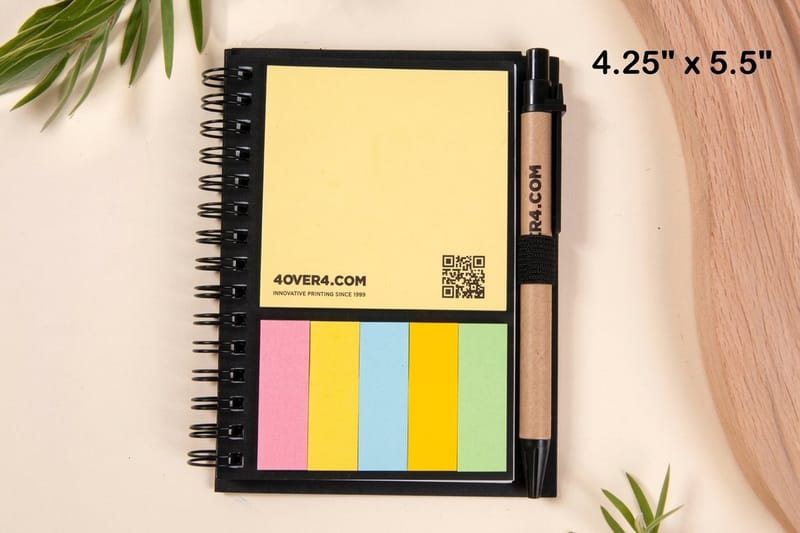
A notebook productivity system wins on friction. An app gives you infinite room, infinite lists, and a notification budget you never agreed to. A page gives you one surface and a hard edge. When the day has to fit in the space you drew for it, you stop collecting tasks and start choosing them, which is the entire job of planning in the first place. That page is cheap to test: a ready-made deluxe spiral notebook at 4.25 by 5.5 or 5 by 7 inches costs $5.00 and ships in 1 business day, so you can rule your own layout by hand this week, then print the version that works as a spiral coil book for the team.
The second advantage is memory. Writing a task out by hand is slower than typing it, and that slowness is the feature. You rehearse the commitment while you form the letters, and you remember it later without opening anything. Nothing syncs, nothing updates, and nothing quietly reorders your priorities overnight because a product team shipped a new default view.
Analog also survives your worst days. A dead battery, a locked laptop, or a meeting where screens feel rude are all normal, and paper handles every one of them. That is why so many people who live in software all day keep one physical notebook next to the keyboard for the short list that actually runs the day. If you want a structure for that desk notebook before you buy one, our work notebook and journal guide lays out a system you can copy on day one.
Start here
The notebook the system runs on
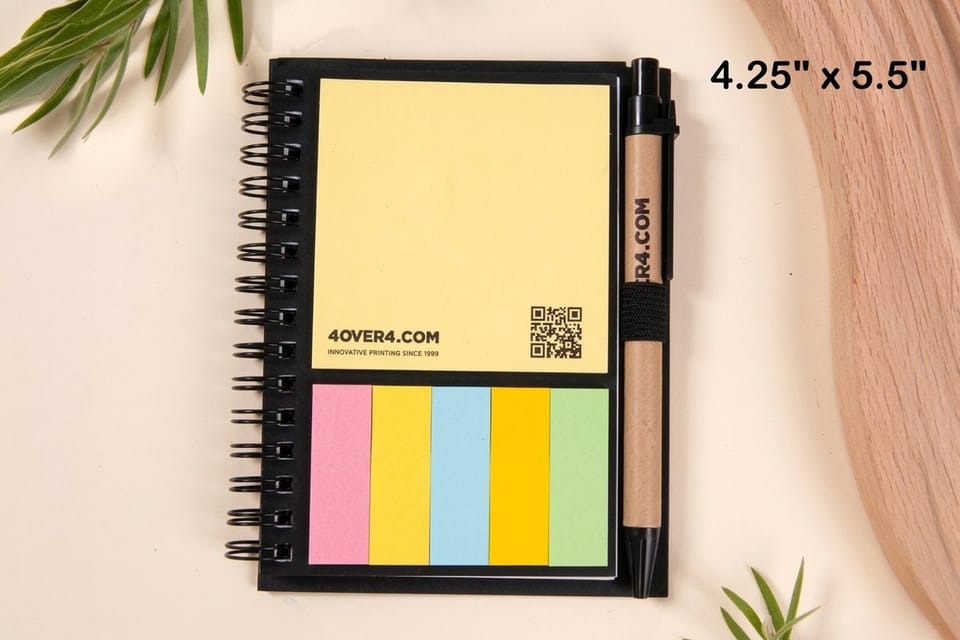
A flat-laying spiral book, cheap enough to keep one per project.
Five Rules for Planning Your Life on Paper
Most paper systems fail for the same reason gym memberships do. They ask for a perfect ritual instead of a small repeatable one. These five rules keep the effort under five minutes a day, which is the only budget a planning habit reliably survives on.
Rule 1: one page owns the day
Give each day a single page and never spill onto a second one. The limit does the prioritizing for you. Anything that does not fit is not urgent, it is just loud, and it can wait on a running list at the back of the book.
Rule 2: three commitments, then everything else
Write the three things that would make the day a success at the top, boxed off from the rest. Everything below that line is optional. On a bad day you still land the three, and a bad day stops feeling like a lost one.
Rule 3: plan tonight, not tomorrow morning
Spend the last four minutes of the workday writing tomorrow page. You are still holding the context, the open loops are fresh, and you get to start the next morning executing instead of deciding what to execute.
Rule 4: one symbol set, used ruthlessly
A dot for a task, a circle for an event, a dash for a note, an X when it is done, an arrow when it moves. Five marks is enough. A key you can read at a glance beats a color system you have to maintain.
Rule 5: review weekly, migrate honestly
Once a week, read back through the pages and rewrite what still matters onto a fresh weekly spread. Anything you refuse to rewrite for the third week was never a real task. Let it die on the old page and move on.
Print picks
Three formats that carry a planning system
Live prices, ready to customize with your own layout and logo.
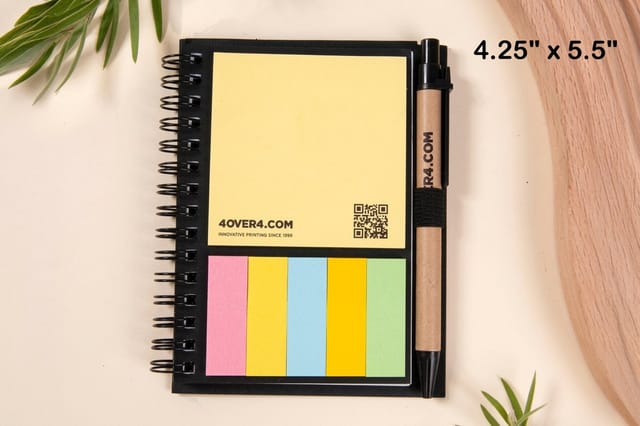 Deluxe Spiral Notebook $5.00 each Lays flat on any desk, so your weekly spread stays open while you work.
  Wedding Planner Business Cards 100 for $17.57 For planners who run other people calendars and need a card that matches the notebook.
  2 Sided Blockout Banners $108.75 each Put the quarterly plan on a wall where nobody on the team can quietly forget it.
 Bullet Journal Anatomy, Page by Page
A bullet journal notebook is not decoration, it is four connected page types that hand work down from the year to the hour. Once you see the anatomy, you can build the same skeleton into any custom planner you print, and you can drop the parts you will genuinely never use.
- Index. The first two spreads, left blank on day one, filled in as you go with page numbers. It turns a stack of notes into something you can actually search.
- Future log. A twelve month grid for dated commitments that live beyond this month, so nothing sits in your head waiting to be forgotten.
- Monthly log. One page of dates down the left edge, one facing page of tasks for the month. This is where the future log lands when a month arrives.
- Weekly or daily log. The working surface. Three commitments, then the run of tasks, events, and notes in the order they happen.
- Collections. Standing lists that are not date driven at all, like a reading list, a client roster, a packing list, or the running log of decisions you keep having to justify later.
- Migration marks. The arrows that move a task forward, backward, or into a collection. Migration is the system quality filter, not busywork.
Dot grid paper is the usual choice because it guides handwriting without boxing you into ruled lines, which matters when half your pages are tables and half are sentences. The mechanics of ruling your own spreads on a dotted page are covered step by step in our dotted journal and planner guide, and if your problem is sticking with the system rather than starting it, read how to organize a planner that actually works before you draw a single line.
Design a Planner Around How You Actually Work
Store bought planners are built for an average person who does not exist. If your week is driven by client sessions, shift rotas, billable hours, mileage, or a training block, the printed layout you buy will fight you every page. Printing your own interior is how you stop adapting to the planner and make it adapt to you: 4.25 by 5.5 inches fits a jacket pocket or a van glovebox, 5 by 7 gives a desk spread room for a billable hours strip.
Start with a month of evidence. Use a plain notebook, rule your spreads by hand, and mark every place you improvise a box or run out of room. That mess is your specification. When you turn it into a print file, the layout is already proven, and you are not paying to reprint a guess.
- Consultants and agencies. A billable hours strip down the right margin next to the daily log, so time tracking happens where the work is recorded.
- Trades and field teams. A job header block with address, contact, and materials at the top of each page, then open space for notes taken standing up.
- Teachers and trainers. A period grid across the week with a wide prep column, because planning happens by session, not by hour.
- Founders and managers. A weekly spread with a one on one column per direct report, so the follow ups survive between meetings.
- Anyone building a habit. A small tracker grid in the same place on every monthly page, close enough to fill in without hunting for it.
Quantity and price
Deluxe spiral notebook pricing and specs
Real configurator numbers. The more you print in one run, the lower the unit cost.
| Quantity | Price Per Unit | Total |
|---|---|---|
| 1 | $5.00 | $5.00 |
| 2 | $5.00 | $10.00 |
| 3 | $5.00 | $15.00 |
| 4 | $5.00 | $20.00 |
| 5 | $5.00 | $25.00 |
| 6 | $5.00 | $30.00 |
Paper, Binding, and Size, and How to Choose
Three physical choices decide whether a planner gets used daily or ends up in a drawer. Binding decides whether it lies flat. Paper weight decides whether your pen bleeds through. Size decides whether it travels with you. Everything else is taste.
Spiral binding is the safe default for a daily driver because the pages fold all the way back and the book takes up half a desk instead of a whole one. Heavier stock is worth it the moment you use anything wetter than a ballpoint. Bigger is better for planning, smaller is better for carrying, and if you truly need both, the honest answer is two books with different jobs.
- Test before you commit. Print a short run, use the exact pen you like on the exact stock, and check the back of the page after a week of real writing.
- Match binding to posture. If you write standing or on a lap, spiral wins outright. If the book lives on a shelf as a record, a flat spine looks better on the shelf.
- Leave a margin you do not design. Real weeks overflow. A blank strip at the bottom of every page absorbs the overflow without wrecking your layout.
Compare formats
Binding and size, side by side
What each choice does to writing posture, durability, and how much of your desk it takes.
| Choice | Lies flat | Best for | Watch out for |
|---|---|---|---|
| Spiral bound, large | Yes, folds fully back | Desk planning and weekly spreads | Coil eats the inside margin, so keep columns clear of it |
| Spiral bound, pocket | Yes | Site notes, standing and walking | Too small for a full week on one spread |
| Flat spine, large | Only when broken in | Archive books you keep on a shelf | Fights you on a lap or a crowded desk |
| Loose printed inserts | Yes | Prototyping a layout before the real run | Pages go missing without a binder or clip |
When Planning Other People Calendars Is the Job
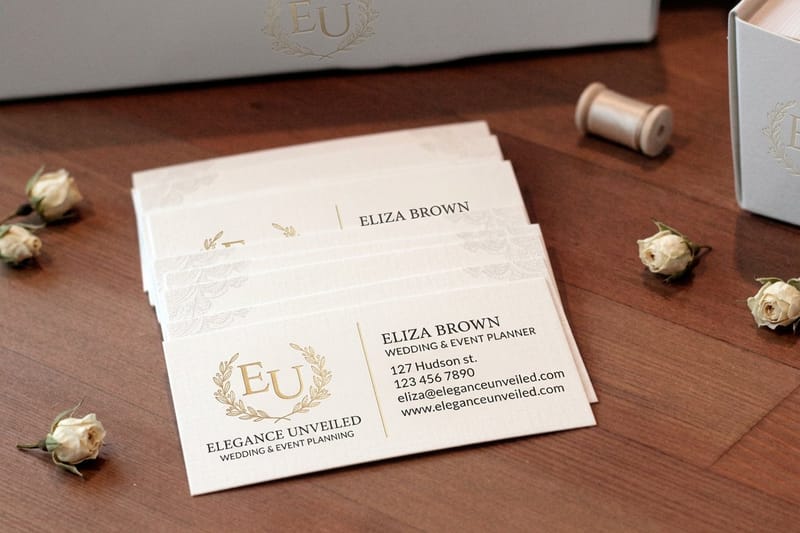
For event planners, wedding coordinators, and project managers, the notebook is not a personal habit, it is client facing equipment. It comes out in venue walkthroughs and vendor meetings, and it gets read upside down across a table by someone deciding whether to trust you with a deposit.
That is why the notebook and the card should look like they came from the same studio. A planner who hands over a card that matches the book they were just writing in reads as organized before saying a word, and organized is the entire product. If you are still shaping that identity, our roundup of event planner business card ideas covers layouts and finishes that hold up in a vendor stack.
- One book per client. Cheap notebooks make this possible, and it ends the search for last month notes entirely.
- A fixed first page. Client, date, venue, budget ceiling, decision maker. Same five fields every time, so any teammate can pick the book up.
- A signed decisions log. A back section where changes get written and initialed on the spot. It settles arguments months later without a single email search.
For professional planners
Wedding planner business cards
The card that comes out of the same bag as the notebook, printed to match it.

Rolling the System Out to a Whole Team
A personal planner is a habit. A shared one is infrastructure. When everyone runs the same layout, a standup stops being a status recital, because the three commitments are already written in the same place on every desk and can be read in seconds.
The rollout that works is unglamorous. Print a small batch with your layout and logo, hand them out with the five rules on the inside cover, and let the pilot group run a month before you order for the whole company. The same logic applies to any planned campaign, whether that is the multi step enrollment push in our private school advertising guide or the mailer sequences in 8 effective direct mail formats. Plan it on paper, prove it small, then scale the version that worked. Seasonal campaigns follow the same rule, as Pride Month Advertising That Works and the Campaigns That Prove It shows with printed pieces.
Then get the plan off the desks and onto a wall. Big printed goals in a shared room do the same job that signage does in a building, which is to answer a question before anyone has to ask it. Our wayfinding signage planning guide is a useful primer on making large format print legible from across a room.
Put the plan on the wall
2 sided blockout banners
Blockout material keeps both printed sides sharp, so a quarterly plan reads clearly from either direction in a shared room.
Print Your Own Planner Pages and Order the Book
Once the layout has survived a month of real use, printing it is the easy part. Set your page size first, keep every element inside a safe margin, and export a print ready file at full resolution with the bleed your printer asks for. Then order a short run, live with it, and treat version two as the real one.
A short checklist before you send the file
- Set the trim size first. Design at the finished size and let everything else follow, rather than scaling a layout you already drew.
- Keep writing space clear of the binding. Spiral coils eat the inside edge, so push your columns away from it or you will be writing into a hole.
- Number the pages in the file. An index is worthless without page numbers, and adding them by hand for a year is a punishment.
- Print undated. Weekday grids without hard dates mean an unused batch is still usable next year instead of scrap.
- Order small, then reorder. The first run is a prototype. Budget for a second one and you will end up with a planner you actually want to open.
If you are weighing a custom run against buying a branded notebook off the shelf, our Moo notebook alternative comparison covers where a printed custom book pulls ahead on price and control.
Start fast
Templates and print-ready blanks
Free layouts plus exact-size blanks so your planner pages land inside the trim on the first run.
Wally sets up your planner in five minutes
A layout that survives real weeks, then a book to print it in
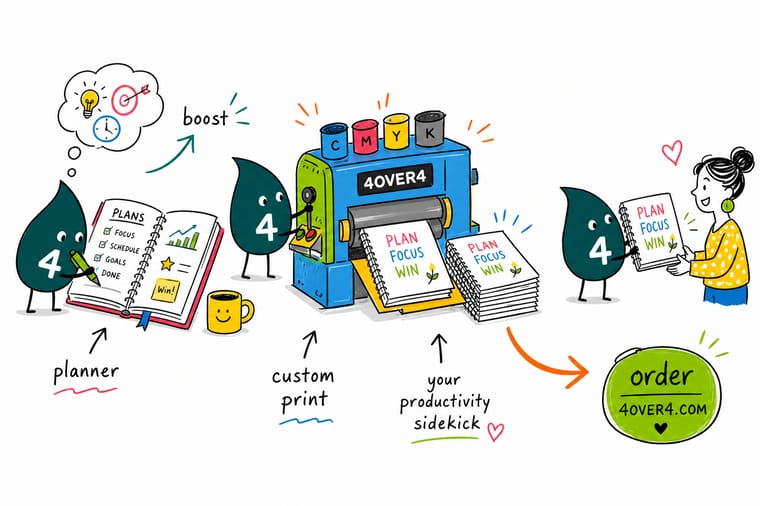
Do not buy a system, build one. Give each day a single page, write three commitments at the top, and use five symbols for everything else. Rule a month of spreads by hand and mark every place you ran out of room. That marked-up month is your print file. Order a short run of spiral coil books, live with it, then reorder the version that actually worked.
Design your custom notebook →Paper Planning by the Numbers
Go deeper
Guides for building the system page by page
Setup, symbols and spreads for a 4.25 by 5.5 or 5 by 7 inch book, and the 2 sided banner version for team walls.
Guide Organize a Planner That Works The setup that survives past the third week of January. Guide Organize a Work Notebook A desk notebook structure you can copy on day one. Guide Use a Dotted Journal Ruling your own spreads on dot grid paper, step by step. Guide Wayfinding Signage Planning Make large format plans legible from across the room. Explore more
More ways to plan, print, and stay organized
Ready-made deluxe spiral notebooks run 1 for $5.00 and ship in 1 business day, so you can rule a test layout this week.
Product Deluxe Spiral Notebook The flat-laying daily driver, from $5.00. Guide Organize a Planner That Works A planning setup built to survive real weeks. 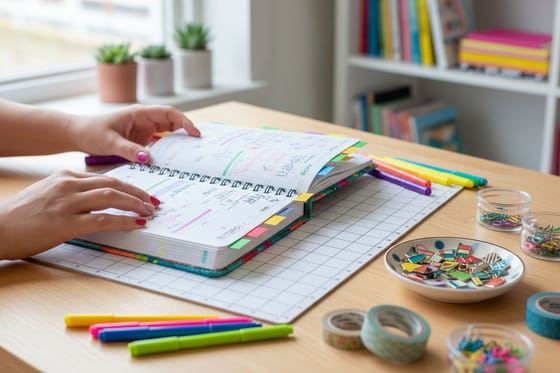 Guide Organize a Work Notebook Structure for the notebook that lives on your desk.
 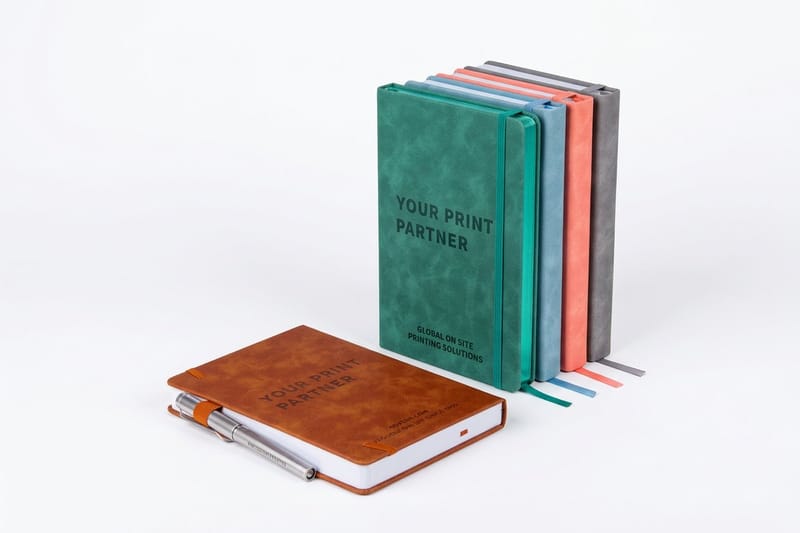 Guide Use a Dotted Journal or Planner Dot grid spreads, symbols, and migration explained.
  Alternative Moo Notebook Alternative Custom printed books compared on price and control. Product Wedding Planner Business Cards A card that matches the book you plan in.
 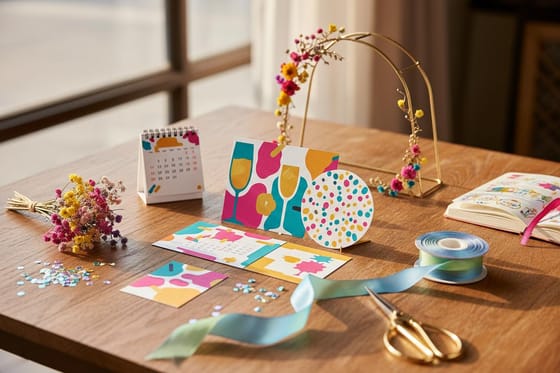 Article Event Planner Card Ideas Layouts and finishes that hold up in a vendor stack.
  Product 2 Sided Blockout Banners Put the quarterly plan somewhere nobody can miss it.
  Guide Wayfinding Signage Planning Large format print that reads from across a room.
  Article 8 Direct Mail Formats Campaign formats worth planning a quarter around.
  Guide Private School Advertising A six step plan mapped across 45 days.
 Ready to print the planner you actually want to open?
Rule your layout in a ready-made notebook, prove it for a month, then print a run of spiral coil books with your pages, your cover, and your team logo on the front.
Notebook Planner Questions
What is the analog productivity trend and why is it back?
It is the move back to notebooks, planners, and handwritten lists by people who spend all day in software. The pull is not nostalgia, it is constraint. A page has a fixed size, no notifications, and no infinite scroll, so it forces a decision about what fits in a day instead of letting you hoard tasks. Handwriting also encodes better than typing, so you remember commitments without opening anything. For a structure you can copy immediately, start with our work notebook guide.
What are the five best tips for planning your life on paper?
Give each day one page and never spill onto a second. Write three real commitments at the top and treat everything below as optional. Plan tomorrow tonight, in the last four minutes of the workday, while the context is still fresh. Use one small symbol key, a dot for tasks, a circle for events, a dash for notes, an X for done, an arrow for moved. Then review weekly and rewrite by hand only what still matters, which quietly kills the tasks that were never real.
What exactly is a notebook productivity system?
It is a single physical book plus a fixed set of page types that hand work down from the year to the day. An index makes it searchable, a future log holds dated commitments beyond this month, a monthly log takes over when the month arrives, and a daily or weekly log is where the work actually happens. Standing collections hold anything that is not date driven. The system is not the notebook, it is the agreement that every task enters and leaves through those pages.
How do I choose the right notebook planner for my work?
Decide three things: binding, paper weight, and size. Spiral binding lays flat and takes half a desk, which matters if you write while standing or in meetings. Heavier stock stops bleed through the moment you use anything wetter than a ballpoint, so test your actual pen on the actual stock before ordering a year of it. Bigger books are better for planning and worse for carrying, so pick the one that matches where you plan, not where you wish you planned.
What does a custom notebook planner cost and how is the price set?
Deluxe Spiral Notebooks at 4OVER4.COM start at $5.00, and the live configurator prices every combination from there. Quantity is the biggest lever, since the setup work is spread across the run and unit cost falls as the batch grows. After that, page count, paper stock, cover treatment, and turnaround speed each move the number. The practical approach is to order a small prototype run, use it for a month, then place the larger reorder on the layout that survived.
