
Fancy Business Card Ideas and the Premium Finishes That Earn a Second Look


Emma is our prepress and print production voice, built from the knowledge of our production team, with over 20 years in printing.
Special finish business cards feel fancy for two reasons: what the hand registers when it takes the card, and what moves when the card tilts under a light. Suede, velvet and ultra thick stock buy the first one; raised foil, spot gloss, edge painting and a die-cut shape buy the second. Pick one from each column, not four from both, and the card reads as a brand instead of a printer sample. The Ultra Thick Suede Business Cards story shows the first column in a few taps.
Card finishes, sorted by what they change
Business card finishes fall into four groups. Coatings change the sheen: gloss, matte and soft touch cover the whole face, and spot UV coats chosen areas only. Laminates such as suede and velvet bond a film across the face and change the feel. Foil adds metal, either flat and pressed into the sheet or raised on a resin bed. Edge painting, edge gilding and die cutting change the cut itself rather than the face.
The first two groups sit on the face, so a flat photograph shows them. Foil shows as a highlight when the card tilts, and the edge group only shows when the card turns or sits in a stack.
Special finish business cards by stock, size and run
Each special finish at 4OVER4.COM comes on a set base stock, and the smallest run differs from one finish to the next.
- Raised foil. 16pt velvet laminated cover at 2 by 3.5 inches, raised gold foil on the front, from 100 cards for $86.78.
- Spot UV. 14pt gloss cover at 2 by 3.5 inches with the gloss on the front, from 500 cards for $76.88.
- Suede. 16 point suede laminated stock in four sizes, from 1.5 by 3.5 up to 2.125 by 3.375 inches, from 250 cards for $87.15.
- Edge painted. 32pt UltraWhite uncoated cover with a black edge as the default color, from 250 cards for $141.70.
- Die-cut. 14pt gloss cover cut to rounded corners, a leaf, an oval or a 2 inch circle, from 100 cards for $26.37.
Upload a print-ready PDF with the finish on its own vector layer, then allow for the extra pass after printing: raised foil runs about 7 business days on the default schedule, against 3 for a die-cut run.
Premium business card finishes at a glance
| Finish | What it does | How it feels | Best for | Product at 4OVER4 |
|---|---|---|---|---|
| Suede or velvet laminate | Soft powdery film over the whole face | Warm, matte, grabs the fingertips | Studios, salons, interiors, anything tactile | Suede Business Cards, from $87.15 |
| Ultra thick stock | Doubles the caliper of a standard card | Rigid, will not flex or curl | Architects, law, high ticket services | Ultra Thick Business Cards, from $36.62 |
| Raised foil | Metallic resin cured above the laminate | You can find the logo with a fingernail | Logos, monograms, one short line | Raised Foil Business Cards, from $86.78 |
| Metallic printing | Shine printed flat across large areas | Smooth, no height change | Full-bleed shine, gradients, patterns | Metallic Business Cards, from $126.32 |
| Spot gloss and raised UV | Clear coating on chosen areas only | Wet-looking, glassy against matte | Photography, pattern, subtle logo repeats | Spot UV Business Cards, from $76.88 |
| Edge painting or gilding | Color or metal leaf on the cut edge | A stripe of color seen side on | Cards handed over in person, stacked on a desk | Edge Painted Business Cards, from $141.70 |
| Die cutting | Cuts the card to a custom outline | Different silhouette in the wallet | Brands with a strong shape in the logo | Die-Cut Business Cards, from $26.37 |
Each price is the smallest run of that product: 50 cards for ultra thick, 100 for raised foil and die-cut, 250 for suede and edge painted, and 500 for spot UV and metallic. Order free samples before a premium run, because caliper and grab are the two things a screen cannot show you. Browse the whole range on business card printing.
What actually makes a card feel expensive
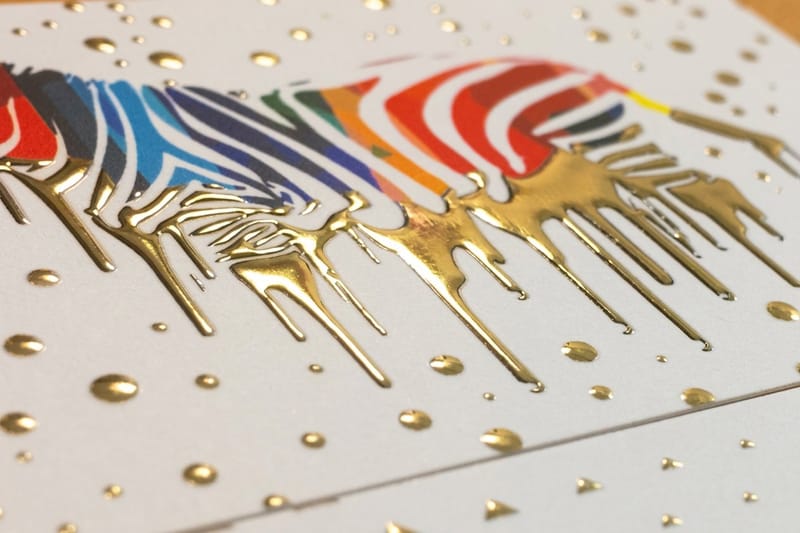
A card reads as fancy through two senses and no others: what the hand registers when it takes the card, and what happens when the card tilts under a light. Everything on this page is one of those two moves. Suede, velvet and ultra thick stock work on the hand. Foil, spot gloss and edge painting work on the light.
That is why a heavier stock in plain black often beats a thin card covered in effects. The person receiving it is not reading your finish list. They pick the card up, and in the first half-second their fingers report one thing: this is unusually solid, or unusually soft, or ordinary. Then they tilt it, and either something moves in the light or nothing does.
The trap is stacking. Foil plus spot gloss plus edge paint plus a die cut on the same card reads as a printer sample, not as a brand. Pick one move for the hand and at most one for the light. If you want to see how the finishes behave in the same family, the rundown of the seven best print finishes covers the same techniques across other products.
The three things a premium finish takes away
Every upgrade on this page costs you something beyond money. Writability goes first: a laminated or foiled card will not take a ballpoint, so if people scribble a mobile number on the back of yours, leave an uncoated panel there. Fine detail goes second: raised finishes round off hairlines and small serifs, so a 6pt disclaimer set in foil turns into a smear. Time goes third, because die cutting, edge painting and gilding all add a physical pass after printing.
Decide which of the three you can afford to lose before you decide which finish you want. That single question kills more bad premium card ideas than any design review.
Start from the stock, not from the effect
Thickness is felt instantly and costs the least to change. A 16pt card already feels considered next to the 12pt and 14pt cards most people carry, and an ultra thick card at $36.62 is unmistakable before anyone looks at the artwork. Our thickness chart lines up the common weights so you can feel the step you are buying.
If the budget only stretches to one upgrade, spend it here. A thick, quiet card is never embarrassing. A thin card with a lot of foil on it sometimes is.
Premium stocks: suede, velvet and ultra thick
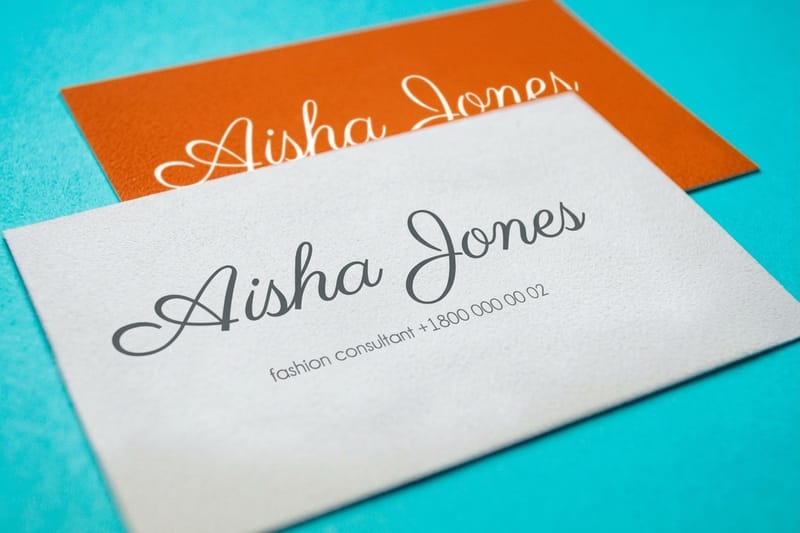
Suede and velvet are laminates, not papers. A film is bonded across the printed sheet, and the film is what your fingers meet. It mutes the color underneath by a noticeable amount, which is the trade nobody mentions: a bright red drops toward brick, and photographs lose a little snap. Designers who plan for that pick deeper, simpler colors and get a card that feels like a book cover.
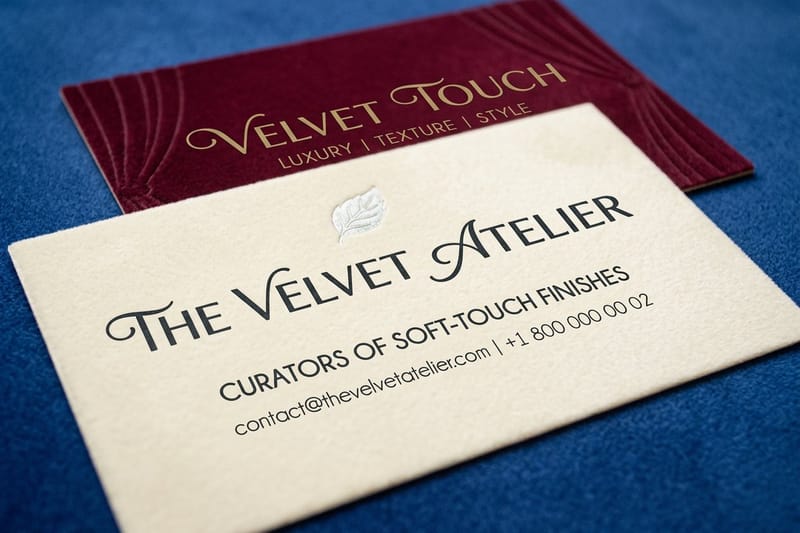
Between the two, suede business cards at $87.15 have the drier, more powdery hand, and velvet business cards at the same $87.15 feel slightly denser and more cushioned. Both fingerprint less than gloss and both scuff if a card rides loose in a pocket for months. If you want something closer to a coated finish that still kills glare, silk lamination at $74.53 sits between the two worlds, and the silk lamination guide explains where each one stops.
Ultra thick is the other route, and it is a different kind of premium. Instead of changing the surface, it changes the mass. Two sheets bonded to a heavy caliper give a card that stays flat in a wallet for a year and lands on a table with a sound. It also gives you a visible edge, which is exactly what edge painting needs later on.
Where soft touch fits
Soft touch business cards start at $40.28 and are the affordable entry to the tactile family. The film is thinner than suede, so the hand is less dramatic and the color shift is milder. For a first premium run, it is the sensible test: order soft touch, hand them out for a month, and see whether anyone comments on the feel before you commit to the deeper laminates. The matte, gloss and soft touch comparison puts the three side by side.
Foil and metallic: what the two words actually mean
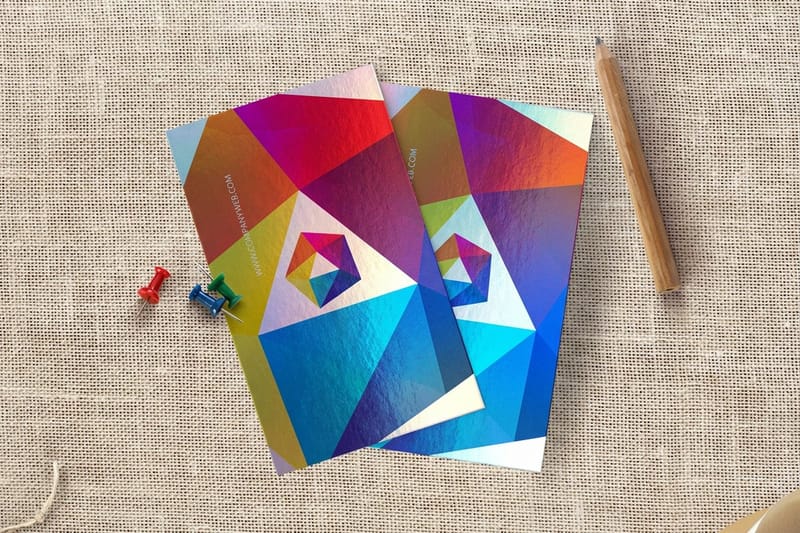
These are three different processes that all end in shine, and picking the wrong one is the most common premium card mistake we see. Flat foil stamping presses a metallic film into the sheet with a heated die, so the metal sits level with the card. Raised foil lays the metal on a cured resin bed, so it stands above the surface and your fingertip finds it. Metallic printing is not foil at all: it prints a metallic effect and can cover large areas and gradients that no die would ever be cut for.
For a logo, a monogram or one short line, raised foil business cards at $86.78 give the biggest reaction for the money, and they carry a 4.9 rating across 105 reviews. For an all-over shine, a pattern, or artwork with tonal steps in it, metallic business cards at $126.32 do what foil cannot. If you are genuinely undecided, foil stamping versus raised foil walks the two apart properly.
The design rule for any foil is the same: give it room. Foil next to foil looks cheap, foil on top of a busy photograph disappears, and thin strokes under about a point tend to fill in. Set the foil element on a quiet field and let the rest of the card stay flat.
What to send the printer
Foil is specified as a separate layer, usually 100% of a single spot color with nothing else on it, sitting over your CMYK artwork. Keep it vector. Keep it away from the trim by a comfortable margin, because a foiled element that runs off the edge is harder to register than an ink one. The finishing techniques guide covers the file setup for foil, spot UV and embossing in one place, and the blank template library has the exact card sizes with bleed and trim already marked.
Spot gloss and raised UV: shine without metal
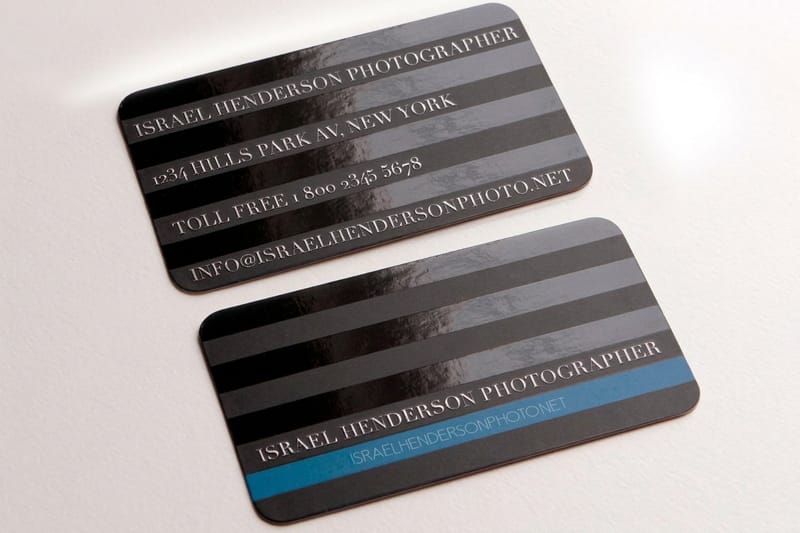
Spot gloss is a clear coating applied to chosen areas of an otherwise matte card. Nothing is metallic, nothing is colored. The effect is entirely contrast: the coated area looks wet and holds a highlight while the rest of the card absorbs the light. It photographs badly and works brilliantly in the hand, which is why it turns up on so many photographer and studio cards.
Spot UV business cards start at $76.88 and hold a 4.9 average across 109 reviews. Raised UV is the same idea with a thicker build, so the coated area has real height and your finger tracks it. Both need a matte or suede base to read at all: put spot gloss on an already glossy card and you have spent money on an effect nobody can see. Watch spot gloss business cards with a raised build in our video before you choose. Spot gloss versus spot UV separates the two terms, which most printers use loosely.
The most underused version is invisible. Run the spot coating as a pattern, a repeated mark, or a full block of body copy that only appears when the card tilts. It gives the receiver a second thing to find thirty seconds after they thought the card was finished. Creatives have been doing this for years, and these spot UV examples show how far it stretches.
Setting up the gloss layer
Like foil, the coating is a separate 100% spot-color layer over your artwork, and the same limits apply: no hairlines, no 5pt type, generous distance from the trim. One extra caution for spot gloss specifically, since it is clear, a misregistration of half a millimeter is visible as a shadow edge on a dark card and almost invisible on a light one. Design the dark cards with a little more tolerance around the coated shape.
Edge painting and edge gilding: the finish nobody photographs
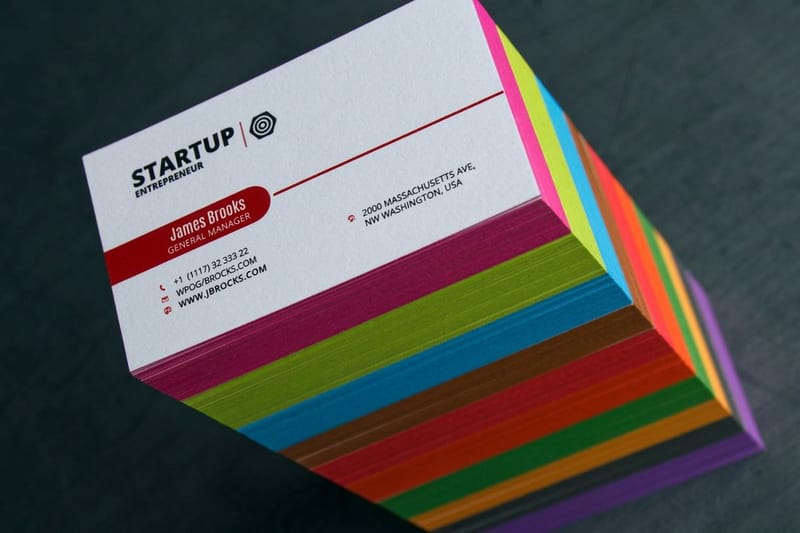
Edge painting puts color on the cut edge of the card, so a stack of them shows a solid band of your brand color and a single card shows a bright line when it turns. Edge gilding does the same job with metal leaf. Neither one appears in a flat photograph, which is precisely why they land: the card looks normal until it moves.
Edge painted business cards start at $141.70 and edge gilded business cards at $328.42. The price gap is honest work: gilding is applied by hand and is the most labor-intensive finish we offer on a card. Both need a thick stock to have an edge worth painting, so budget for the heavier caliper as part of the decision rather than as a surprise. The edge gilded business cards video shows the hand-applied edge up close.
The color choice matters more than people expect. An edge in the same color as the card face reads as a deliberate detail, while an edge in a contrasting color reads as a statement and is far harder to get right. When in doubt, take the darkest color already in your logo and use that.
Who it actually suits
Edge finishes only pay off when cards are handed over in person and often. A consultant who gives out fifteen cards a week at events gets full value. A business whose cards mostly travel in envelopes does not, because the recipient sees the face and never sees the side. Spend the same money on stock and one foil mark instead. For the base coat, our matte vs glossy guide compares the two business cards finishes most people start with.
Die-cut shapes, and when a rectangle is the braver choice
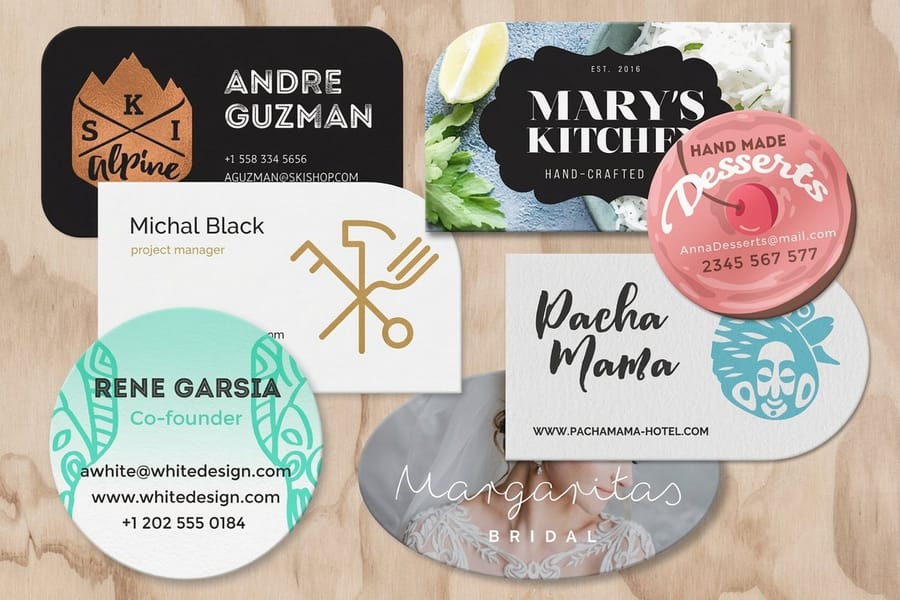
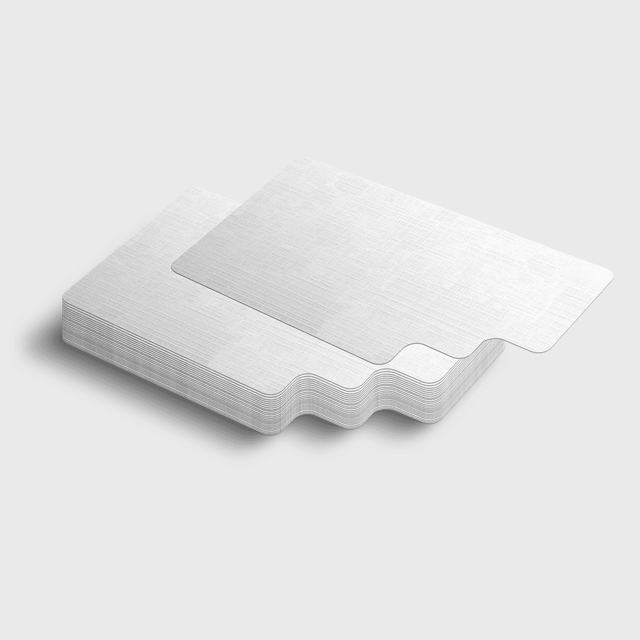
A custom outline is the cheapest way to look unlike everyone else in the cardholder. Die-cut business cards start at $26.37, below several plain stocks, because the cost is a die and a cutting pass rather than a new material. Rounded corners are the mild version and they change the feel of the card more than most people expect, since a sharp corner is what makes a thin card feel disposable.
The shape has to come from the brand, not from a shape library. A key for a locksmith, a leaf for a landscaper, a bottle silhouette for a bar: those work because the outline carries meaning. A star for an accountancy firm does not. And there is a practical cost nobody warns about, which is that a non-rectangular card may not sit in a standard cardholder or a wallet slot, so a percentage of them get put down rather than kept. If the shape is not doing real work, a heavy rectangle with one good finish is the stronger card. These custom-shaped card ideas show which outlines earn their keep.
Premium card pricing and specs at 4OVER4.COM
Raised foil starts at $86.78 for 100 cards on 16pt velvet laminated cover at 2 by 3.5 inches, and the cost per card falls from about 87 cents at 100 to about 37 cents at 500. The numbers below come straight from the live configurator for raised foil, so you can size a budget before you commit to a die or a laminate.
Quantity and price
Raised foil pricing and specs
Real configurator numbers for raised foil business cards, where the more you order the lower the per unit cost drops.
| Quantity | Price Per Unit | Total |
|---|---|---|
| 100 | 86.8¢ | $86.78 |
| 250 | 47.9¢ | $119.73 |
| 500 | 37.1¢ | $185.63 |
| 1,000 | 36.1¢ | $361.37 |
You can also earn coins on every order and redeem them against future printing, which takes some of the sting out of a first premium run.
Print it
Suede, for the hand
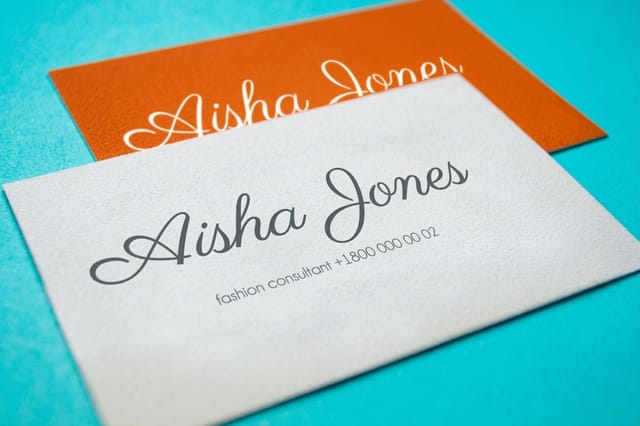
The soft powdery laminate that makes a card feel like a book cover, on a stock heavy enough to carry it.
Choosing finishes for your industry
The right finish depends less on taste than on what happens to your card after you hand it over. Cards that get written on, cards that live in a pocket for months and cards that sit in a holder on a counter all want different things.
- Architects, designers and studios. Ultra thick stock with a suede laminate and nothing else. The restraint is the message, and the card survives a portfolio bag without curling.
- Law, finance and consulting. A 16pt or thicker card with flat foil on the name only. Avoid raised finishes here, because clients still write on the back of these cards.
- Photographers and creatives. Matte or silk base with spot gloss over the imagery. It gives you a second layer of work on a card that has to prove you see detail.
- Salons, spas and wellness. Velvet or suede, because the whole business is about how something feels. Leave one uncoated panel if staff pencil appointment times on the back.
- Restaurants, bars and hospitality. Die-cut shapes and edge painting travel well here, since cards get handed across a counter and stacked in a holder where the edge shows.
- Real estate and high-ticket sales. Raised foil on the logo, plain everywhere else. It survives being pulled from a pocket repeatedly and still reads as considered.
Blanks that register a finish layer
Premium finishes are less forgiving of a badly built file than plain ink is, because a foil or gloss layer has to register against artwork that is already on the sheet. Build the finish as its own layer at 100% of one spot color, keep it vector, hold strokes above roughly a point and type above roughly eight points, and keep it clear of the trim. 4OVER4.COM sizes its blanks to the exact product specs, so your bleed, trim and safe area are already marked and your finish layer lands where you drew it. Start from a print-ready blank, or pick a layout from the design template library and change the colors.
Start fast
Blanks that register a finish layer
Business card design templates and exact-size blanks so your artwork and your finish layer land inside the cut line.





Wally picks one finish for the hand and one for the light
Two senses decide whether a card reads as premium
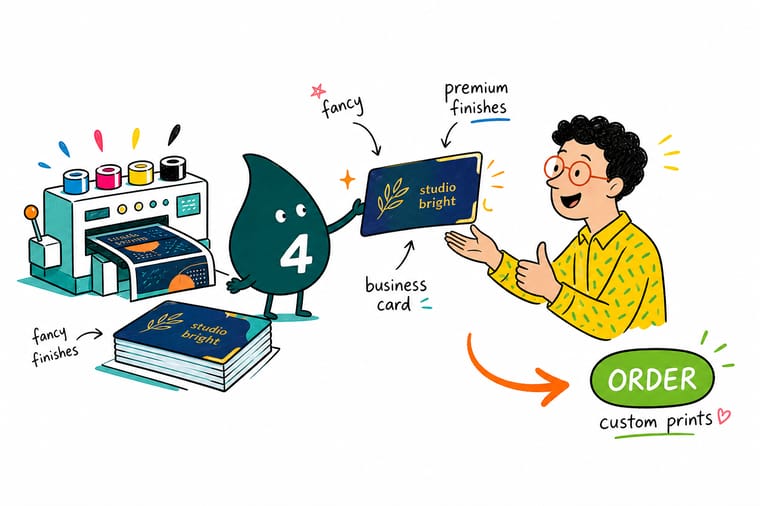
Choose the stock first, because thickness is felt before the artwork is read. Then add a single optical finish: raised foil on a logo, spot gloss over imagery, or edge paint if the card is handed over in person. Keep foil vector and above a point of stroke weight, leave an uncoated panel if people write on the back, and order free samples before the run so you feel the caliper rather than guessing at it.
Order raised foil cards →What each finish takes away from the artwork
Design rules that hold across every finish
- One move for the hand, one for the light. Pick a single tactile upgrade and at most one optical one. Cards carrying four finishes read as a printer sample rather than a brand.
- Leave a writable panel if people write. Laminates and coatings refuse ballpoint ink. If the back of your card gets used for notes, keep that area uncoated and plan the layout around it.
- No hairlines under a finish. Raised foil and raised UV round off fine strokes and small serifs. Set anything below roughly a point in ink, never in a raised finish.
- Match the finish to the base. Spot gloss needs a matte base to be visible. Edge painting needs a thick stock to have an edge. A finish on the wrong base is money spent invisibly.
- Order a sample before the run. Feel beats a screen every time. Request free samples and hold the stocks before you commit, because no monitor shows caliper or grab.
Explore more
More premium cards and finishing guides
Silk laminated cards run 250 for $74.53 in 4 business days and edge gilded 250 for $328.42 in 15.
Product Raised Foil Business Cards Metallic logo that stands above the card surface. Product Suede Business Cards Soft powdery laminate across the whole face. Product Spot UV Business Cards Glassy coating on chosen areas of a matte card. Product Edge Painted Business Cards Color on the cut edge, invisible face on. 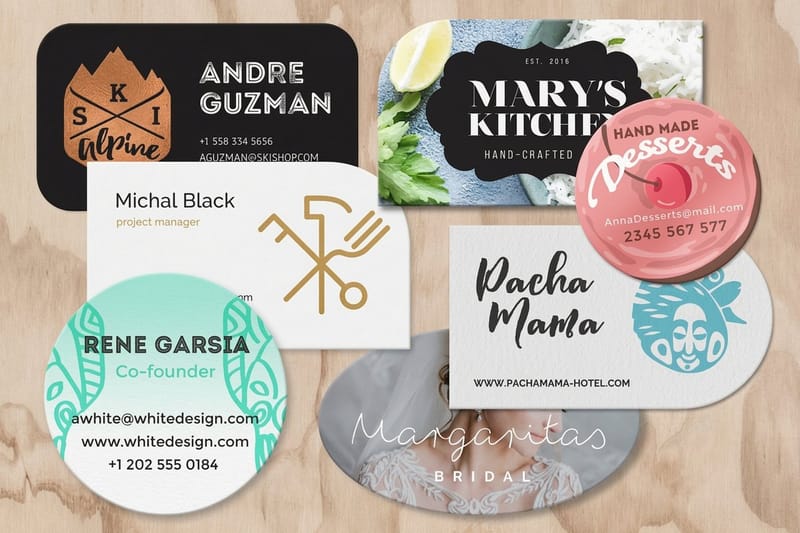 Product Die-Cut Business Cards Cut to your outline instead of a rectangle.
 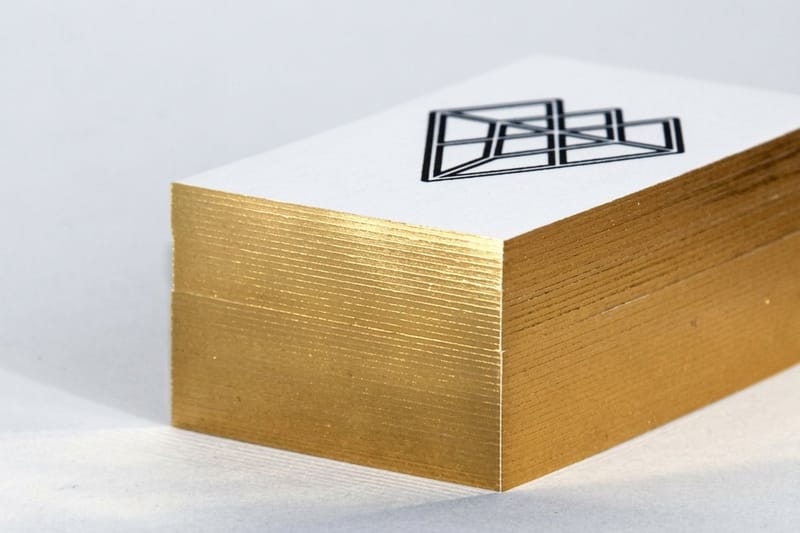 Product Edge Gilded Business Cards Metal leaf applied by hand to the card edge.
  Product Velvet Business Cards Denser, more cushioned hand than suede.
  Category Business Card Printing Every stock, finish and shape in one place.
  Guide Print Finishing Techniques Explained Foil, spot UV and embossing, and how to set the files up.
 Ready to print a card people keep?
Pick the stock, add one finish, and 4OVER4.COM prints it sharp with a free proof before the run. Ask for samples first if you want to feel the difference in the hand.
Common questions about premium business cards
What is the cheapest way to make a business card look expensive?
Buy thickness before you buy an effect. An ultra thick card at 4OVER4.COM starts at $36.62 and is registered by the hand before anyone reads a word, while a die-cut shape starts at $26.37 and separates you from every rectangle in the cardholder. Both cost less than a foil or edge treatment and neither one can look overdone. Spend on a heavier stock, keep the artwork quiet, and add a single finish later once you know the design is settled.
Can I combine foil and spot gloss on the same card?
Technically yes, and it is usually a mistake. Both finishes work by contrast against a flat field, so running them together means each one is competing with the other for the same attention. If you do want both, keep them physically apart: foil on the front for the logo, spot gloss on the back as a pattern or a large quiet block. Never put them on the same element or within a few millimeters of each other, because the eye reads the result as a printing error rather than a design decision.
Will people be able to write on a premium business card?
Not on the finished areas. Suede, velvet, soft touch and silk laminates all reject ballpoint ink, and spot gloss and foil are worse. If your customers write appointment times, quotes or notes on the back of your card, you need an uncoated panel left in the layout, which is something to specify when you order rather than something to discover afterwards. Uncoated stock takes pen cleanly and can still be paired with a foil element on the front face.
Does edge painting show up in photographs of the card?
Almost never, and that is the point of it. Edge painting and edge gilding sit on the cut edge, so a card photographed flat looks like an ordinary card. The finish only appears when someone turns the card, fans a stack, or sees it standing in a holder. That makes it a strong choice for cards handed over face to face and a poor choice for cards that mostly travel inside envelopes, where the recipient sees one face and puts it down.
How much artwork detail can a raised finish hold?
Less than ink can. Raised foil and raised UV build height with a cured resin, and that resin rounds off very fine strokes, tight counters and small serifs. As a working rule, keep anything in a raised finish above roughly one point of stroke weight and above roughly eight points of type, keep it vector, and keep it clear of the trim. Fine print, disclaimers and small contact type belong in flat ink on the same card, which also keeps them readable.
