
Automotive Poster Printing Ideas for Dealerships and Shops


Pick the spot before the poster: measure the distance it will be read from, size the headline to about one inch of cap height per ten feet, and let the sheet size follow. Then split what you print into perishable and permanent, because prices and event dates belong on cheap paper you swap, and the brand, the certifications and the hours belong on a rigid sign you never reprint.
Automotive poster placements at a glance
| Placement | Working size | Read from | What it should say | Print it on |
|---|---|---|---|---|
| Showroom window, facing out | 24 x 36 or 27 x 40 in | 20 to 40 ft | One model, one number, one call to action | Rigid sign, not paper, if it stays up past a month |
| Service drive and write-up lane | 18 x 24 in | 6 to 12 ft | This month’s service specials, priced | Paper poster in a hanger frame, swapped monthly |
| Customer waiting area | 18 x 24 in | 3 to 8 ft | Process explainers, certifications, why the work costs what it costs | Matte paper, framed |
| Parts counter | 11 x 17 or 18 x 24 in | 2 to 5 ft | Seasonal parts, fluids, wiper and battery reminders | Matte paper, reprinted each season |
| Bay door and lot edge | A-frame or panel sign | 30 ft plus, outdoors | Open, hiring, walk-ins welcome, detail packages | Weatherproof sign panel or A-frame |
Measure the real reading distance before you set the size, because a showroom that looks open on a floor plan is often a twelve foot read in practice. You can configure automotive signs for the placements where paper will not last.
Posters that work in a dealership, and where they fail

A dealership poster earns its place by doing one job at one distance. Pick the spot first, measure how far away someone actually reads it from, then size the type to that distance and let the size of the poster follow. The sign trade works to about one inch of capital letter height per ten feet of reading distance, which means a headline meant for the sidewalk twenty five feet away wants caps around two and a half inches tall, and that single number decides how many words you are allowed.
The failure mode is always the same. Somebody lays out a showroom poster on a laptop, it looks packed and informative at arm’s length, and out on the glass it is a grey rectangle nobody reads. Three lines of copy at the right size beats twelve lines at the wrong one, every time, and the words you cut are the ones that were doing the least work anyway.
The second thing that catches shops out is sun. A paper poster taped inside a south facing showroom window will visibly shift in a few months, and window glass alone does not stop enough UV to save it. If the message is permanent, put it on a rigid automotive sign and stop reprinting it. If the message changes monthly, paper is the right answer precisely because it is disposable.
Separate the permanent from the perishable
Split everything you print into two piles. Permanent means the brand, the certifications, the hours, the service menu categories, the safety and process messaging that has not changed in three years. Perishable means prices, APRs, lease payments, seasonal promotions and event dates.
Print the permanent pile once, properly, on something rigid. Print the perishable pile cheap and often on paper, and design the permanent piece with a window in it where the perishable strip drops in. Dealerships that skip this step end up reprinting a full 24 by 36 poster because a payment moved by nine dollars.
Glare is a design problem, not a printing problem
Showroom lighting is usually a grid of downlights, and a gloss poster mounted flat under them throws a bright band across the middle of the artwork exactly where the headline sits. Matte stock removes the band. The trade-off is real: matte also flattens the deep blacks and the metallic flake in a vehicle photo, which is the whole reason you put the car on the poster.
The practical split most shops land on is matte for anything indoors under hard lighting, gloss for anything behind window glass or lit indirectly, where the reflection is coming off the glass anyway and the extra saturation is worth having. If the poster is mostly type and price, matte wins by default.
Ten poster ideas for dealerships, shops and detailers
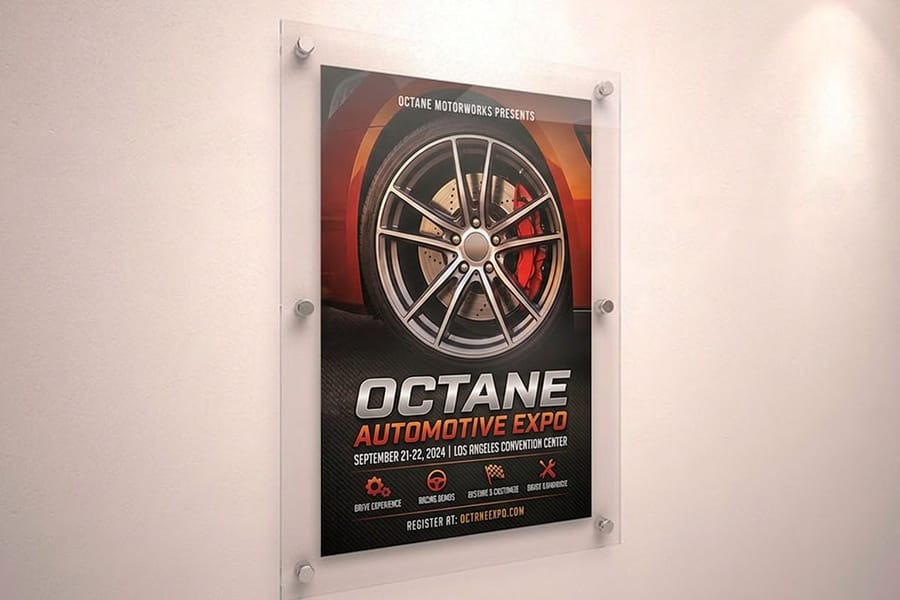
These are ten posters that actually get read in an automotive business, roughly in the order a shop should print them. The first four pay for themselves in the service department, which is where most of the margin lives anyway.
None of them are expensive to test. A poster in a wood poster hanger frame starts at $32.75 for the frame and reads as intentional instead of taped, and a rigid automotive sign starts at $25 when the message is staying put.
Ideas one to five: the service side
1. The monthly service specials board. One 18 by 24 poster in the write-up lane, four offers maximum, each with a price. Swap it on the first of the month. Four priced offers outsell nine vague ones because a customer can decide standing there.
2. The why it costs that explainer. A waiting room poster that shows what a brake job actually includes, part by part. It answers the objection before the advisor has to, and it is the single most useful thing on most shop walls.
3. The seasonal parts counter poster. Wipers in autumn, batteries before the first cold snap, coolant before summer. Same layout every year, new season, printed cheap and swapped four times a year.
4. The we buy cars poster at the service drive. Your service lane is full of the exact used inventory you want. A poster there, with a real number on it rather than "top dollar", turns oil changes into trade appraisals.
5. The technician recruiting poster. Print it for the bay door and the parts counter, not the front window. Techs walk through parts departments. Put the pay range on it, because the shops that do get called and the shops that do not, do not.
Ideas six to ten: the showroom and the lot
6. The single model spotlight. One vehicle, one trim, one payment, printed large for the window. The temptation is to show the whole lineup, and the whole lineup at sidewalk reading size means each car gets a postage stamp and nobody reads any of them.
7. The finance ladder with a swappable strip. Print the tiers and the terms permanently, leave a clean band for the current rate, and reprint only the band. It is the cheapest fix on this page.
8. The detailer before and after wall. Detailing sells on evidence. A grid of your own paint correction and interior shots, printed properly and framed, does more than any list of packages. Use your own vehicles, never stock photography, because customers recognise a stock interior instantly.
9. The certification and staff wall. Names, faces, years with the shop, certifications held. It is the E-E-A-T of a repair shop, hanging in the waiting room, and it turns a stranger with a wrench into a person who has done this for eleven years.
10. The event poster with a date on it. Cars and coffee, a truck month, a tire event. Because it dies on a known date, print it on paper, hang it in a frame, and recycle it the following Monday without a second thought.
Print for the lot and the sidewalk
Everything above hangs indoors. The lot is a different environment and paper does not belong in it, because wind, rain and a week of direct sun will finish a poster long before the promotion does.
Three pieces cover most of what happens outside. An A frame at the entrance carries the message for whoever is passing at walking pace, and it comes back inside at night. A banner across the front of the building handles the seasonal event, and on an exposed frontage it wants a mesh material rather than solid vinyl so wind passes through instead of pulling the fixings out. A rigid panel on the fence or the wall carries the things that never change, the hours, the service entrance, the makes you are certified on.
Size the outdoor pieces for a moving reader rather than a standing one. The cap height rule from the window still applies, except that a driver gets a second rather than a minute, which usually means three or four words and a number. Configure the durable half of the set as automotive signs and keep paper for the things that expire.
Sizes, stock and finish for automotive posters
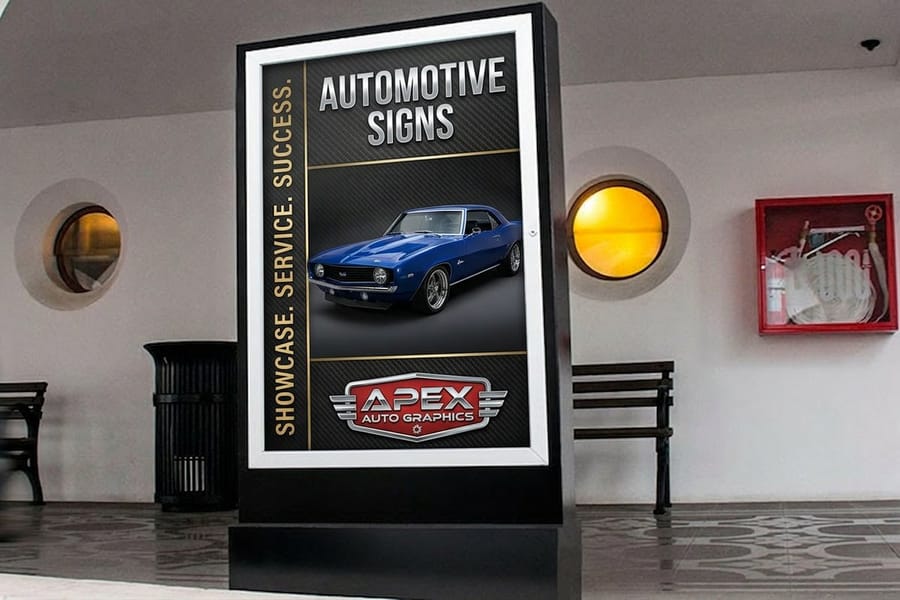
Three choices set the price and the lifespan: how big, on what, and with what finish. Everything else is artwork, and artwork is free to change.
Size follows reading distance, not wall space. An 18 by 24 poster is the workhorse for anything read inside a building from under twelve feet, which covers the service drive, the waiting room and the parts counter. Move to 24 by 36 when the read is across a showroom, and to 27 by 40 for a window that gets read from the sidewalk. Bigger than that and you are usually better served by a sign panel than by a poster.
Stock is the lifespan decision. Paper is right when the message expires, which is most of what a dealership prints. A rigid substrate is right when the message does not, and outdoors it is the only honest answer, since a paper poster on a lot lasts until the first real weather. Our A-frame sign printing range covers the sidewalk and lot edge cases where a poster simply cannot survive.
Colour, and why the brand blue drifts
Manufacturer brand colours are the thing most automotive print gets wrong. A corporate blue that was specified as a spot colour will shift when it is reproduced in four colour process, and it shifts differently on matte stock than on gloss. If your franchise brand standards name a Pantone, say so at order time and read our guide to spot colour and Pantone printing before you build the file.
For everything else, convert your artwork properly rather than letting the press guess. The best colour profile for printing guide walks through which CMYK profile to assign and what happens to a vivid RGB red when you do not.
Mounting, and the thing everyone forgets
A poster taped to glass at the four corners will curl inward within a week of the HVAC running, and a curled poster reads as a business that is not paying attention. A hanger frame holds the top and bottom edges flat, costs less than a reprint, and lets you swap the poster in about a minute without a ladder.
For window posters read from outside, hang the poster a couple of feet inside the glass rather than against it. It cuts the reflection the viewer is fighting, and it stops the sun cooking the sheet directly against the pane.
Ordering one print set for several stores
A group with more than one store wastes money in a predictable way. Each location orders its own specials board when it runs out, at its own quantity, from whoever is nearest, and by the second quarter no two waiting rooms look like the same business.
Order the set centrally and the economics change. The artwork is built once with a reserved band for the numbers, the run covers every location at a quantity that actually earns a price break, and each store receives its own carton. The only variation per store is the address block and the phone number, which is a small change to a file rather than a new design job.
Keep a shared file library and a fixed calendar. One folder with the current artwork for each placement, one date each month when the specials board changes, and a named person who approves it. Stores that know the poster is coming stop printing their own on the office machine, which is where the mismatched waiting rooms started.
Automotive sign pricing and specs at 4OVER4.COM
Pricing moves with size, substrate and quantity, and the per unit cost drops as the run grows. The numbers below come straight from the live configurator, so you can size the budget for the permanent half of your print before you commit to it.
Quantity and price
Automotive sign pricing and specs
Real configurator numbers, where ordering the shop’s full set at once brings the per unit cost down.
| Quantity | Price Per Unit | Total |
|---|---|---|
| 1 | $25.00 | $25.00 |

You can also earn coins on every order and redeem them against future printing, which helps when the specials board is a recurring monthly line in the marketing budget.
What else a shop prints around the poster
A poster starts a conversation and something else has to carry it. The advisor who walks a customer through the specials board hands over a card, and the car that leaves after a service goes out with a reminder sticker in the corner of the windshield. Those two pieces are what turn a poster into a repeat visit, and both are cheap enough that skipping them makes no sense.
Print it
Automotive signs, ready to hang
Rigid signage for the messages that outlive a promotion, sized to your placement.

Automotive business cards start at $17.57 and are the piece a service advisor actually uses, so put the direct line on them rather than the switchboard. Standard labels start at $23.88 and cover oil change reminders, tire rotation dates and parts department stickers, printed once for the year in a single run. Both sit alongside the poster in our automotive printing collection, which is the fastest way to see what a full shop set costs before you order piece by piece.
Choosing the right approach for your business
Different automotive businesses need different posters, so here is the split by business type.
- Franchise dealerships. One model per window poster, brand colours specified as spot colours, and the payment on a swappable strip so a rate change does not trigger a reprint.
- Independent repair shops. A priced specials board in the write-up lane and a process explainer in the waiting room. Those two do more work than everything else on the walls combined.
- Detailers and paint correction. Your own before and after work, printed large and framed. Stock photography of a shiny hood convinces nobody who is about to spend six hundred dollars.
- Tire and quick lube. Seasonal parts counter posters on a fixed rotation, plus a rigid outdoor sign for the price that never changes.
- Used car lots. Rigid signage for anything facing the lot, because paper posters and weather do not coexist. Save the paper for the office and the desk.
Templates and print-ready blanks
If you are not starting from a blank artboard, a print-ready blank saves the two mistakes that cost a reprint: artwork that runs short of the bleed and type that sits too close to the trim. 4OVER4.COM sizes its blanks to exact product specs, and you can pull one from the blank template library with bleed and trim already marked.
Start fast
Print-ready poster blanks
Exact size press blanks so your headline lands inside the trim and your bleed is already there.

Wally sizes the poster to the walk, not the wall
Reading distance first, sheet size second
Stand where your customer stands and count the paces. Ten feet of reading distance wants roughly one inch of capital letter height, so a sidewalk read at 25 feet needs a headline near two and a half inches and about five words. Use 18 by 24 inches indoors, 24 by 36 across a showroom, and move to a rigid sign the moment the message stops expiring. Add 0.125 inch bleed on every side, build in CMYK at 300 DPI, and leave a clean band for the price so a rate change costs you a strip and not a reprint.
Order automotive signs →What to remember about automotive posters
Design tips that hold up at every size
- Size the type to the distance. About one inch of cap height per ten feet of reading distance. Work out the distance first, then find out how many words fit. The words that do not fit were the weak ones.
- One poster, one job. A poster that announces a model, a service special and the hours is three posters fighting each other. Split them and hang them in different places.
- Put the number on it. Priced offers get read and vague offers get skipped. If you cannot publish the price, publish the range, and if you cannot publish the range, publish something else.
- Design the swap in. Leave a clean band for whatever changes monthly. Reprinting a strip costs a fraction of reprinting the sheet.
- Check it from the doorway. Print a proof, hang it where it will live, walk to where the customer stands, and read it. Every layout problem shows up in that ten second walk and none of them show up on a monitor.
For a wider set of layout directions before you commit to one, our 15 creative poster ideas covers concepts that translate well to a showroom, and poster printing for MUPIs is worth reading if you are buying street furniture advertising near the dealership, since those panels are read at speed and follow different rules.
Explore more
More ways to print for an automotive business
Related products and categories on 4OVER4.COM, one card each, so you can plan the whole shop set.
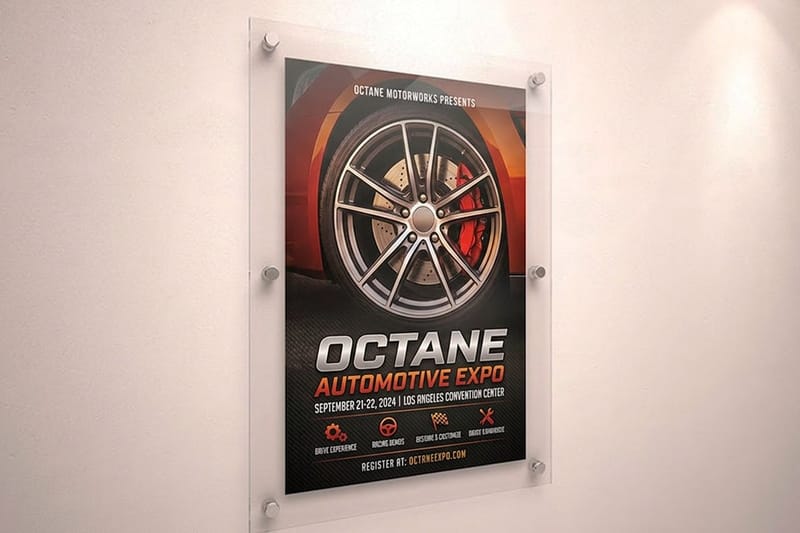 Product Automotive Signs Rigid signage for the messages that stay up past a season.
  Product Wood Poster Hanger Frame Holds a poster flat and swaps it in about a minute.
  Product Automotive Business Cards The card the advisor hands over when the poster has done its job.
  Product Standard Labels Service reminder stickers for the windshield corner.
 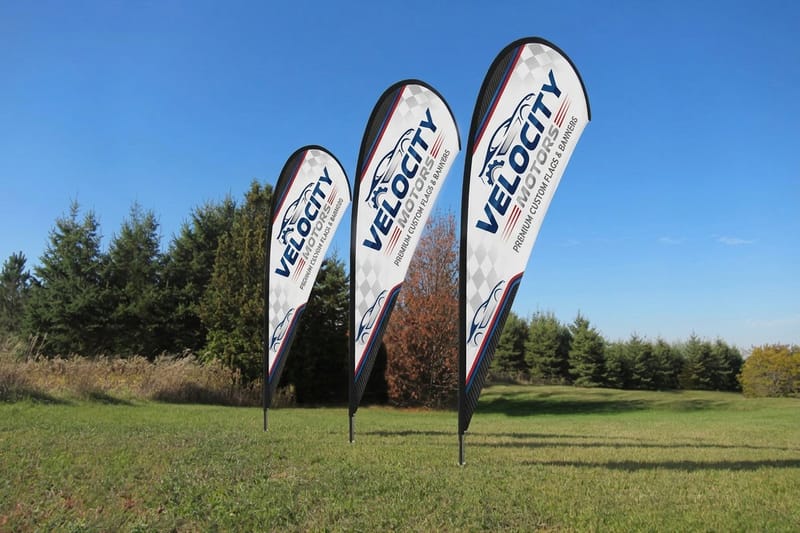 Category Automotive Printing Every print piece a dealership or shop runs, in one place.
 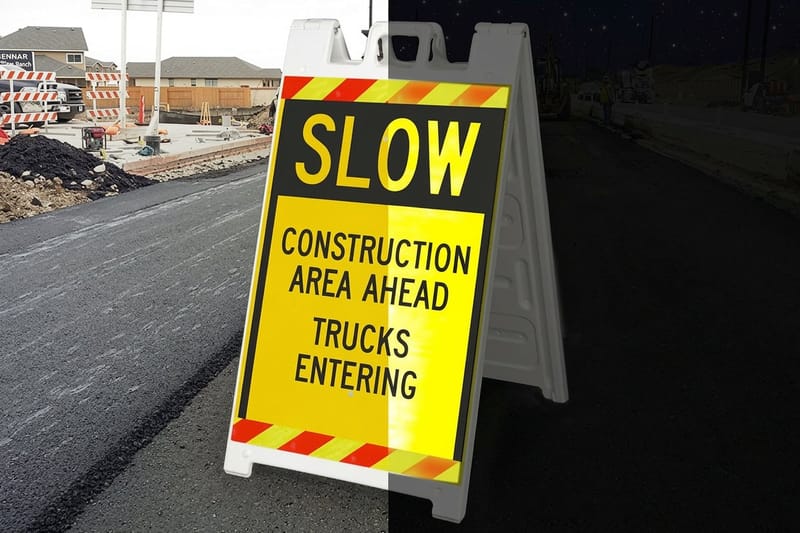 Category A-Frame Sign Printing Sidewalk and lot edge signage that survives weather.
 Ready to print for your shop?
Pick the placement, size the type to the distance, and 4OVER4.COM prints it sharp on paper or on a rigid panel, as fast as your deadline needs.
Common questions about automotive posters
What should a dealership print for a weekend sales event?
Four pieces cover it. An A frame or a banner at the road so people know something is on before they turn in, a window or showroom poster carrying the offer with a real number on it, price cards on the vehicles in the promotion, and a card the salesperson hands over so the visit continues after the weekend. Keep the dates off the banner and print them on the cheap pieces, because the banner should hang again at the next event.
How long does a printed banner last outside at a dealership?
A vinyl banner on a sheltered frontage will usually hold color for a season or two, and one on an exposed south facing wall fades faster, losing the reds first. Wind is the bigger risk than sun. A solid banner on an open frontage tears at the fixings, which is why an exposed site wants mesh from the start rather than slits cut in afterwards. For anything meant to stay up for years, print a rigid panel instead of a banner.
Can you screen print on plastic?
Yes, with an ink formulated for the plastic and a proper cure, which is how plastic cards, containers and molded parts are decorated in volume. For shop signage it is rarely the route you want. A rigid plastic or aluminum panel printed on a UV flatbed handles full color artwork and photographs with no screens and no minimum run, so one sign costs what one sign should.
What size poster should a dealership print for the showroom window?
For a window read from the sidewalk, 24 by 36 or 27 by 40 inches is the working range, and the deciding factor is the reading distance rather than the size of the glass. Work to about one inch of capital letter height for every ten feet of reading distance: a customer standing 25 feet away needs a headline around two and a half inches tall, which fits perhaps five or six words across a 27 by 40 sheet. If the message needs more words than that, it is not a window poster, it is a piece for the service drive or the waiting room where people read from a few feet away.
Will a paper poster survive in a sunny showroom window?
Not indefinitely. Window glass blocks some UV but not enough to protect a printed sheet, and a poster in a south facing window will visibly shift over a few months, usually losing the reds and the deep blues first. That is fine for a promotion that expires anyway. It is the wrong choice for anything permanent, and the honest fix is to move the permanent message onto a rigid automotive sign, which starts at $25 at 4OVER4.COM, and keep paper for the things that were always going to be recycled.
Should automotive posters be printed gloss or matte?
Matte for anything hanging indoors under a grid of downlights, because gloss throws a bright reflection band across the middle of the sheet, which is exactly where the headline usually sits. Gloss for posters behind window glass or under indirect light, where you are already fighting the glass reflection and the extra saturation is worth having. Gloss also does more for metallic paint in a vehicle photograph, so if the car is the message, gloss earns its place. If the poster is mostly type and prices, take matte.
How do I avoid reprinting the whole poster when a price or rate changes?
Design a band into the layout for the numbers and print that band separately. The permanent poster carries the brand, the model, the terms and the layout; the strip carries the payment, the APR or the specials pricing, and it drops into the reserved space. Reprinting a strip costs a fraction of reprinting a 24 by 36 sheet, and it means the finance office can update the window on the first of the month without a design job. Dealerships that skip this step reprint full posters over a nine dollar payment change.
What should go on a service specials poster so people actually read it?
Four offers, each with a real price, and nothing else on the sheet. The instinct is to list nine services so nobody feels left out, and nine unpriced lines is the version customers skim past. A customer standing at the write-up desk is deciding in about four seconds whether anything on that board applies to the car they just handed over, and a price is what makes that decision possible. Keep the layout identical every month so regulars know where to look, and change only the offers and the numbers.
