
13 Fitness Catalog Ideas That Sell More Memberships and Gear


Emma is our prepress and print production voice, built from the knowledge of our production team, with over 20 years in printing.
A fitness catalog sells when every spread ends in one thing to do: book the tour, claim the pass, order the bar. Print it 8.5 by 11 inches, 16 to 24 pages, saddle stitched on 100lb gloss text with a heavier cover, and put the class timetable on page two instead of a welcome letter.
Fitness catalog formats at a glance
| Format | Trim size | Pages | Binding | Where it works |
|---|---|---|---|---|
| Pocket gear guide | 5.5 x 8.5 in | 8 to 16 | Saddle stitch | Front desk handout, tour giveaway |
| Membership catalog | 8.5 x 11 in | 16 to 24 | Saddle stitch | Tours, corporate wellness, mail to leads |
| Square lookbook | 11 x 11 in | 12 to 24 | Saddle stitch | Apparel, merch, studio brand books |
| Full gear catalog | 8.5 x 11 in | 40 and up | Perfect bind | Equipment dealers, wholesale buyers |
| Class schedule book | 5.5 x 8.5 in | 8 to 12 | Saddle stitch | Seasonal timetables, new intake weeks |
Page counts on a stitched book are always a multiple of four, so plan the spare pages rather than padding the copy. You can configure a catalog in any of these formats and see the price move as the page count changes.
What a fitness catalog is actually for
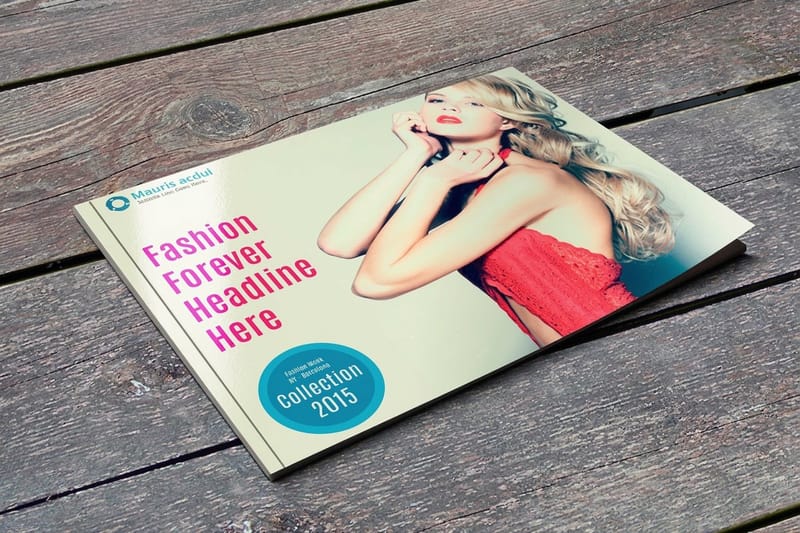
A gym catalog is not a brochure with more pages. It is the thing a prospect carries home after a tour and the thing a member flips through while waiting for a squat rack, which means it has to survive a gym bag and still answer the question that brought them in: what do I get, when does it run, and what does it cost.
That job changes the layout. A brochure argues. A catalog lists, and the listing has to be scannable by someone standing up. Put the timetable early, put prices on one spread instead of three, and end every spread with a single instruction rather than a paragraph of brand voice.
It also changes where the catalog sits in the funnel. It is a strong second touch and a weak first one. A cold prospect who has never heard of your club is a job for a mailer, and our postcard ideas guide covers that piece. The catalog earns its cost once someone has walked in, booked a trial, or asked for the gear list.
Page count is a binding decision, not a writing decision
Saddle stitching folds sheets and staples them through the spine, so the page count is always a multiple of four. If your content lands on 18 pages you are printing 20, and the two spare pages are better used on a goal tracker or a guest pass than left blank.
A stitched catalog tops out at 60 pages here, and as the page count climbs the book springs open and the inner pages creep outward toward your margins. Past that point a perfect bound book takes over, and the spine gives you somewhere to print a title for a shelf.
The size that fits the room
8.5 by 11 inches is the default for a reason: it holds a readable timetable grid and a two column price table without shrinking type. Go down to 5.5 by 8.5 inches when the book lives in a hand or a jacket pocket, which is the right call for a class schedule or a short gear guide.
Square formats read as design pieces rather than reference pieces. They work for apparel and studio branding and they work badly for a spec table, because a wide table on a square page forces the type down a size.
The 13 ideas worth printing
Ideas one to seven sell memberships. Eight to thirteen sell gear and keep members reading after they have joined. Most clubs only need six or seven of these in one book.
You can print all of them on the same specs. Standard catalogs start at $240.55, for 25 copies, and the price moves with the page count you pick.
Ideas one to seven: selling the membership
1. Open on the week, not the welcome. Page two should be a real timetable with class names, times, and the room. A prospect is shopping for the schedule, not the mission statement.
2. All the tiers on one spread. Three columns, one marked as the common choice, joining fee stated in the same type size as everything else. Splitting tiers across pages is what makes a prospect ask the desk to explain, and the explanation is where the sale slows down.
3. A first 30 days spread. Day one assessment, week two class to try, week four check in. It answers the fear that actually stops people signing, which is not price but not knowing what to do on the floor.
4. Your room, your members. Photograph the club you have. A stock photo of a chrome gym in another country tells a local reader the pictures are not of your building, and they will assume the same about the claims.
5. Trainers by who they suit. Name, certification, and the one line that matters: post natal return, first powerlifting meet, knee rehab. A grid of headshots with job titles is a page nobody uses.
6. One offer, one deadline, one code. Print the expiry date on the offer. A catalog with a code and no date sits in a drawer for a year and gets redeemed at a price you set last season.
7. A guest pass panel with its own code. Give it a boxed panel and a unique code so you can count what the book brought in. Mark it with a dotted cut line so the member knows it is meant to come out.
Ideas eight to thirteen: selling gear and keeping readers
8. Index the gear by goal, not by category. Buyers arrive with a goal, not a product family. A page headed "first year of lifting" that mixes a belt, sleeves, and chalk beats three separate category pages.
9. Sizing printed at scale. Where the trim size allows it, print belt widths, grip diameters, and strap lengths at actual size so a reader can hold their own gear against the page. It removes a common reason gear comes back.
10. A real spec table for equipment. Bar weight, knurl pattern, tensile strength, sleeve rotation, warranty length. Serious buyers compare numbers, and the catalog that prints them wins the comparison it invited.
11. The maintenance page. Rack bolt checks, belt conditioning, cable inspection intervals. It is the page that stays on a noticeboard, and a page that stays on a noticeboard is cheap advertising with a long life.
12. Codes next to the product, not on the back cover. Put the QR beside the item it demonstrates and label what it opens. A code that lands on a homepage teaches people not to scan your codes again.
13. A back cover with one next step. Address, hours, phone, and one instruction. A collage of logos on the back of a catalog is the most valuable page in the book spent on nothing.
Paper, binding, and the print that carries it
Three choices set the price of a catalog: page count, stock, and quantity. Everything else is artwork, and artwork is free to change until the file goes to press.
Inside pages are usually a 100lb gloss text. It holds equipment photography and skin tones without the ink drying dull, and it keeps the book light enough to mail. Uncoated text is the alternative and it has one real advantage: a member can write on it, which is the difference between a goal tracker page that gets used and one that smears. The cover goes heavier, a 14pt or 80# gloss cover, so the corners survive a gym bag.
Heavier is not automatically better. Put a thick stock inside a saddle stitched book and the spine bulks, the book springs open on a desk, and the outer pages creep enough to clip a page number. If you want a substantial feel, add pages rather than weight.
The pieces that hand the catalog over
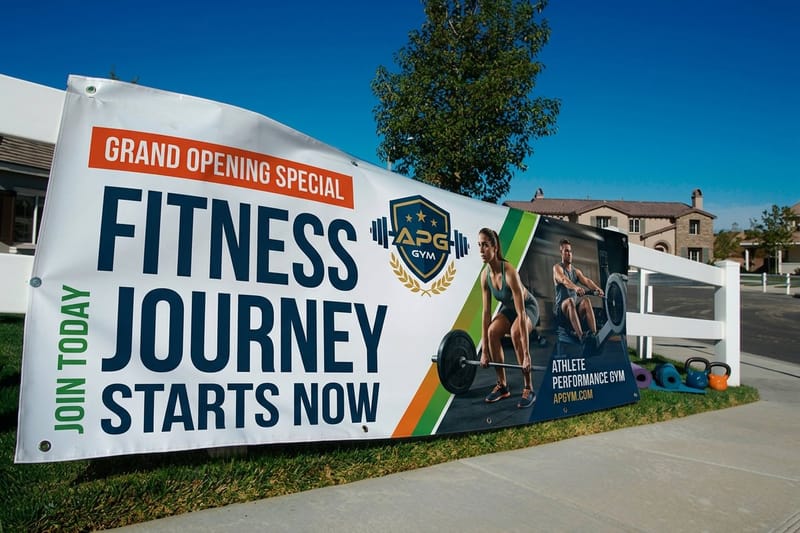
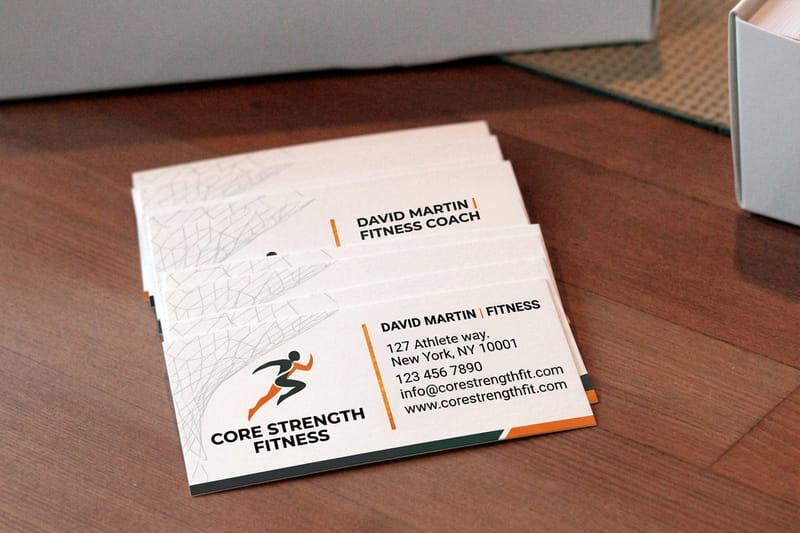
A catalog rarely works alone. The fitness banner above the desk, from $79 for one 2 x 4 foot banner, is what gets the question asked. Fitness flags at $108.75 for one do the same job at the curb for a club set back from the street, and a trainer hands over fitness business cards, 100 for $17.57, with the catalog so there is a name attached to the book. Watch the fitness flags video to see one standing before you pick a size.
Match them properly. Same accent color, same typeface, same photography, printed in the same window so the paper whites agree. The rest of the range sits in the fitness printing collection if you are building the set in one go.
Setting the file up so nothing gets trimmed off
Build the file as single pages, not reader spreads, at 300 DPI in CMYK with 0.125 inches of bleed on every edge. Keep anything you need to read, including page numbers and folios, at least 0.25 inches inside the trim.
On a saddle stitched book the inner sheets push outward as the book thickens and get trimmed back, which shifts the outer margin on the center pages. Give the outer margin a little extra room on those spreads rather than discovering the shift after the run. For large solid blacks, build a rich black instead of 100 percent K alone, or the flat panels behind your headline will look gray next to the photographs.
Catalog pricing and specs at 4OVER4.COM
A club book starts at $240.55 for 25 saddle stitched copies, about $9.62 each, and the per book cost falls as the run grows, so price your member count rather than a round number. Budget the pieces that travel with it at the same time: a $79 fitness banner over the front desk, a $108.75 flag at the curb, and 100 trainer cards for $17.57. Trim size and page count, always a multiple of four, move the catalog price most; the table below shows the live numbers.
Quantity and price
Catalog pricing and specs
Configurator numbers for a saddle stitched book, starting at 25 copies for $240.55.
| Quantity | Price Per Unit | Total |
|---|---|---|
| 25 | $9.62 | $240.55 |
| 50 | $6.04 | $302.06 |
| 100 | $3.61 | $361.37 |
| 200 | $2.22 | $444.85 |
| 300 | $1.65 | $495.38 |
| 400 | $1.29 | $515.14 |

You can also earn coins on every order and redeem them against future printing, which helps when the timetable changes and the book needs a reprint.
When a catalog is the wrong piece
At about $9.62 a copy on a 25 book run, a catalog is expensive per copy and slow to change, so there are jobs it should not take. A one week promotion belongs on a postcard or a poster, because the catalog will still be sitting on the desk long after the offer expired. A cold audience that has never heard of the club belongs to a mailer too. And a single class or a single package does not need pages at all: it needs one sheet somebody can pin up. If the message will change inside a month, print something cheaper.
Print it
Catalogs, ready to bind
Saddle stitched from 8 to 60 pages, on stocks that survive a gym bag.
The counterweight is longevity. A catalog stays in a bag or on a noticeboard for months, and every page you gave a genuine use, the maintenance checklist, the sizing chart, the first 30 days plan, buys more of that time. That is also why the merch pages are worth doing properly: if you are building a branded merchandise range alongside the club, the branded merchandise ideas guide covers what actually gets worn, and packaging that sells covers how it ships.
Choosing the right format for your business
Different fitness businesses need different books, so here is a quick breakdown by type.
- Independent gyms. A 16 page book: timetable, three tiers on one spread, trainers by specialism, guest pass panel. Reprint it when the schedule changes rather than trying to make one book last two years.
- Boutique studios. A square lookbook that sells the room and the instructor. Fewer pages, bigger pictures, and a class description page that says what a first session feels like.
- Personal trainers. Eight pages is plenty: packages, availability, a first 30 days plan, and results you can actually name. Hand it over with a business card so the follow up has a phone number.
- Equipment dealers. Perfect bound, 48 pages and up, with a real spec table on every product family and a maintenance section buyers keep at the back.
- Apparel and supplement brands. Fit and sizing printed at scale, one colorway per spread, and codes beside each item rather than a single code on the back cover.
Catalog blanks with the gutter allowed for
A saddle stitched club book is the one piece here where the blank saves real money, because a spread laid out without the gutter and creep ruins a $240.55 run. The blanks below mark the 0.125 inch bleed, the 0.25 inch safe area and the middle spread creep, and the same files keep a $79 banner or a $17.57 card run consistent with the book. Grab a print ready blank from the blank template library with bleed and trim already marked.
Start fast
Catalog blanks with the gutter allowed for
Catalog blanks with the creep on the middle spreads already allowed for.
Wally plans a gym catalog that people keep
Pick the page count before you write a word
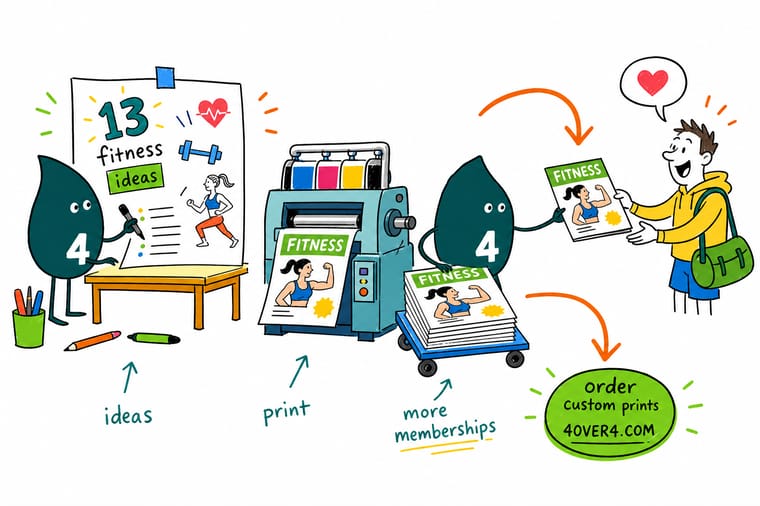
Set the trim at 8.5 by 11 inches, land the page count on a multiple of four, and saddle stitch anything under about 64 pages. Print the inside on 100lb gloss text and the cover heavier so corners survive a gym bag, add 0.125 inch bleed with 0.25 inch safety, and give every spread one instruction. 4OVER4.COM prints it with a free proof before the run.
Order catalogs →What makes a gym book worth keeping
Design tips that work at every page count
- One instruction per spread. Book the tour, claim the pass, order the bar. A spread that asks for three things gets none of them.
- Type big enough to read standing up. The catalog is read at arm’s length in a busy room, not at a desk. If the timetable needs 7pt to fit, cut a column instead of the type size.
- Print the date on every offer. An undated code is a discount you will still be honouring next season at a price you no longer charge.
- Photograph the club you have. Local readers recognize their own room. They also recognize a stock photo, and they discount everything on the page next to it.
- Proof it folded, not flat. Ask for the printed proof, fold it, and hold it. Gutter crowding and creep on the center pages only show up in the physical book.
Explore more
More ways to print and promote
Standard catalogs run 25 for $240.55, which is $9.62 a book, out in 7 business days.
Product Catalog Printing Saddle stitched from 8 to 60 pages, from $240.55 for 25. Product Fitness Banners The piece above the desk that gets the question asked. 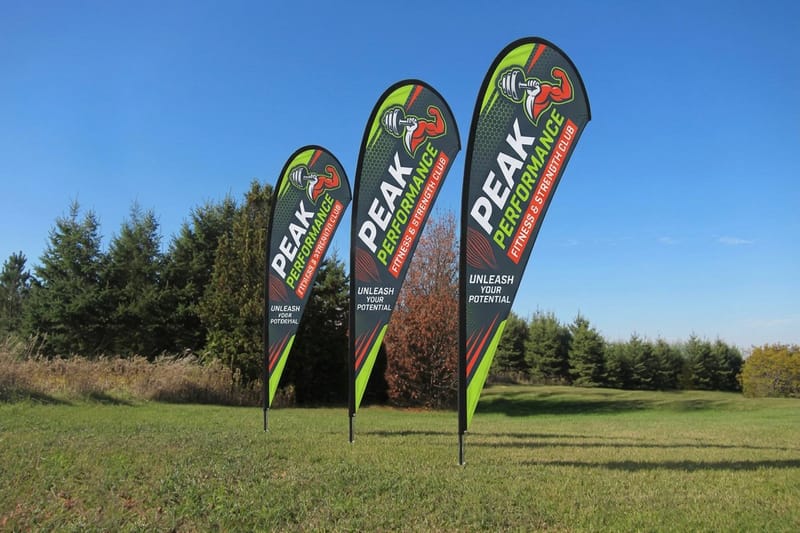 Product Fitness Flags Curb visibility for a club set back from the street. Product Fitness Business Cards A name attached to the catalog you just handed over. Category Fitness Printing Collection Every piece a gym prints, in one place.
 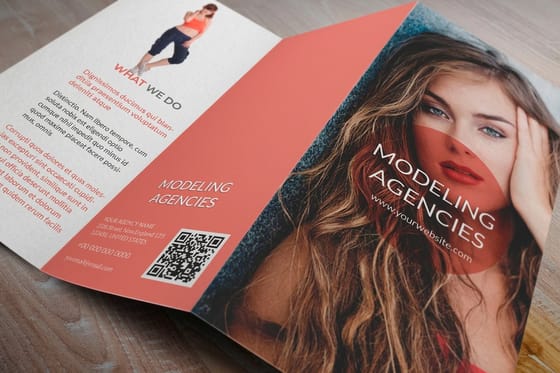 Article 10 Brochure Ideas You Have Not Thought Of Yet Shorter format, same job, different folds.
 Still shaping the offer rather than the book? Five marketing ideas that sell more works the same way for a club, salon signage ideas transfer straight to a studio front, and business card ideas sellers actually use covers the card you hand over with the catalog.
Ready to print your catalog?
Pick the trim and the page count, drop in your design or a free template, and 4OVER4.COM prints it sharp on premium stock, as fast as your deadline needs.
Common questions about fitness catalogs
How many pages should a gym catalog be?
Sixteen to twenty four pages covers a full club: timetable, membership tiers, trainers, a first 30 days plan, a guest pass panel, and a back cover with one instruction. Eight to twelve is enough for a personal trainer or a seasonal class schedule. Whatever you land on has to be a multiple of four, because saddle stitching folds sheets in half and staples them through the spine. If your content ends at 18 pages you are printing 20, so plan the two spare pages as a goal tracker or a maintenance page rather than leaving them blank.
Saddle stitch or perfect binding for a fitness catalog?
Saddle stitch for anything up to 60 pages, which covers almost every gym and studio book: it costs less, lies flatter on a desk and mails at a lower weight. A perfect bound book, from 40 inside pages, suits a full equipment catalog and gives you a printable spine for a buyer's shelf. Our perfect binding vs saddle stitch comparison lines the two methods up side by side.
What paper should the inside pages be printed on?
A 100# gloss text is the standard for the inside pages. It carries equipment photography and skin tones without the ink drying flat, and it keeps the finished book light enough to mail. Choose 70# uncoated text if the catalog has pages members write on, because ink sits on top of a gloss coating and smears. Covers go heavier, a 14pt or 80# gloss cover, so the corners survive a gym bag.
Should I mail the catalog or hand it out?
Hand it out, mostly. A catalog is a strong second touch and an expensive first one, so it does its best work after somebody has taken a tour, booked a trial, or asked for the gear list. Mailing it to a cold purchased list spends catalog money on a job a postcard does for a fraction of the cost. The exception is a warm list you already own, such as lapsed members or corporate wellness contacts, where the extra pages give you room to answer the objection that made them leave.
How do I set up the file so nothing gets cut off?
Export single pages rather than reader spreads, at 300 DPI in CMYK, with 0.125 inches of bleed on every edge. Keep live copy, page numbers and folios at least 0.25 inches inside the trim line. On a saddle stitched book the inner sheets push outward as the book thickens and get trimmed back, so give the outer margins on the center spreads a little more room than the outer ones. Build large solid blacks as a rich black instead of 100 percent K, or flat panels will read gray beside the photography. Blank templates with bleed and trim already marked save the whole exercise.
