
Vinyl Cut Decals vs Vinyl Printed Stickers and How to Pick


One is carved out of colored film, the other is printed on white film and cut to shape. Here is how that single difference decides color, detail, life span, and how you put it on.
A vinyl cut decal is cut out of pre colored film with a blade, so it has no background and only the color the film already is. A vinyl printed sticker is CMYK printed onto white or clear vinyl and then contour cut, so it can carry photographs, gradients and any number of colors, but it keeps a visible printed border. Choose the cut decal when the surface should show through and the art is one or two solid colors. Choose the printed sticker when the artwork itself is the object.
Quick answer
The blade cuts the color, the press prints it
Cut decals get their color from the vinyl. Printed stickers get theirs from the ink. That is the whole comparison in one line, and every practical difference follows from it. Cut vinyl gives you artwork with no background and color that holds outdoors, at the price of one color per layer and no fine detail. Printed vinyl gives you photographs, gradients and small type, at the price of a visible cut border and an ink layer that depends on its laminate to survive the sun.
What a Vinyl Cut Decal Actually Is
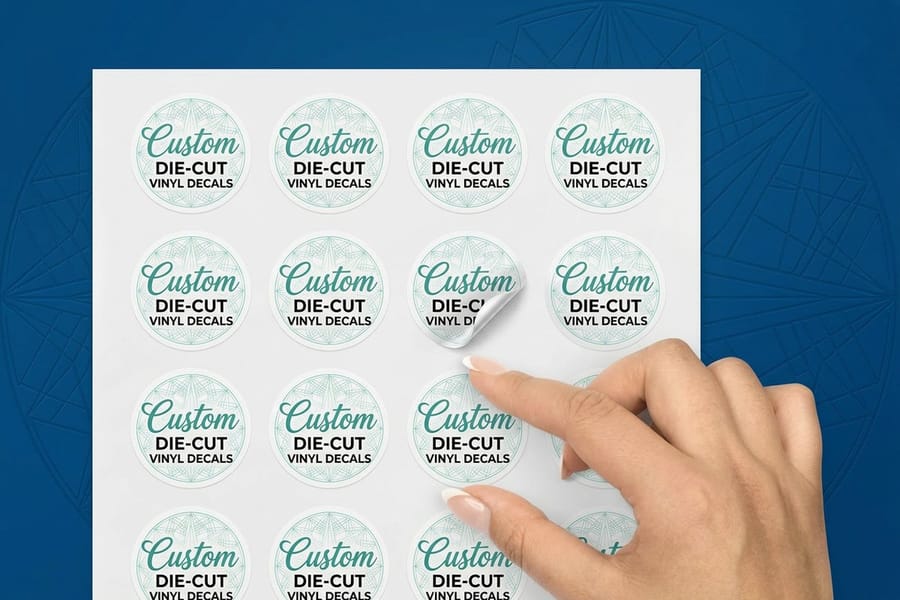
A cut decal starts as a roll of vinyl that is already the color you asked for. A plotter drags a small blade through the film along your vector paths, cutting the top layer but not the backing liner underneath. Nothing is printed at any point.
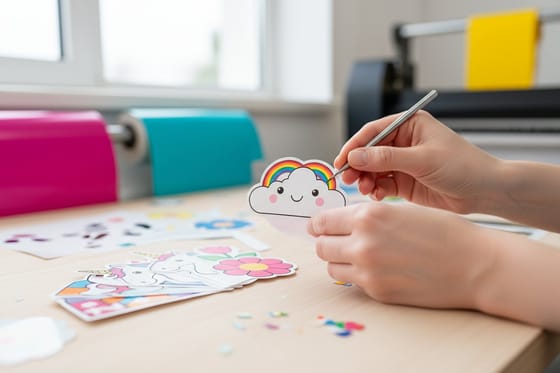
Then comes weeding, and weeding is where the process shows its personality. Someone picks the unwanted vinyl off the liner by hand with a pin, leaving only the letters and shapes behind. The inside of an O, the gap in an ampersand, the space between two tight serifs: every one of those has to be lifted out individually. That is why cut artwork has to be drawn with weight. Strokes thinner than roughly a sixteenth of an inch stretch and tear on the way up, and small text with delicate counters comes out looking chewed.
What survives gets covered with a sheet of transfer tape so the loose pieces stay in their layout, and that is the sandwich that ships to you. On the wall or the window, the result looks painted on rather than stuck on, because there is no background and no visible edge. Our cut vinyl lettering guide covers the sizing and spacing rules in detail, and vinyl decals start at $93.37 in the configurator.
What a Vinyl Printed Sticker Actually Is
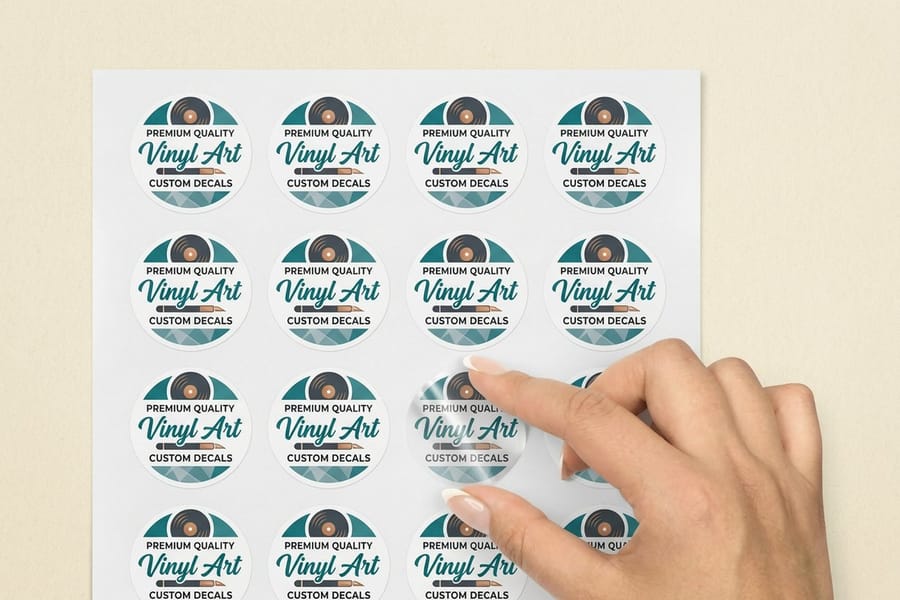
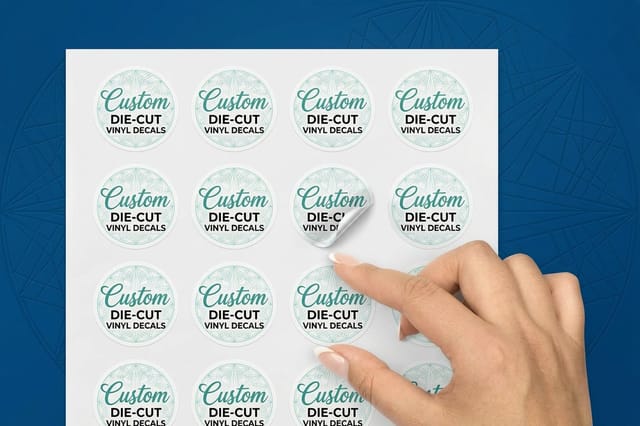
A printed sticker runs the other way around. The vinyl arrives white, the press lays CMYK ink across it, a clear laminate goes over the ink, and only then does a blade contour cut the shape. The color is ink sitting on the film, not the film itself.
That single difference removes almost every artwork restriction. Photographs, gradients, drop shadows, six brand colors, hand drawn illustration with a hundred tones: all of it prints. Detail is limited by the printer resolution rather than by what a person can pick off a liner with a pin, so fine type stays fine.
The trade you make is the background. Printed artwork sits inside a cut edge, and unless you order clear stock that edge is white. Even clear vinyl has a catch: without a white underprint layer, anything printed on it goes translucent against a dark surface, so pale artwork on a black laptop lid disappears. How stickers are printed walks through the press stage, die cut stickers explains the cutting stage, and vinyl stickers start at $25.
The Four Differences That Decide the Job
Color, detail, durability, application. Every other difference between the two is downstream of one of these four, and one of them will usually make the decision for you before you finish reading the row.
| Vinyl cut decal | Vinyl printed sticker | |
|---|---|---|
| Color | One color per layer of film. Extra colors mean extra cut, weed and layup passes. No gradients, no photographs, no halftones. | Unlimited color from CMYK ink. Gradients, photographs and full illustration print without any extra process step. |
| Detail | Limited by weeding. Keep strokes above roughly a sixteenth of an inch and avoid tight counters at small sizes. | Limited by print resolution. Fine serifs, small legal text and thin rules all reproduce cleanly. |
| Durability | Pigment runs through the film, so color holds until the vinyl itself chalks or the adhesive lets go. | Ink sits on the surface, so the laminate above it decides how long the artwork stays saturated. |
| Application | Transfer tape, one alignment, squeegee, peel the tape back at a sharp angle. No second attempt. | Peel from the liner and press down. Small stickers can be lifted and repositioned within the first seconds. |
| Finished look | Artwork only. No background, no visible edge, reads as applied to the surface. | A printed object with a cut border, whether that border is white, clear or die cut to the artwork. |
Read the color row first and most jobs sort themselves. A one or two color logo going on glass or paint wants a cut decal. Anything with a photograph or a gradient has no decision to make, because a blade cannot produce a tone the film does not already have. If you are torn between materials rather than processes, vinyl stickers versus paper stickers covers that axis separately.
What Each One Is Genuinely Best At
Both stick to things. They earn their money in different places.
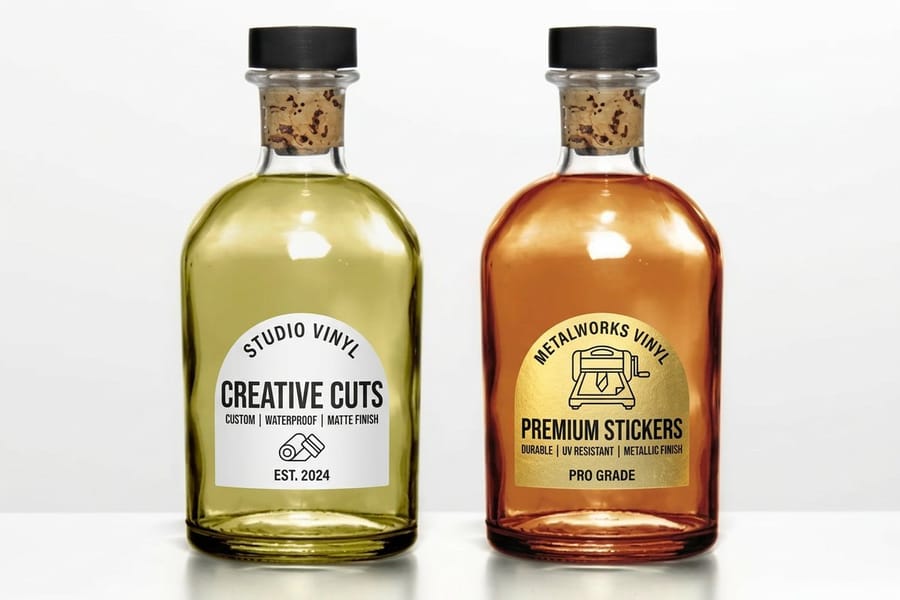
Cut decals win when the surface should stay visible. Storefront hours and phone numbers on glass, a company name and DOT number down a van door, a boat name across a transom, a single color mark on a painted wall. In all of those, a rectangle of white film around the artwork would look wrong, and the whole point is that the surface shows through the gaps. Window decals and car decals are the two most common versions.
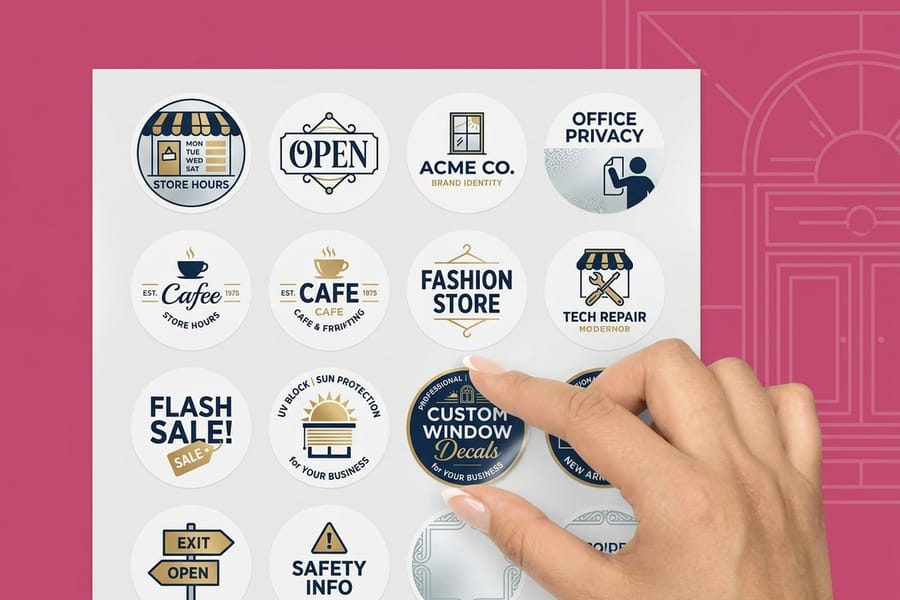
Printed stickers win when the artwork is the object. Product labels, packaging seals, laptop and water bottle stickers, event giveaways, character art, anything with a photo of a product on it. Here the border is either invisible against a busy background or actively useful as a frame. Bumper stickers start at $38.44 and are printed for exactly this reason: a bumper sticker with no background would be unreadable at forty feet.
There is a middle case worth naming. A multi color logo that needs to look painted onto glass can be printed on clear vinyl with a white underprint and contour cut tight to the artwork. It is not a true cut decal, and up close you can find the edge, but from six feet it holds. If the choice is really between decals and magnets for a vehicle, car decals versus magnets versus bumper stickers compares all three.
Indoor, Outdoor, and What Actually Kills Each One
Neither option is simply weatherproof or not. They degrade by different mechanisms, and knowing which one applies tells you what to specify.
| Condition | Cut decal | Printed sticker | What to ask for |
|---|---|---|---|
| Indoors, no sun | Effectively permanent until removed. | Effectively permanent until removed. | Either. Choose on look, not on life. |
| Storefront glass | Color holds. Failure shows up as edges lifting where the glass was not cleaned. | Holds well behind glass, since the pane blocks part of the UV. | Clean with isopropyl alcohol, not glass cleaner. Silicone residue kills adhesion. |
| Vehicle exterior | Strong. Cast film conforms to curves and stays put through car washes. | Fine when laminated. Unlaminated print chalks and fades first. | Cast vinyl for curves, laminate on anything printed. |
| Full sun, year round | Fades slowly and evenly because pigment is through the film. | Fades in the ink layer. Reds and yellows shift first. | UV laminate, and expect a printed piece to age faster than a cut one. |
| Pressure washing | Survives if the jet is kept off the edges. | Laminate survives. The cut edge is still the weak point. | Spray across the piece, never straight into an edge. |
The pattern is consistent. A cut decal usually fails at the adhesive or as the film goes brittle, while a printed sticker usually fails in the ink long before the vinyl gives up. That is why laminate is not an upgrade on a printed outdoor piece, it is the thing keeping the artwork alive, and why a cheap unlaminated print is a false economy on anything that lives outside. Our guide to outdoor sticker materials that survive sun and rain goes deeper on films and adhesives, and sticker materials explained lists what each stock is for.
Which One Should You Choose
Answer the first question that applies to your job and stop there. The rows are ordered so the ones that end the decision come first.
| If this is true | Order | Because |
|---|---|---|
| The art has a photo or a gradient | Printed sticker | A blade cannot make a tone the film does not already have. |
| The surface must show through | Cut decal | There is no background at all, only the artwork. |
| Three or more solid colors | Printed sticker | Cut costs rise with every extra layer to weed and align. |
| One or two colors, going on glass or paint | Cut decal | Cleanest look, and the pigment outlasts printed ink outdoors. |
| Small type or fine line work | Printed sticker | Thin strokes tear during weeding. |
| Handing them out at an event | Printed sticker | Peel and stick with no transfer tape and no technique to explain. |
| Vehicle lettering that has to last years | Cut decal | Cast film on curves, and no ink layer to fade. |
If two rows both apply and point different ways, follow the one about the background. Everything else can be worked around. A visible white rectangle where you wanted bare glass cannot.
How to Order the Right One at 4OVER4.COM
The two products want different files, and sending the wrong kind is the most common reason a job comes back for revision.
- For a cut decal, supply vector artwork with every font converted to outlines and every stroke expanded to a filled shape. A plotter cuts paths, so a live stroke has no path to follow. Name the color you want from the film range rather than specifying a CMYK build, and keep the smallest stroke above roughly a sixteenth of an inch at final size.
- For a printed sticker, build at final size in CMYK at 300 dpi with an eighth of an inch of bleed, and hold important text an eighth of an inch inside the cut line. If you want a shape other than a square or a circle, include the cut path as a separate spot colored line so the plotter knows where to follow.
- For either one, measure the surface before you pick a size. A decal that is two inches too wide for a van door panel is a reprint, and nothing in the file will save it.
Start from a correctly sized layout in the blank template library, then configure the job. Decal printing lists the cut options including window, car and floor decals. Sticker printing lists the printed side, and die cut decals sit between the two with the cut following your artwork outline. When the box arrives, how to apply a vinyl decal covers the wet method that gives you one chance to slide it into position before the adhesive grabs.
Wally weighs a cut decal against a printed sticker
No background, or every color you want
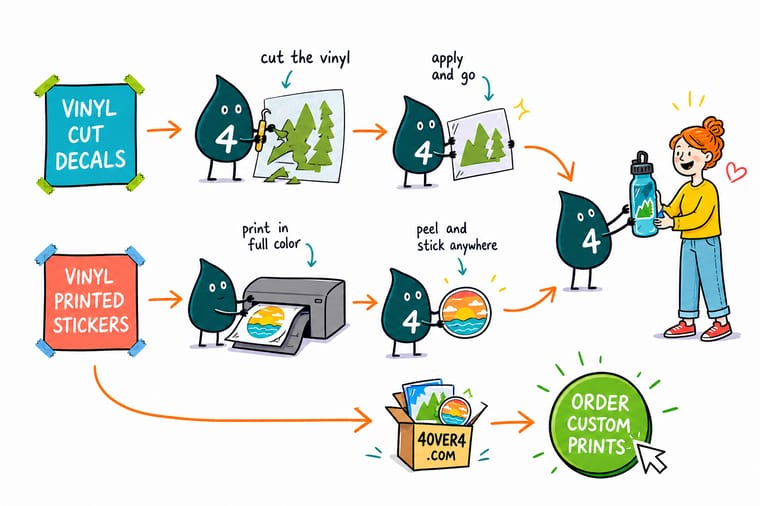
In Wally's left hand is a cut decal. A blade traced the letters out of solid teal film, he picked the waste off with a pin, and transfer tape is holding the pieces in place until they hit the glass. Nothing but the artwork lands on the window. In his right hand is a printed sticker, full color, photo and all, with a laminate on top and a cut edge around the outside. He will tell you the same thing every time. If the surface should show through, cut it. If the picture is the point, print it.
Compare decals and stickers →Specs and pricing
Sizes, materials, and starting prices side by side
Cut decals, printed vinyl stickers, and window decals with the live configuration options and starting prices straight from the 4OVER4.COM configurator.


Print it
Order the one your job actually needs
Explore more
Where to go next





By the numbers
Vinyl printing you can count on at 4OVER4
Common Questions
Decal and sticker questions, answered
What is the difference between a decal and a vinyl sticker?
A cut decal is cut out of colored vinyl film with a blade, so the artwork is the only thing that ends up on the surface and the color comes from the film itself. A printed sticker is inkjet or UV printed onto white or clear vinyl and then cut to shape, so it carries a printed background inside its cut edge. In practice, that means a decal reads as lettering or a mark applied straight onto glass or paint, while a sticker reads as a small printed object stuck to it.
Can a cut decal have more than one color?
Yes, but every color is a separate piece of film that has to be cut, weeded, and layered by hand in register. Two colors is routine, three is common on vehicle work, and past that the labor cost climbs faster than a printed version would. If your logo has four or more colors, or any gradient at all, print it instead. A two color mark with clean solid areas is where cut vinyl is genuinely the better buy.
Will a printed vinyl sticker survive a car wash?
A laminated printed vinyl sticker will survive brush and touchless car washes for years. The laminate is the part doing the work, because it takes the abrasion and blocks the UV that would otherwise fade the ink underneath. Unlaminated paper or uncoated vinyl stickers are the ones that come back chalky and lifted at the corners after a season. If the sticker is going on a vehicle, confirm it is laminated before you order.
Why does my decal arrive with paper stuck to the front?
That is transfer tape, and it is the only thing holding the loose cut pieces in position. The decal is really a set of separate letters and shapes sitting on a backing liner. You peel the liner away, the tape carries the whole layout to the surface at once, you squeegee it down, then you peel the tape off at a sharp angle and leave the vinyl behind. Remove the tape too early or pull it straight up and the thinner strokes come with it.
Can I get a photograph cut as a decal?
No. A plotter follows vector paths, so it can only cut an outline. A photograph would have to be reduced to one flat silhouette in a single color, which usually looks nothing like the original. Send a photo to a printed sticker, where CMYK ink reproduces the whole image, and reserve cutting for logos, lettering, and any mark that already works in one or two solid colors.
Do decals cost more than stickers?
They usually start higher because they are made from a more durable film and finished by hand. At 4OVER4.COM vinyl stickers start at $25 and vinyl decals start at $93.37, since the decal price covers the cut, the weeding, and the transfer tape. Compare them per year on the surface rather than per unit. A decal that stays legible on a van door for several seasons often works out cheaper than reprinting a sticker every year.
Get Started
Ready to put your artwork on something?
Pick the cut decal when the surface should show through, the printed sticker when the artwork is the object. Upload the file, choose your size, and we cut or print it.
Legal Disclaimer
Gold Standard guarantees apply to all standard orders placed through 4over4.com. Price match requires verifiable proof of a competitor's published price for an equivalent product with matching specifications and turnaround time. Satisfaction guarantee covers manufacturing defects and print quality issues. Contact support with order number and documentation. On-time delivery rate based on tracked orders 1999 to 2026. Individual results may vary based on shipping carrier performance.
