
How to Spec Business Card Boxes That Fit, Protect and Sell Your Cards


Card fit, box style, board weight, branding and bulk quantities, written as the six numbers and choices a printer needs from you. Follow the order below and you will hand over a spec that comes back right the first time.
To spec a business card box, give the printer inside dimensions in length by width by depth. Length and width come from the trimmed card, usually 3.5 by 2 inches, plus about a sixteenth of an inch of clearance. Depth comes from measuring the real stack at the count and stock you print. Then choose the construction, tuck end for shipping or lid and base for presentation, set the board weight, and decide which panels get printed inside and out.

Start here
The whole spec in one paragraph
A business card box is specified by inside dimensions, construction and finish, in that order. Measure the trimmed card for length and width, measure a real stack at your card count and stock for depth, and add a small clearance so cards drop in rather than jam. Choose a tuck end carton for shipping, a lid and base box for presentation, or a sleeve for premium sets. Then set board weight to match how the box will be handled, match the lamination to the card finish, and decide whether the interior gets printed.
Why the box decides how your business cards land
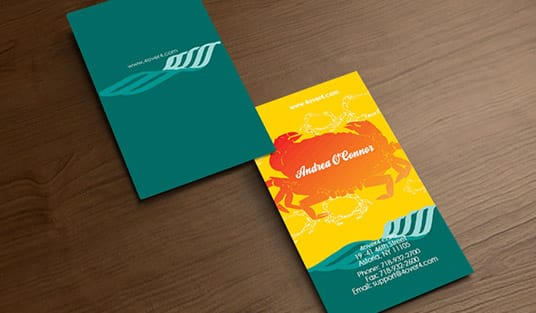
A box of business cards is handed over in the moments that matter most, at a trade show table, across a reception desk, inside a welcome kit for a new hire. The cards do the talking, but the container sets expectations before a single card is pulled out. A carton that bulges, rattles or crushes at the corner undoes the money you spent on thick stock and soft touch lamination.
Specifying a box is a measurement job first and a design job second. Get the inside dimensions right and everything else, the closure, the board weight, the printed interior, becomes a straightforward choice. Get them wrong by even a sixteenth of an inch and the cards either jam going in or slide loose in transit. This guide walks the spec in the order a printer needs it, so you can hand over numbers instead of a description.
Step 1: measure the stack, not the single card

Length and width come from the trimmed card, which for a standard US card is 3.5 by 2 inches. Depth is the number people get wrong, because it depends on two variables at once: how many cards go in the box and how thick the stock is. A 100 card set on 14pt stock is a very different height from 100 cards on 32pt triple layer stock.
The reliable method is physical. Print or pull a sample stack at the exact count and the exact stock, square it up on a flat surface, then measure the height with a caliper or a steel rule. Do not calculate it from a single card thickness and multiply, because ink coverage, lamination and the natural air between sheets add up across a stack. Whatever you measure, add roughly one sixteenth of an inch of clearance so cards drop in cleanly rather than needing to be forced.
Write the result as inside dimensions, always in the order length by width by depth. Inside dimensions describe the cavity the cards occupy. Outside dimensions describe the finished box after board thickness is added on every wall, which is the printer's job to work out. Mixing the two is the single most common cause of a box that arrives a size off.
Step 2: pick the construction that matches the job
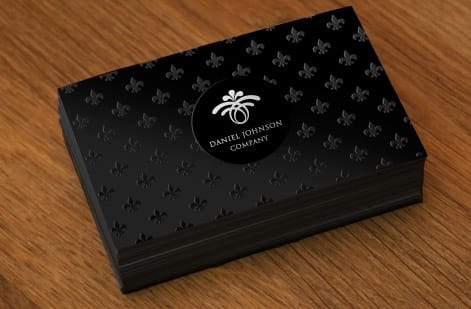
Three constructions cover almost every business card use case. A tuck end folding carton is the workhorse. It ships flat, folds up in seconds, costs the least per unit and closes securely enough to survive a courier. Use it for bulk card runs, reseller fulfillment and anything that gets mailed.
A two piece lid and base box is the presentation option. The lid lifts off in one motion, the cards sit revealed in the base, and the rigid walls hold their shape on a counter or in a display. It costs more and ships assembled rather than flat, so it takes more space, but nothing else feels like a product the way a rigid lid does.
A slipcase or sleeve is the third route, a printed band or open ended shell that the card block slides into. It suits thick or specialty cards where the stock is the story, including textured, painted edge and 3D lenticular business cards that reward being revealed slowly. Decide the construction before you design anything, because each one gives you a different set of printable panels.
Step 3: choose board weight and match it to the card
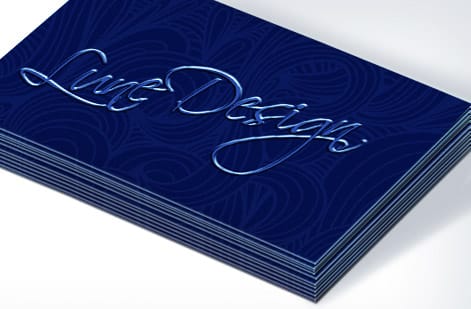
Board weight controls how the box feels in the hand and how much abuse it absorbs. Folding carton stock in the range printers use for cosmetic and retail packaging is enough for a tuck end box holding 50 to 250 cards. Once the count climbs toward 500, or the box will be handled repeatedly rather than opened once, step up to a heavier caliper or move to laminated rigid board.
Match the finish to the card, not to your logo file. If the cards are matte laminated, a matte box reads as one product. A gloss box around matte cards reads as two things that happened to arrive together. Soft touch lamination is the exception that flatters almost anything, and it also hides fingerprints on a dark box far better than gloss does.
Remember that the box is a printed piece with its own color behavior. Board takes ink differently from card stock, so a brand color that sits perfectly on a coated card can shift on uncoated packaging board. Ask for a printed proof on the actual board rather than approving from a screen, and check it under the light where the box will really be seen.
Step 4: brand the outside and the inside
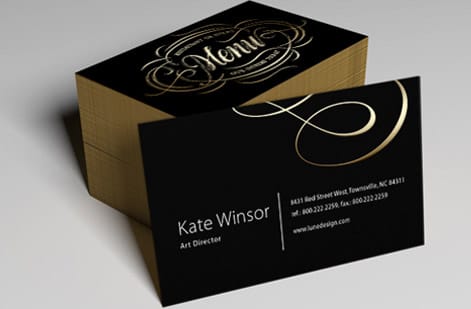
Most people design the lid and stop. The interior is the surface a recipient looks at longest, in the second between lifting the lid and taking a card, and it is usually blank white board. Printing the inside of the lid with a short line, a pattern or a single mark turns an ordinary carton into something people keep on a desk.
Keep the outside restrained. A box has less usable area than a flyer and every added element competes with the mark you actually want remembered. One logo, one supporting line, and generous empty board around them is stronger than a full bleed collage. Where you want impact, spend it on a finish rather than on more artwork: foil on the logo, a spot gloss shape on a matte field, or a blind emboss that only shows when the light rakes across it.
The same restraint that makes a good card makes a good box. If you want a fast sense of what reads well at this scale, the roundups of stylish business card examples and the 30 most amazing business card designs are full of layouts that survive being shrunk onto a two inch panel.
Step 5: run the quantity math before you commit

Packaging pricing is dominated by setup. The die, the plates and the makeready cost the same whether you print 250 boxes or 2,500, so the per unit price falls steeply as the run grows and then flattens out. That curve is why buying boxes job by job is the most expensive way to do it, and why studios and resellers standardize.
The practical move is to look back at your last year of card orders, find the two card counts you sell most often, and spec a box for each. One depth for 100 card sets and one for 500 card sets covers the large majority of real work. Order both in a single run, store them flat if they are folding cartons, and pull from stock as jobs close.
If you are comparing that approach against buying prepacked cards from a consumer print site, run the numbers on the whole delivery rather than the card price alone. The breakdown in our Vistaprint business card prices alternative shows how quickly reorder pricing and packaging change the total.
Step 6: build artwork on the dieline and proof it folded
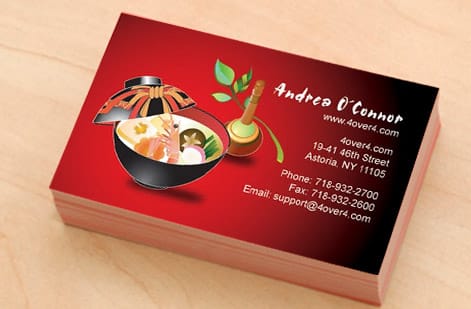
Every custom box starts from a dieline, the flat template that shows cut lines, score lines, glue tabs and the bleed area around each panel. Artwork goes onto that template as a separate layer, never merged into it, and the dieline layer is set to overprint so it does not knock holes in your color when the file rips. Panels that will be folded need their content pulled in from the crease, since a design element sitting right on a fold line will crack.
Set bleed generously. Packaging tolerances are wider than flat sheet tolerances because folding introduces movement, so an eighth of an inch of bleed is safer than the sixteenth you might use on a card. Keep type and logos at least an eighth of an inch inside the trim on every panel.
Before approving anything, print the dieline at full size, cut it out and fold it. Two minutes with paper and a craft knife catches upside down back panels, artwork that reads sideways once assembled, and copy that lands on the glue tab. If you are choosing software to build the file, the comparison of business card design tools for beginners and pros covers which apps handle dielines and which do not.
Wally explains box fit
Measure the stack, then leave it room to breathe
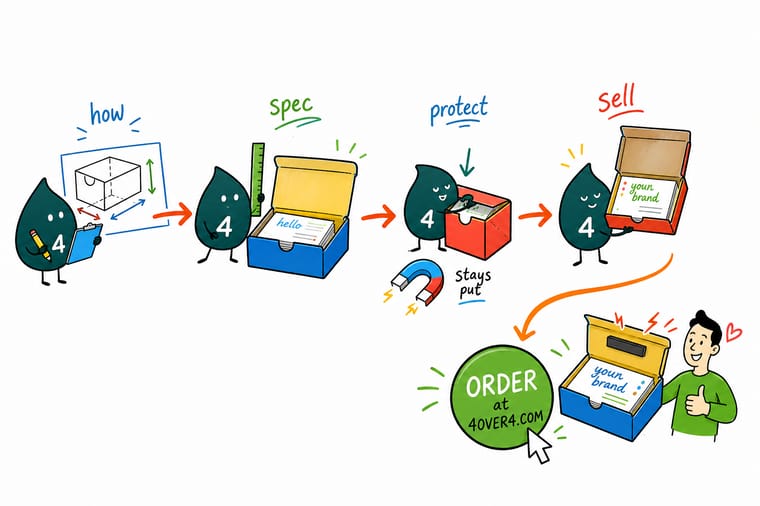
Wally's rule is that a box is never sized from a drawing, it is sized from a stack you can hold. Square up the real cards on the real stock, measure the height, add a sliver of clearance, and quote inside dimensions so the printer can add the wall thickness. Do that and the lid seats, the cards lift out cleanly, and nothing rattles in the mail.
Print your business cards →Fit diagram
How a card stack turns into box dimensions
One frame showing where each number comes from, from the trimmed card to the finished outside dimensions. Save it and use it as the checklist next time you brief a packaging run.
Work the six numbers in order and the seventh step, the folded dieline check, almost never turns up a surprise. Skip straight to artwork and it usually does.
Specs and pricing
Card specs and live pricing to build the box around
Your box depth is only as accurate as the stock underneath it, so start from a real product spec. Business Card Magnets start at $19.68 and give you a thick, rigid piece that needs noticeably more depth per unit than a paper card.

| Quantity | Price Per Unit | Total |
|---|---|---|
| 1 | $19.68 | $19.68 |
Print it
Cards worth boxing, printed at 4OVER4


See it in use
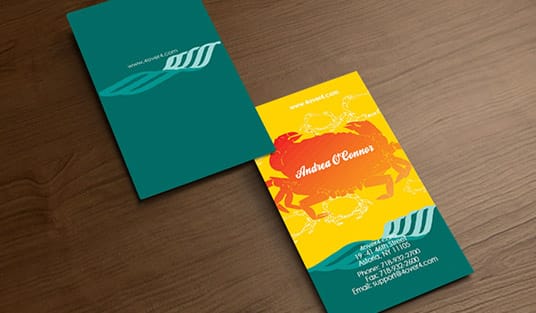
Real card work, printed in-house



Explore more
Where to go next

By the numbers
Printing you can count on at 4OVER4
Common Questions
Common questions about business card boxes
What is a business card box?
A business card box is a small rigid or folding carton built to hold a stack of printed cards at a set count, usually 50, 100, 250 or 500. It does two jobs at once. It protects the corners and edges of the cards from crushing and scuffing while they travel or sit in a drawer, and it presents the cards as a finished product when a client, a rep or a retail buyer opens it. The box is specified by inside dimensions, board thickness, closure style and print finish.
How do I choose the right business card boxes?
Start with the card itself, because everything else follows from it. Note the trimmed card size, the stock weight and the number of cards per box, then measure the height of that stack. Choose a closure that matches how the box will be used, a tuck-end for shipping, a lid and base for presentation, a slipcase for premium sets. Then pick board and finish to match the card. A soft touch card inside a glossy box reads as mismatched, while matching finishes look deliberate.
What does a business card box cost and how are prices set?
Price is driven by four things: the quantity you order, the size and board weight, the number of printed sides and surfaces, and any finishing such as foil, spot gloss or soft touch lamination. Unit cost drops sharply with volume because setup and die costs spread across the run, which is why resellers standardize on one or two sizes. Printing the interior, adding a magnetic closure or specifying rigid board all move the price up.
What sizes, stocks and finishes are available for business card boxes?
Standard boxes are built around the 3.5 by 2 inch card, with inside lengths near 3.6 inches and widths near 2.1 inches. Depth is the variable that changes, typically from a quarter inch for a fifty card set up to about two inches for a five hundred card set. Board choices run from folding carton stock for lightweight cartons to laminated rigid board for premium lid boxes. Finishes include matte and gloss lamination, soft touch, foil stamping, spot UV and embossing.
How long does it take to print and ship business card boxes?
Turnaround depends on construction. Folding cartons on a stock die move fastest because they print flat and fold at the end of the line. Rigid two piece boxes take longer, since the board is wrapped and assembled by hand after printing. Add a business day or two when you specify foil, embossing or a custom die that has to be cut before the first sheet runs. Build proofing time into your schedule as well.
Do I need a dieline before I can order?
Yes for any custom size or shape. A dieline is the flat blueprint of the box showing cut lines, fold lines, glue tabs and bleed, and your artwork has to sit on that template so the panels land in the right place after folding. If you are working to a standard size, ask for the existing dieline and design onto it. If the size is new, the die is cut first and the dieline comes back to you before artwork is due.
Can I buy business card boxes wholesale as a reseller?
Yes, and it is the normal way print resellers and design studios handle packaging. Lock in one or two inside sizes that cover most of your card work, order the boxes in a single larger run, then draw down against that stock as jobs come in. You get a lower unit cost, one consistent look across every client delivery, and no waiting on packaging when a card order is already on press.
Get Started
Ready to print the cards that go in the box?
Send us the stock, the count and the finish, and we will print cards that hold their edge from the press to the moment the lid comes off.
Legal Disclaimer
Gold Standard guarantees apply to all standard orders placed through 4over4.com. Price match requires verifiable proof of a competitor's published price for an equivalent product with matching specifications and turnaround time. Satisfaction guarantee covers manufacturing defects and print quality issues. Contact support with order number and documentation. On-time delivery rate based on tracked orders 1999 to 2026. Individual results may vary based on shipping carrier performance.
