
How to Design Customized Presentation Folders That Print Right the First Time


Emma is our prepress and print production voice, built from the knowledge of our production team, with over 20 years in printing.
Pocket depth, where the card slit gets cut, and which finish is worth paying for, with the real per folder price at every run size we print.
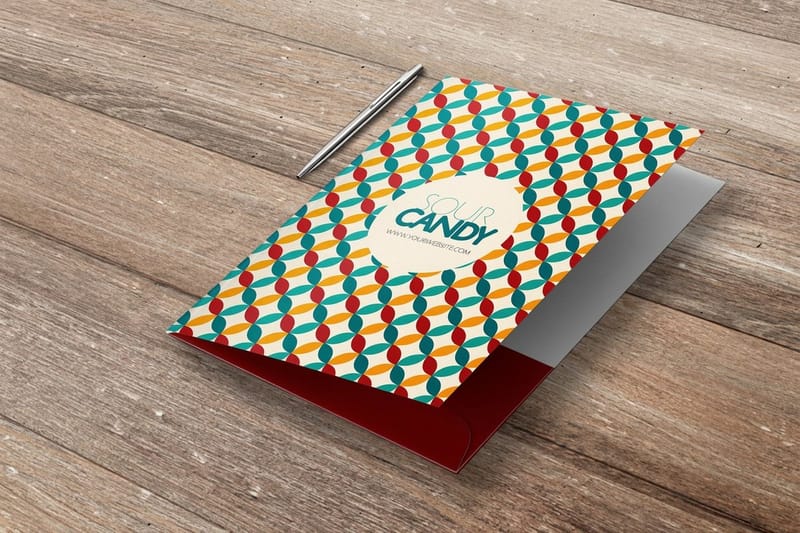
A customized presentation folder is three decisions: the pocket size, where the business card slit is cut, and the finish on the outside. A 9 by 12 inch folder holds letter sheets with half an inch of width and one inch of height to spare, the taller 9 by 14.5 takes legal length, and the glued pocket covers the bottom four inches of the inside panel, so nothing important should be designed there. Card slits go on the right pocket, the left, or both, and they have to be selected at order time.
Quick answer
Size the pockets, place the slit, then pick the finish
The three choices that make a folder custom are the size, the card slit, and the surface. Start with the stack the folder has to carry: 9 by 12 inches for letter documents, 9 by 14.5 for legal length or an overstuffed packet. Then decide which pocket carries the card slit, since the die cuts through anything printed in that corner. Finish last, and only after you know the quantity, because the run size swings the per folder price harder than any upgrade on the list. Pocket folders come in 9 by 12 and 9 by 14.5 inches on 14pt gloss, 16pt gloss, 14pt uncoated with 30% recycled content or 14pt white linen, from 250 folders at 7 business days, and short run folders cover 10 to 100 at 3 business days.
Create a Presentation Folder in Five Steps
You can create a presentation folder from the configurator and one flat file. Work through it in this order and the die line never has to be redrawn.
1. Pick the size from the stack. 9 by 12 inches for letter sheets, 9 by 14.5 inches for legal length or an overstuffed packet.
2. Pick the stock. 14pt gloss, 16pt gloss for a stiffer folder, 14pt uncoated with 30% recycled content if someone writes on the cover, or 14pt white linen for texture.
3. Choose the card slit. Right pocket, left pocket or both, selected at order time.
4. Build the art on the die line. Download the template for your size from the blank template library and lay out the cover, spine, inside panels and pocket faces on the one flat sheet.
5. Pick the run. Short run presentation folders cover 10 to 100 at 3 business days standard, and pocket folders start at $844.54 for 250 at 7 business days.
Start From What the Pockets Have to Swallow
Pick the size by measuring the stack, not by looking at a picture. A 9 by 12 inch folder is built around an 8.5 by 11 sheet, leaving half an inch of width and one inch of height as clearance. That gap is the whole reason the size exists: it is what lets somebody pinch a loaded stack and pull it out without bending a corner.
The taller 9 by 14.5 inch option earns its place in three situations. Legal length documents, obviously. A brochure or a folded sales sheet that runs past 11 inches. And any folder you know will be overstuffed, because a deeper body keeps the pocket mouth well below the top of the paper instead of level with it. Legal presentation folders carry both sizes, as do standard pocket folders.
Both pockets on a two pocket folder are the same depth, roughly four inches, and the mistake is loading one and leaving the other empty. Split the contents: proposal and pricing on the right, brochure and spec sheets on the left. A balanced folder closes flat and sits square on a desk. A folder with everything jammed in one pocket gapes open at the corner and looks like it was packed in a hurry.
Stock is the other half of the same decision. Pocket folders come on 14pt Gloss, 16pt Gloss, 14pt Uncoated with 30% recycled content, and 14pt White Linen. The 16pt is noticeably more rigid once the folder is loaded, which matters if it gets handed across a table rather than mailed flat. The 14pt uncoated is the one to pick when somebody will write a name on the cover, because a pen actually takes on it. Compare the full range on presentation folders printing.
Which Size to Choose for A4, A5 or DL Inserts
Our folders are cut to US sizes, so the question for metric paper is which of the two holds your inserts with room to pull them out.
- A4, 210 by 297 mm, about 8.27 by 11.69 inches. The 9 by 12 inch folder holds it with about 0.7 inch of width and 0.3 inch of height to spare. That height margin is tight, so pick the 9 by 14.5 inch folder for a thick A4 proposal or a bound report.
- A5, 148 by 210 mm, about 5.83 by 8.27 inches. Either folder takes A5 standing in the pocket, and the 9 by 12 is the sensible default.
- DL, 99 by 210 mm, about 3.9 by 8.27 inches. DL leaflets and compliment slips stand in a pocket of the 9 by 12 folder, which leaves the other pocket free for the main document.
The size choice moves the price less than the run and the finish do. Standard pocket folders start at $844.54 for 250, about $3.38 each, raised foil pocket folders start at $1,037.97 for 50, and spot UV folders fall to $1.04 each at 10,000.
Business Card Slits: Right Pocket, Left Pocket, or Both
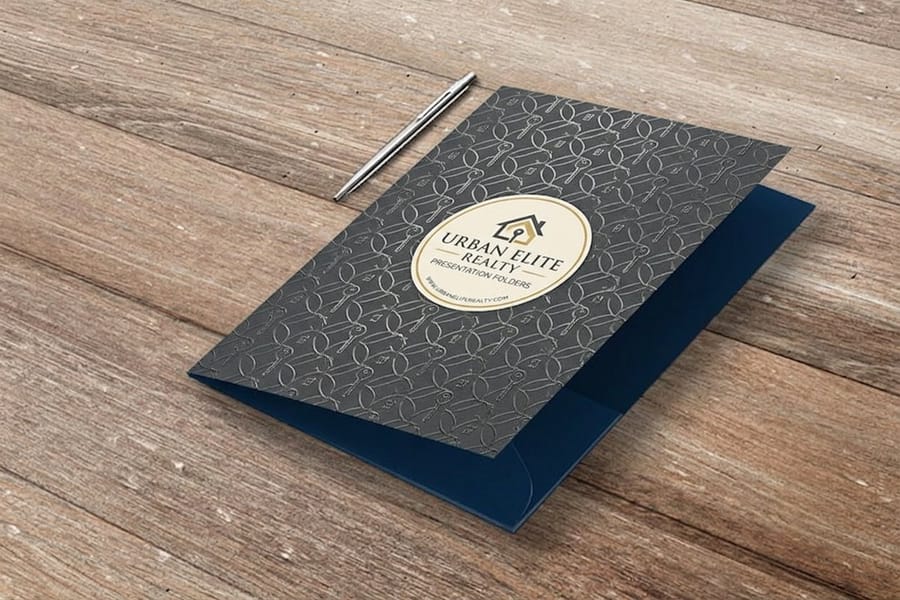
The slit is a diagonal cut in the pocket face sized for a standard 3.5 by 2 inch card, and it is a configuration choice rather than something every folder gets. Right pocket, left pocket, or both. Choose it when you build the order, because a folder that arrives without the slit cannot have one added later.
Default to the right pocket. People open a folder and their eye lands on the right side first, so that is where a card gets seen and where a hand reaches for it. Both slits are worth the extra when two people share one folder, a listing agent and a lender for instance, or when the left pocket holds a separate leave behind that needs its own contact. Adding the second slit costs little; what it costs you is layout room, since you now have to keep two pocket corners clear.
Two design rules follow from the cut itself. First, the die goes through whatever is printed in that corner, so a logo, a rule, or a line of type sitting there will be sliced in half. Keep the slit corner quiet. Second, the card covers the corner once it is inserted, so anything you do design behind it is hidden in normal use anyway. Treat that corner as structural, not decorative.
Match the card to the folder while you are at it. A 14pt standard business card slides into the slit and stays put; a card on very thin stock curls and slips out in a bag. If you are printing a handful of folders for one pitch, short run presentation folders carry optional slits on both pockets at runs as small as 10. More on card stock choices in business card printing.
Finish Upgrades and What Each One Costs Per Folder
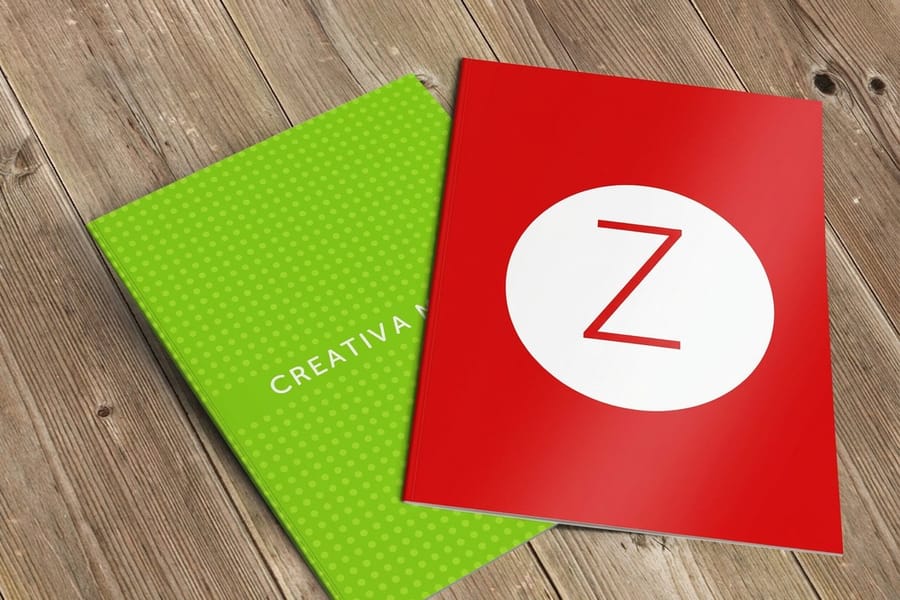
Here is the part nobody tells you before you start shopping finishes: the run size moves the price more than the upgrade does. Spot UV folders land at $1.04 each at 10,000, while plain pocket folders sit at $3.38 each at 250. Decide the quantity first, then pick the surface.
| Finish | Entry price | Per folder at entry | At the top of the run | The trade-off |
|---|---|---|---|---|
| 14pt gloss, short run | $108.75 for 10 | about $10.88 | about $4.05 each at 100 | The only way to buy 10 folders, but the most expensive per piece by a wide margin. |
| Gloss or UV coated | $844.54 for 250 | about $3.38 | keeps sliding to 10,000 | Hard wearing and cheap, but fingerprints show on a dark solid cover. |
| 14pt white linen | $844.54 for 250 | about $3.38 | keeps sliding to 10,000 | Woven texture at no price premium, but ink sits flatter and photos lose punch. |
| Spot UV | $2,194.56 for 500 | $4.39 | $1.04 each at 10,000 | Needs a separate mask file, and the effect only reads against a matte or dark field. |
| Silk soft touch, 16pt | $3,030.26 for 250 | $12.12 | $2.15 each at 10,000 | Best surface against fingerprints, worst against scratches, which stay bright and permanent. |
| Raised foil, 16pt | $1,037.97 for 50 | $20.76 | $2.93 each at 2,500 | Foil is capped near 10% coverage and the pass adds days, so it suits a logo, not a cover. |
Read the last column before the price column. Silk laminated presentation folders are the right answer for a proposal that lives on a desk, and the wrong one for folders that ride in a car with keys and clipboards. Spot UV presentation folders want a dark or matte field for the gloss to play against, so a busy photographic cover wastes the coating. Raised foil pocket folders put gold, silver, or rose gold up off the surface, which is the strongest tactile signal in the range, but the standard turnaround is 10 business days. The silk laminated presentation folders and spot UV presentation folders stories show both finishes on finished covers.
If the brief is texture rather than shine, linen presentation folders get you a woven surface inside the standard price band. That is an unusual thing in print: a finish that costs nothing extra.
Set the Artwork on the Die Line, Not on a Mock-Up
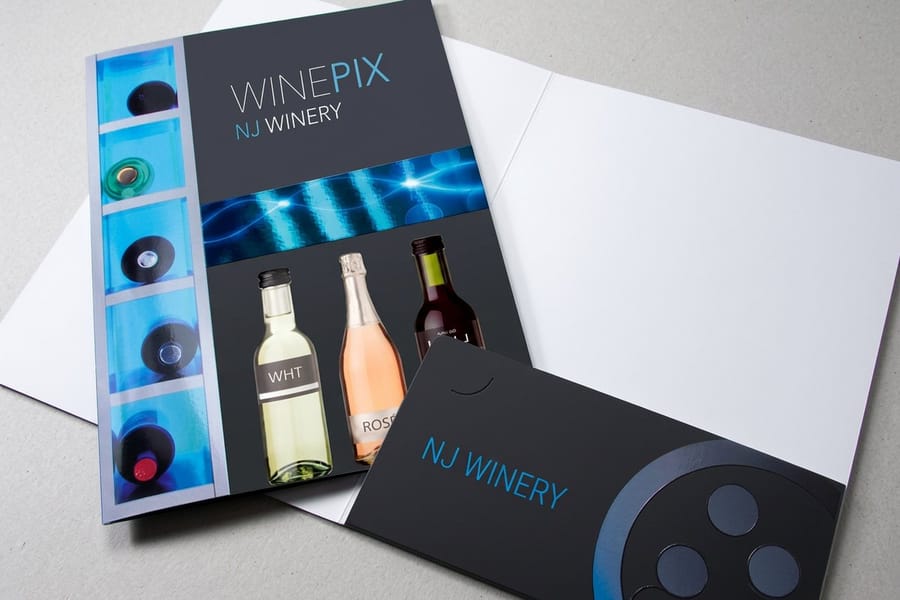
A folder is printed as one flat sheet and then cut, scored, and glued, so the file has to be built flat on the die line for the exact size and pocket style you ordered. Cover, spine, both inside panels, and both pocket faces all live on that one layout. Download the correct template from the blank template library before you draw anything.
Four things go wrong most often. Bleed stops short of the pocket flaps, because people bleed the panel edges and forget the flaps are cut edges too. Type sits within a quarter inch of a score and ends up bent through the fold. Artwork gets placed in the bottom four inches of an inside panel, which the glued pocket covers completely. And a dark solid runs across the spine score, where the coating cracks into a white line as the board bends. Lamination hides that last one; a plain coated sheet will not.
Know what your sides selection actually buys. On the flat layout the pocket faces fold up onto the inside, so a front only job leaves the pockets and inside panels blank. Printing both sides is what puts color on the pocket faces, a message on the inside panel, and a pattern behind the card slit. It is worth checking against your quote, because plenty of folder designs are drawn with colored pockets and then ordered as front only.
Everything else is standard print file hygiene: full size artwork, fonts outlined, images at press resolution, CMYK. To design your own presentation folder, upload one PDF built flat on the template for your size, with 0.125 inch of bleed past every cut edge including the pocket flaps, type a quarter inch clear of every score, and the slit corner left empty. Our bleed, cut line and safety checklist covers the margins in detail, and the pocket folder printing guide walks the ordering side from stock through turnaround. For the cover concept rather than the mechanics, read designing company folders.
Wally explains the folder die line
One flat sheet becomes a cover, a spine, two panels and two pockets
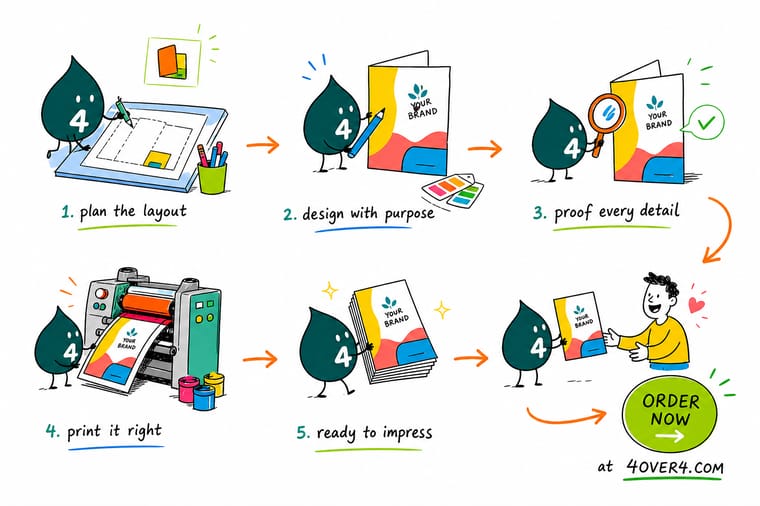
Wally lays the whole folder out flat, because that is how it prints. The cover, the spine, both inside panels and both pocket faces sit on one sheet, then the press hands it to the die cutter. He keeps the artwork clear of the slit corner so the blade does not slice a logo, and he keeps anything worth reading out of the bottom four inches of the inside panel, because the pocket folds up and covers it. Bleed runs past the pocket flaps too, not only the panel edges.
Order customized pocket folders →
Specs and pricing
Folder sizes, stocks, and starting prices
Pocket folders start at $844.54 for 250 and raised foil pocket folders at $1,037.97 for 50, with slit positions set on each product page.


Print it
Order a folder built around your own stack
Pocket folders for a run of 250 or more in 9 by 12 or 9 by 14.5 inches, silk laminated folders on 16pt for a proposal that sits on a desk, and raised foil pocket folders from 50 when the logo should stand up off the cover.

Explore more
Where to go next
How the price of a folder run is built, every common folder size and what fits inside, the cover and message side of company folders, and when legal size beats 9 by 12.
By the numbers
Pockets glued and card slits cut to order
Common Questions
Your presentation folder questions, answered
What size presentation folder holds a letter size proposal?
The 9 by 12 inch folder. It leaves half an inch of width and one inch of height around an 8.5 by 11 sheet, which sounds like nothing until you try to pull a thick stack out of a folder cut tighter. Go to the taller 9 by 14.5 inch size when the contents are legal length, when a brochure runs longer than a letter sheet, or when the folder will be stuffed and you want the pocket mouth to sit lower than the top of the paper. Both sizes carry two pockets.
Should I put business card slits on both pockets?
Usually just the right one. Most people open a folder and read the right pocket first, so a card in the left pocket gets found second or not at all. Both is worth selecting when two people share the folder, an agent and a loan officer for example, or when the left pocket carries a separate leave behind that needs its own card. The cost of adding the second slit is small; the real cost is design room, because you now have to keep two pocket corners clear of type.
Do the pockets print in full color?
Only if you order printing on both sides. On a flat die line the pocket faces end up on the inside of the finished folder, so a front only job leaves them blank. That is why short run presentation folders list the pockets as blank at the 4/0 option. If you want a colored pocket, a message inside, or an interior pattern behind the slit, choose the both sides configuration when you build the order.
Which folder finish resists fingerprints best?
Silk soft touch lamination. The matte film scatters light instead of reflecting it, so the oil from a hand does not show the way it does on a gloss folder with a dark cover. The trade is scratching: a key or a staple drags a bright line across soft touch that cannot be buffed out, while gloss shrugs off the same contact. If the folders will live in a bag or a car, gloss is the safer surface even though it shows prints.
Can I order fewer than 250 customized folders?
Yes, with short run presentation folders, which run from 10 to 100 units. They are the same 9 by 12 inch two pocket folder on 14pt gloss cover, with optional card slits, so a run of 10 or 30 is a real option for a single pitch or a small event. The per folder price is the honest catch: $108.75 for 10 works out to about $10.88 each, sliding to roughly $4.05 each at 100, against $3.38 each on a 250 run of standard pocket folders.
How long do customized presentation folders take?
Longer than flat print, because folders are die cut, scored, and glued after they come off press. Standard pocket folders run 7 business days with rush speeds down to 2 days, silk laminated run 5 business days, and raised foil pocket folders run 10 business days because the foil is a separate pass. Short run folders are the fast lane at 3 business days standard, with 2 day, next day, and same day rush available.
Get Started
Order 250 pocket folders from $844.54
Pick the size, choose which pocket carries the card slit, and set the finish. We die cut, score, and glue every folder in house before it ships.
Legal Disclaimer
Gold Standard guarantees apply to all standard orders placed through 4over4.com. Price match requires verifiable proof of a competitor's published price for an equivalent product with matching specifications and turnaround time. Satisfaction guarantee covers manufacturing defects and print quality issues. Contact support with order number and documentation.
