
How to Design an A-Frame Sign That Stops People on the Sidewalk


Cap heights that read from across a sidewalk, contrast that holds up at noon, the panel size each frame actually takes, and what to do with the second face.
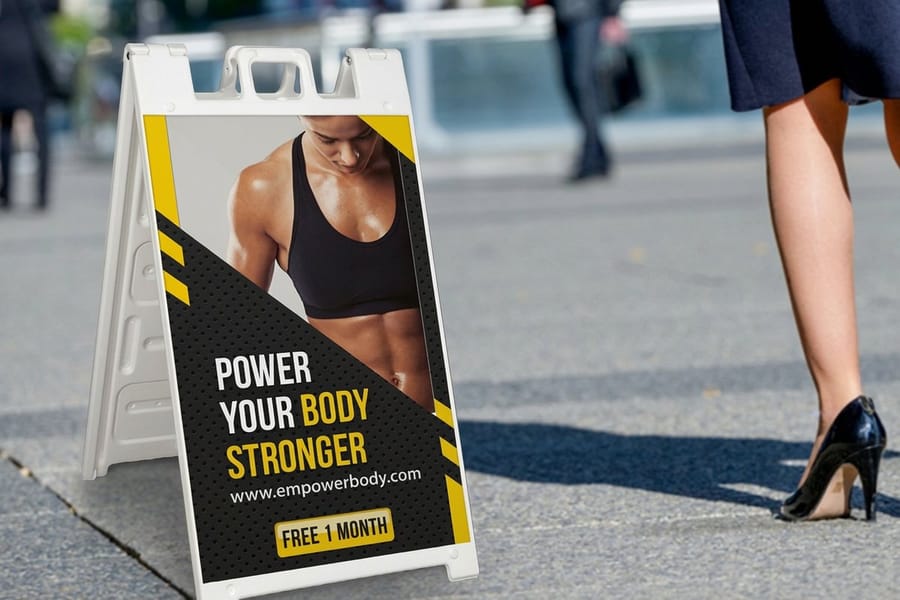
Design an A-frame sign around one message, put it in the top third of the panel, and set the headline at three inches of cap height on a 24" x 36" face. Build the file at the panel size the frame takes, not the frame size, keep type half an inch inside every edge because the lip covers it, and use dark type on a light field so it survives direct sun. Give the second face a different job rather than the same artwork, and mirror any arrow.
Quick answer
One message, three inch caps, and nothing important in the bottom third
A sidewalk sign is read at a glance, from ten to thirty feet, by someone already walking. Give the headline the top 12 inches of the panel at three inches of cap height, one sub-line at an inch and a half below it, and leave the bottom 10 inches for the logo and hours, because that band sits at knee height and disappears behind passing legs. Set the document to the panel size the frame takes, hold type half an inch inside the trim, and pick dark type on a light ground so the contrast holds through the middle of the day.
Set the Type for the Distance, Not for Your Screen
An A-frame gets one glance and a stride. Design for that and the rest of the decisions make themselves.
The sign trade works to about one inch of capital height for every 25 feet of viewing distance. Treat that as the floor for legible rather than the size that makes someone break step. On a 24" x 36" panel, a headline at three inches of cap height runs to roughly four short words across the width, and it reads clean from the far edge of the sidewalk. If your headline will not fit at three inches, the problem is the headline.
Under it, one sub-line at about an inch and a half. Then stop. Hours, the phone number and the web address can sit at an inch, and everyone will accept that they are there for the person already standing at the sign rather than the person walking past it. Anything smaller than that on an outdoor panel is texture.
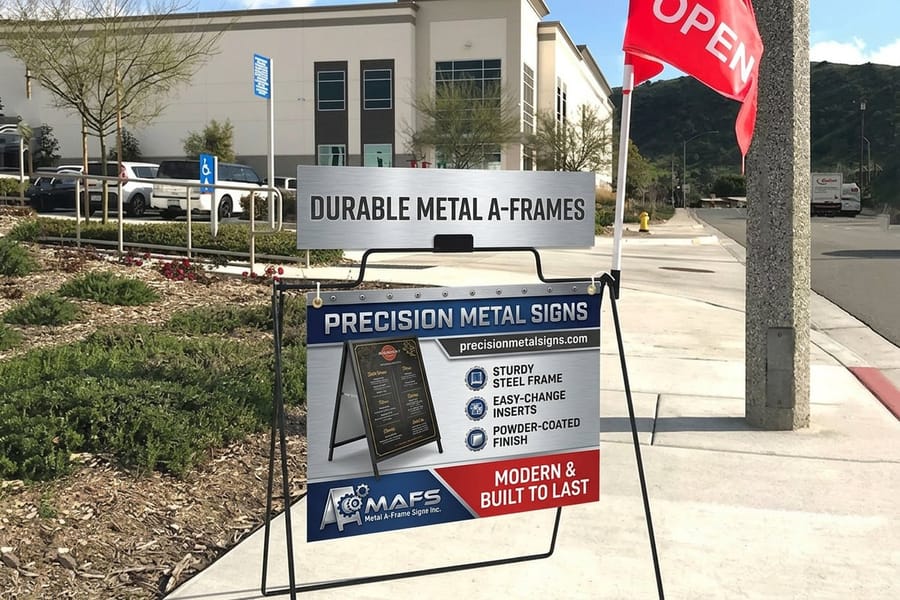
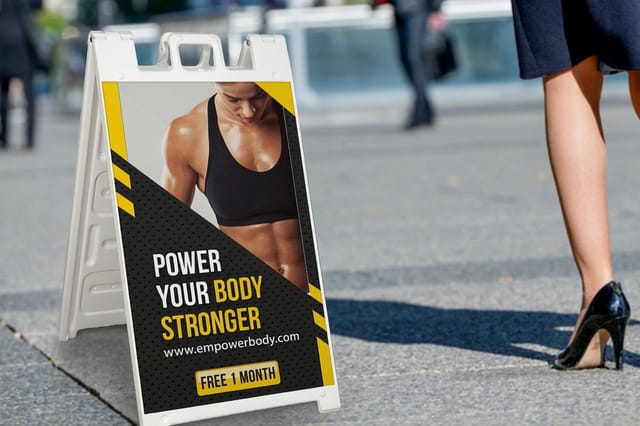
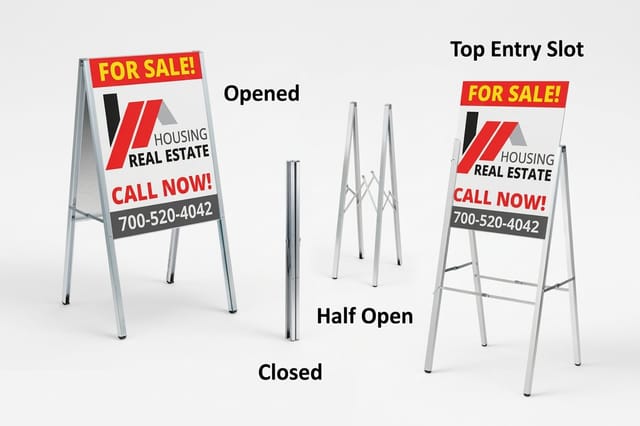
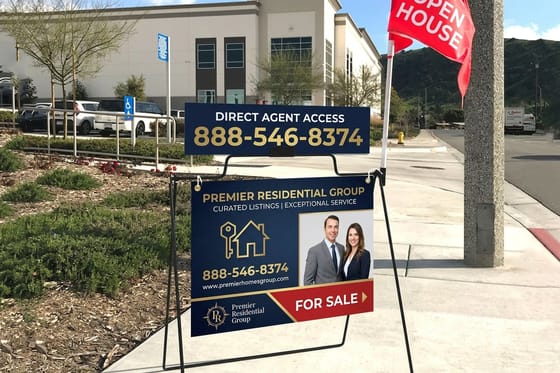
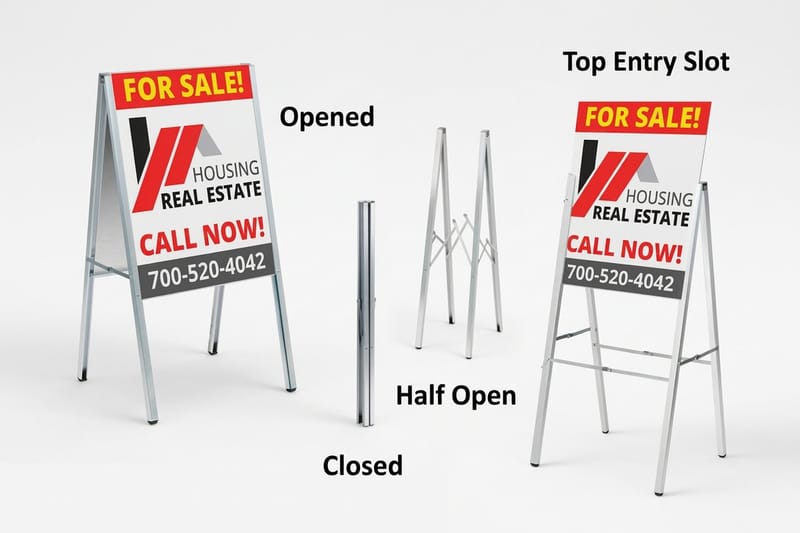
The hard part is subtraction. Most A-frames fail because someone tried to fit the offer, the tagline, three services and a QR code onto one face, and a walker resolved none of them. Decide the single action you want from a stranger, give it the top of the panel, and let everything else support it. Our guide to A-frame sign boards covers how the frames themselves are built, which is worth reading before you commit to a layout. The classic sidewalk unit is the Signicade A-frame, which ships as a 25" x 45" plastic frame with two printed 24" x 36" panels from $182.32.
Contrast Is the Only Color Rule That Matters Outdoors
Color choice on a sidewalk sign is not a branding question, it is a luminance question. Two colors can be miles apart on a swatch card and still collapse into one gray smear at 30 feet.
Dark type on a light field is the safe default outdoors, and it stays readable through the whole day. White or pale type on a dark ground looks sharper in a shaded doorway, then flattens under noon sun when the panel picks up glare across the solid area. There is a second cost to big dark fields: 4mm coroplast has flutes running one direction through the sheet, and a large dark solid shows that ribbing whenever low morning or evening light rakes across the panel. It also shows every scuff and every fingerprint from being carried in and out.
The combinations to avoid are the ones with similar brightness even when the hues clash: red on black, dark blue on green, orange on red, and any two mid tone corporate colors stacked on each other. If you are unsure, convert the layout to greyscale and look at it small. If the type disappears, so will the sign. There is more on outdoor color behavior in our guide to the best colors for advertising signs.
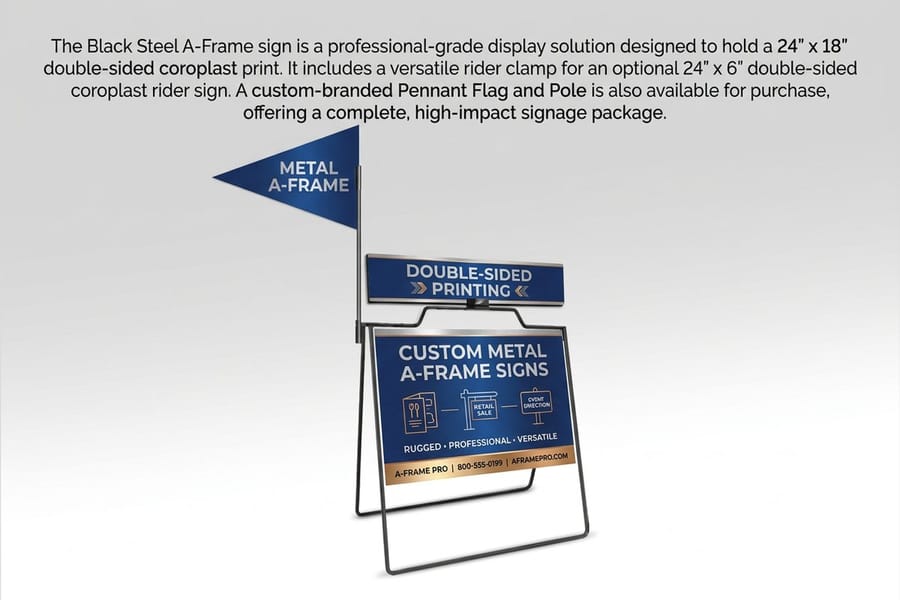
One more practical note on stock. The panels print on white 4mm corrugated plastic, so a light design needs less ink coverage and holds up better to handling than a full bleed black. The metal A-frame sign starts at $65.90 with a 24" x 18" panel in a black 27.75" x 31.5" frame, which is the small footprint version of the same design problem.
Build the File at the Panel Size, Never the Frame Size
This is where most files come back for correction. The frame dimension and the panel dimension are two different numbers, and the frame is always the bigger one because it has to hold the panel by its edges.
| Frame | Panel size | Frame size | From |
|---|---|---|---|
| Signicade A-Frame | 24" x 36", two panels | 25" x 45" white plastic | $182.32 |
| Signicade Deluxe | 24" x 36", two panels | 27" x 46.125" white plastic | $196.60 |
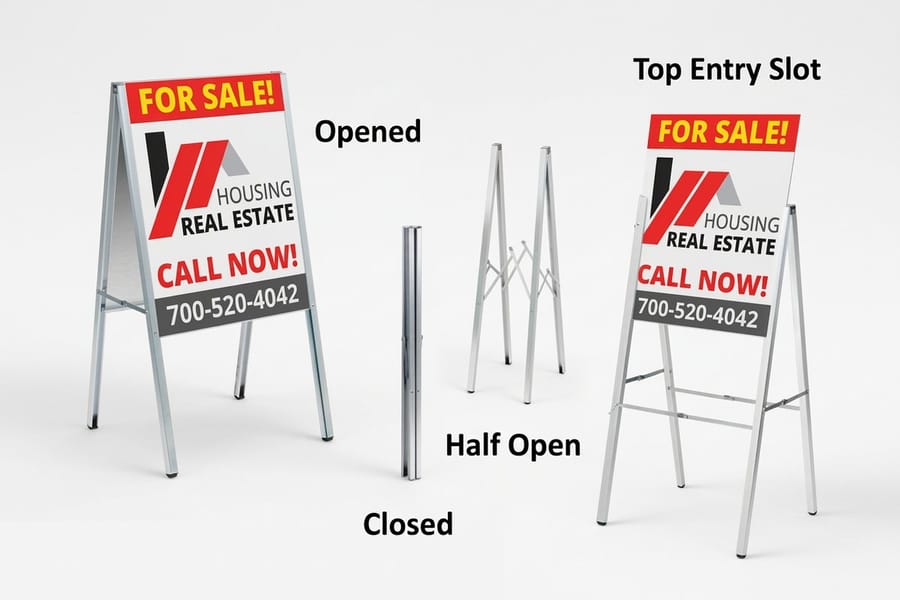
| Aluminum A-Frame | 22" x 28" or 24" x 36" | 26" x 44.5" satin silver | $146.07 |
| Quik-Sign A-Frame | 24" x 18", two panels | 31.7" x 26" white plastic | $163.67 |
| Metal A-Frame Sign | 24" x 18" | 27.75" x 31.5" black metal | $65.90 |
Set the document to the panel size in the middle column. Add an eighth of an inch of bleed on every side, then pull all type and any logo you care about at least half an inch inside the trim, because the frame lip sits over that edge once the panel is seated. A layout that runs the phone number to within a quarter inch of the bottom will lose half of it to the frame and look like a printing fault.
Resolution is the other place people overwork the file. A panel read from ten feet does not need 300 dpi. Build at full size and 100 to 150 dpi, in CMYK, with fonts converted to outlines, and export a print ready PDF. That file uploads in seconds and prints identically to the four hundred megabyte version. Correctly sized starting layouts live in the blank template library, and the full dimension list is in our guide to standard A-frame sign sizes. If you want a heavier frame for an exposed corner, the aluminum A-frame starts at $146.07 and takes either panel size; the whole range sits on the A-frame sign printing page.
Two Faces Doing Two Different Jobs
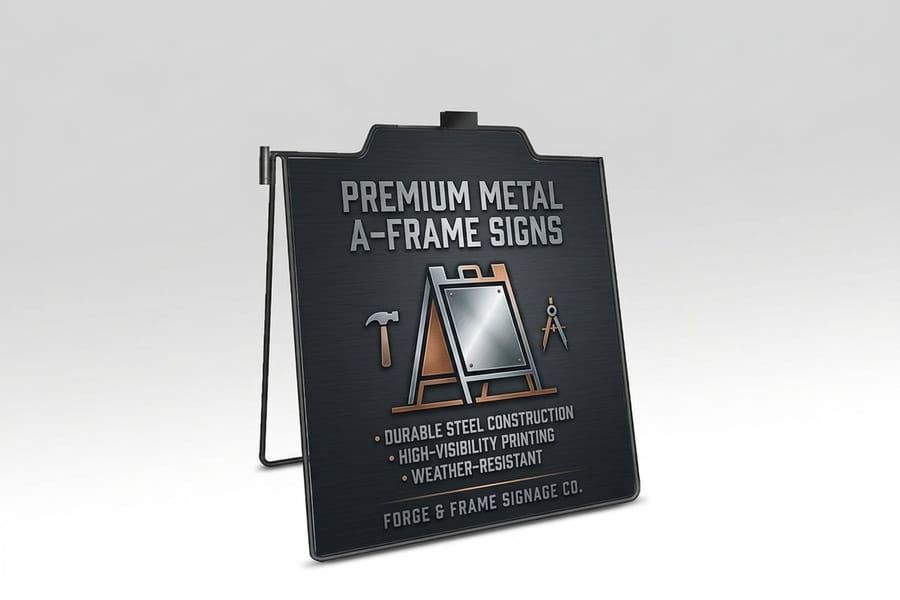
Every A-frame we print carries a face in each direction, and you can put the same art on both or a different design on each for the same kit. Running the same art twice is a decision, not a saving, and it usually wastes half the sign.
Stand where the sign will stand and watch who arrives from where. One face is looking at people coming off the parking lot or out of the subway, and those people have not decided anything yet, so that face gets the offer. The other face is looking back down the sidewalk at people who have already walked past your door, and that face gets the arrow and the word that turns them around. Same brand, same colors, two jobs.
The arrow is the trap. An arrow pointing right on the north face points away from your door when you read the south face, because the panel has flipped. Mirror it, and check the mirrored version on screen before you approve the proof. It is the single most common thing we see caught at proof stage on sidewalk signs.
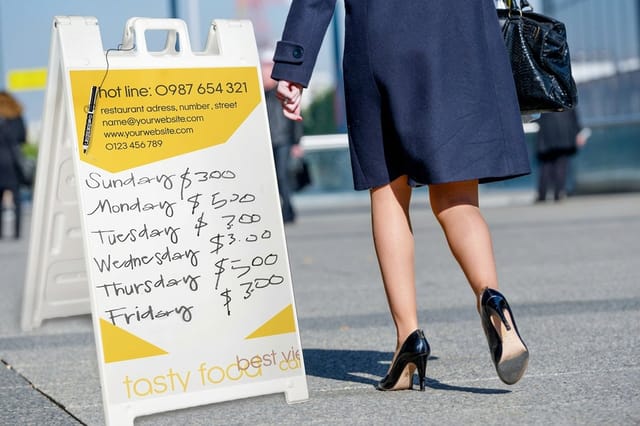
If the message changes daily, print the branding and write the rest. A dry erase Signicade puts a 24" x 36" print behind a dry erase lamination from $185.63, so the logo stays typeset and the soup of the day gets a marker. If the message changes monthly, keep the frame and reprint panels instead. And if the sign is going onto grass rather than pavement, coroplast yard signs start at $25 on the same 4mm stock. Our comparison of yard signs, A-frames and banners covers which one belongs where, and the wider outdoor sign printing guide covers durability and mounting. One last thing before you print: many cities regulate sidewalk sign footprint, height and placement, so confirm the local rule before you commit to the tallest frame.
Wally explains A-frame layout
Big at the top, quiet at the bottom, different on the back
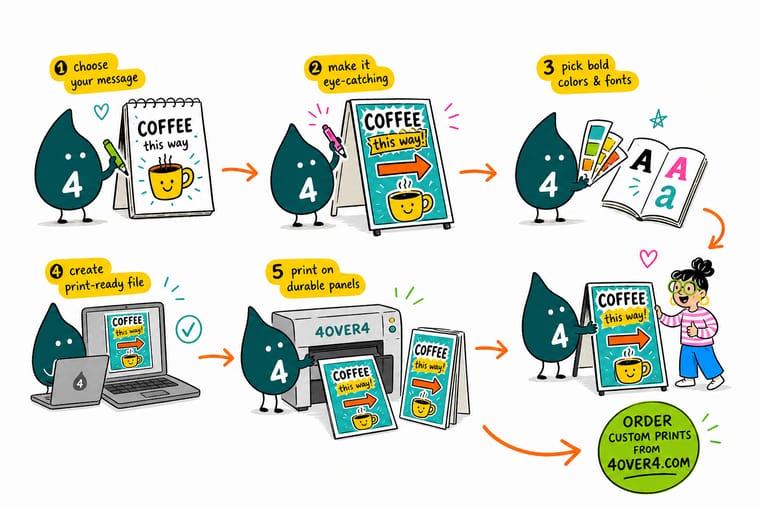
Wally sets the frame on the pavement and walks twenty feet away. If he cannot read the headline from there, the letters are too small, so he pushes them to three inches on a 24 by 36 panel and cuts the words until four of them fit. Everything that has to be read goes in the top 12 inches, because the bottom of the panel is at knee height and the next person walking past hides it. Then he turns the sign around and gives the second face a different job, and he remembers to flip the arrow.
Order a Signicade A-frame →Specs and pricing
Frames, panel sizes, and starting prices
Compare the three frames people order most, with live configuration choices and starting prices straight from the 4OVER4.COM configurator.

Print it
Put your design on the sidewalk
Explore more
Where to go next

By the numbers
Twenty five years of sidewalk sign printing, in numbers
Common Questions
Your A-frame design questions, answered
What size should an A-frame sign be?
Let the frame decide, because the panel has to fit it. The Signicade and Signicade Deluxe frames take 24" x 36" panels, aluminum A-frames take either 22" x 28" or 24" x 36", and the smaller metal and Quik-Sign frames take 24" x 18". A 24" x 36" panel is the one to pick when the sign sits on an open sidewalk and needs to be read from across the street. The 24" x 18" panels suit tight entryways, hallways and real estate work where a tall frame would be in the way, and they cost noticeably less because the frame is smaller.
How big should the text be on a sidewalk sign?
Work from the distance you want the sign read at. One inch of capital height per 25 feet of viewing distance is the rule of thumb the sign trade uses, so a sign meant to catch someone 50 feet away needs two inch caps before it is even legible. On a 24" x 36" panel a headline at three inches of cap height fits roughly four short words across the width and reads comfortably from the far side of a sidewalk. Drop the sub-line to about an inch and a half and stop there. Anything under an inch on an outdoor sign is decoration, not information.
Should both sides of an A-frame have the same design?
Usually not, and it is the cheapest upgrade on the sign. These kits print both faces either way, so running identical art twice is a choice rather than a saving. People approach from two directions, and those two groups are rarely in the same state of mind. The face pointing at the parking lot can carry the offer. The face pointing back along the sidewalk can carry the arrow and the door. If you do put an arrow on the sign, mirror it on the second face, because an arrow pointing right on one side points away from your door on the other.
What file setup do I need for a coroplast A-frame panel?
Build the artwork at full panel size, in CMYK, with an eighth of an inch of bleed and all type kept at least half an inch inside the trim so the frame lip does not clip it. Resolution does not need to be huge: 100 to 150 dpi at final size is plenty for a piece read from ten feet away, and a 300 dpi 24" x 36" file is a slow upload for no visible gain. Convert fonts to outlines and send a print-ready PDF. Starting from a correctly sized layout in the blank template library removes most of the guesswork.
Can I change the message on an A-frame sign without reprinting?
Two ways. A dry erase Signicade carries a 24" x 36" printed panel with a dry erase lamination over it, so the branded part stays fixed and you write the daily special with a marker and wipe it off. That starts at $185.63 and is the right answer for a cafe or a bar with a menu that moves. The other way is to keep the frame and print spare panels, which works when the message changes monthly rather than daily and you want it typeset rather than handwritten.
Will an A-frame sign survive wind and rain?
Rain is not the problem. The panels are 4mm corrugated plastic, which is a closed plastic sheet and shrugs off water, sun and road spray for seasons. Wind is the problem, because a folded A-frame is a sail with a small footprint, and the plastic frames are light by design so you can carry them out each morning. Weight the base, set the sign against a wall or a planter rather than out in an open crosswind, and bring it in overnight. A metal or aluminum frame is heavier and holds better, which is the practical reason to pay for one on an exposed corner.
Get Started
Order a dry erase Signicade from $185.63
Pick the frame, upload a panel built to size, and we print both faces on 4mm corrugated plastic that stands up to a season outdoors.
Legal Disclaimer
Gold Standard guarantees apply to all standard orders placed through 4over4.com. Price match requires verifiable proof of a competitor's published price for an equivalent product with matching specifications and turnaround time. Satisfaction guarantee covers manufacturing defects and print quality issues. Contact support with order number and documentation. On-time delivery rate based on tracked orders 1999 to 2026. Individual results may vary based on shipping carrier performance.
