
How to Design a Campaign Flyer That Voters Actually Read


The layout order that makes a flyer readable at a doorstep, the disclaimer rules that decide whether the run is legal, and the sizes and stocks that match how the piece actually gets delivered.
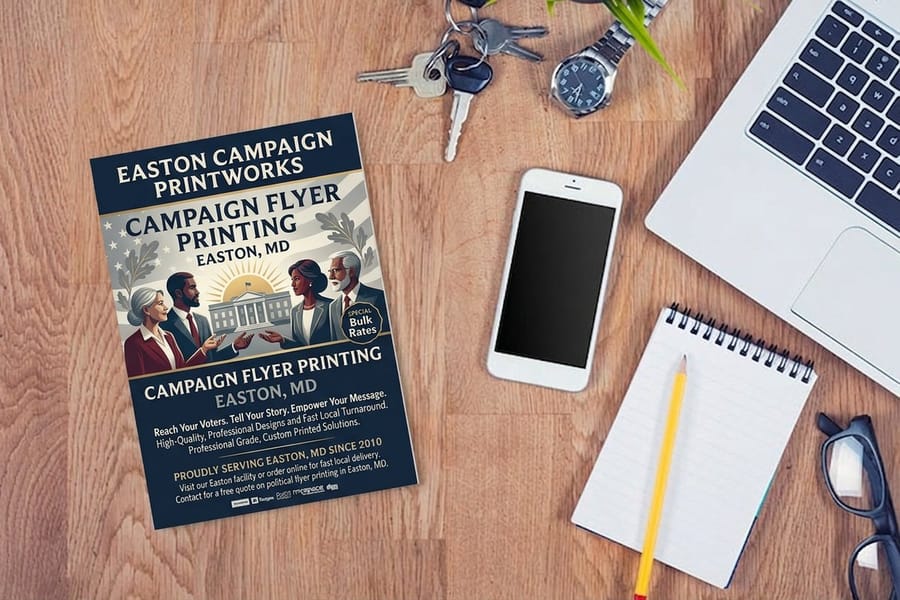
Design a campaign flyer as a stack of bands: candidate name in the largest type, office and election date directly under it, one photo, one message with three short proofs, one call to action, and the paid for by disclaimer in a bordered box at the bottom. Print it at 8.5 by 11 inches on 100lb gloss text for handouts, or 6 by 9 inches on card stock if it goes in the mail. The disclaimer has to sit in a printed box with a border, in type large enough to read, with real color contrast, and 12 point is the safe harbor on anything up to 24 by 36 inches.
Quick answer
One name, one message, one action, one bordered disclaimer
A campaign flyer works when a stranger can read the name and the race from three feet away. Set the candidate name larger than anything else, put the office and the election date immediately beneath it, use a single photo shot for this campaign, state one issue with three short proof lines, and close with one thing to do. The paid for by disclaimer goes in a printed box with a border, set apart from the rest of the copy, in readable type with real contrast. Size the piece to its delivery method: 8.5 by 11 inches for handouts, 5.5 by 8.5 inches for high-volume canvassing, 6 by 9 inches for mail.
Build the Flyer Downward, One Decision Per Band
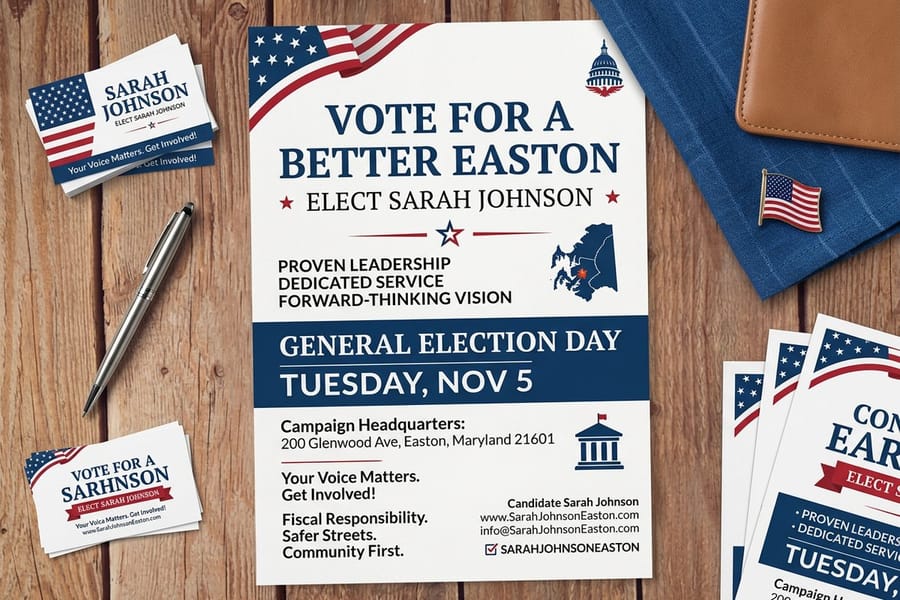
A campaign flyer is not a brochure with a rosette on it. It has one job, which is to attach a name to a race in the two seconds someone spends looking at it before deciding whether to keep reading. Design it as a stack of bands, top to bottom, and every layout question answers itself.
Band one, the name. Largest type on the sheet, no competition. On an 8.5 by 11 inch flyer that usually lands somewhere around 60 to 90 point, and the test is simple: hold the proof at arm's length and see whether the name reads before anything else does.
Band two, the office and the date. These two facts go directly under the name, in that order. A voter who cannot tell within one second which seat you are running for will not go looking.
Band three, the photo. One photo, taken for this campaign. A phone snapshot scaled up to fill a full page drops well below 300 dpi and prints soft and grey, which reads as an underfunded campaign whether or not that is true. At 8.5 by 11 inches you want roughly 2550 by 3300 pixels at final size.
Band four, one message and three proofs. Name the single issue the campaign is running on in a short sentence, then three short lines that back it. Nine bullet points is not thoroughness, it is an unranked list, and voters read it as one.
Band five, the action. Vote on this date, early voting opens then, or sign up here. Pick one. Two competing calls to action split the response instead of doubling it.
Band six, the disclaimer. The paid for by box, which has its own rules and gets its own section below. Leave room for it at the start of the layout rather than squeezing it in at the end, because that is when it ends up at 6 point in the gutter.
The Paid For By Disclaimer, and How It Has To Look

This is the part that gets campaigns into trouble, and it is entirely avoidable. The disclaimer is not just words that have to appear somewhere on the piece. Federal rules at 11 CFR 110.11 govern the wording and the typography, and a flyer printed without a compliant one is a run you may have to throw away.
The wording depends on who paid and who authorized it. If the candidate's own authorized committee paid for the flyer, the line is short: paid for by the committee name. If a person or group other than the candidate paid for it and the candidate did not authorize it, the disclaimer has to name the payer, give a permanent street address, telephone number or website, and state that it was not authorized by any candidate or candidate's committee.
Then the layout rules, which are the part designers miss:
- It sits in a printed box, set apart from the rest of the content on the piece.
- The box has a printed border. A tint panel with no rule around it does not satisfy this.
- The type is large enough to be clearly readable. Twelve point is the stated safe harbor for a printed communication no larger than 24 by 36 inches, which covers every flyer size you are likely to order.
- There is a reasonable degree of color contrast between the background and the text. Grey type on a photo fails. Black on white passes.
Small items where a disclaimer is impracticable, such as buttons and pens, are exempt. A flyer never is. And this is federal law for federal races: state and local races run under their own election codes, and plenty of states add requirements of their own, including who has to be named and how large the text must be. Confirm with your state election board before you approve the proof, because a reprint two weeks out is the most expensive kind of print job there is.
One practical layout habit: build the disclaimer box first, park it in the bottom margin inside the safety line, and design the rest of the flyer around the space that is left. It never gets forgotten that way, and it never ends up crossing a trim edge. Our guide to bleed and trim covers why anything sitting near the edge is at risk in the first place.
Sizes and Stocks: Handout, Walk List, or Mailbox
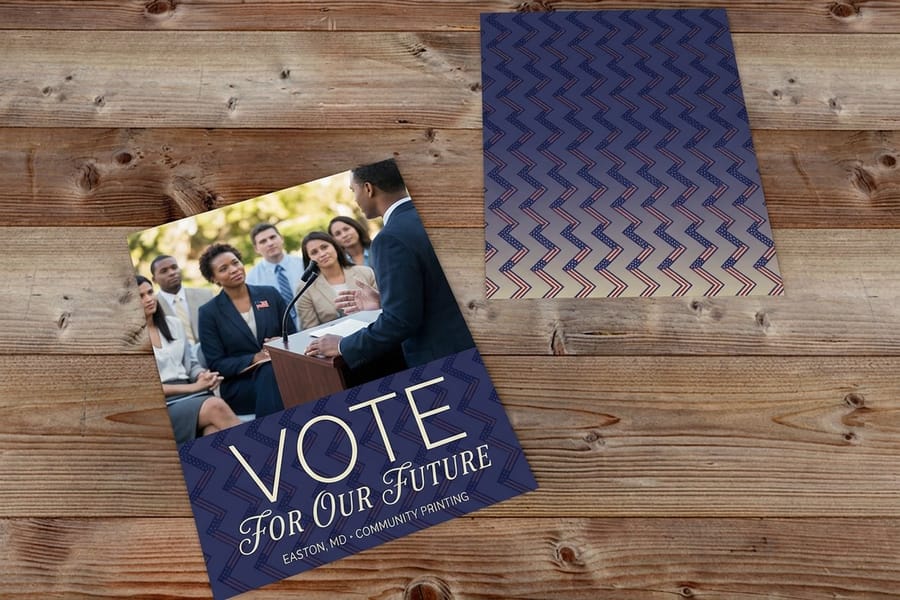
Size follows distribution, not taste. Decide how the piece reaches the voter and the format picks itself.
| Size | Where it fits | Typical stock | The catch |
|---|---|---|---|
| 4 x 6 in | Rally handouts, tabling, literature drops at events. | 14pt card stock | Room for a name and one line, not for policy. |
| 5.5 x 8.5 in | Big canvass quantities where cost per piece rules. | 100lb gloss text | Half the page means the photo or the copy has to give. |
| 6 x 9 in | Mailers that go without an envelope. | 14pt or 16pt card stock | Needs an address side left clear, so plan the back around it. |
| 8.5 x 11 in | The standard handout, door drops, counters, endorsement sheets. | 100lb gloss or uncoated text | Folding it to fit a pocket cracks heavy ink coverage unless it is scored. |
| 11 x 17 in | Windows, community boards, campaign office walls. | 100lb gloss cover | This is a poster, and it needs poster-scale type to work. |
The stock decision comes down to one question nobody asks early enough: will a human being write on this? 100lb gloss text is the cheapest and the most photogenic, and it is the right call for a piece that gets read and recycled. It is the wrong call the moment a canvasser needs to write a callback time on the back, because ballpoint ink skids on a coated sheet and never dries. Order uncoated for door-to-door teams, gloss for mail and events. If you want the full breakdown, the guide on flyer paper weight compares the stocks side by side, and flyer sizes and dimensions gives the setup measurements for each format.
Set every file up the same way regardless of size: 0.125 inch bleed on all four sides, 0.25 inch safety margin with nothing important outside it, 300 dpi at final size, CMYK. A correctly sized starting file for any of these formats is in the blank template library, which saves the round of proofs where the trim eats the disclaimer.
Printing the Whole Campaign Before Election Day
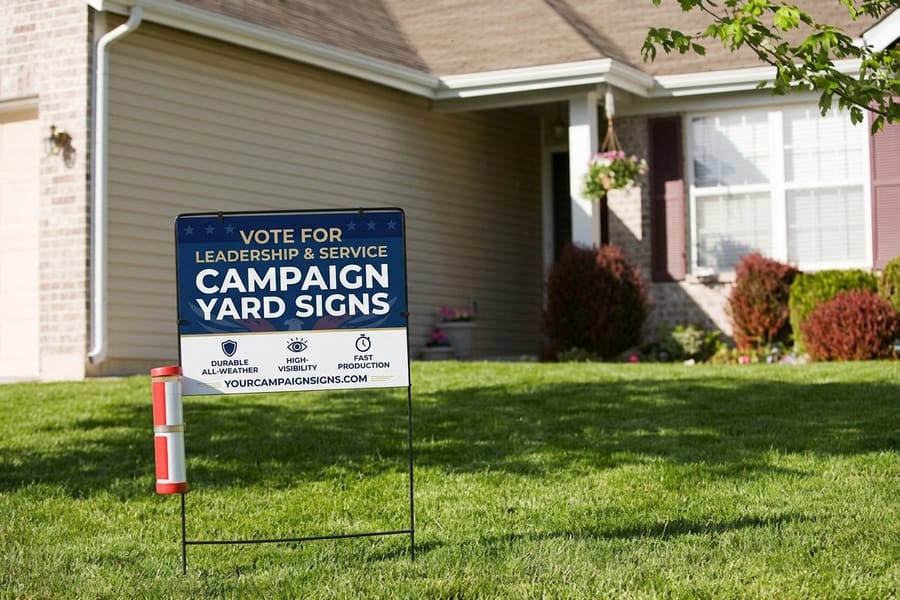
The flyer is one piece of a set, and the set only works when every piece carries the same lockup. A voter who sees a lawn sign on the way to work and a flyer on the door that evening should not have to work out that they are the same campaign. Same name treatment, same two colors, same photo crop.
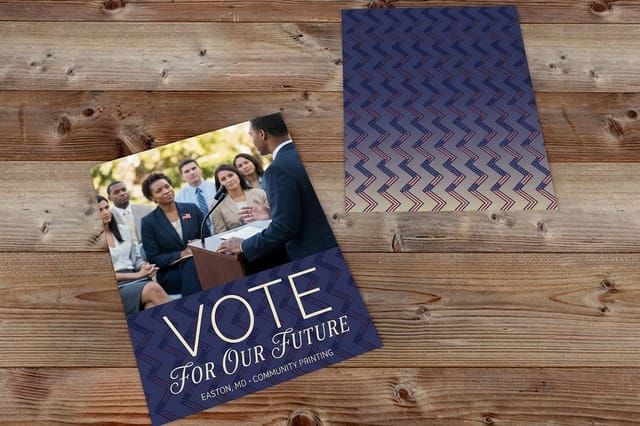
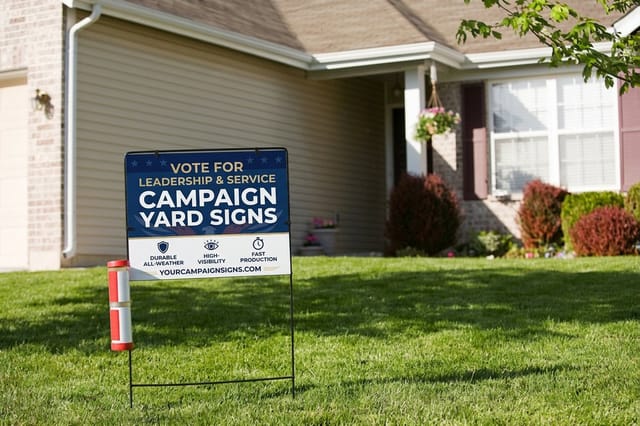
Political flyers start at $39.54 and are the workhorse: canvass drops, counters, endorsement sheets. Political postcards start at $16.48 and are the cheapest way to reach a household that never answers the door, since they mail without an envelope. Campaign yard signs start at $25 and do the job the flyer cannot, which is repetition on a commute. Political door hangers start at $290.41 and are the legal way to leave something at a house nobody is home at, because a mailbox is off limits and a flyer under a doormat blows away. For endorsement lists and long policy pieces, political brochures start at $57.11 and fold down to pocket size.
Two scheduling habits save more campaigns than any design choice. First, count backward from the day the walk starts, not from election day, and add transit time on top of production time. Those are two separate clocks and the second one is the one that gets forgotten. Second, order the full quantity in one run. Reprints in the last fortnight cost more per piece and arrive later than the extra thousand would have.
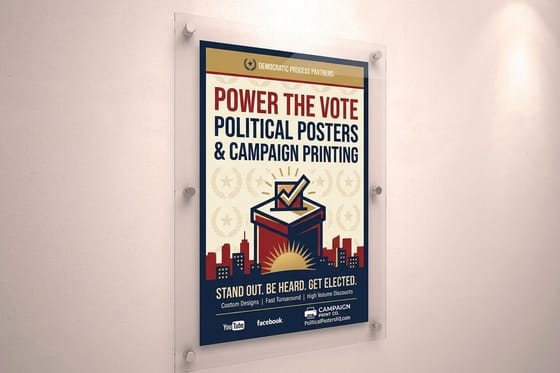
Once the artwork is approved, keep it moving across the rest of the set from the flyer printing and yard sign printing categories, and treat the distribution plan as part of the print order rather than an afterthought. The flyer distribution guide is where most of the wasted pieces get saved, and the campaign poster guide takes the same hierarchy up to window and board size.
Wally lays out a campaign flyer
Name at the top, disclaimer in a box at the bottom
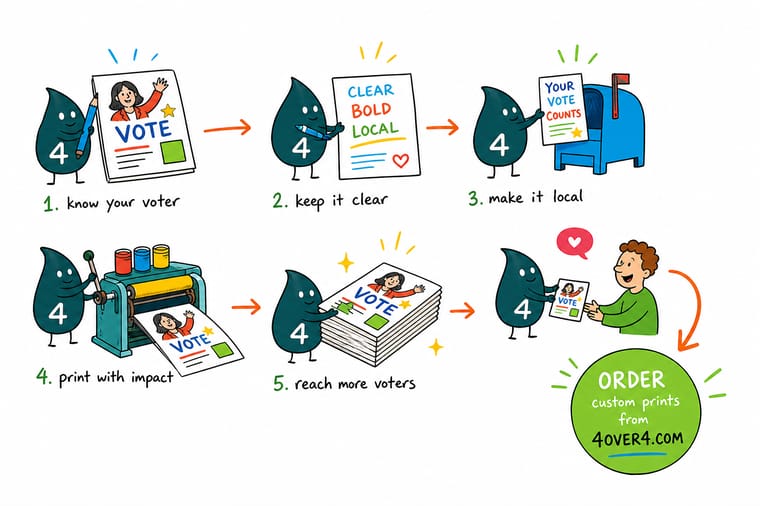
Wally starts at the bottom, not the top. He draws the paid for by box first, with its border, inside the safety margin, so it can never be squeezed out later. Then he works upward: the action line, one message with three short proofs, one photo shot for this campaign, the office and the date, and the candidate name set bigger than everything else. He holds the proof at arm's length. If the name reads first, the flyer is done.
Order political flyers →Specs and pricing
Campaign print sizes, stocks and starting prices
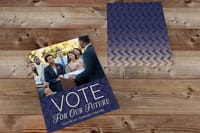
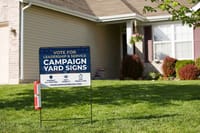
Configure the flyer, the mailer and the lawn sign side by side, with live options and starting prices straight from the 4OVER4.COM configurator.

Print it
Print the whole campaign from one place
Explore more
Where to go next

By the numbers
Campaign printing you can count on at 4OVER4
Common Questions
Your campaign flyer questions, answered
What has to be on a campaign flyer by law?
For a federal race, any printed public communication paid for by a campaign carries a disclaimer. If the candidate committee paid for it, the line reads "Paid for by [committee name]." If someone else paid for it and the candidate did not authorize it, the line names the payer, gives a permanent street address, phone number or website, and adds that it was not authorized by any candidate or candidate committee. The FEC rule at 11 CFR 110.11 also governs how it looks: a printed box set apart from the other content, with a printed border, type large enough to read easily, and reasonable color contrast against the background. Twelve point type is the stated safe harbor for a printed piece no larger than 24 by 36 inches. State and municipal races have their own disclaimer laws that often differ, so check with the state election board before the file goes to press.
What size should a campaign flyer be?
8.5 by 11 inches for anything handed to a person or left on a counter, because it holds a photo, a message and a signature block without crowding. Drop to 5.5 by 8.5 inches when you are printing a big walk-list quantity and want twice the pieces from the same sheet. Use 6 by 9 inches when the piece is going in the mail, since the card size sits in the postcard rate range and does not need an envelope. 11 by 17 inches is a poster rather than a flyer, and it belongs on a window or a community board.
What paper should a campaign flyer be printed on?
For a mass handout, 100lb gloss text is the default: the photo looks saturated, it is the cheapest stock per piece at volume, and it survives a canvass bag. The catch is that pens skate on it, so if volunteers write callback times or door numbers on the back, order uncoated instead. For a piece meant to be kept, such as a slate card or a mailer, move up to 14pt or 16pt card stock so it does not curl in a mailbox. Heavy dark ink coverage across a folded flyer cracks along the fold, so a scoring step matters more than the stock choice there.
Can I put campaign flyers in mailboxes?
No. A residential mailbox is reserved for material that carries postage, and putting an unstamped flyer inside is a federal violation under 18 U.S.C. 1725. Wedge it in the door frame, hang it on the knob, or mail it properly. This is the single most common mistake volunteer teams make in the last week of a campaign, and it is also why political door hangers exist as a separate product. We cover the rule and the alternatives in the guide on whether you can put flyers in mailboxes.
How many campaign flyers should I print?
Count the doors on your walk list, then add a second pass for the households you plan to hit twice, then add the literature drops at events. Order that number in one run rather than reordering. Print pricing steps down as quantity climbs, so a second short run late in the campaign usually costs more per piece than the extra quantity would have cost in the first order, and it eats days you do not have in October.
How fast can campaign flyers be printed before election day?
Production time and shipping time are two separate clocks, and campaigns lose to the second one. Pick the turnaround on the product page, then count backward from the day the walk starts, not from election day, and add transit days for the destination. If the deadline is genuinely tight, cut the piece down to one size and one stock, keep the file to a straightforward front and back with no folding or special finish, and approve the proof the same day it arrives.
Get Started
Ready to get the flyer on doors?
Pick your size and stock, upload the artwork with the disclaimer box already in place, and we print the flyers, the mailers and the lawn signs on the same schedule.
Legal Disclaimer
Gold Standard guarantees apply to all standard orders placed through 4over4.com. Price match requires verifiable proof of a competitor's published price for an equivalent product with matching specifications and turnaround time. Satisfaction guarantee covers manufacturing defects and print quality issues. Contact support with order number and documentation. On-time delivery rate based on tracked orders 1999 to 2026. Individual results may vary based on shipping carrier performance.
