
How to Choose an Eco Friendly Printing Service You Can Verify


A buyer's checklist for vetting a print vendor on sustainability: the certificates that are auditable, the paper and ink questions that get real answers, and the paperwork your ESG report actually needs.
Choose an eco friendly printing service by verifying four things: the printer's own chain of custody certificate code in the FSC, SFI or PEFC public register, the named stock with its post-consumer waste percentage, the coating (plastic lamination cancels recyclability), and the claim written onto your quote or invoice. Certifications on the paper alone do not transfer to your printed piece, and a vendor that answers in adjectives instead of certificate numbers has nothing an auditor can use.

Quick answer
Certificate code, named stock, coating, and it in writing
The whole assessment reduces to whether a claim can be traced. Ask for the printer's own chain of custody number and look it up in the issuing body's public register. Ask for the sheet by mill, brand and post-consumer waste percentage rather than the word recycled. Ask what the standard finish is, because a plastic laminate makes the piece unrepulpable no matter what it was printed on. Then ask for all three on the quote, since that document is the only thing your sustainability report can cite.
The Certifications Worth Checking, and How to Check Them

Start with the certificates because they are the only part of a sustainability claim that a third party audits. Everything else on a vendor page is self reported.
| Scheme | What it certifies | Who has to hold it | How you verify it |
|---|---|---|---|
| FSC | Responsible forest management plus an unbroken chain of custody down to the printed piece. | Forest, mill, merchant AND printer, each separately. | A code in the form FSC-C000000, searchable in the public FSC certificate database. |
| SFI | Fibre sourcing and forest management, mainly North American supply. | Mill and converter, with its own chain of custody standard. | Certificate number listed in the SFI program participant search. |
| PEFC | An umbrella that recognises national forest schemes worldwide. | Each link in the supply chain, same logic as FSC. | Certificate lookup on the PEFC register by company name or code. |
| SGP | The printing facility itself: waste, chemistry, energy, continuous improvement. | The print plant, not the paper. | Facility listed as a certified printer, renewed on a fixed cycle. |
| Green Seal | Product level environmental performance against a published standard. | The manufacturer of the specific product. | Product listed by name in the Green Seal directory. |
Notice the third column. FSC, SFI and PEFC certify a chain, so a printer that buys certified paper but holds no certificate of its own cannot put the logo on your job. That is not a technicality invented by auditors. It is the rule that keeps the label meaningful, and it is the fastest way to separate a printer who works with the scheme from one who has simply read about it.
SGP is a different animal and worth asking about separately. It looks at the plant rather than the paper: how solvent is handled, how much waste is diverted, whether the facility has a measurable improvement plan. A shop can print on beautiful recycled stock in a facility with terrible chemistry, and the certificate on the paper will never tell you.
What FSC Certification Actually Certifies
FSC stands for the Forest Stewardship Council, and the scheme has two halves that buyers routinely merge into one. Forest management certification covers the forest itself, against standards for regrowth, biodiversity, indigenous rights and worker safety. Chain of custody certification covers everyone who handles the fiber afterwards, and it is the half that decides what may appear on your job.
Chain of custody is a tracking obligation rather than a quality claim. A certified company has to keep certified material identifiable through its own process, record what came in against what went out, and submit to an annual audit by a body the council accredits. Break the record at any link and the material stops being certified, even though the tree has not changed.
That is also the answer to the most common question about the label. FSC does not certify a printer as environmentally good. It certifies that the paper in your job traces back to a managed forest and that every hand it passed through kept the trace intact.
The Paper and Ink Questions That Separate Real From Marketing

Two words do most of the greenwashing work in print: recycled and sustainable. Neither is regulated in the way buyers assume, so replace both with numbers.
Ask for post-consumer waste, per stock, in writing. Mill broke, the trim that never left the paper machine, has always been fed back into the furnish. Calling that recycled content is accurate and almost meaningless, because it would have happened anyway. Post-consumer waste is paper that reached a person, got used, and came back. Thirty percent PCW is common and cheap. One hundred percent PCW is a genuine choice with genuine costs: a narrower range of weights, a warmer base sheet that shifts your brand colours, and often a longer lead time.
Ask what happens after the ink. Soy and vegetable based inks cut VOC emissions at the press and de-ink more cleanly, which is a real improvement to the recycled fibre that comes back. They also dry slower on coated stock. UV cured inks emit almost nothing at the press and cure instantly, but the cured film is harder to remove during recycling. There is no option here that wins on every axis, which is exactly why a vendor who names only the upside is telling you half of it.
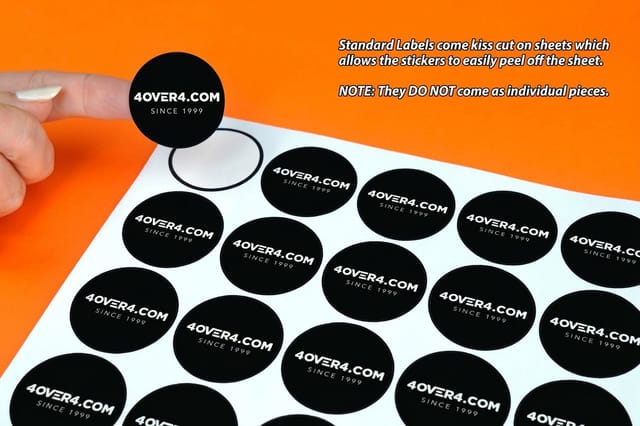
Ask about the coating, because it decides recyclability. A gloss or matte plastic laminate bonds to the fibre and most mills reject the sheet outright. Aqueous coating is water based and repulpable. This is why a job can be printed on one hundred percent PCW with soy ink and still end up in landfill: the finish, not the paper, made the call. If you are ordering something like standard labels from $23.88, ask about the liner too, since the silicone backing is the part that almost never gets recycled.
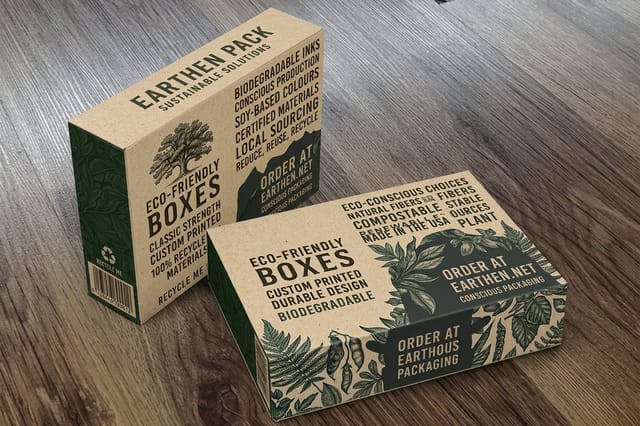
The same logic runs through apparel and packaging. Custom t-shirts from $21.96 raise a different set of questions about the blank and the ink chemistry, and eco friendly boxes live or die on the board grade and whether the print is water based. Our guide to bamboo and alternative fibre cards covers what happens when the stock is not wood pulp at all.
Verifying a Vendor in About Twenty Minutes

You do not need an audit team. You need four artefacts, and a printer who can produce them quickly is telling you something a brochure cannot.
- The certificate code. Ask for the printer's own chain of custody number and look it up in the issuing register. Check the scope line: certificates list which product categories are covered, and a code valid for one product family does not cover another.
- The stock specification. Mill, brand name, basis weight, PCW percentage. If the answer is recycled stock rather than a named sheet, there is nothing to verify.
- A physical sample on that stock. This confirms the sheet exists in the size and weight quoted, and it shows you the colour shift before your brand team sees it on a run of ten thousand. Request it as an unprinted sample plus a printed piece.
- The claim on a document. Quote, job ticket or invoice, carrying the certificate code and the stock spec. This is the artefact your sustainability report actually needs.
Two questions catch the rest. First, where does the job ship from, because a certified sheet trucked across three states erodes a fair amount of the benefit and nobody puts freight distance on a sustainability page. Second, how is the press waste handled: a plant that bales its trim and sells it back into the fibre stream will say so immediately and specifically, and a plant that does not will answer in adjectives.
The general vetting work still applies on top of all this. Proof policy, reprint terms and turnaround decide whether the job succeeds at all, and our guide to choosing a professional printing service and the online print service checklist cover that layer. A vendor with perfect certificates and a bad reprint policy still costs you a second print run, which is the least green outcome available.
Finding a Certified Printer Rather Than Checking One
The public register works in both directions. The same database you use to check a code will list every certificate holder, filtered by country, by certificate type and by product group, which makes it a search tool rather than only a lookup. SFI and PEFC publish equivalent searches of their own participants.
Search it the way a buyer should. Filter to chain of custody holders in the country you want the job printed in, then read the product scope on each certificate before you contact anyone, because a company certified for packaging is not certified for your stationery. Scope is the field that quietly eliminates most of a long list.
Two shortcuts save time after that. Ask any printer you already use for its own code first, since a shop that prints well and holds a certificate beats a certified stranger. And check the expiry date on the record, because a lapsed certificate is the single most common thing a buyer finds after the job has been quoted.
Where Green Printing Costs More, and Where It Genuinely Does Not

Some of the honest answer here works against the sales pitch. On small format work the environmental choice is close to free, and on packaging it is not.
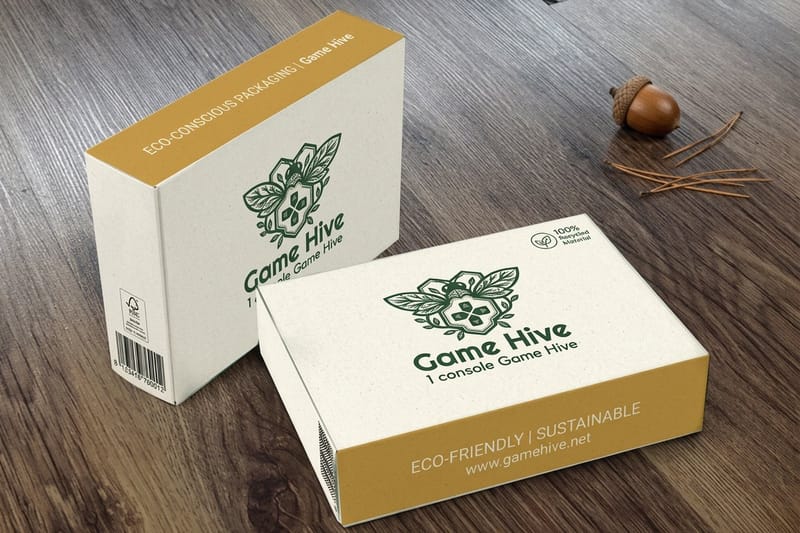
Business cards, greeting cards from $56.02 and short run flyers sit on standard house stocks, and swapping to a certified or thirty percent PCW sheet usually moves the unit price a little and the lead time not at all. Packaging is the opposite: eco friendly boxes start at $711.78 because corrugated tooling and minimum runs dominate the cost, so the stock decision has to be made at quote stage, before artwork is approved and a die is cut.
The counter-intuitive one is press method. A gang run, where several customers share one large press sheet, is often the lower impact option for a short run even though it sounds like mass production. The make-ready waste, the plates and the wash-up are spread across every job on the sheet instead of being charged in full to yours. Ordering five hundred cards on a dedicated press throws away a startling amount of paper before the first good sheet appears.
The last trade-off is the one buyers regret most. Ordering the smallest quantity feels responsible and frequently is not, because a reprint three months later repeats every fixed cost and every sheet of make-ready waste. Order to a real forecast, keep the artwork versioned, and print once. The eco friendly printing collection lists what we run on recycled and responsibly sourced stock, and seven eco friendly packaging ideas shows where the packaging decisions land in practice.
Wally checks the certificate, not the leaf
A logo is a picture, a code is a fact
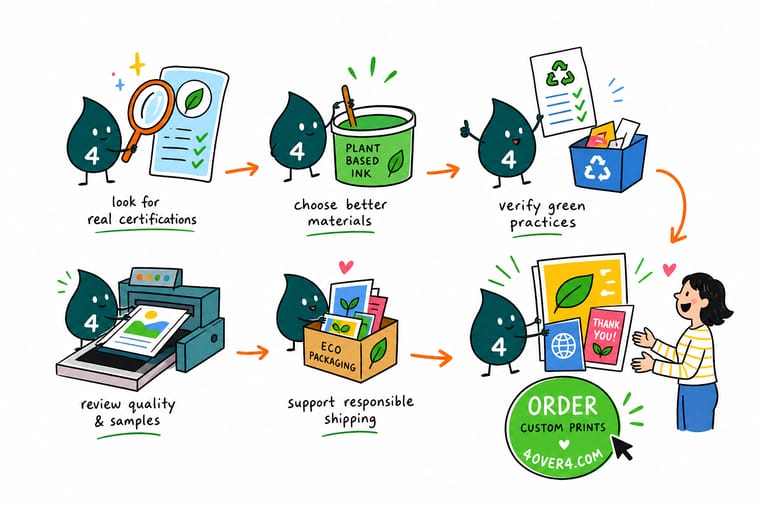
Wally does not argue with a vendor about how green they are. He asks for three things: the chain of custody number, the sheet by mill name and post-consumer waste percentage, and the standard coating on that product. Then he looks the number up in the public register and checks the scope line, because a certificate covering one product family does not cover another. If all three come back in a minute, he orders. If they come back as adjectives, he stops.
Shop the eco friendly printing collection →Specs and pricing
Stocks, sizes and starting prices to quote against
Configure the products buyers most often move onto recycled and responsibly sourced stock, with live options and starting prices from the 4OVER4.COM configurator.

Print it
Order print you can defend in a sustainability review

Explore more
Where to go next



By the numbers
A print partner your procurement team can check
Common Questions
Eco friendly printing, answered straight
What companies are FSC certified?
Tens of thousands worldwide, and no short list is worth trusting, because certificates are issued, suspended and allowed to expire continuously. The only current answer is the council's own public register, which is searchable by company name, by country and by product group. Anyone claiming certification should hand you a code that resolves in it, and a code that does not resolve ends the conversation.
How do I know if a company is FSC certified?
Ask for its own certificate code, in the form FSC C followed by six digits, and search that code in the public register. Read three fields on the record that comes back: the company name, the status, and the product scope. A valid code held by a different company in the same group, or a scope covering packaging when you are buying stationery, is the same as no certificate at all for your job.
Is FSC certification legit?
It is the most widely audited scheme in the industry and the only one with a public register you can check yourself, which is what separates it from a self declared claim. It has real critics, mostly about how mixed source material is accounted for and about audit depth in some regions. For a print buyer that argument is beside the point. A code you can look up is evidence, and a leaf icon on a website is not.
Does FSC certified paper mean my printed job is FSC certified?
No, and this is the single most common mistake in print procurement. FSC works as a chain of custody: the forest, the mill, the merchant and the printer each hold their own certificate, and the chain breaks at any link that does not. A printer can buy genuinely FSC certified stock and still be forbidden from putting the FSC label on your piece, because the printer itself has no chain of custody code. If the label needs to appear on the printed piece, ask for the printer's own certificate code and confirm it in the public FSC certificate database before the job goes to press.
What percentage of post-consumer waste should I ask for?
Thirty percent PCW is widely stocked, prints close to virgin stock and rarely carries a large premium. One hundred percent PCW is the real environmental step and the real trade-off: fewer available weights and finishes, a warmer and slightly greyer base sheet, and a longer lead time when it is not house stock. For anything colour critical, order a printed sample on the exact stock rather than trusting an on-screen proof, because a solid brand blue sits noticeably duller on high PCW uncoated paper.
Are soy and vegetable based inks actually better?
They help in two specific places. Soy based inks release fewer volatile organic compounds during the press run, and they release the pigment more easily during de-inking, so the recycled fibre comes back cleaner. What they do not do is make the finished sheet biodegradable or change the ink coverage. They also dry more slowly on coated stock, which can add a day to turnaround on heavy coverage jobs. UV cured inks are the opposite trade: almost no VOC emission at the press, but a cured plastic film that is harder to de-ink.
Does lamination make a printed piece unrecyclable?
In most municipal streams, yes. A polypropylene or polyester laminate is bonded to the fibre and mills reject the sheet because the plastic will not break down in the pulper. If a job has to survive handling, aqueous coating is the usual answer: it is water based, repulpable, and it gives a light scuff resistance. Soft touch and velvet laminates feel excellent and are the least recyclable finish on the menu, so pick them deliberately rather than by default.
What should I ask a printer that most buyers forget?
Four questions. Where does the paper actually come from, by mill and certificate code. What happens to the trim and the make-ready sheets, and is that waste baled and sold back into the fibre stream. What is the shipping origin, because a certified sheet flown across the country undoes a lot of the gain. And what is the standard finish on this product, since the default coating decides whether the piece is recyclable no matter which stock you chose.
Is eco friendly printing more expensive?
It depends far more on the product than on the certification. Standard labels start at $23.88 at 4OVER4.COM and greeting cards at $56.02, and choosing a certified or high recycled stock on those moves the price by a small margin. Packaging is the category where the choice is material: eco friendly boxes start at $711.78 because corrugated packaging carries a real minimum run, so specify the stock and the coating at quote stage rather than after the artwork is approved.
Can I use a vendor claim in our sustainability report?
Only if it arrives as a document with a verifiable reference on it. Auditors accept a certificate code that resolves in the issuing body's public register, a stock specification naming the mill and PCW percentage, and an invoice or job ticket that ties both to your purchase order. Marketing copy on a supplier website, a leaf icon, and the phrase environmentally friendly are not evidence, and a claim you cannot trace is worse than no claim because it becomes a greenwashing exposure of your own.
Get Started
Ready to spec a job you can put in the report?
Tell us the stock and the finish you need, ask for the paperwork, and we print it. Free samples let your team feel the sheet before the run.
Legal Disclaimer
Gold Standard guarantees apply to all standard orders placed through 4over4.com. Price match requires verifiable proof of a competitor's published price for an equivalent product with matching specifications and turnaround time. Satisfaction guarantee covers manufacturing defects and print quality issues. Contact support with order number and documentation. On-time delivery rate based on tracked orders 1999 to 2026. Individual results may vary based on shipping carrier performance.
