
Die-Cut Card Printing and the Custom Shapes That Cut Clean


Shaped cards live or die on the file. Here is how the cut is made, which outlines already have a die, and how to build a dieline that goes through on the first upload.
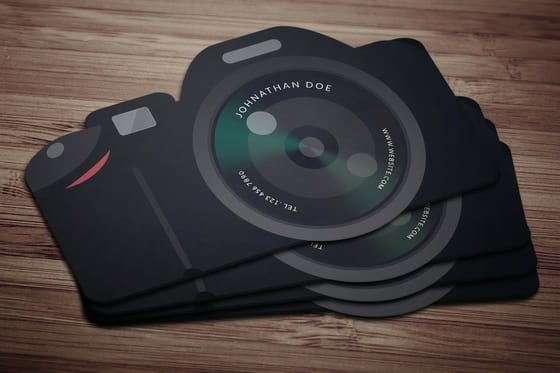
A die-cut card is cut to a custom outline by a shaped steel blade instead of a straight guillotine, and your file has to carry that outline as a stroke-only vector path in a spot colour named Dieline. Stock shapes such as rounded corners, ovals and leaf cuts use a die we already hold, so Die-Cut Business Cards start at $26.37. A bespoke silhouette needs a new die made, which is why Die-Cut Any Shape Business Cards start at $95.56. Bleed runs 1/8 inch outside the cut path and safety 1/8 inch inside it, both following the curve.
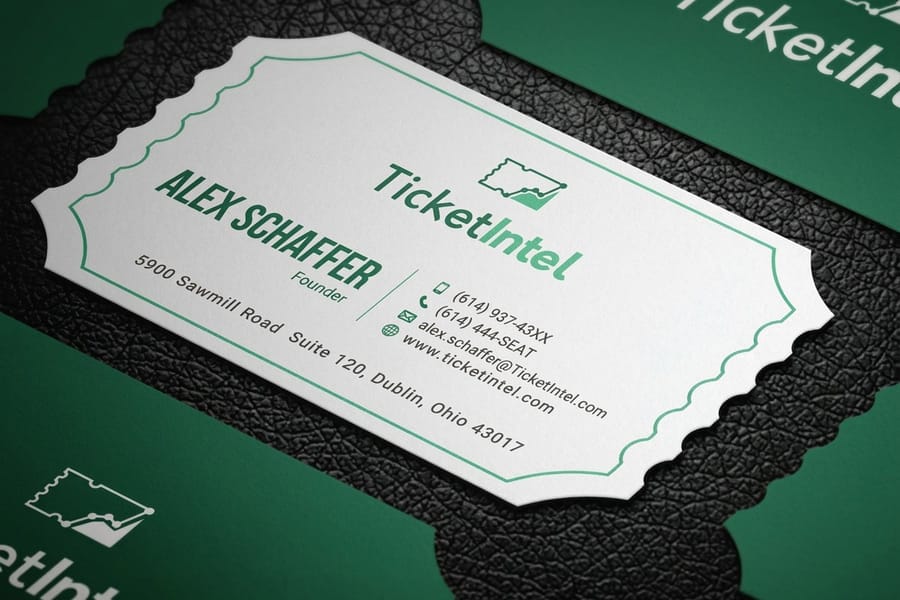
Quick answer
One cut path, one bleed offset, one safety offset
Die cutting presses a shaped blade through the printed sheet, so the shape has to exist in your file before it can exist in steel. Draw the outline as a single closed path, strip the fill, paint the stroke in a spot swatch named Dieline, and put it on its own layer above the artwork. Offset that path outward by 1/8 inch for bleed and inward by 1/8 inch for safety, following the curve rather than the artboard. Keep inside corners at roughly a 1/8 inch radius and any connecting neck at least 1/4 inch wide, and the die will cut what you drew.
What Die Cutting Does to a Printed Sheet
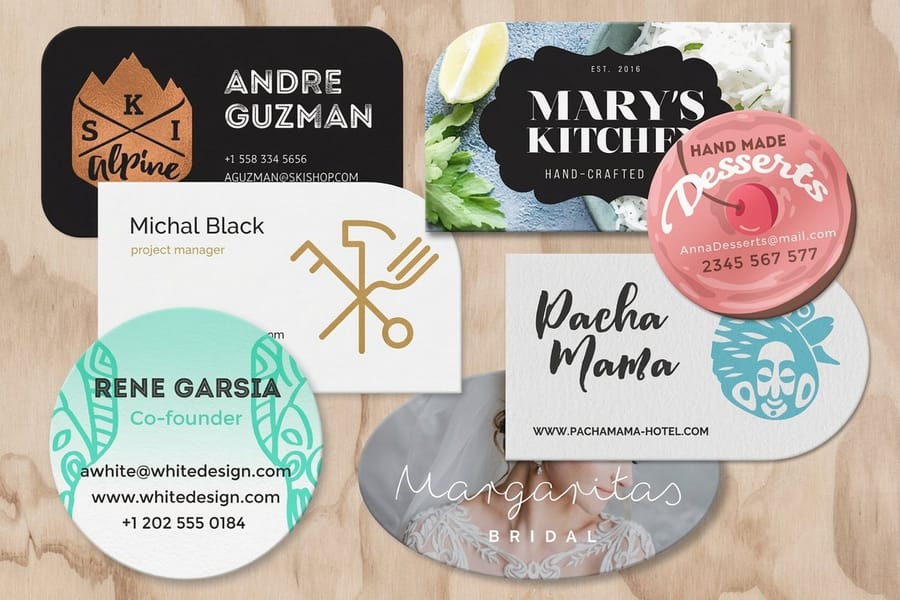
Die cutting cuts printed stock to an outline that a straight blade cannot produce. A guillotine gives you rectangles. A die gives you curves, notches, arches and silhouettes.
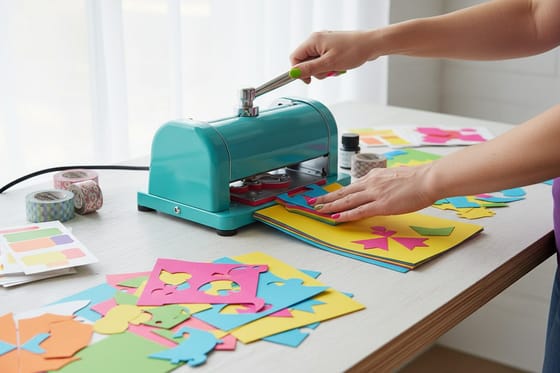
The tool for a production run is a steel rule die. A strip of cutting blade is bent by hand to your outline, set into a plywood board, and packed with rubber that pushes the sheet off the blade after each hit. The board goes onto a platen press, the printed sheets feed through, and each impression cuts the shape. That die is a physical object with a cost, and it lives on a shelf afterward, which is the single fact that explains the pricing of every die-cut product you will look at.
Short runs and one-offs can skip the die. A digital cutter drags a small knife along the vector path, or a laser burns it, working straight from your file. No tooling cost, slower per sheet, so it suits low quantities and prototypes. Either way the machine is following the same thing: the cut path you drew.
Cards are always cut all the way through the stock. Stickers are often cut only through the face material so the sheet stays intact, which is a different operation covered in kiss cut versus die cut. If you want the wider view across labels, boxes and hangtags, our guide to die cutting takes the process end to end.
What a Shaped Card Buys You, and What It Costs
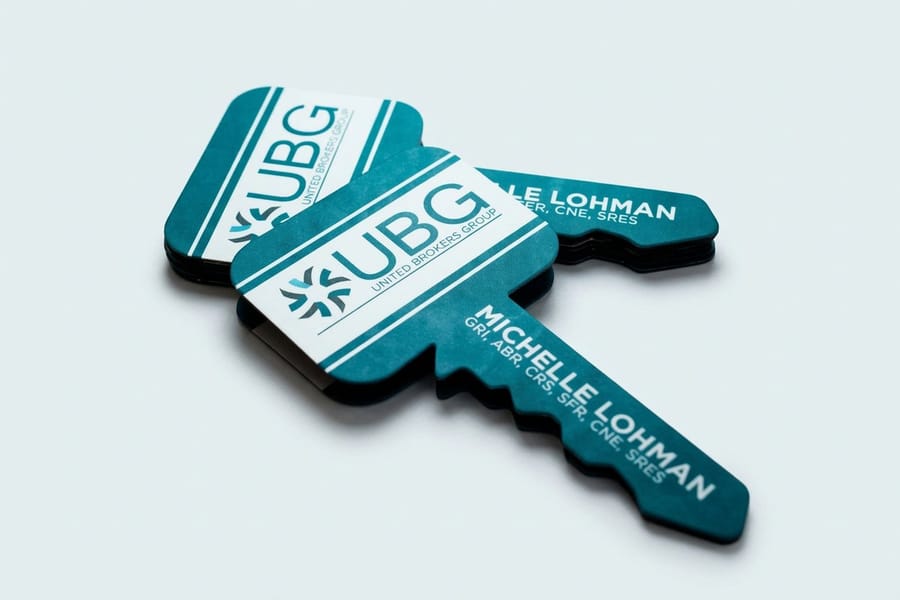
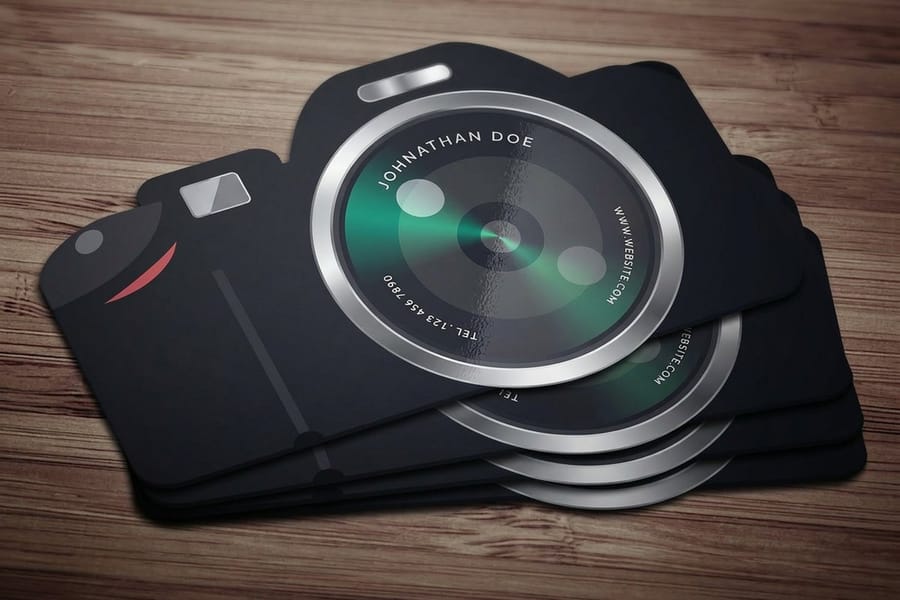
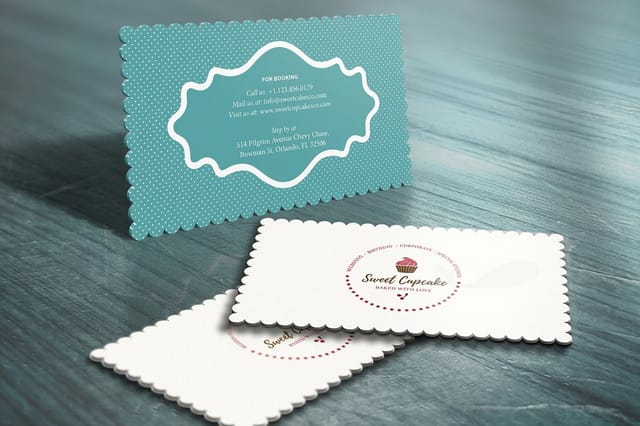
A shaped card gets handled differently. Someone picks it out of a stack because it is the one that is not a rectangle, turns it over, and it ends up on a desk rather than in a drawer. That is the whole argument, and it is a good one.
The costs are real and worth naming before you commit. Die-Cut Business Cards start at $26.37 against $17.57 for Standard Business Cards, which is a modest step up for a stock shape. Go to a genuinely custom outline and Die-Cut Any Shape Business Cards start at $95.56, because a new die has to be made for your artwork.
Then there are the practical costs nobody mentions. A shaped card will not sit flush in a wallet slot, a card file, or the pocket of a leather folder, and anything wider than the standard 3.5 inches simply will not slide in. Odd shapes stack unevenly in a card holder on a trade show table. And if the piece is going in the mail, USPS charges a nonmachinable surcharge on mail that is square, rigid or oddly shaped, so a die-cut mailer costs more per piece to send than a rectangular one.
The rule of thumb from behind the counter: if the shape says something about the business, it earns its cost. A dental practice with a tooth-shaped card, a landscaper with a leaf, a realtor with a house outline. If the shape is decorative only, spend the difference on stock weight or a finish instead, and read the finish comparison before you decide.
The Shapes People Actually Order, and Where Each One Fails
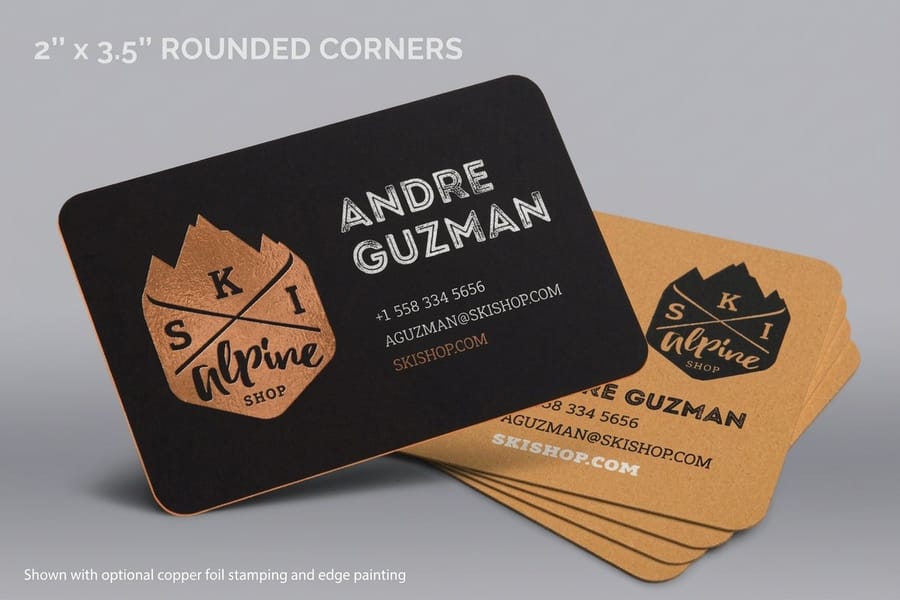
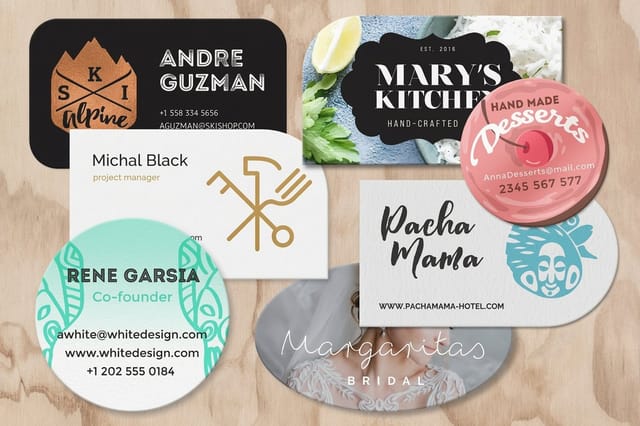
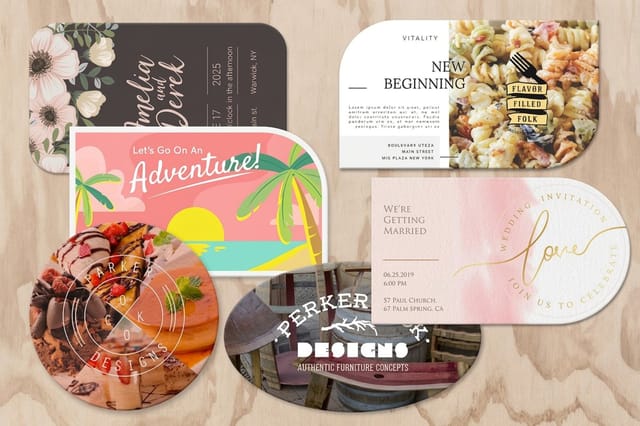
Most die-cut card work uses one of six outlines. Five of them already have a die on the shelf, which is why they cost so much less than a bespoke silhouette.
| Shape | Die needed | Best stock | Where it gives trouble |
|---|---|---|---|
| Rounded corners | Standard corner die, all four corners at once. | Any weight from 14pt up. | Almost none. Radius is fixed by the die, so you cannot specify an unusual one. |
| Leaf (two opposite rounded corners) | Stock die. | 14pt and up. | The asymmetry reads as an error unless the layout leans into it. |
| Oval and circle | Stock die. | 16pt holds the curve flatter. | You lose the corners, so usable layout area drops sharply. Type has to move inward. |
| Arch or half-circle top | Stock die. | 14pt and up. | Logos centred at the top get clipped by the curve if the safety margin is ignored. |
| Slot or perforated tab | Stock die with a slot rule. | 16pt, or laminated. | The material either side of the slot is the weak point. Keep it wide. |
| Custom silhouette | New die, cut for your outline. | 16pt or laminated. | Thin necks, tight inward notches and sharp protruding points. Simplify before you send it. |
Read the last column first. Every one of these shapes prints; the question is what your artwork does inside it. A circle removes roughly a fifth of the usable area of a rectangular card, so a layout that fits a standard card will not simply drop in. Round card setup covers that case on its own, and the full shape guide runs through the rest.
Building a Dieline Your Printer Can Use First Time
Six steps, and the order matters, because every offset is measured from the cut path rather than from the artboard.
- Draw the cut path. One closed vector path, drawn at final size. Not two overlapping shapes, not a compound of five pieces, not a live effect. Expand everything first.
- Make it a spot colour. Create a new swatch, set the colour type to spot, name it Dieline, and paint the path with it as a stroke. Remove the fill. A cut line built from CMYK gets treated as artwork and printed on the card.
- Put it on its own layer. Name the layer Dieline, place it above the artwork layers, and set the stroke to overprint so it does not knock a white outline out of the art underneath.
- Offset the bleed outward by 0.125 inch. Copy the cut path, offset it, and run the background artwork out to that line. It has to follow the curve. A rectangular bleed box around a curved card is the single most common reason a die-cut job comes back with white slivers on the edge.
- Offset the safety inward by 0.125 inch. Keep all type, logos and anything you would notice being clipped inside that line. Die cutting registers to the sheet a little looser than trimming does, so the margin is doing real work.
- Export a print PDF with layers preserved. Send the dieline in the same file as the artwork, not as a separate sketch, and say in the notes that the spot swatch is the cut.
Two limits to design around before you draw anything. Inside corners need roughly a 1/8 inch radius, because steel rule bends outward to a point but cannot fold back into a tight inward notch. And any neck or bridge connecting two wider parts of the shape wants about a 1/4 inch of width, or it bends in a pocket and tears at the cut.
If you would rather start from a correctly sized file, the blank template library gives you the trim and bleed already in place, and the print-ready checklist covers the same three offsets on ordinary rectangular work. For file format and colour questions, the print-ready file guide has the rest.
Stock and Finish Choices That Hold a Shape
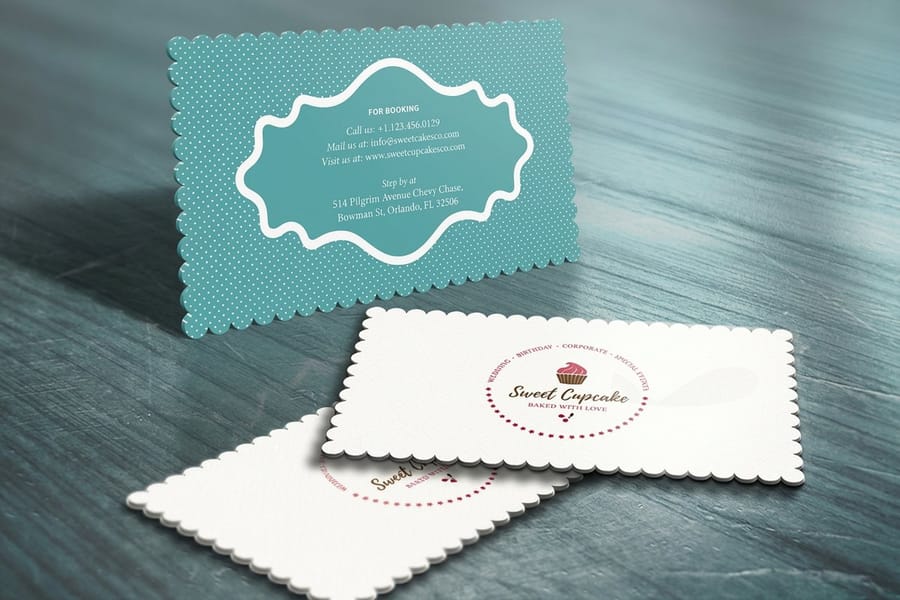
Weight matters more on a shaped card than on a rectangular one, because the edge is doing something. A curve or a point on 14pt stock will soften after a few weeks in a pocket. On 16pt it stays crisp.
Lamination changes the calculation again. A laminated card has a plastic film bonded to both faces, so the sheet resists tearing at a narrow neck or a protruding point in a way uncoated or aqueous-coated stock does not. Die-Cut Laminated Business Cards start at $174.65, which is a serious step up from $26.37, so it is a choice for a shape that genuinely needs the strength rather than a default. A soft-touch or matte laminate also gives the cut edge a cleaner look, because the film seals the exposed paper core that a gloss coating leaves visible.
One thing to watch: coating and lamination stop at the face of the sheet. The cut edge itself is raw paper on any stock, laminated or not, and on a dark background that white edge line is visible. It is normal, it is not a defect, and if it bothers you the fix is a lighter background near the edge rather than a different coating. Our stock guide and the thickness chart lay out the weights side by side.
Ordering Die-Cut Cards Without a Proof Round
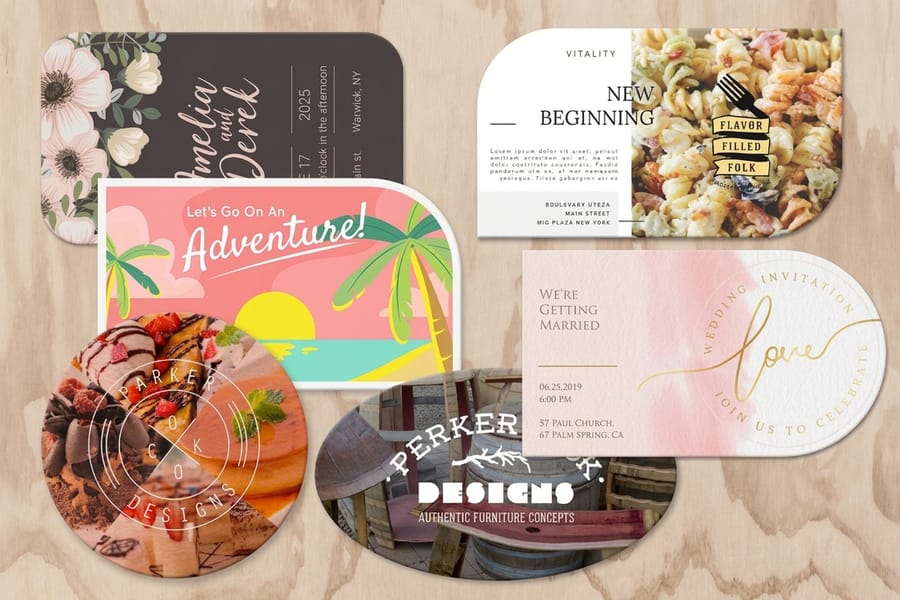
Decide the die first, because it sets the price and the file you need to build. If a stock shape works, Die-Cut Business Cards at $26.37 and Die-Cut Postcards at $34.05 both use shapes already tooled, so you pick the outline in the configurator and supply artwork built to it. If the outline is yours, the any-shape products carry the die into the price: $95.56 for cards, $126.32 for Die-Cut Any Shape Postcards.
Then set quantity and stock together. A die cut adds a pass on the press, so the per-piece cost falls faster with quantity than it does on a flat job. Ordering 500 shaped cards twice costs noticeably more than ordering 1,000 once, and the second run has to hit the same die anyway.
Before you upload, check three things: the cut path is a stroke-only spot colour on its own layer, the bleed follows the curve rather than a rectangle, and nothing you care about sits within 1/8 inch of the cut. Those three account for nearly every die-cut file we send back. The rest of the range is on the die cutting collection, and the shape options across the card family sit under business card printing.
Wally explains the dieline
Draw the cut path, then measure everything else from it
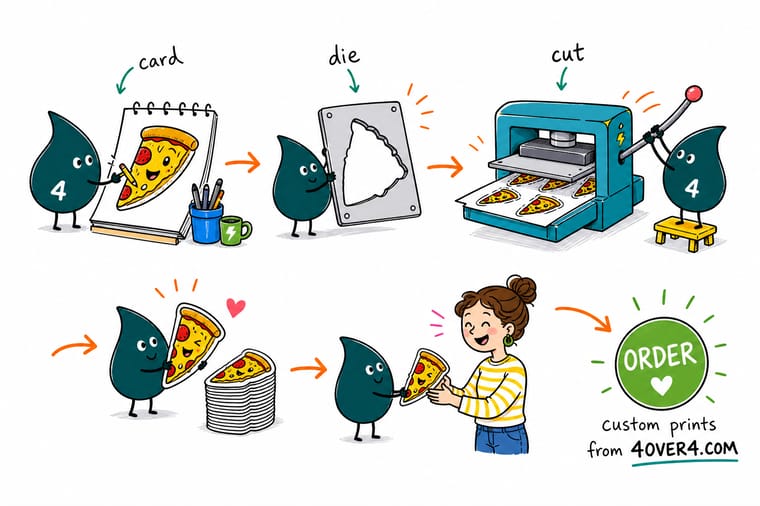
Wally bends a strip of blade into your shape, sets it into a board, and presses it through the sheet. He can bend steel out to a sharp point, but he cannot fold it into a tight inward notch, so inside corners get a small radius. Give him one closed path, no fill, in a spot swatch named Dieline, with the background art running 1/8 inch past it and the type sitting 1/8 inch inside it. Draw the bleed as a rectangle around a curved card and he will hand you back a card with a white sliver on the edge.
Order die-cut business cards →Specs and pricing
Die-cut card options, sizes and starting prices
Stock shape, custom outline, or laminated for strength. Compare the three side by side with live configuration choices and starting prices from the 4OVER4.COM configurator.

Print it
Order a card that is not another rectangle
Explore more
Where to go next

By the numbers
Custom die cutting you can count on at 4OVER4
Common Questions
Your die-cut card questions, answered
What is a dieline and how do I make one?
A dieline is the vector path that tells the cutting die where to go. Draw the outline of your card as a single closed path with the pen or shape tool, remove the fill, and give the stroke a new swatch set as a spot colour named Dieline. Put that path on its own layer named Dieline, above the artwork, and set it to overprint so it does not knock a white line out of the art underneath. Export a print PDF with layers preserved. If the cut line is built from CMYK values or sits on a filled shape, it comes back printed on the card instead of cut out of it.
Do I need a custom die or can I use a stock shape?
Use a stock shape whenever one is close enough. Rounded corners, ovals, leaf shapes, arched tops and half-circles are already tooled, so Die-Cut Business Cards start at $26.37 against $17.57 for Standard Business Cards, which is a small premium for a card that looks nothing like the stack it sits in. A genuinely custom silhouette, a bottle outline or a house shape or your logo cut out, needs a new die made, and that is why Die-Cut Any Shape Business Cards start at $95.56. If the shape is decorative rather than meaningful, the stock die is the better spend.
How much bleed does a die-cut card need?
An eighth of an inch beyond the cut path, following the shape rather than a bounding box. This is where most files fail. Designers set up bleed as a rectangle around the artboard, then a curved die cuts inside that rectangle in one place and outside the printed art in another, and a hairline of white paper shows on the finished edge. Offset the cut path outward by 0.125 inch and push the background art to that new line. Keep type and logos 1/8 inch inside the cut path, because a die moves on the sheet a little more than a guillotine trim does.
What is the smallest detail a die can cut?
Plan for about a 1/8 inch radius on any inside corner and about a 1/4 inch minimum width on any neck or tab. A steel rule die is bent metal, so it takes a sharp outward point easily but cannot fold back into a tight inward notch. Thin connecting sections are the other failure: a shape with a narrow bridge between two wider areas will bend at that point in a pocket or tear at it during cutting, especially on 14pt stock. Widen the neck or move to 16pt if the design depends on it.
Can die-cut postcards be mailed?
They can, but shaped mail usually costs more to send. USPS applies a nonmachinable surcharge to mailpieces that are square, rigid, or oddly shaped, because they cannot run through the automated sorting equipment. That surcharge applies per piece, so it scales with the mailing. For a drop of a few hundred it is usually worth it for the response lift a shaped piece gets. For a mailing in the tens of thousands, price the surcharge before you commit, and check the current rate with USPS rather than assuming last year's figure.
What is the difference between a die cut and a kiss cut?
A die cut goes all the way through the material. A kiss cut goes through the face material only and leaves the backing liner intact, which is how a sticker peels off a sheet. Cards are always through-cut. The distinction only matters when you are ordering stickers or labels, and it is covered in full in our comparison of kiss cut and die cut.
Get Started
Ready to cut your card to shape?
Pick a stock outline or send your own, choose 14pt, 16pt or laminated, and we cut the shape you drew with the bleed and safety already accounted for.
Legal Disclaimer
Gold Standard guarantees apply to all standard orders placed through 4over4.com. Price match requires verifiable proof of a competitor's published price for an equivalent product with matching specifications and turnaround time. Satisfaction guarantee covers manufacturing defects and print quality issues. Contact support with order number and documentation. On-time delivery rate based on tracked orders 1999 to 2026. Individual results may vary based on shipping carrier performance.
