
Aluminum Signage Built for Weather, From Gauge to Mounting


Tobias is our voice for cutting, binding and large format, built from the knowledge of our production team, with over 20 years in printing.
Aluminum is the substrate you pick when the sign has to still be there next winter. The gauge has to match your panel size, each finish changes the artwork, and there are mounting mistakes that crack a good panel early.
Aluminum signage is a printed graphic on a solid aluminum blank, usually .040, .063 or .080 inch thick, and it survives outdoors because aluminum forms a protective oxide film instead of rusting. Choose the gauge for panel size and wind, the finish for how the sign has to be read, and stainless or aluminum bolts with nylon washers in slightly oversize holes so heat expansion never cracks the panel.
Quick answer
Gauge carries the wind, the ink stack carries the message
An aluminum sign is a graphic printed on a solid metal blank, and the two decisions that matter are thickness and finish. Thickness decides whether the panel stays flat in a gust: .040 inch for small signs bolted to a wall, .063 inch from 18 by 24 inches up or anywhere in open air, .080 inch for roadside and long spans. Finish decides how it reads: coated white for distance, brushed metal for close-up interiors, reflective sheeting for anything a headlight will find after dark. The metal itself is close to permanent, so the print, and whether it carries a laminate, is what sets the real service life.
Why Aluminum Holds Up Outdoors When Other Substrates Give Up
Aluminum does not rust. It oxidizes, and the thin dull film that forms within hours of the metal meeting air is what stops the corrosion going any deeper. That single property is the reason a bare aluminum blank can hang on a fence for years and still be a flat, drillable piece of metal.
The substrates it competes with fail in ways you can predict. Steel fails from the edges and the bolt holes, wherever the coating got nicked and water crept under it, and once it starts the rust bleeds down the face of the sign. Coroplast fails from sunlight: the polypropylene goes brittle, the flutes chalk, and a couple of freeze and thaw cycles split it along a corrugation. Foam PVC survives longer than coroplast but bows in summer heat, especially with a dark background soaking up sun on a south wall.
Aluminum has its own weakness, and it is worth saying out loud before you order. It dents, and a dent is permanent. Gravel off a plow, a delivery door swinging into it, a ladder set against it, all leave marks that no amount of cleaning takes out, where a coroplast panel would have flexed and sprung back. If a sign lives somewhere it will get physically hit every week, cheap and replaceable beats permanent.
The second thing to accept is that the metal outlives the print. On an aluminum sign the panel is usually still perfectly serviceable long after the ink on the sun-facing side has gone flat. That is why the laminate question later in this guide is a real decision and not an upsell. If you are still weighing substrates, the aluminum, coroplast and PVC comparison puts the three side by side on cost and lifespan.
Gauges, and How to Pick One Without Guessing
Thickness is the one spec that changes how an aluminum sign behaves once it is up. Everything else on the order affects how it looks. Aluminum sign blanks come in three gauges that cover nearly every job, and picking between them is a question about span and wind, not about quality.
| Gauge | How it feels in the hand | Stays flat up to | The job it belongs on |
|---|---|---|---|
| .040 in | Bends under steady thumb pressure at a corner and keeps the bend. | Roughly 12 by 18 in, fixed flat to a wall or post. | Parking spaces, doors, restrooms, property rules, anything read from a few feet away. |
| .063 in | Springs back instead of creasing when you flex a corner. | 18 by 24 in and 24 by 36 in on a single post. | Open wind, site entrances, real estate riders, anything that rattles in a gust. |
| .080 in | Carries its own weight held from one corner with almost no droop. | Large panels and long spans between two posts. | Roadside, industrial yards, and signs meant to still be there in ten years. |
The failure you are buying your way out of with a heavier gauge is called oil canning: a thin panel that is too big for its fixings starts flexing in and out in the wind, the face ripples, and the metal work-hardens around the bolt holes until it cracks. You see it on .040 in blanks that were sized for a wall and then put on a post. Our aluminum signs print on .040 inch in all three sizes, so for a 24 x 36 inch panel in open wind the 1/8 inch aluminum sign panels are the stiffer choice.
Two smaller specs are worth setting deliberately. Rounded corners, a 0.75 inch radius on our aluminum signs and 1/4 inch on the 1/8 inch panels, take the sharp point off a panel that people walk past and stop the corner becoming the place the sign starts to tear. And bolt holes should be drilled a touch larger than the fastener, because aluminum grows more across a hot afternoon than the steel post behind it. Aluminum signs start at $36 for one 12 x 18 inch sign with the holes and corners handled at our end, and plain aluminum sign panels start at $29 for one 11 x 17 inch panel if you want to drill to your own bracket pattern.
There is a ceiling on solid sheet. Once a panel gets past about four by eight feet, a single sheet of aluminum gets heavy and hard to keep dead flat, and a composite panel with a plastic core does the job better. The ACM sign guide covers where that crossover sits and what the composite core costs you at a cut edge.
Finishes: Coated White, Brushed Metal, Reflective and Dry Erase
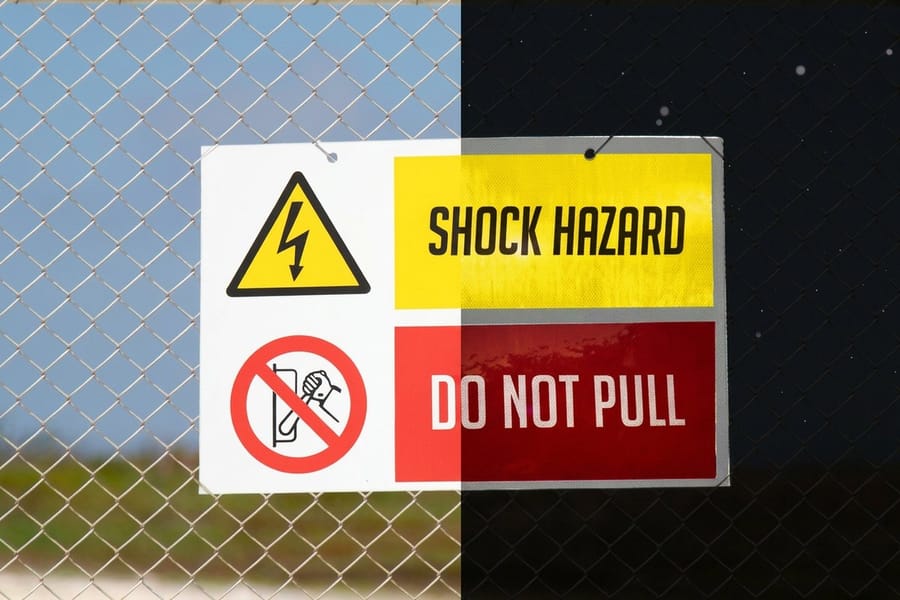
The finish decides how the sign reads, and reading is the entire job. A blank arrives either with a baked white coating that ink sits on at full opacity, or with the mill or brushed metal left exposed so the surface shows through. Everything else is a variation on those two.
| Finish | What you actually see | Where it wins | The catch |
|---|---|---|---|
| Coated white | Solid, saturated color on a flat white ground. | Anything read fast, at distance, by someone who is moving. | The substrate contributes nothing visually. It reads as a printed panel. |
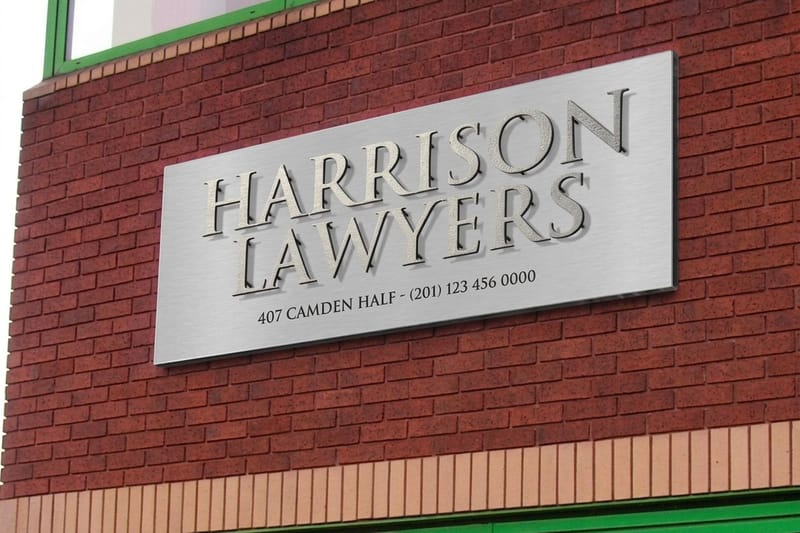
| Brushed metal | Directional grain showing through the ink, metal in the unprinted areas. | Lobbies, offices, taprooms, product displays, anywhere people stand close. | Ink goes semi transparent, and the panel darkens badly in low light. |
| Reflective | Sheeting that throws headlight beams back at the driver after dark. | Driveways, gates, parking, private roads, any sign read at night. | Costs more and does nothing where no light source points at it. |
| Dry erase | Gloss white surface that takes a marker and wipes clean. | Daily menus, schedules, job-site boards, anything that changes weekly. | Solvent markers ghost, and printed artwork has to stay out of the writing area. |
Brushed is the finish people order without understanding what it does to artwork. Ink on bare aluminum behaves like a wash, so a pale tint reads as a hint of color over grain rather than as the color you specified, and a photograph turns muddy. The fix is a white underprint laid down first under the type and the logo, leaving the bare metal to carry only the background. That is a deliberate two-layer build, not a default, so confirm the product offers it before you design around it.
Reflective aluminum signs start at $41.02 for one 12 x 18 inch sign and are worth it in one specific situation: a vehicle with headlights approaches the sign in the dark. That covers gate numbers, private road warnings, speed and parking notices on a lot. It covers nothing in a courtyard lit by nothing. Keep reflective artwork blunt, because retroreflection flattens tonal differences, and pick colors that already separate in daylight using the reasoning in our guide to sign colors that stay visible.
Dry erase aluminum signs start at $47.22 for one 12 x 18 inch sign and solve the sign that has to change without a reprint. Print the fixed part, the header, the logo, the categories, and leave a clean field for the marker. One rule saves the surface: use dry erase markers only, because permanent and solvent markers leave a ghost in the gloss that no cleaner fully lifts. The dry erase aluminum signs video shows the finished panel before you order.
Mounting a Panel So the Wind and the Weather Leave It Alone
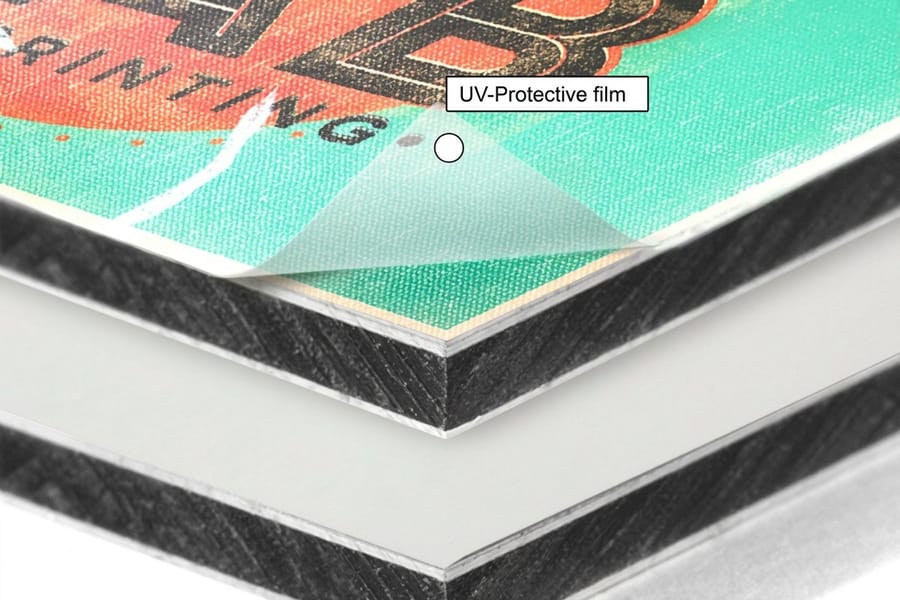
Most aluminum signs that fail early were mounted badly rather than made badly. Three habits prevent nearly all of it: oversize the holes, use the right metal for the fastener, and give the wind more than two points to twist against.
Start with the fasteners. Plain steel bolts sitting wet against bare aluminum set up galvanic corrosion, and it eats the panel at the hole while the rest of the sign still looks new. Stainless or aluminum hardware with a nylon washer on both faces removes that entirely, and the nylon also lets the panel slide a fraction as it expands. Drill or specify holes slightly larger than the bolt for the same reason: aluminum moves more across a hot day than the post behind it, and a tight hole turns that movement into a crack that runs to the nearest corner.
Then think about how many fixings the panel gets. Two holes along the top edge look tidy and let a gust spin the sign around that line until the holes elongate. Anything wider than roughly 18 inches wants four points, one near each corner, so the wind has nothing to pivot on. On a round pole, stainless banding straps beat drilling the pole. On a masonry wall, sleeve anchors into the brick body rather than the mortar joint hold far better, and standoffs lift the panel off the surface so water drains behind it instead of sitting in a damp line along the top edge.
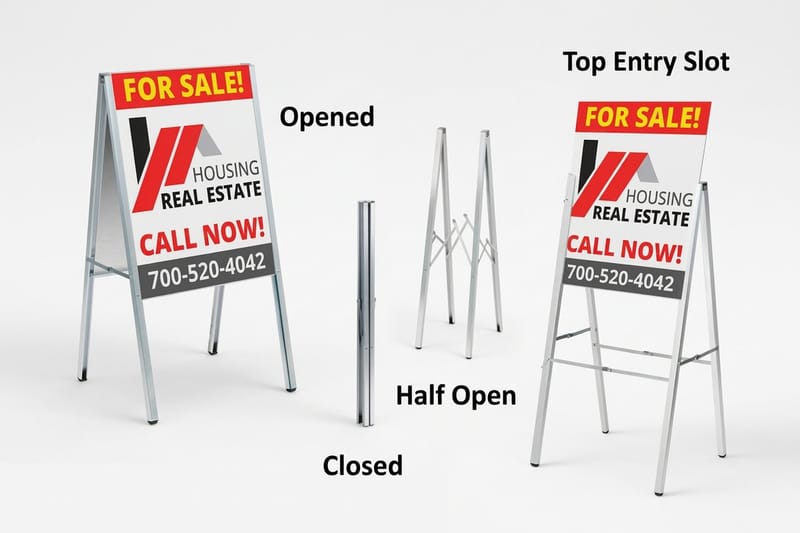
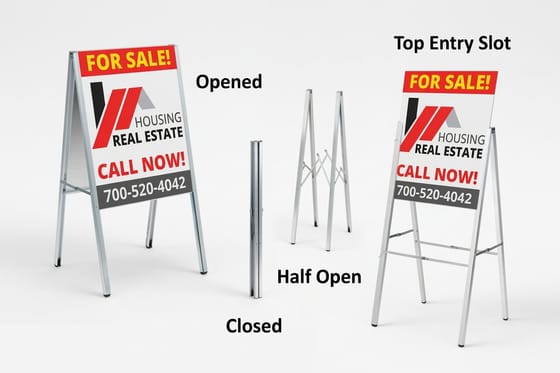
When drilling is not allowed at all, which covers most leased storefronts and every event, the panel needs to stand on its own. Aluminum A-frames start at $146.07 for a frame with two boards and hold a printed insert at the pavement edge without touching the building. For interior walls where a bolted panel would be overkill, aluminum wall graphics give the same brushed metal look in a lighter, adhesive-mounted form.
Set the artwork up at the finished panel size with the bleed and safe margins the press expects, and keep type and logos well clear of the corners where the mounting holes land. The correctly sized starting files are in the blank template library. If this sign is one of several that have to work as a set, plan the placement first using our wayfinding signage planning guide, and read the outdoor sign printing guide for how the same mounting decisions play out on other substrates. Everything we print on aluminum sits in the aluminum printing collection.
Wally explains aluminum signage
Thickness for the wind, washers for the heat
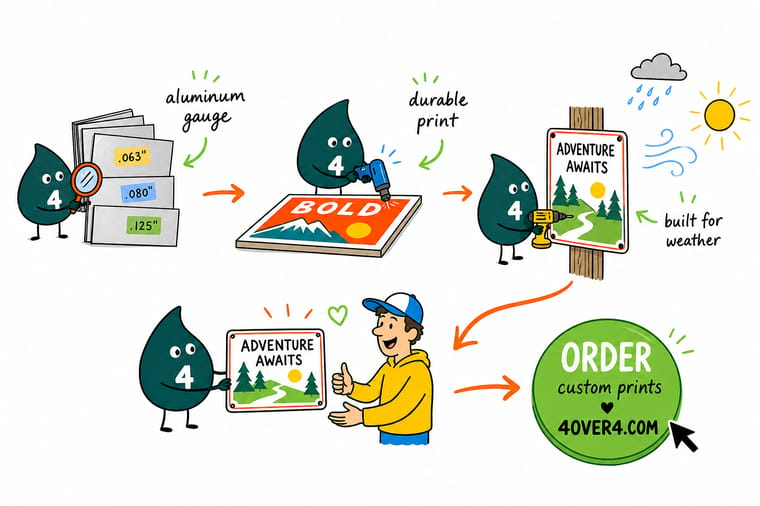
Wally holds the blank on its edge first, because that is the spec that matters. Thin .040 for a small sign flat on a wall, .063 once it goes on a post in open air, .080 when it has to still be there in ten years. Then he drills the hole a shade bigger than the bolt, drops a nylon washer on each side, and uses stainless hardware so the fastener never corrodes the panel. The metal will outlast all of us. The ink is what needs the laminate.
Order aluminum signs →
Specs and pricing
Aluminum sizes, finishes and starting prices
Aluminum signs, panels, wall graphics and reflective stock all print in 4 business days. Aluminum signs run on .040 inch aluminum in 12 x 18, 18 x 24 and 24 x 36 inches from $36 for one sign, reflective signs add reflective film from $41.02 for one, and 1/8 inch sign panels come in eight sizes up to 30 x 40 inches or any size from $29 for one, with gloss or matte lamination.

Print it
Order a panel that is still readable next winter
Choose coated aluminum from $36 a sign for daytime, reflective from $41.02 a sign for anything a headlight finds, or dry erase from $47.22 a sign for a board that changes weekly, then add holes at all 4 corners, the top corners or center top and bottom.

Explore more
Where to go next
Compare aluminum against coroplast and PVC by the season each one tires, see where a composite ACM panel beats solid sheet, pick an outdoor substrate and mount, and plan wayfinding sign sizes.

By the numbers
Metal panels cut to your size
Common Questions
Your aluminum signage questions, answered
What thickness should an aluminum sign be?
Match the gauge to the panel size and the exposure. A .040 inch blank is right for parking, door and property-rule signs up to roughly 12 by 18 inches bolted flat against a wall or a post. Move to .063 inch at 18 by 24 inches and above, or any time the sign stands in open wind where it can flap against its fixings. Use .080 inch for roadside panels, long spans between two posts, and anything you expect to leave in place for a decade. The price step between gauges is small next to the cost of replacing a creased panel.
How long does an aluminum sign last outdoors?
The metal itself is effectively permanent unless something hits it, because aluminum forms a protective oxide film rather than rusting through. What ages is the graphic. UV ink printed straight onto a coated blank starts to lose saturation on the sun-facing side first, and reds and oranges go before blues. A laminate slows that down considerably. Plan the sign around the artwork life, not the panel life, and keep the print file so a reprint on the same blank is cheap.
Can you print full color on brushed aluminum?
Yes, but the ink behaves as a wash rather than a solid layer, so the grain reads through every color and light tones almost vanish. For a lobby sign or a taproom board that is exactly the effect people want. When the artwork has to survive being read at distance or from an angle, ask for a white underprint under the type and the logo, and let the bare brushed metal carry only the background. Mixing the two on one panel is the usual answer.
What is the difference between an aluminum sign and an ACM or Dibond panel?
A solid aluminum sign is one sheet of metal all the way through. ACM is aluminum composite: two thin aluminum skins bonded to a polyethylene core. Composite is lighter and stays flatter across a large panel, which is why it wins above about 4 by 8 feet, but the core is plastic, it dents more easily, and a cut edge can open up if water gets into it. Solid aluminum has no core to fail and takes a bolt hole better. Our ACM sign guide covers where the composite is the smarter choice.
Do reflective aluminum signs need different artwork?
They need higher contrast and simpler shapes. Retroreflective sheeting sends light from a headlight back toward the driver, so at night the sign reads mostly as bright background against dark type. Heavy sans-serif type, a small number of words, and strong tonal separation survive that. Fine strokes, photographs and mid-tone colors do not. Reflective also earns nothing where no light source points at the sign, so a shaded courtyard sign is money spent on physics that never happens.
How do you mount an aluminum sign without cracking it?
Drill the holes slightly oversize and let the panel move. Aluminum expands more across a hot afternoon than the post it is bolted to, and a tight hole turns that movement into a stress crack at the corner. Use stainless or aluminum bolts with nylon washers on both faces, never plain steel against bare aluminum in a wet spot. On anything wider than about 18 inches, use four fixing points instead of two so the wind cannot twist the panel around a single axis.
Get Started
An aluminum A-frame costs $146.07 and ships in 4 business days
Pick the gauge, choose a coated, brushed or reflective face, and we ship an aluminum panel with the corners rounded and the holes already where your bracket needs them.
Legal Disclaimer
Gold Standard guarantees apply to all standard orders placed through 4over4.com. Price match requires verifiable proof of a competitor's published price for an equivalent product with matching specifications and turnaround time. Satisfaction guarantee covers manufacturing defects and print quality issues. Contact support with order number and documentation.
