
The AI-Ready Change Management Playbook Every Team Needs Before Rollout


Five phases, in order, with an owner and a finish line for each. What to decide before anyone gets access, how long to pilot, and what to hand people so the new way survives the next deadline.
An AI-ready change management playbook runs in five phases: build the case for one specific job, write the guardrails before anyone gets access, pilot with one team for a month against a stated measure, train from the pilot team's real work, then make the new way the default in checklists and templates. The AI part is the review date, because models and vendor terms change under you. Most rollouts fail by jumping from the case straight to the pilot and writing the rules afterwards.

Quick answer
Case, guardrails, pilot, train, habit
Run the five phases in that order and give each one an owner and a finish line. The case names one job with a measurable baseline. The guardrails set what data may be entered, what a named human must check, what gets disclosed, and who to ask, and they are written before access is granted. The pilot runs one team for a month against the same measure, ending on a fixed decision date. Training comes from the pilot team's own work, including a case where the output was wrong. Habit means the new way sits in the checklist and the template, with a review date, because what worked on this model may not hold on the next one.
Why AI Rollouts Stall, and What Actually Breaks
The tool is almost never the problem. Rollouts stall on three things: nobody can say which job is supposed to get better, the rules arrive after the behavior, and the managers in the middle were told about the change instead of being asked into it.
The vague job. A goal like better productivity cannot be measured, so it cannot be defended when someone asks what the licences bought. Pick a job with edges. Drafting the first version of a quote. Summarising support tickets into a weekly theme list. Turning a call recording into a follow up note. Each of those has a start, an end, an owner, and a before state you can describe without a survey.
The late rule. When access comes first, people improvise. Client names go into a public model, a summary goes out unchecked, and the policy that follows reads as a telling off rather than a standard. It also poisons the pilot data, because you can no longer tell whether the results came from the approved workflow or the improvised one.
The manager who was skipped. A team lead who first hears about the change in a company wide message has no answer when their team asks the only question that matters to them. They will not sabotage it. They will simply not defend it, and a change nobody defends reverts within about a quarter, usually the moment the next deadline arrives.
Ordinary change management already knows most of this. What AI adds is a moving floor. The model gets updated, the vendor changes its terms, a feature you built a step around disappears. That is why the playbook needs a review date written into it, the same way a brand refresh checklist carries one.
The Five Phase Playbook, From Case to Habit

Five phases, run in order. Each one has an owner and a way to know it is finished, because a phase without a finish line becomes a permanent state.
| Phase | What you decide | Who owns it | Done when |
|---|---|---|---|
| 1. Case | The one job being changed, the current cost of doing it, and what better looks like in a number. | The person who owns the process, not the person who owns the software. | You can state the job, the measure, and the baseline in three sentences. |
| 2. Guardrails | What data may be entered, what needs a named human check, what must be disclosed, who to ask. | The sponsor with legal or compliance in the room from the start. | The rules fit on one page and a sceptical employee can follow them without a call. |
| 3. Pilot | One team, one month, the same measure as the case, plus a written list of what went wrong. | The team lead running it, reporting to the sponsor weekly. | You have a decision on a set date: keep, change the workflow, or stop. |
| 4. Train | How people learn it, who teaches, and what they take away with them. | The pilot team, teaching from their own work. | A new starter can do the task from the handout without asking. |
| 5. Habit | How the new way enters the checklist, the template, and the review, and when it gets revisited. | The line manager, permanently. | Doing it the old way now takes deliberate effort. |
The table is the argument. Most failed rollouts are recognisable as a jump from phase one to phase three, with the guardrails written afterwards from whatever went wrong.
Phase four and five are where paper starts earning its place, because both depend on something being visible without a login. A four line data rule reads well as a wall poster in the room the team actually sits in, and a task card printed as a small notepad on the desk gets used at the moment somebody hesitates. Neither replaces the intranet page. They cover the ten seconds where nobody is going to go and look for it.
Write the Rules Before the Tools Arrive

Guardrails are the phase most teams compress, and the one that costs the most when it is wrong. Keep the written policy to a single page with four headings: what goes in, what gets checked, what gets disclosed, and who to ask.
What goes in. Name the categories, not the examples. Customer records, unreleased financials, anything under a signed confidentiality agreement, and anything covered by a client contract that limits processing. Then say what the approved alternative is, because a rule with no permitted path is a rule people route around quietly.
What gets checked. Decide which outputs need a named human before they leave the building. Anything that goes to a customer, anything that becomes a commitment, anything a regulator could read. Named is doing work in that sentence. Reviewed by the team is nobody.
What gets disclosed. Some clients and some sectors require it, some do not care, and guessing is how you find out in the worst way. Ask your three largest clients directly and write the answer down.
Who to ask. One route, one person, and a promised response time. Without it, the person deciding at 6pm on a Friday will decide alone.
Print the one page version and put it where the work happens. In practice that means the rule card on the desk, the same four rules on the meeting room wall, and a copy inside the onboarding pack so a new joiner meets the rule before they meet the tool. Short run presentation folders start at $108.75 and hold the policy sheet, the task card and the training booklet as one handover, which is easier to keep current than four separate emails. Put a version number and a month on every printed piece so the stale copy is obvious on sight, and shop the full presentation folders range when the rollout moves past the pilot team.
Train From Real Work, Then Measure Something Honest
The best training session for a rollout is the pilot team showing what they did last week, including one case where the output was wrong and how they caught it. Vendor demos show the tool at its best on a clean example. People discount that immediately, and they are right to.
Give everyone something to take away that is short enough to be read. A twelve to twenty page saddle stitched booklet covering the approved workflow, the four rules, three worked examples and the escalation route is roughly the ceiling of what gets read once. Standard Booklets start at $240.55 and print in runs small enough for a department, which matters when the content will be revised after the second cohort. Longer than about twenty pages and you are producing a reference nobody opens, which is fine, but write it as a document and keep it online.
Measure the job, not the tool. License logins and messages sent tell you about curiosity. Time from request to first draft, the share of drafts that go out with no rewrite, and the volume of the task handled per person per week tell you whether the work changed. Collect the same numbers you collected for the baseline in phase one, or the comparison is decoration.
Also track two things that are easy to skip. The rate at which the human check catches something, because a review step that never catches anything is either unnecessary or not happening. And the count of people who quietly stopped using it after week three, which is the earliest honest signal that the workflow does not fit the job.
When the pilot converts to a full rollout, keep the announcement physical as well as digital. A single flyer at each desk on launch week costs little and reaches the people who never open the all staff email, and the same artwork works across the flyers range and the posters range without a redesign. For teams standardising this across several departments, our print management guidance for large teams covers keeping versions straight when four offices reorder the same pack.
Wally explains the rollout order
Rules on the wall before logins in the inbox
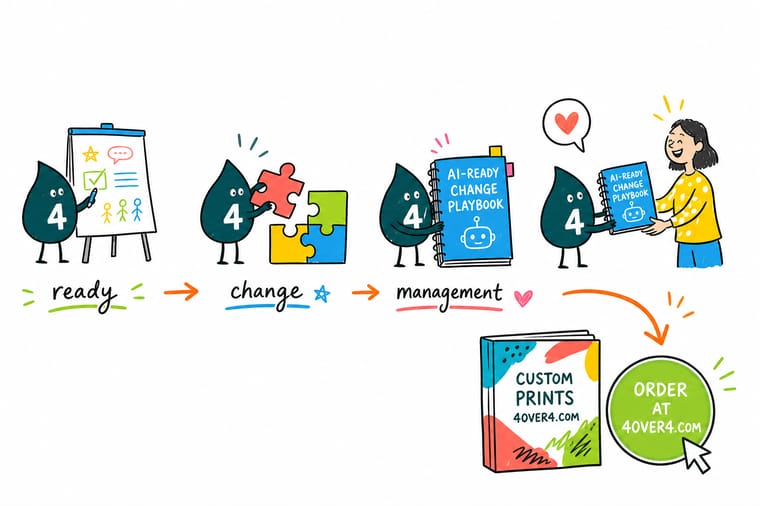
Wally has watched this go wrong the same way twice. Access first, rules later, and now the policy reads like a telling off. So he does it backwards on purpose: one job picked, four rules written on a single page, the page printed and pinned where the team actually sits. Then the pilot runs for a month against a number somebody wrote down beforehand. Then the pilot team teaches it, from their own work, including the week it got something wrong. Print the short, stable parts. Keep the long reference online.
Print your team playbook →Specs and pricing
Rollout materials, sizes, and starting prices
The three pieces most rollouts print: the training booklet, the wall rule card, and the desk task pad. Live configuration choices and starting prices come straight from the 4OVER4.COM configurator.



Print it
Equip the pilot team before launch week


Explore more
Where to go next





By the numbers
Rollout materials printed on schedule at 4OVER4
Common Questions
Your AI rollout questions, answered
What is an AI-ready change management playbook?
It is a written plan that decides, in order, what job you are changing, what rules apply to it, who pilots it, how people learn it, and how the new way becomes the default. The AI-ready part is what gets added to ordinary change management: a data handling rule, a human review step, a disclosure rule, and a review date, because the tool changes under you in a way that a new CRM does not. A playbook that names an owner and a measure for each phase is a plan. One that lists benefits is a memo.
Who should own an AI rollout?
One named person with budget authority, and a working group that includes the managers whose teams will actually change. Legal or compliance belongs in the guardrails phase, not at the end as an approval gate, because a rule discovered late forces a rewrite of everything after it. Avoid putting the rollout under whoever is most excited about the technology unless they also own the process being changed. Enthusiasm is not the same as accountability for the outcome.
How long should an AI pilot run?
Long enough to include a bad week. A month is the usual floor, because the first fortnight measures novelty rather than habit, and short pilots miss month end, holidays, and the day the system is down. Fix the scope before you start: one team, one task, one measure, and the date you will decide. Pilots without an end date do not end, they just stop being mentioned.
What should an AI use policy actually say?
Four things, in plain language. What may be entered into a model and what may never be, which outputs need a named human to check them before they leave the building, when the use of AI has to be disclosed to a client or a regulator, and who to ask when the answer is not obvious. Keep it to one page. A long policy gets skimmed once, and the parts people remember are the ones printed near where the work happens.
How do you handle staff who fear being replaced?
Answer the question directly rather than around it. If roles are changing, say which and by when. If nothing is being cut, say that and put a name behind it, because a vague reassurance from an unnamed source is read as a soft yes. In the training phase, have people who already use the tool show their own work, including a case where it got something wrong. That does more for trust than a slide about capability.
Is printed material worth it when everything is on the intranet?
It is worth it for the short, stable pieces that people need at the moment of doing the work. A one page rule card by the desk, a poster in the room where the team meets, and a training booklet handed out on day one get read because nobody has to search for them. The trade-off is real: print goes stale, so only commit the parts you expect to hold for a quarter or more, and keep the version and month on the artwork. Standard Booklets start at $240.55 and Standard Posters at $108.75 at 4OVER4.COM, so a pilot team can be equipped without a large commitment.
Get Started
10 short run folders cost $108.75, or $10.88 each
Print the training booklet, the wall rule card and the desk task pad together, with a version number on every piece so the stale copy is obvious.
Legal Disclaimer
Gold Standard guarantees apply to all standard orders placed through 4over4.com. Price match requires verifiable proof of a competitor's published price for an equivalent product with matching specifications and turnaround time. Satisfaction guarantee covers manufacturing defects and print quality issues. Contact support with order number and documentation. On-time delivery rate based on tracked orders 1999 to 2026. Individual results may vary based on shipping carrier performance.
