
Acrylic Board Explained From Thickness to Standoff Mounting


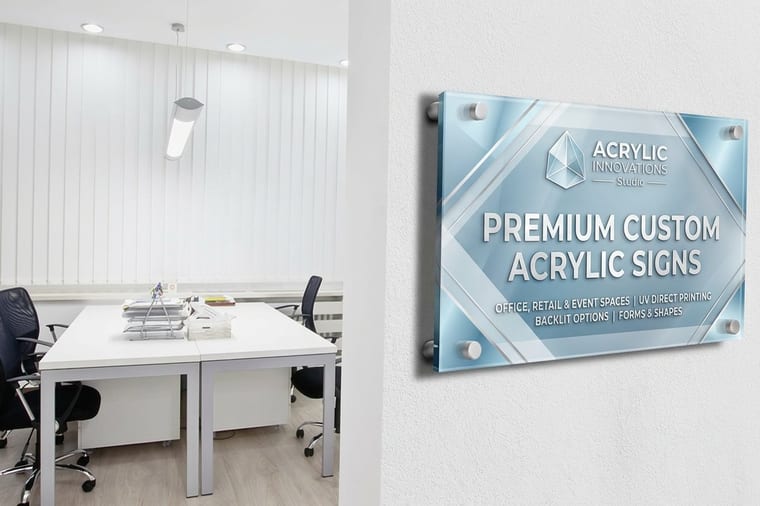
Acrylic board is the clear, rigid panel behind those glass-like lobby signs and floating wall prints. What sets one apart is the details: the thickness, whether the edges are polished, and the standoff hardware that lifts it off the wall.
Acrylic board is a clear, rigid plastic panel, printed for signs and wall art, defined by its thickness, edge finish, and mounting. Common thicknesses run 1/8, 1/4 and 3/8 inch, and a thicker panel holds its plane on a large sign. Polished edges give a glass-like clarity, and metal standoff hardware floats the panel off the wall for a modern look. It suits indoor lobbies and holds up outdoors when specified for it.
Start here
PMMA, polished and floated
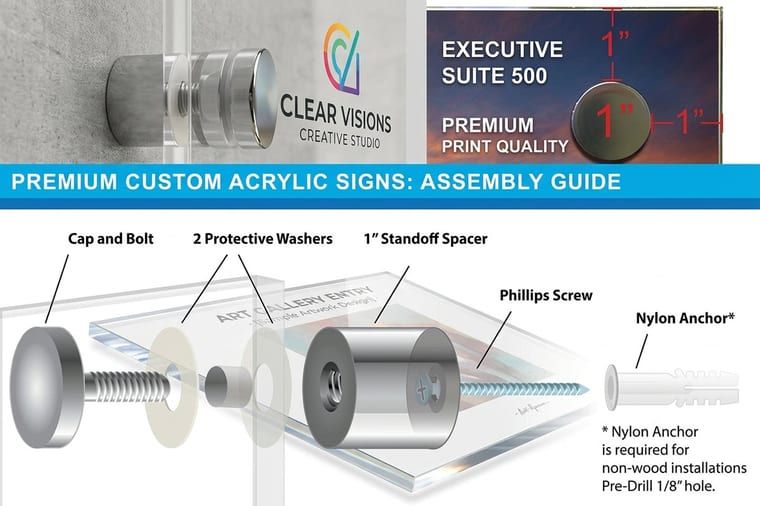
Acrylic board is a clear, rigid plastic sheet, the same family as plexiglass, printed to make signs and wall prints. The choices that define a piece are its thickness, whether the edges are polished to a glass-like clarity, and the standoff hardware that mounts it off the wall. The diagram below shows how a standoff floats the panel and where each spec sits.
What acrylic board is
Acrylic board is a rigid, transparent plastic sheet, technically a material called PMMA and often known by names like plexiglass. It is prized in signage and display because it looks like glass, with real clarity and depth, but weighs far less and does not shatter the way glass does. Printed and mounted well, an acrylic panel reads as a premium, modern piece.
There are two common ways to put an image on it. The design can be printed directly onto the acrylic with UV-cured inks, or a photo can be face-mounted behind the panel so you view it through the clear surface, which gives images a glossy, luminous depth. Either way the acrylic itself supplies the glass-like quality that makes the finish feel high-end.
That is why acrylic shows up as lobby signs, gallery-style wall art, and directional signage. Our acrylic signs and acrylic prints use exactly this material, and the wider acrylic collection shows the range from small signs to large statement pieces.
Thickness options and what they change
Thickness is the first spec that changes how an acrylic board feels and behaves. Common options are 1/8 inch, 1/4 inch, and 3/8 inch. A thinner 1/8 inch panel is light and economical, well suited to smaller signs. A 1/4 inch panel is the popular middle ground, rigid and substantial without being heavy, and it reads noticeably more premium. A 3/8 inch panel is thick, weighty, and ideal for large statement pieces that need to stay flat.
Thicker material buys two things: rigidity and perceived quality. A larger sign in a thin gauge can bow slightly, while a thicker panel holds its plane. And a chunky edge simply looks more expensive, especially when it is polished, because you see the depth of the material. The trade-off is weight and cost, both of which climb with thickness.
Choose the gauge to the size and the setting. A small counter or door sign is fine in a lighter panel, while a large lobby sign or a gallery print earns its keep in 1/4 inch or thicker. The live specs on the product page show which thicknesses are available for each acrylic product.
Edge polishing and clarity
When acrylic is cut, the raw edge comes out slightly frosted and matte. Edge polishing turns that cut edge clear and glossy, so it looks like the edge of a pane of glass. The two common methods are flame polishing, which passes a controlled flame along the edge to melt it clear, and diamond polishing, which machines the edge to a smooth optical finish. Polished edges are a big part of why a good acrylic piece looks so clean.
The effect matters most where the edge is visible, which on a floating panel is everywhere. Because standoffs lift the board off the wall, light passes through the polished edges and gives the whole piece a bright, glass-like glow. Leave the edge unpolished and it reads matte and unfinished by comparison, undercutting the glass-like finish you are paying for.
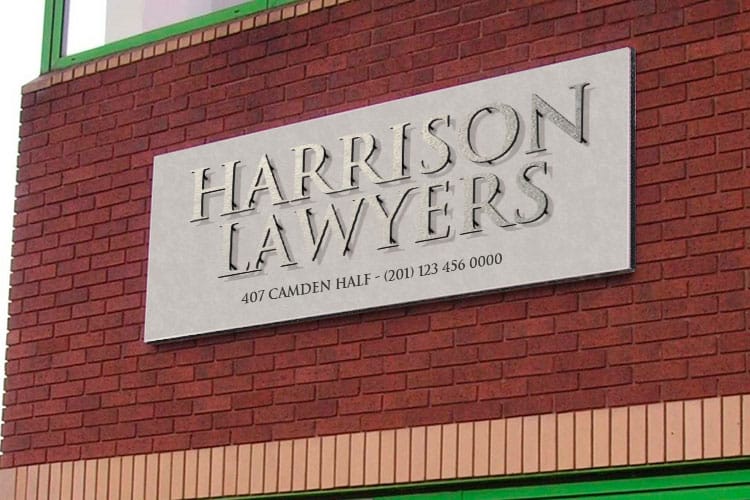
Match the edge finish to how the piece is displayed. A polished edge is worth it for anything mounted on standoffs or seen up close, like a lobby sign or a wall print. For a piece set into a frame or channel where the edge is hidden, polishing matters less. Our acrylic signs are built with this glass-like presentation in mind.
Standoff hardware and mounting

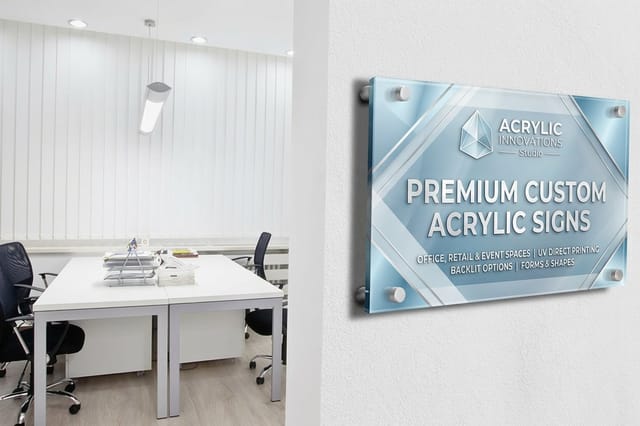
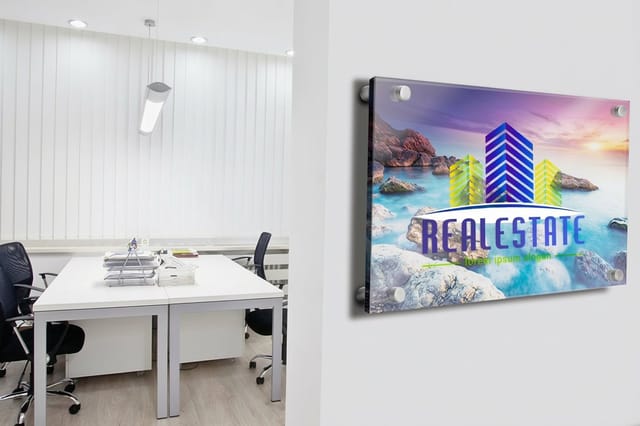
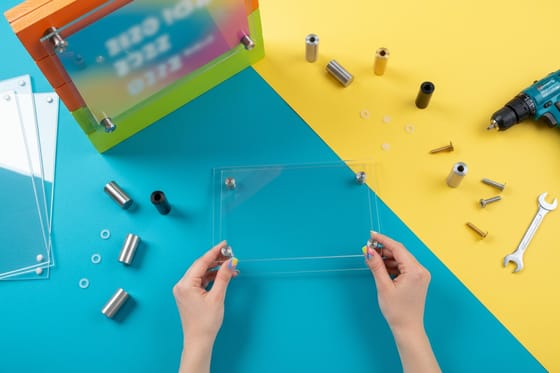
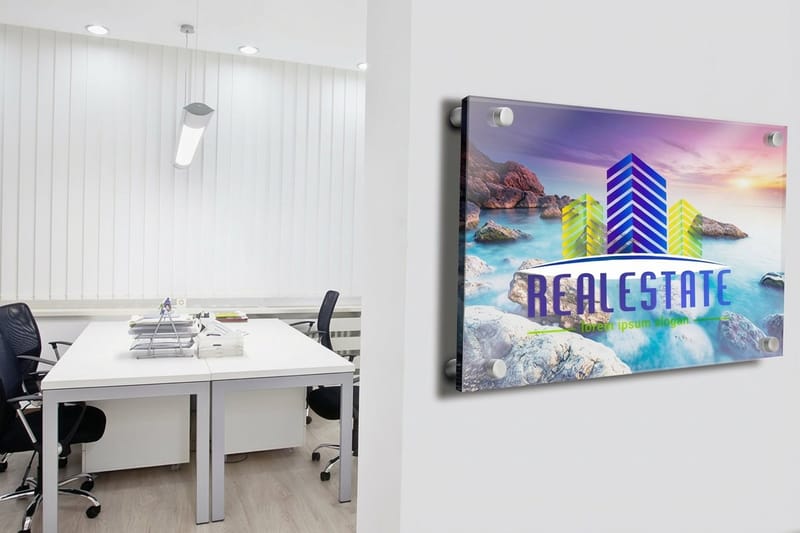
Standoffs are the metal hardware that give acrylic its signature floating look. Each standoff is a small barrel, usually brushed aluminum or stainless steel, that anchors to the wall and holds the panel out from the surface by roughly three quarters of an inch to an inch. The board is drilled at the corners, the barrels pass through, and a cap screws on to hold it in place, leaving a clean gap between the sign and the wall.
That gap does two things. It casts a subtle shadow that makes the piece look dimensional and intentional rather than flat against the wall, and it lets light wrap the polished edges for that glass-like glow. Standoffs come in different diameters and finishes, so the hardware itself becomes part of the look, from understated to a more prominent industrial accent.
For a deeper look at how the hardware works, our guide on standoff screws and standoff signage walks through the mechanics. When you order an acrylic sign, the mounting hardware is part of the spec, so the panel arrives ready to float off the wall.
Indoor versus outdoor use

Acrylic is a versatile material, but the setting shapes how you spec it. Indoors it is nearly ideal: it resists yellowing, holds color well, and its clarity shines under gallery and lobby lighting, which is why acrylic prints and interior signs are so popular. For most indoor jobs the main decisions are just thickness, edge finish, and standoffs.
Outdoors, acrylic can still perform, but the print and the mounting have to be chosen for it. UV-stable inks and a suitable panel resist sun and weather, while the mounting has to handle wind and temperature swings. Acrylic can scratch more easily than glass, so in high-traffic or exposed spots that is worth weighing against alternatives. Specified correctly, though, it delivers the same clean look outside that it does inside.
Decide the environment first, then let it drive the spec. For an interior lobby or gallery wall, lean into clarity with a thicker panel, polished edges, and standoffs. For an exposed exterior location, confirm the print and material are rated for it. Browse the acrylic collection and the broader acrylic prints range to match the piece to where it will live.
Wally floats the panel off the wall
Thickness, polished edges, standoff hardware
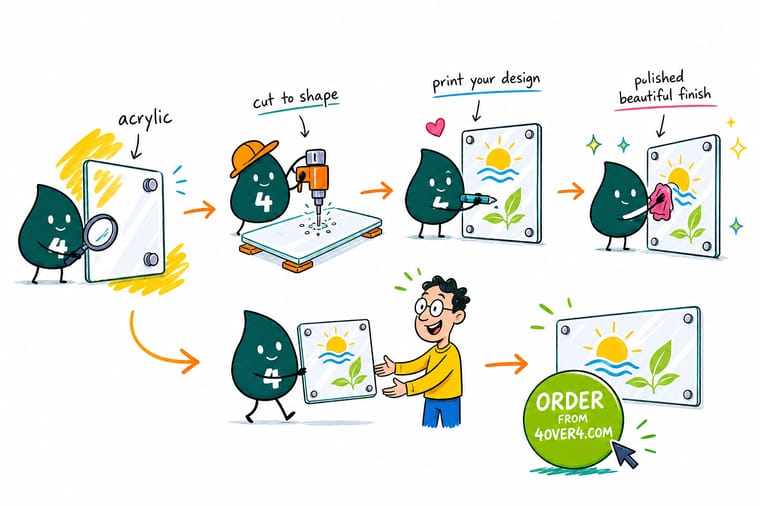
Wally spec's an acrylic board in three moves: pick the thickness, 1/4 inch for that premium rigid feel, polish the edges so they glow like glass, and mount it on metal standoffs that float it about an inch off the wall. Set the environment first, indoor or outdoor rated, and 4OVER4 prints and drills it ready to hang.
Order acrylic signs →Quick reference
Acrylic board specs at a glance
The choices that define an acrylic piece, and what each one changes about the look and the build.
| Spec | Options | What it changes |
|---|---|---|
| Material | PMMA sheet, cast or extruded | Cast cuts, drills and polishes cleaner; extruded costs less and thermoforms more easily. |
| Thickness | 1/8, 1/4, or 3/8 in | Thicker reads more premium and stays rigid at larger sizes. |
| Print method | Direct UV print or face-mount | Direct printing prints on the panel; face-mounting views a photo through it for depth. |
| Edge finish | Flame or diamond polished | Turns a frosted cut edge clear and glass-like, key on floating panels. |
| Mounting | Metal standoff barrels | Floats the panel off the wall for shadow and edge glow. |
| Standoff gap | About 3/4 to 1 in off the wall | Creates the dimensional floating look and lets light wrap the edges. |
| Setting | Indoor or outdoor rated | Outdoor use needs UV-stable print and weather-ready mounting. |
| Use | Lobby signs, wall prints, directional | The clarity and depth suit premium signage and gallery-style art. |
Material comparison
Acrylic vs glass vs polycarbonate
Acrylic board sits between the other two clear sheets: clearer than both, far lighter than glass, and harder to scratch than polycarbonate.
| Property | Acrylic, PMMA | Glass | Polycarbonate |
|---|---|---|---|
| Clarity | The clearest of the three, with no green cast in the edge | Very clear face on, but a thick edge goes green | Clear with a faint amber cast that deepens as the sheet thickens |
| Weight | Much lighter than glass at the same panel size, which is what lets a 3/8 inch panel hang on standoff barrels | The heaviest, so large panels need structural fixings rather than standoffs | Close to acrylic, light for how tough it is |
| Impact resistance | Does not shatter the way glass can; it cracks rather than showering shards | Breaks into sharp pieces unless tempered or laminated | The toughest by a wide margin, the default for machine guards and glazing that gets hit |
| Scratch resistance | Harder face than polycarbonate, and light scratches can be polished back out | The hardest surface, stays clear for years with normal cleaning | The softest, marks easily and cannot be flame polished |
| UV behaviour | Holds its clarity in sunlight and does not yellow, so it suits outdoor signs when the print is UV-stable | Unaffected by sunlight | Yellows outdoors unless the sheet carries a UV-resistant coating |
| Edges and fabrication | Flame or diamond polishes to a glass-like edge and drills cleanly for standoff barrels, cast sheet more cleanly than extruded | Needs a glass shop to cut, seam and drill, and every change of mind is a new panel | Cuts and drills easily but the edge stays dull, since it will not flame polish |
| Cost | More per sheet than plain glass, less than polycarbonate | The cheapest raw sheet, dearer once it is cut, seamed and tempered | The most expensive of the three |
For anything printed the answer is almost always acrylic: it takes UV-cured ink and face-mounting, polishes to a glass edge, and is light enough to float on standoffs. That is the same acrylic board behind our acrylic signs and acrylic prints. Choose polycarbonate instead when the panel will be struck, and glass only when the surface has to survive daily scrubbing.
Step by step
Spec an acrylic board in 6 steps
- Decide indoor or outdoor Set the environment first, since outdoor use requires UV-stable printing and weather-ready mounting, while indoor leans into clarity.
- Choose the sheet and thickness Ask for cast acrylic when the edges will show or the panel gets drilled for standoffs, since it machines and polishes cleaner than extruded, then pick 1/8 inch for small signs, 1/4 inch for a premium middle ground, or 3/8 inch for large statement pieces that must stay flat.
- Pick the print method Choose direct UV printing to print on the panel, or face-mounting to view a photo through the acrylic for glossy depth.
- Specify polished edges Add flame or diamond edge polishing for a glass-like clarity, especially important on panels mounted with standoffs.
- Select standoff hardware Choose the standoff diameter and finish to float the panel off the wall and set the look, from subtle to industrial.
- Order it ready to mount Confirm the specs and order the acrylic sign or print, which arrives drilled and ready with its mounting hardware.
Specs and pricing
Acrylic sign specs and live pricing
Once thickness, edge and mounting are set, size and quantity are what is left, and acrylic signs ship in 4 business days.
| Quantity | Price Per Unit | Total |
|---|---|---|
| 1 | $152.72 | $152.72 |
Order it
Order your acrylic signs and prints at 4OVER4

See it in use
Panels we cut, polished and drilled


Explore more
Where to go next
By the numbers
Acrylic cut and printed by a shop 25+ years in
Common Questions
Common questions about acrylic board
What is acrylic board?
Acrylic board is a clear, rigid plastic sheet, technically PMMA, polymethyl methacrylate, and commonly known as plexiglass, used to make signs and wall prints. It looks like glass, with real clarity and depth, but is much lighter and does not shatter the way glass can. It comes as two sheet types. Cast acrylic is poured and cured between glass moulds, so it routers, engraves, laser cuts and flame or diamond polishes cleanly, which makes it the sheet used for finished signage and floating panels. Extruded acrylic is melted and pushed through a die, so it costs less, holds a more consistent thickness and thermoforms easily, but it is softer and more likely to chip at a drilled hole. The same sheet does plenty of work with no printing on it at all, as window and door glazing, counter and machine guards, display cases, shelf risers and picture framing, which is why one material is sold under both names. For signage, designs are either printed directly onto the panel with UV-cured inks or face-mounted behind it so you view the image through the clear surface. Its glass-like quality is what makes acrylic signage and prints read as premium and modern.
What is acrylic board made of?
It is made of polymethyl methacrylate, PMMA, a transparent thermoplastic. The clarity is the plastic itself: there is no glass layer and no clear coating holding it up. Cast sheet is made by pouring the liquid between two glass plates and letting it cure, which gives a harder surface, cleaner cut edges and edges that flame or diamond polish to real clarity. Extruded sheet is melted and pushed through a die, which makes it cheaper and more even in thickness but softer, easier to scratch and more prone to chipping when drilled for standoff barrels. Either way the finished panel weighs far less than a glass panel of the same size and does not break into sharp shards, which is why it can hang off standoff hardware where glass would be too heavy.
Is acrylic the same as plexiglass?
Yes, in everyday use. Plexiglass started as a trade name and became the common word for the same PMMA sheet, so acrylic board, acrylic sheet and plexiglass all describe one material. What actually changes the panel you receive is the spec, not the word: cast or extruded, 1/8, 1/4 or 3/8 inch thickness, flame or diamond polished edges, whether it is drilled for standoff barrels, and whether the print is direct UV or face-mounted. Give a supplier those and you get the same panel whichever name is on the quote.
What thickness does my panel size need?
Start with the setting, indoor or outdoor, since outdoor use needs UV-stable printing and weather-ready mounting. Then pick a thickness: 1/8 inch for small signs, 1/4 inch for a premium and rigid middle ground, or 3/8 inch for large statement pieces. Ask for cast acrylic if the edges are on show, since it polishes clearer and drills without chipping. Add polished edges for a glass-like look, especially if the panel will be mounted on standoffs, and choose standoff hardware in a diameter and finish that fits the space. Each choice affects both the look and the cost.
What does acrylic board cost and how is it priced?
Acrylic price scales with size, thickness, edge finish, mounting hardware, and quantity. A larger or thicker panel uses more material and costs more, polished edges and standoff hardware add to the total, and larger runs lower the unit price. You set each option in the configurator and the total updates live as you adjust it, so you can see exactly how a thicker panel or polished edges change the number before you order.
What sizes, thicknesses, and finishes are available for acrylic?
Acrylic comes in a range of sizes from small counter and door signs up to large lobby signs and gallery prints, in common thicknesses of 1/8, 1/4, and 3/8 inch. Finishes include polished edges for a glass-like clarity and a choice of direct UV printing or face-mounting for the image, plus standoff hardware in different diameters and metal finishes. The live specs on each acrylic product page show the exact sizes, thicknesses, and mounting options available.
Can acrylic board be used outdoors?
Yes, acrylic can be used outdoors when it is specified for it. UV-stable inks and a suitable panel resist sun and weather, and the mounting has to be chosen to handle wind and temperature changes. Acrylic can scratch more easily than glass, so in very high-traffic or exposed locations that is worth weighing. Specified correctly, an outdoor acrylic sign delivers the same clean, glass-like look it does indoors, which is why it works for exterior signage as well as lobby and gallery pieces.
Get Started
Ready to hang a sign that looks like glass?
Pick your thickness, polish the edges, and choose standoff hardware that floats the panel off the wall. Acrylic signs ship in 4 business days at 4OVER4.
Legal Disclaimer
Gold Standard guarantees apply to all standard orders placed through 4over4.com. Price match requires verifiable proof of a competitor's published price for an equivalent product with matching specifications and turnaround time. Satisfaction guarantee covers manufacturing defects and print quality issues. Contact support with order number and documentation. On-time delivery rate based on tracked orders 1999 to 2026. Individual results may vary based on shipping carrier performance.
