
Who Invented Notebooks? The Real History From Wax Tablets to Spiral Coils


Emma is our prepress and print production voice, built from the knowledge of our production team, with over 20 years in printing.
Nobody invented the notebook. It arrived in four steps spread over about two thousand years, each fixing a problem the step before it could not: the Roman wax tablet made a writing surface reusable, the codex stacked folded sheets so a single page could be found, sewn binding held the block together for decades, and cheap paper finally made it acceptable to fill a page with a mistake. The names people attach to it, including the 1888 date that circulates online, belong to individual improvements rather than to the invention. Three of those steps are still on an order form: the 1930s coil is a ready-made deluxe spiral notebook, the glued edge of the 1888 Holyoke pad is a printed notepad of 50 or 100 sheets, and the codex block with a spine you can label is a perfect bound book. To borrow from the history when you print your own, pick coil if people write at a desk, set college ruling at 7.1 mm for dense notes, and print a dated first page the way Darwin dated his entries.
The notebook timeline at a glance
| When | What appeared | The problem it solved | What it became |
|---|---|---|---|
| Roman era | Wax tablet (tabula cerata) | Reusable. Smooth the wax with the flat end of the stylus and the page is blank again. | Nothing, and that is the point. Permanence is what paper added. |
| c. 100 to 400 CE | The codex replaces the scroll | Random access. You can open a codex at page 40 without unrolling 39 pages of it first. | Every bound book and booklet we print |
| c. 300 CE onward | Coptic chain stitch | The book lies flat, because nothing rigid or glued crosses the spine. | Saddle stitch and sewn sections |
| 1490s | Leonardo’s paper notebooks | Paper made a working notebook cheap enough to fill with mistakes. | Sketchbooks and journals |
| 1888 | Paper offcuts bound into pads in Holyoke, Massachusetts | Waste became a product, and the tear-off sheet was born. | Printed notepads, from $93.37 a run |
| 1930s onward | Coil and twin loop wire binding | The cover turns a full 360 degrees, so the book takes up half a desk instead of a whole one. | Deluxe spiral notebooks, from $5.00 |
Read the right hand column as a shopping list, because the later steps are still bindings you can order. The 1930s coil is the deluxe spiral notebook in 4.25" x 5.5" or 5" x 7", and the spiral coil book stretches it to 40 to 300 inside pages at sizes up to 8.5" x 11". The 1888 glued edge lives on in notepads of 50 or 100 sheets, and perfect binding takes the same 40 to 300 pages with a printable spine. You pick between them the same way an eighth century binder did: how flat does it need to open, and how long does it need to last. Start at notebook printing to see the current options side by side.
Where notebooks began in the ancient world
The oldest thing that behaves like a notebook is the Roman wax tablet: a shallow wooden frame filled with a thin layer of beeswax, written on with the pointed end of a stylus and wiped clean with the flat end. Schoolchildren used them, merchants kept accounts on them, and two or more could be hinged together into a set, which is roughly a notebook with two pages. What it could not do was keep anything. Every tablet was a draft.
Permanence arrived with the codex. Instead of one long rolled sheet, scribes folded sheets, stacked the folds, and sewed through them at one edge. By about the fourth century CE the codex had pushed the scroll aside across the Roman world, and the reason was practical rather than aesthetic: you can open a codex straight to page 40, write on both sides of every leaf, and hold it in one hand. Anyone who has ever flipped back three pages to check a measurement has used the feature that killed the scroll.
Both halves of the notebook were now in place, a surface you could carry and a structure that kept the pages in order. Everything after this point is a refinement of the binding and the paper, which is exactly the ground our paper binding methods guide covers for anything we print today.
Why the scroll lost
A scroll is a serial device. To read the end you have to move everything before it, and to write a note against a passage you have to find that passage the same way. The codex made a page addressable. That single change is what allowed indexes, page numbers, marginal notes and eventually the habit of dating an entry, which is what turns a bound stack of paper into a record.
It also changed the economics. A codex uses both sides of the sheet, so the same quantity of parchment holds roughly twice as much text. Printers still think in exactly this way. Page count on a booklet moves in multiples of four because of how sheets fold, and that folding logic has not changed since the codex.
The first notebook patent, and why it does not exist
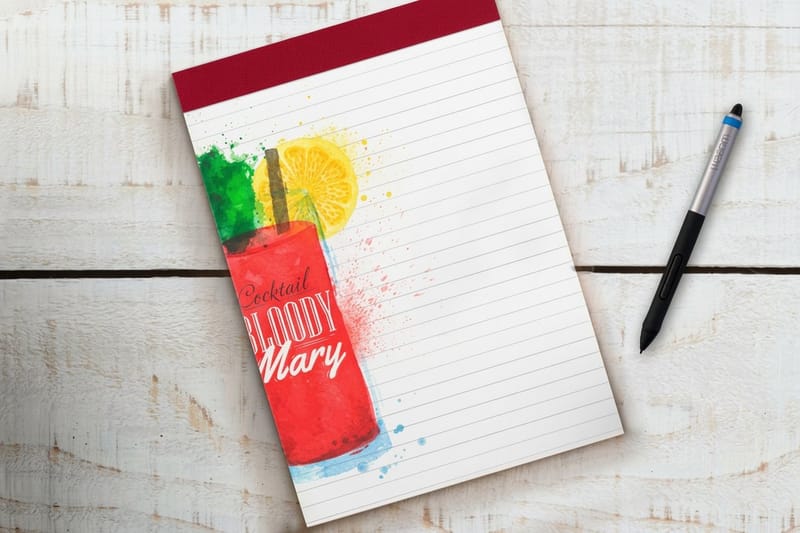
You will see it repeated that the first notebook patent was filed in 1888. It is a garbled version of a real story, and the real one is better. In 1888 a young paper mill worker in Holyoke, Massachusetts, took the offcuts that the mill was throwing away, squared them up, glued one edge, and sold them as cheap writing pads. The invention was not the notebook. It was making a product out of waste, and along with it the tear-off sheet.
There is no first notebook patent because a notebook is a format, not a mechanism. Patents attach to mechanisms, which is why the notebook patent record is full of binding hardware, coil formers, index tabs and cover hinges rather than the notebook itself. The ruled margin line on a legal pad came later still, added around the turn of the century so a judge had somewhere to write.
That distinction matters if you are sourcing one. What you actually choose is a binding, a paper weight and a cover, and each of those has a real cost consequence. Our notepad versus notebook comparison covers it briefly, and printed notepads start at $93.37 for a run if the tear-off sheet is what you are after.
What people actually mean by inventor
The names that get attached to the notebook usually belong to people who commercialised a format rather than invented one. Lewis Edson Waterman, who turns up in most of these lists, patented a fountain pen feed in 1884. He solved the ink, not the paper. Confusing the two is how the 1888 date ended up on the wrong man.
If you want a single moment to point at, point at cheap paper. Once a sheet cost little enough to waste, the notebook stopped being a ledger for finished thoughts and became a place for unfinished ones. Nothing in the object changed. The price did.
How binding evolved, from Coptic stitch to coil
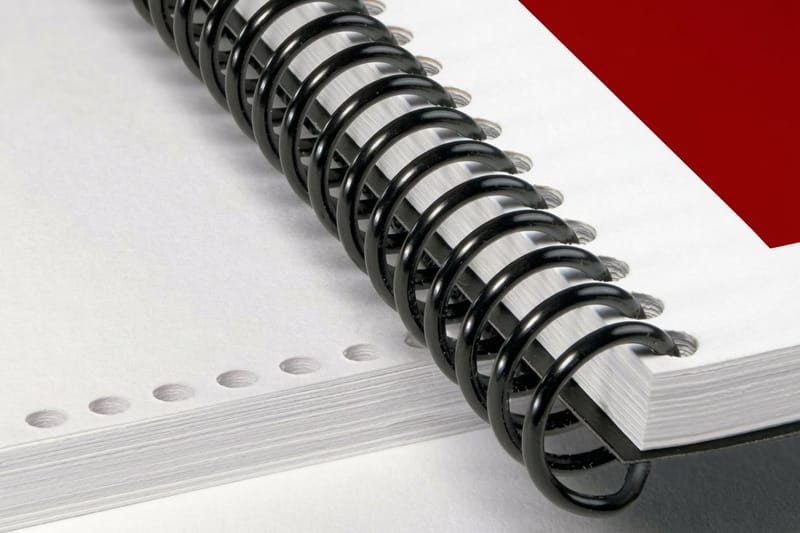
Binding is the part of a notebook you notice only when it fails. Every method is a trade between how flat the book opens, how long the spine survives, and how much it costs, and no method wins all three.
Coptic binding, from Egypt, sews the folded sections to each other with an exposed chain stitch and puts no glue on the spine. Because nothing rigid crosses the spine, the book opens completely flat, which is why bookbinders still use the stitch on sketchbooks fifteen centuries later. It is slow work, so it stayed a craft method rather than a factory one.
Coil binding, which reached schools and offices from the 1930s onward, achieved the same flatness by a different route: punch the whole block, thread a plastic or wire coil through it, and the cover turns a full 360 degrees behind the pages. That is the real advantage of a deluxe spiral notebook on a crowded desk, and it is worth the trade. A coil bent in a bag stays bent, and a coil-bound book has no printable spine. You can watch the cover fold all the way back in the deluxe spiral notebook video.
Perfect binding went the other way. Mill the folds off, glue the block into a wrapped cover, and you get a flat printable spine and a cleaner shelf presence at the cost of the book never lying open on its own. That is the right choice for a perfect bound book or a catalog and the wrong one for anything someone has to write in. The full binding comparison lays out the page counts each method can carry.
Softcover, and what changed after the war
Softcover notebooks became ordinary once cheap board and machine binding met a mass market for stationery. A softcover weighs less, costs less and takes a fold in a coat pocket, which is exactly what a hardcover refuses to do. What you give up is corner protection and a cover that stays square after a month in a bag.
If the notebook is going to be carried daily, a heavier cover board earns its cost back. If it is going to sit on a desk or be handed out at an event, it does not. Our softcover notebook guide sets out where each one makes sense, and wire-o binding sits between the two.
Ruling is a specification, not a style
Wide ruled paper spaces its lines 8.7 mm apart. College ruled tightens to 7.1 mm. On a 70 sheet notebook that difference is worth several pages of writing, which is why students switch to college ruled and why anyone printing a custom notebook should decide the ruling before the page count.
Dot grid is the modern third option. It gives you alignment without printed lines fighting your drawings, and it photographs cleanly, which matters if the notebook is going to appear in your own marketing shots.
Notebooks in art and science
Leonardo da Vinci left thousands of notebook pages, and the most famous of them is the Codex Leicester: 18 sheets of paper folded into 72 pages of notes and diagrams on water, rock and the moon. It sold at Christie’s in 1994 for $30.8 million, which makes it the most expensive notebook anyone has bought. What is striking about the pages is not the price. It is that they are working documents, full of crossings out and second attempts.
Charles Darwin’s notebooks did the same job. Notebook B, started in 1837, carries the branching sketch above the words "I think", which is the first drawing of an evolutionary tree. Two of the notebooks, including that one, disappeared from Cambridge University Library and were unaccounted for over roughly two decades, until they were returned anonymously in March 2022 in a pink gift bag left in a public part of the library.
The lesson for anyone choosing a notebook is small and practical. Both men used ordinary paper, kept the entries dated, and never treated a page as too precious to ruin. A notebook that is too nice to write badly in stops being a notebook. That is a genuine argument for the cheaper end of the range when the book is for thinking, and for a leather journal when it is for keeping.
Mirror writing, and other things people get wrong
Leonardo wrote most of his notes right to left in mirror script. The popular explanation is secrecy, but he was left handed and writing right to left avoids dragging the hand through wet ink, and his notes were not written in a cipher anyone had to break. Plenty of his contemporaries read them.
The practical descendant of that habit is still with us. Left handed writers pay a real penalty on a coil bound notebook, because the coil sits under the writing hand on the right hand page. If you are printing notebooks for a team, that is a reason to consider a sewn or perfect bound block instead.
Why notebooks still matter for memory and focus
The case for paper is narrow, and it holds because it is narrow. A laptop is faster at capture, searchable afterwards, and impossible to lose in a taxi. A 4.25" x 5.5" or 5" x 7" coil notebook fits beside that laptop on a meeting table without a second screen. What handwriting has over it is that it is slower, which forces you to compress a sentence instead of transcribing it. A 2014 study by Pam Mueller and Daniel Oppenheimer found that students taking notes by hand answered conceptual questions about a lecture better than students typing on laptops, and the explanation the authors gave was exactly that: typists captured more words and understood less.
The second thing paper does is stay open. A notebook on a desk has no notifications behind it and no other tab. That is not a claim about neurology, it is a claim about the object, and it is why a coil bound book that lies flat next to a keyboard gets used during a meeting while a glued one gets closed.
Where paper loses, it loses badly. You cannot search it, you cannot back it up, and two of Darwin’s notebooks sat missing for two decades to prove the point. Most people who write by hand end up with a hybrid: capture on paper, then photograph or retype the four lines that mattered. If you want the practical version of that habit, our piece on organising a work notebook sets out an indexing system that makes an old book findable.
Notebook printing and specs at 4OVER4.COM
A deluxe spiral notebook costs $5.00 a book whether you order one or ten, which makes it the cheap way to test a ruling before a bigger run. Bound books work the other way and drop hard with quantity: a perfect bound book comes to about $37.51 a copy at 10 and about $7.67 at 500, and a spiral coil book about $42.33 at 10 and about $10.89 at 500. A leather journal at $10.00 covers the single copy someone keeps. Leonardo’s 72 page Codex Leicester fetched $30.8 million; a 72 page coil book of your own prints from the same configurator as the table below.
Quantity and price
Deluxe spiral notebook pricing and specs
Live configurator numbers on our coil bound notebook, priced per book from one copy to ten.
| Quantity | Price Per Unit | Total |
|---|---|---|
| 1 | $5.00 | $5.00 |
| 2 | $5.00 | $10.00 |
| 3 | $5.00 | $15.00 |
| 4 | $5.00 | $20.00 |
| 5 | $5.00 | $25.00 |
| 6 | $5.00 | $30.00 |
For larger bound work the economics change. A spiral coil book starts at $423.28 for a run and a perfect bound book at $375.05, because both carry a real page block rather than a cover and a pad. If you are ordering in volume, the quantity breaks in our bulk notebook printing guide are worth reading before you set the quantity, and you can earn coins on the order to offset the next one.
How a custom notebook makes your brand memorable
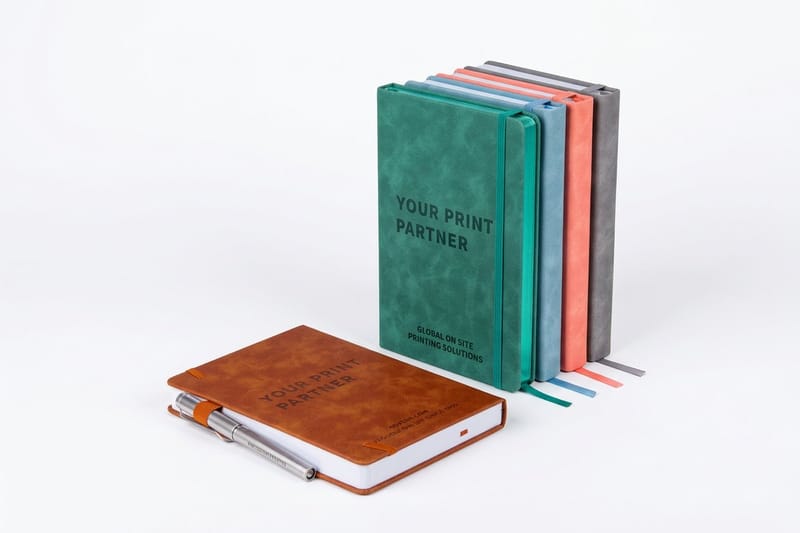
A notebook is one of the few branded objects that people keep on purpose. A pen gets lost, a tote gets used for the gym, but a half filled notebook has the owner’s own handwriting in it, and that is why it survives desk clearouts that kill everything else you printed. The logo on the cover is the least interesting part of that. What earns the keeping is the interior, and the interior is a spec you choose. On a spiral coil book, 70# uncoated text takes a ballpoint or a pencil better than 100# gloss text, and a 5.5" x 8.5" page leaves the first spread room for an agenda. A ready-made leather journal comes at 5.75" x 8.25" in blue, green, gray, mocha or pink, so the cover color can match the brand with no logo on it.
Print it
Embossed notebooks
A blind deboss reads as quality on the shelf without any printed ink on the cover at all.
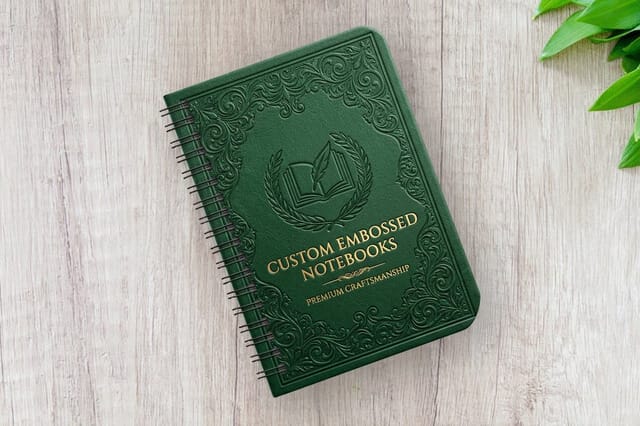
Print something useful on the first spread. A dated contents grid, a conference agenda, a set of sizing charts your customers actually need, or a single page of house style rules for a new hire. A book that answers a question on page one gets opened; a book that starts with a blank page gets shelved. Then decide the cover treatment, because an embossed or debossed cover carries a brand mark without ink and survives handling better than a printed one, which is the whole argument in our notebook customisation guide.
Who a custom notebook suits
- Conferences and events. A branded notebook outlives the lanyard by years. Print it with the agenda inside the first spread so it is useful during the event and not just after it.
- Onboarding and training. A coil bound book lies flat next to a laptop, which is the whole reason people write in it during a session instead of taking it home unopened.
- Client gifts. A leather journal reads as a gift rather than a giveaway. It is the one place where a heavier cover clearly earns its cost.
- Schools and universities. Ruling is the decision that matters. College ruled at 7.1 mm holds more per page, so the same paper cost carries more writing.
- Retail and stationery brands. Embossed covers give the shelf a reason to pick the book up, and the deboss reads as quality without any printed ink at all.
Blanks with the spine allowance already set
If you are not starting from a blank artboard, a template removes the two mistakes that cost a reprint: a spine allowance that does not match the binding, and an interior page count that is not a multiple of four. 4OVER4.COM draws each blank at the product's exact size with bleed and trim marked: 4.25" x 5.5" and 5" x 7" for the deluxe spiral notebook, and 5.5" x 8.5", 6" x 6", 6" x 9" or 8.5" x 11" for the spiral coil and perfect bound books. A perfect bound spine widens with every page you add between 40 and 300, so match the cover template to your final page count. Pull one from the blank template library before you start the cover.
Start fast
Blanks with the spine allowance already set
Notebook design templates and exact size blanks so your cover art lands inside the cut line.
Wally traces the notebook back to its four inventions
Reuse, then order, then a spine, then cheap paper
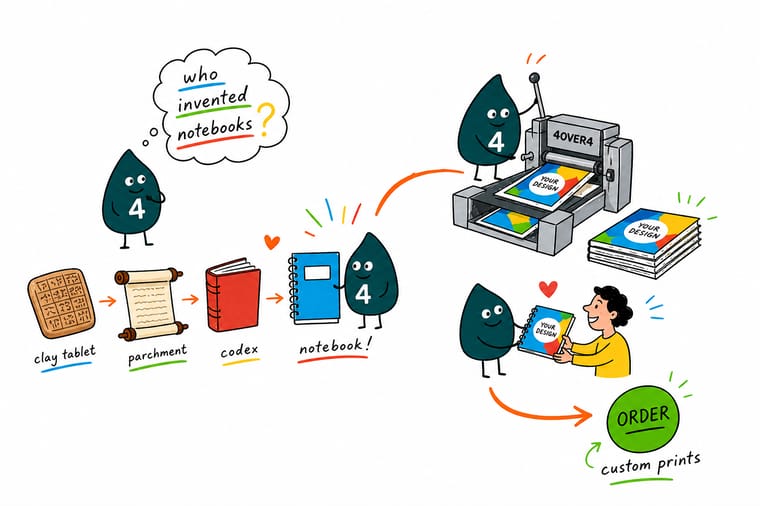
The wax tablet made writing reusable, the codex made a page findable, the sewn spine made the block last, and cheap paper made it fine to waste a sheet. Every modern choice is a version of one of those: coil and Coptic stitch open flat, perfect binding gives you a printable spine, and page counts still move in multiples of four because a sheet folds into four pages.
Print your own notebook →What the binding history still decides
Print decisions that follow from the history
- Decide the binding before the artwork. Coil, wire-o, saddle stitch and perfect binding each take a different spine allowance and a different page count rule. Redesigning a cover after the binding changes is a full rework.
- Keep type off the gutter. On a perfect bound block the inner margin disappears into the glue. Pull anything you want read at least a quarter inch further in than feels necessary.
- Page counts move in fours. A folded sheet makes four pages. Plan the interior to a multiple of four or the printer plans it for you, with blanks.
- Print the first spread, not just the cover. A dated first page, a contents grid or a short agenda gets the book opened. An empty first page gets it shelved.
- Test the ruling on real paper. Line spacing that looks fine on screen can read cramped in hand. Print one sheet at final size and write a paragraph on it before you commit the run.
Explore more
Notebooks, binding and the guides behind them
Perfect bound books run 10 for $375.05 and spiral coil books 10 for $423.28, both in 5 business days.
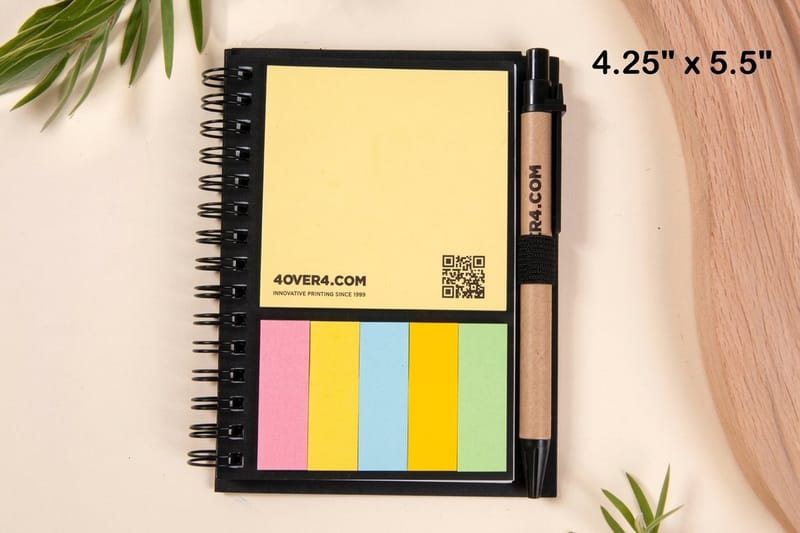 Product Deluxe Spiral Notebook Coil bound, opens a full 360 degrees, from $5.00. Product Leather Journals The book you keep rather than the one you fill, from $10.00.
 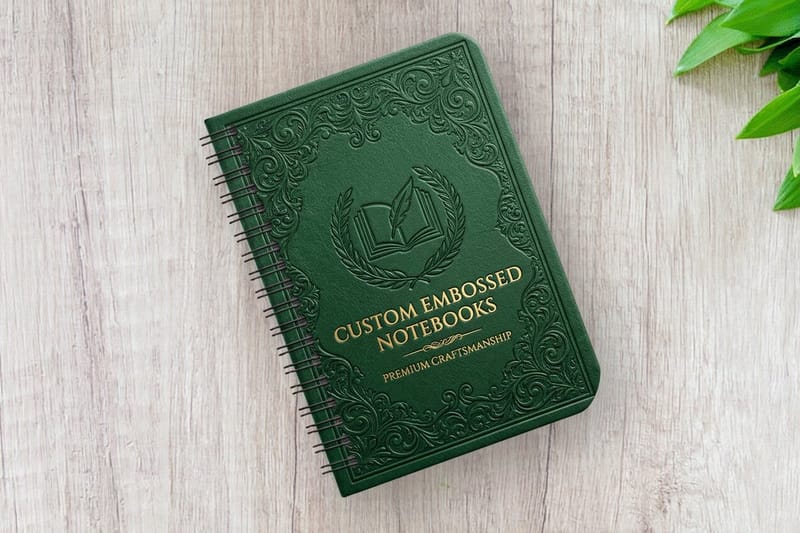 Product Embossed Notebooks A cover that reads as quality with no printed ink at all.
 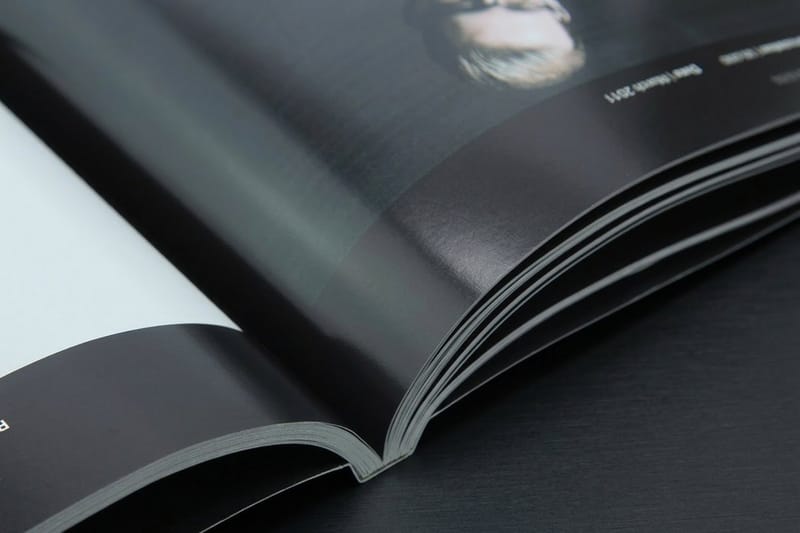 Product Perfect Bound Book Milled and glued into a wrapped cover with a printable spine. Category Notebook Printing Every binding, cover and ruling we produce, in one place. Guide Binding Types Explained What each binding costs you and what it gives back.
  Guide Design a Branded Notebook Cover, spread and spine decisions in the right order. Article Custom Printed Notebooks What a personalised run actually involves. Article Kraft Paper Journals Uncoated kraft covers and how ink behaves on them.
 Ready to print a notebook of your own?
Pick the binding, the ruling and the cover, drop in your artwork or a free blank, and 4OVER4.COM prints it on stock that survives being carried.
Common questions about notebook history
Who invented the notebook?
No one person did. The notebook is the sum of four separate inventions arriving over about two thousand years: the Roman wax tablet, which made a writing surface reusable; the codex, which stacked folded sheets and sewed them at one edge so a page could be found directly; the sewn or stitched binding, which held the block together for decades; and cheap paper, which made it acceptable to fill a page with a mistake. Names get attached to individual improvements, such as the person who bound mill offcuts into pads in 1888, but none of them invented the object.
Was there a first notebook patent?
Not in any meaningful sense, because a notebook is a format rather than a mechanism and patents attach to mechanisms. What the record actually contains is binding hardware: coil formers, wire loop machines, index tab systems, cover hinges and page perforation methods. The frequently repeated claim about a first notebook patent in 1888 is a distorted retelling of the Holyoke story, in which a paper mill worker glued the mill’s waste offcuts into writing pads and created a product rather than a patent.
When did spiral notebooks appear?
Coil bound notebooks spread through schools and offices from the 1930s onward, once machines could punch a full block and thread a coil through it at speed. The appeal was mechanical rather than decorative: a coil lets the cover rotate a full 360 degrees behind the pages, so the book occupies half a desk when open. The trade is real. A coil crushed in a bag stays crushed, there is no printable spine, and a left handed writer has the coil under their hand on every right hand page.
Why do some notebooks lie flat and others refuse to?
It depends on whether anything rigid crosses the spine. Coptic stitching sews the sections to one another with no glue on the spine, and coil binding replaces the spine with a rotating coil, so both open completely flat. Perfect binding mills the folds off and glues the block into a wrapped cover, which produces a flat printable spine and a book that closes itself when you let go. Saddle stitching sits in between and works only up to modest page counts. Pick flatness for anything people write in, and a printable spine for anything that has to be found on a shelf.
What does a custom printed notebook cost?
At 4OVER4.COM a deluxe spiral notebook starts at $5.00 and a leather journal at $10.00, while larger bound runs such as a perfect bound book start at $375.05 and a spiral coil book at $423.28. The variables that move the price are the binding, the cover stock, the interior page count and the quantity, in that order. Order a small first run, write in it for a week, then reorder at volume once the ruling and the page count have survived contact with real use.
