
Banners, Yard Signs and A-Frames Compared for Grand Opening Day


One of these three reaches the road, one gives directions, and one closes the sale on the sidewalk. Each format has a cost, a reading distance, and a point where it fails.
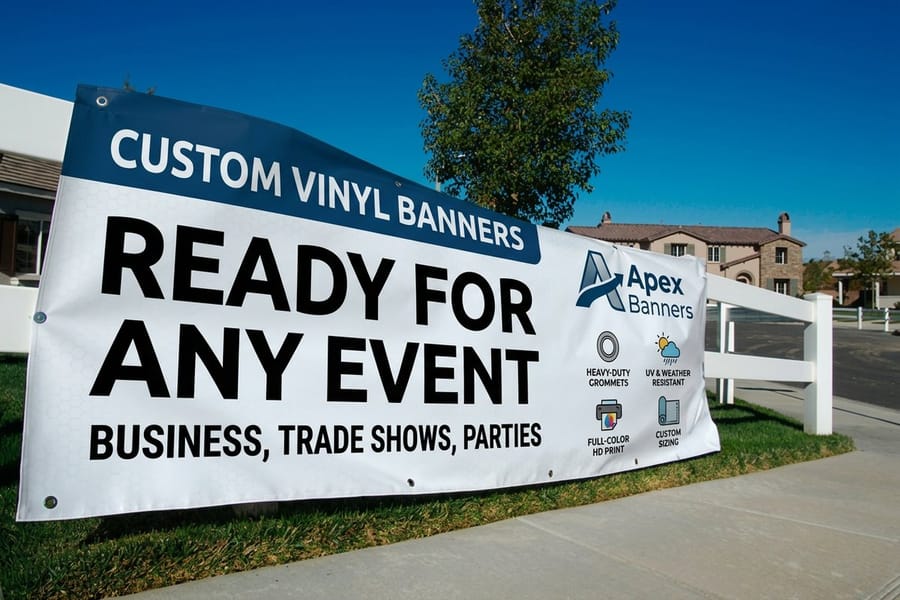
Buy the banner first. It is the only one of the three big enough to be read from a moving car, and a 3 by 8 foot vinyl banner starts at $79. Add an A-frame at the door from $146.07 to carry the offer to people already on the sidewalk, and put yard signs at $25 each only where an unmarked turn genuinely loses people. The sizing rule for all three is the same: cap height in inches equals viewing distance in feet divided by ten.
Quick answer
Distance picks the format, and the format picks the copy
A banner is read at about 100 feet, a yard sign at about 30, an A-frame at about 12. That single fact decides everything else: how many words fit, how big the type has to be, and which sign is doing which job on opening day. Buy the banner for reach, the A-frame for the offer, and yard signs only where people get lost. Then check every headline against the ten to one rule before you approve the proof.
Three Formats, Three Different Jobs
Most grand opening signage goes wrong for one reason: the owner buys three versions of the same message instead of three signs doing three different things. Sort them by how far away the reader is and the plan writes itself.
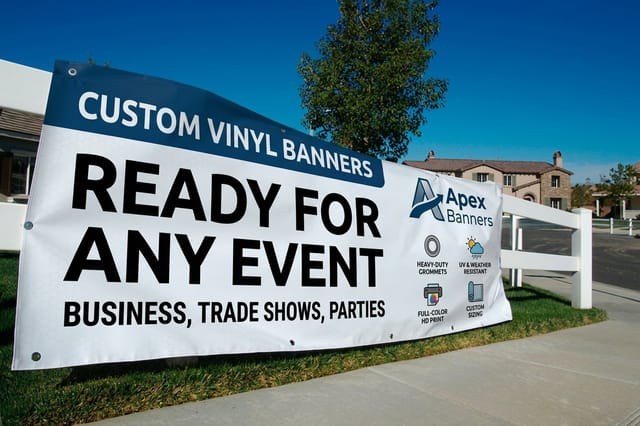
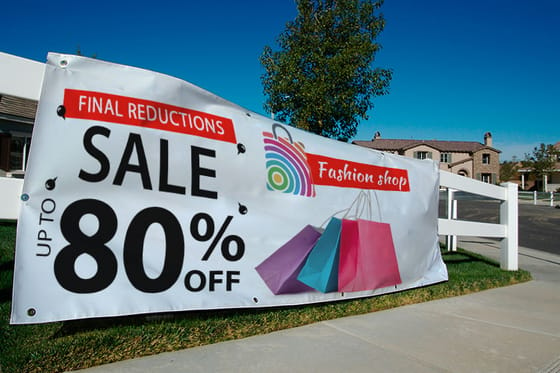
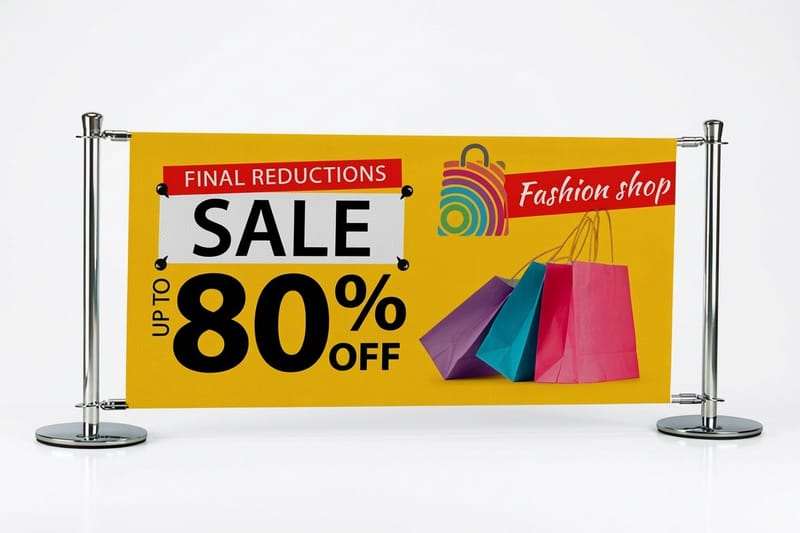
The banner announces. It goes on the building, above or beside the entrance, and it is read by people who are not looking for you. A 3 by 8 foot vinyl banner on 13 ounce scrim vinyl gives you enough height for roughly 10 inch capitals, which is the size a driver at 100 feet can actually resolve. Banners start at $79.
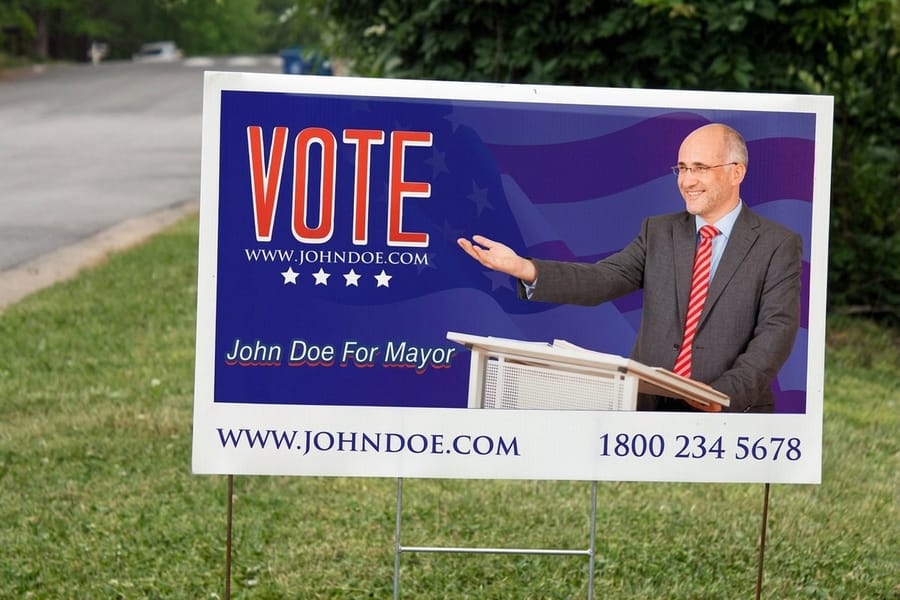
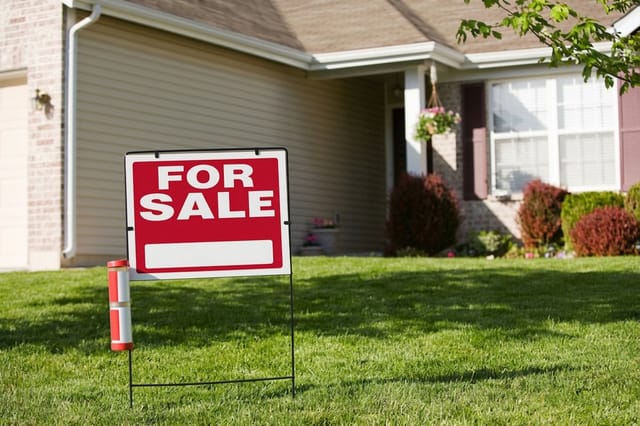
The yard sign directs. An 18 by 24 inch panel is read at about 30 feet by someone doing 25 miles an hour, so it holds three words and an arrow. That is a feature, not a limit. Yard signs start at $25 and belong at the turn people miss, not lined up along the storefront where the banner already did the work.
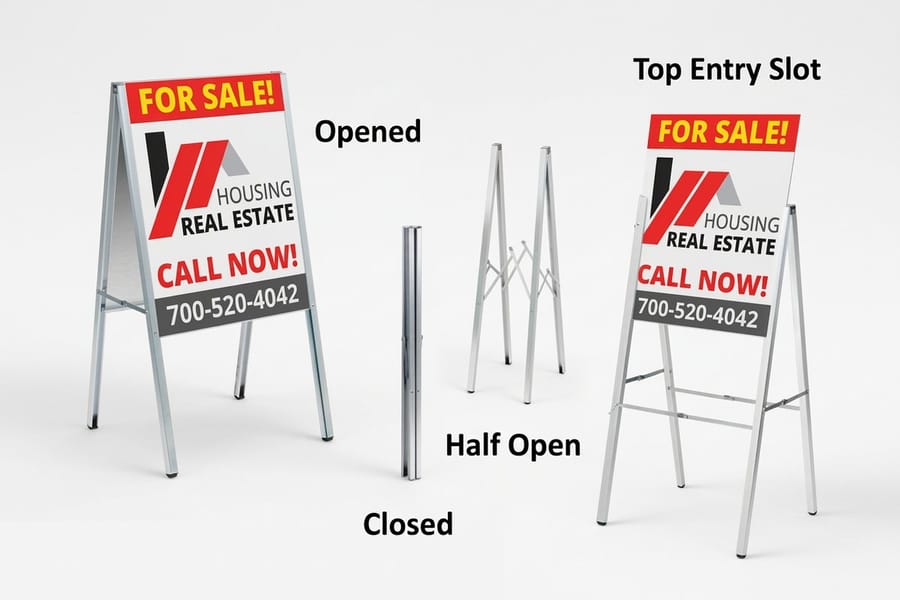
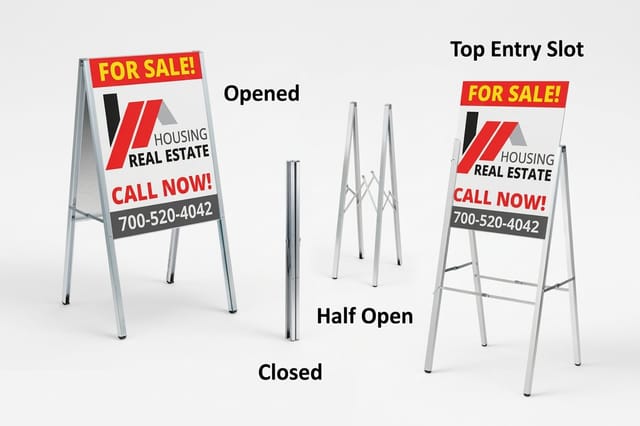
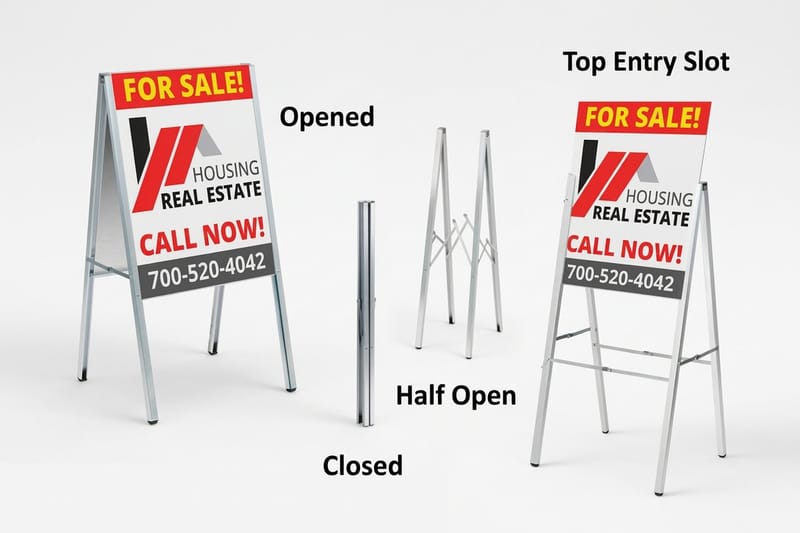
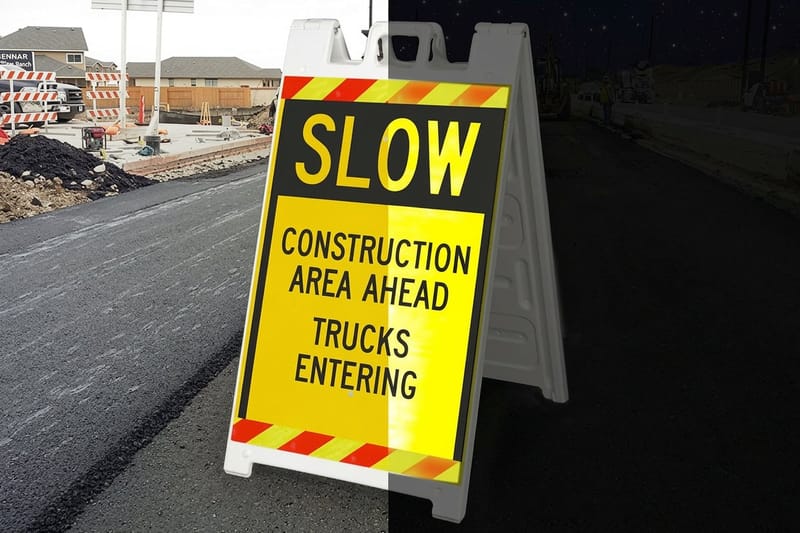
The A-frame converts. It stands on the sidewalk inside 12 feet of a walker, which is close enough for 1.5 inch type, an offer, the hours and an arrow to the door. Aluminum A-frames start at $146.07 and hold a 24 by 36 inch double sided panel you swap out later.
The rule underneath all three is the same one sign shops use for storefront lettering: cap height in inches is roughly viewing distance in feet divided by ten. Run your headline through that before you approve a proof and half the arguments about layout disappear.
Banner vs Yard Sign vs A-Frame, Side by Side
They separate once you stop counting price per piece and start counting the job each one does on opening day.
| Format | Starting price | Read from | Copy it holds | Wind behavior | Life after opening |
|---|---|---|---|---|---|
| Vinyl banner | $79 | Roughly 100 ft, from a car | Name, three to five words, logo | Balloons on a flat wall unless you use mesh or leave an air gap | Low. The word Opening dates it |
| Yard sign | $25 | Roughly 30 ft, at 25 mph | Three words and an arrow | Fine on an H-stake in firm ground, folds in soft soil | High. Store them and reuse for events |
| Aluminum A-frame | $146.07 | Roughly 12 ft, on foot | Offer, hours, arrow, a short list | Light frame. Needs 20 to 30 lb of ballast on an open corner | Highest. New panels make it a daily board |
| Feather flag | $108.75 | Peripheral vision, moving | Logo and one word | Designed to flex. That is the point | High, if the flag carries no date |
Read the fourth column before the second. A banner that says three lines of features at 100 feet is a blank rectangle, and an A-frame with two words on it is wasted surface. The formats are not interchangeable at any price, which is why swapping one for another to save money usually costs you the message instead.
If your storefront is set back from the road or hidden behind a shared lot, add a curb presence rather than a bigger banner. Two feather flags at the driveway do more for a hidden entrance than another 4 feet of vinyl on a wall nobody can see.
Wind, Mounting and the Failures Nobody Warns You About
Every grand opening signage disaster we hear about is a mounting problem, not a printing problem. Three of them account for almost all of it.
- The ballooning banner. A solid vinyl banner flat against a wall has nowhere for air to go, so it inflates like a sail and pulls at the grommets until one tears. Cutting slits in the vinyl is the folk fix and it does not work well, because the slits stay open and fray. Mesh banners start at $75 and are perforated so the air passes straight through, which is why fence and wall installations in exposed spots use them.
- The folded yard sign. Corrugated plastic has flutes running one direction, and the wire H-stake only stiffens the panel when those flutes run vertically so the legs slide up inside them. Get that wrong and the sign hinges in the first gust. Soft ground after rain is the other half of the problem: push the stake in fully, and on turf use two stakes on anything wider than 24 inches.
- The traveling A-frame. An aluminum frame is light on purpose so staff can carry it in at close. On an open corner that lightness turns it into a projectile. Hang a 20 to 30 pound weight bag over the bottom rail, or use a plastic frame with a water fillable base and accept the extra weight instead.
Order banners with hemmed edges and grommets every 2 to 3 feet, and bring the banner in overnight if a storm is forecast. Our sidewalk signage guide covers the panel sizes and placement rules for frames in more detail, and the blank template library has correctly sized layouts so nothing important sits in the hem allowance.
The Verdict and What to Actually Buy
Buy the banner first. If the budget only stretches to one sign, it is the banner every time, because it is the only format that reaches people who were not already coming to you. At $79 for a 3 by 8 foot vinyl banner it is also the cheapest square foot on this page.
Buy the A-frame second. It is the most expensive of the three on day one and the cheapest over a year, because the frame outlives the event and takes new panels for every promotion after it. Order a second insert with your regular offer at the same time and the changeover on Monday takes a minute. Browse the frames on the A-frame signs page and the panel options in the sidewalk signs range.
Buy yard signs only where they solve a real navigation problem. Six to ten signs at $25 each is money well spent when there is an unmarked turn or a shared lot. The same money on a corner people find easily buys nothing, and you will spend a Saturday collecting them.
A typical suburban strip opening comes out around a 3 by 8 foot banner over the entrance, one aluminum A-frame at the door, eight yard signs on the approach, and a pair of feather flags at the driveway if the building sits back from the road. If any of it moves indoors for a ribbon cutting or a trade fair table, a retractable banner stand from $139 is the indoor version of the same announcement, covered in the pull-up banner guide. Everything on the list ships from our Queens plant, and you can compare sizes and prices across the banner printing range, the yard signs range and the flags range in one sitting.
Wally sets up opening day
One sign for the road, one for the turn, one for the door
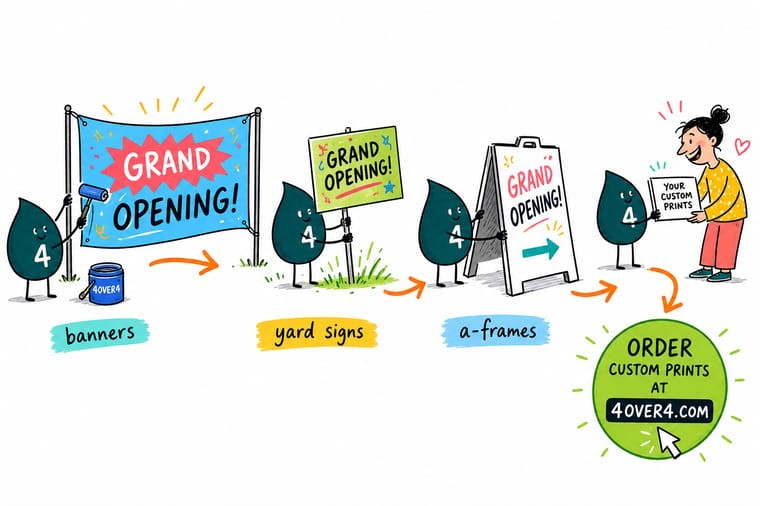
Wally hangs the banner first, because it is the only sign the traffic will ever read. Then he puts the A-frame on the sidewalk where the offer and the hours can be read at walking pace. Yard signs go out last, and only at the turn people keep missing. He fills the A-frame base before he leaves, because an empty aluminum frame on a windy corner ends up in the parking lot.
Order vinyl banners →Specs and pricing
Sizes, options and starting prices for all three
Compare the three formats side by side with live configuration choices and starting prices straight from the 4OVER4.COM configurator.
Print it
Order the signage your opening actually needs
Explore more
Where to go next
By the numbers
Opening day signage across 25 years on press
Common Questions
Your grand opening signage questions, answered
What size banner do I need for a grand opening?
Match the width of the storefront, not a round number. On a typical 20 to 25 foot retail bay, a 3 by 8 foot banner reads well without looking undersized, and a 4 by 10 foot banner is the step up for a wide facade or a setback building. The height matters more than people expect: 3 feet of banner gives you room for roughly 10 inch capitals plus a logo, which is the size a driver 100 feet away can read. Anything shorter than 2 feet turns into a sign only pedestrians see.
How many yard signs should I put out?
Count the decision points, not the acreage. One at each turn a first-time visitor could miss, one at the entrance to the parking lot, and one at the far end of the lot if the storefront is not visible from the road. That is usually six to ten signs for a suburban strip and two or three for a downtown block. Buying thirty and lining a road with them mostly produces a pile of signs in the back room, and in many towns it produces a call from code enforcement.
Do I need a permit for a grand opening banner?
Often yes, and it is worth the ten minute phone call. Most municipal sign ordinances treat a banner as a temporary sign, allow it for a limited window, commonly around 30 days, and require it to be attached flat to the building rather than strung between poles. Yard signs placed in the public right of way get pulled by code enforcement in a lot of towns. Call the planning or building department, give them the address, and ask what a temporary sign permit covers.
Will an A-frame blow over on a windy sidewalk?
An empty aluminum frame will. The frame itself weighs a few pounds, which is fine for a sheltered doorway and not enough for an open corner. Add 20 to 30 pounds of ballast at the base, either a weight bag draped across the bottom rail or a water fillable base, and set the frame with the hinge facing into the prevailing wind. A plastic frame with a water fillable base solves the same problem with a heavier product instead of an accessory.
Can I reuse grand opening signs after the first week?
The A-frame and the yard signs yes, the banner mostly no. An A-frame takes new inserts, so the panel that said Now Open becomes the daily specials board. Yard signs printed on 4mm corrugated plastic survive a season outdoors and get reused for events. A banner that says Grand Opening has one job, which is why it is worth printing a second undated banner at the same time if you already know you want signage on that wall in month two.
What about feather flags instead of yard signs?
Different job. A feather flag moves, and movement is what catches peripheral vision from a car, so a pair of flags at the curb outperforms a row of static yard signs for pure attention. What a flag cannot do is carry information, because you get a logo and one or two words on a surface that is never still. Flags start at $108.75 and need a ground spike or a cross base. Use them to say something is happening here and use yard signs to say turn left.
Get Started
Opening in two weeks? Start with the banner.
Pick your size, choose solid vinyl or mesh for a windy wall, and we print hemmed and grommeted banners that go up in ten minutes.
Legal Disclaimer
Gold Standard guarantees apply to all standard orders placed through 4over4.com. Price match requires verifiable proof of a competitor's published price for an equivalent product with matching specifications and turnaround time. Satisfaction guarantee covers manufacturing defects and print quality issues. Contact support with order number and documentation. On-time delivery rate based on tracked orders 1999 to 2026. Individual results may vary based on shipping carrier performance.
