
Pull Up Banner Design Rules That Put Your Message at Eye Level


Tobias is our voice for cutting, binding and large format, built from the knowledge of our production team, with over 20 years in printing.
A pull up banner gets three seconds from someone already walking past. These are the zones, margins, type sizes and file settings that decide whether the message lands in those three seconds.
Design a pull up banner from the floor up: logo in the top 14 inches, headline between 44 and 68 inches where adult eye level lands, one supporting line or a QR code from 36 to 44 inches, and nothing important below 36 inches because a table or a person will cover it. Leave 1 inch clear at each side and 3 inches at the top and bottom, since the rail and the cassette each hide about 2 inches of print. Build the file at final size in CMYK at 100 to 150 ppi, and set the headline at 2 inch cap height so it reads across an aisle.
Quick answer
Heights are measured from the floor, and the floor is not your canvas
Every rule that matters on a pull up banner is a height above the ground, not a position in the file. The cassette lifts a 79 inch graphic about 3 inches, so the top edge lands near 82 inches and eye level cuts across two thirds of the way up. Logo in the top 14 inches, headline between 44 and 68 inches, one supporting line down to 36 inches, and everything below that treated as background because a table or a crowd will cover it. Keep 1 inch clear at each side and 3 inches at each end for the rail and the cassette.
The Four Zones That Decide Whether Anyone Reads It
A pull up banner is read by someone walking past at three miles an hour. Design it from the floor up, in four bands, and most of the layout arguments settle themselves.
The top 14 inches, roughly 68 to 82 inches off the floor. The cassette lifts a 79 inch graphic about 3 inches, so the top edge lands near 82 inches, above every head in the room. Put the brand mark there. It stays visible once a crowd forms in front of the stand, which is exactly when you want it.
44 to 68 inches: the headline. Adult eye level sits between 57 and 65 inches, so this band catches the glance. Give it one idea. A stand carrying a headline, a tagline, four bullets and a photo caption reads as noise from ten feet, and ten feet is the only distance that matters.
36 to 44 inches: one supporting line. A short offer, a URL or a QR code. Below 36 inches a phone camera points down at an angle people will not bother holding.
Below 36 inches: assume it is covered. A 30 inch banquet table, a 42 inch counter or a single person standing in front hides the bottom third for most of an event. Use it for color, a photo crop or plain background. The phone number does not go there.
A wall poster lets you choose the mounting height. A stand does not, because the hardware sets it, which is why these numbers are fixed rather than a matter of taste. If you are still choosing hardware, the pull up banner sizes and setup guide covers the mechanics before the artwork.
Set the Canvas, the Margins and the Resolution First
Half the reprints we see start with a document that was never the right shape. Build at final size, in CMYK, before you place a single element.
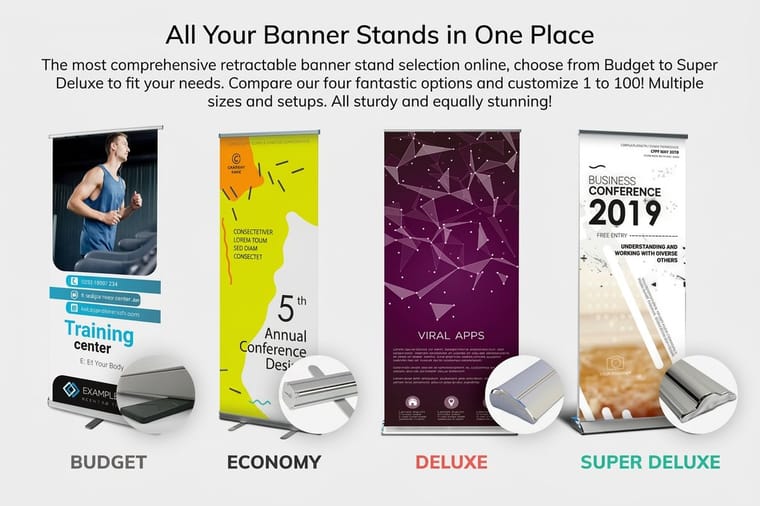
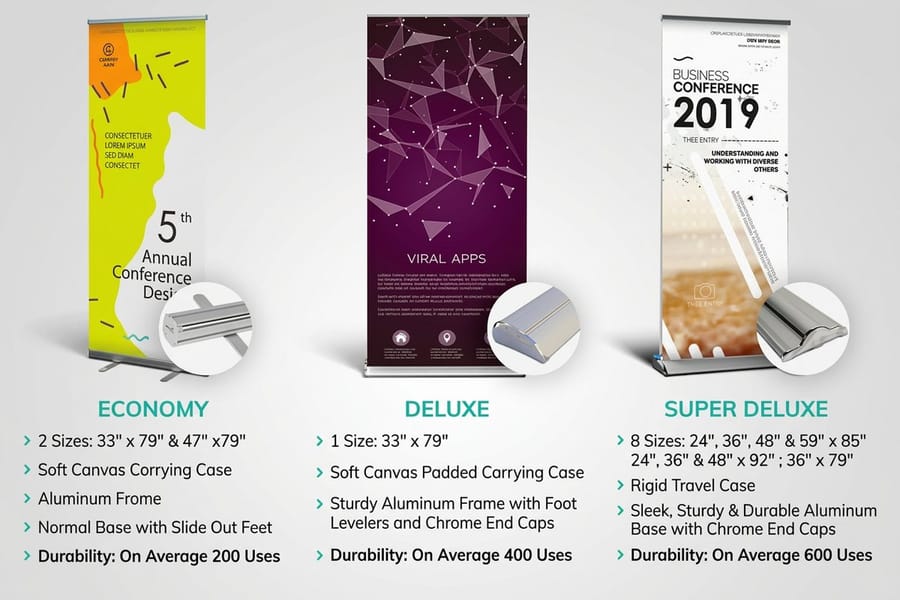
Retractable banner stands come in 13 sizes, widths from 24 to 59 inches and heights of 79, 85 or 92 inches, with custom sizing up to 59 by 92 inches. The everyday choices are these:
- 24 by 79 in for a tight alcove, a shop aisle or a doorway, and the size the $139 starting price refers to.
- 33 by 79 in for a booth or a lobby. This is the default, and the one to pick if you are not sure.
- 47 by 79 in when the banner has to carry a photograph rather than type.
- 36 by 92 in for a high ceiling hall where the crowd is deep and you need height over heads.
Margins. Leave 1 inch clear on each side and 3 inches clear at the top and bottom. The side allowance covers the small drift a graphic makes as it rolls, and the top and bottom allowance covers the rail and the cassette, which each swallow about 2 inches of print. Skip the border that sits an inch inside the edge. A sixteenth of an inch of drift turns that border into something the eye reads as crooked.
Resolution. Place raster images at 100 to 150 ppi at full size. A 33 by 79 inch document at 300 ppi is a slow file with no visible payoff on a panel nobody inspects from six inches. If your machine struggles, build at quarter scale at 300 ppi and scale on export.
Color. Work in CMYK and build large black areas as a rich black around 60C 40M 40Y 100K, because 100K on its own prints as a soft charcoal over an area this size. Outline your fonts and export a print ready PDF. Start from the retractable banner stand blank template and the rail allowances are already drawn for you. To match the size to the room instead of guessing, read the breakdown of the five most used retractable sizes.
| Pull up design order | What you choose |
|---|---|
| Vinyl retractable | 13 sizes from 24 x 79 to 59 x 85 in on 13oz smooth blockout vinyl, aluminum base |
| Fabric retractable | 23 x 66 to 60 x 92 in on 9oz UV printed coated polyester |
| X-frame | 24 x 60, 32 x 72 or 48 x 78 in on 13oz blockout vinyl with four grommets |
| Quantity and time | From a single stand, 3 business days of standard production on the retractables |
| What to upload | A CMYK PDF at full size, images at 100 to 150 ppi, fonts outlined, rail and cassette margins clear |
Type Sizes That Survive a Walk Past

The sign trade works on one rule of thumb: one inch of capital letter height for every ten feet of reading distance. It is conservative in a quiet lobby and about right in a crowded hall, so build to it and you will not be caught out.
| Read from | Minimum cap height | What it carries on a 33 in wide banner |
|---|---|---|
| 6 to 10 ft | 1 in | The supporting line, the URL, any body copy at all. |
| 15 to 20 ft | 2 in | The headline. Three to five words fit across 33 inches at this size. |
| 30 ft or more | 3 in | The logo and one word. Nothing else survives the distance. |
Count the words before you set them. Five words at 2 inch cap height fill a 33 inch line, which is why the headline gets one idea. If a sixth word is needed, the sentence is wrong, not the type size.
Contrast matters more than the typeface. Dark type on a light ground holds up under a booth spotlight; reversed white type on a mid tone loses its edges as soon as glare hits the vinyl. If the venue is lit hard and reverse type is non negotiable, print on fabric instead, where a matte weave scatters the reflection. Condensed faces buy you a word, humanist sans faces stay readable at distance, and script faces fail at both. The banner fonts guide goes through the families that hold their shape at 2 inches.
Four Retractable Banner Examples and What Each Layout Is Doing
The zone map is the same on every stand. What changes is how many stands you have and where the reader is standing when they meet them.
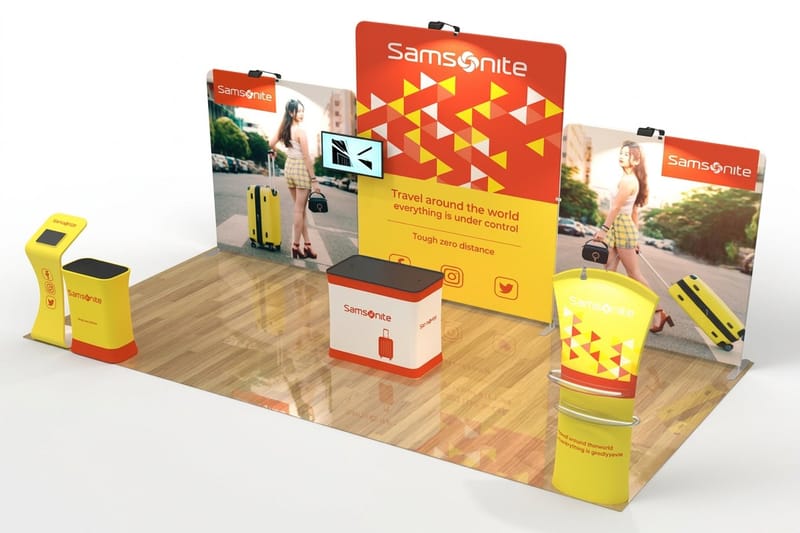
The paired booth backdrop. Two 33 by 79 inch stands behind a table, designed as one image with the seam falling in dead space rather than through the logo. Because a table blocks the bottom 30 inches of both panels, everything below that line is background. The pair reads as a wall from the aisle and packs into two tubes.
The lobby greeter. One stand at a door, carrying a single sentence at 2 inch cap height and nothing else. Whoever reads it is moving, has three seconds, and is already looking for reception. A second message here costs you the first one.
The two way corridor. People approach an aisle from both ends, so a single sided stand is blank half the time. Double retractable stands carry two 33 by 81 inch faces in one base, as the double retractable stands story shows, and you can run the same art on both or split it, an offer on one side and directions on the other. One base, $525, two working faces.
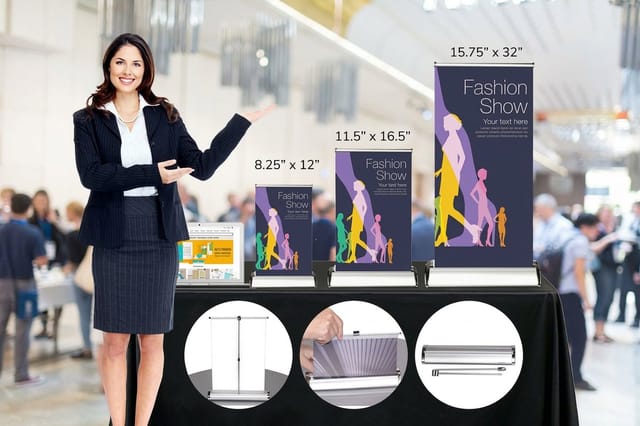
The counter version. On a reception desk the whole zone map shifts up, because a 40 inch counter already puts the graphic at chest height. Mini retractable banner stands run 8.25 by 12 inches up to 15.75 by 32 inches on 10 mil vinyl from $49.41, and they are read from three feet, so 1 inch cap height is plenty. For a photo wall rather than a message, the rules change again and the step and repeat banner guide covers the tiling spacing.
Pick the Stand Before You Finish the Artwork
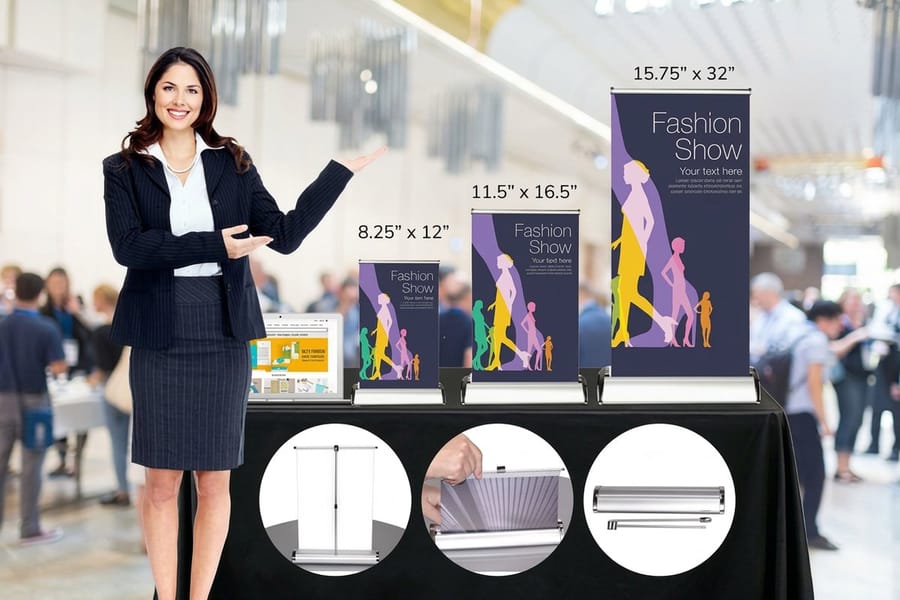
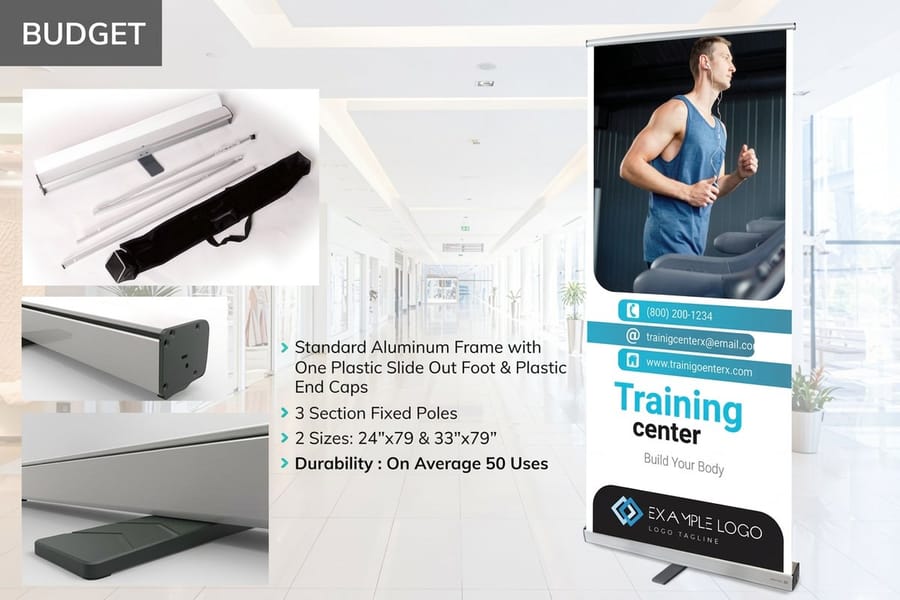
The hardware sets the aspect ratio, the material and the two dead strips, so choosing it last means redrawing the file. Here is the range, with what each one actually buys you.
| Stand | Graphic sizes | Material | Starts at | Where it earns its keep |
|---|---|---|---|---|
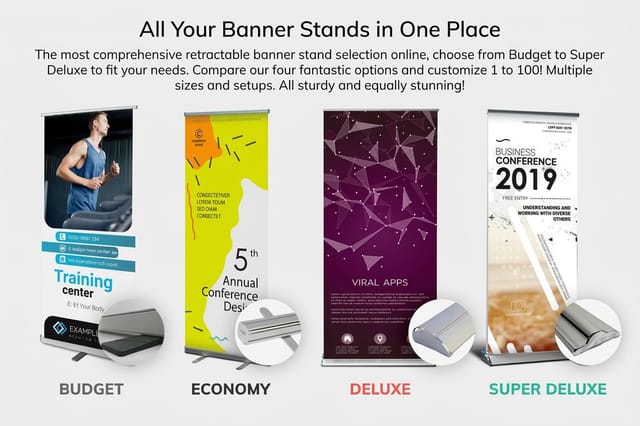
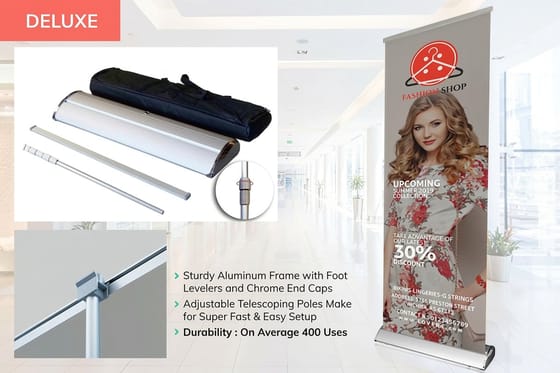
| Retractable banner stands | 24 to 59 in wide, 79, 85 or 92 in tall, 13 sizes | 13oz blockout vinyl | $139 | The default booth and lobby stand. Sets up in under a minute. |
| Retractable fabric banner stands | 23 by 66 in up to 60 by 92 in, 8 sizes | 9oz coated polyester | $159.85 | Rooms lit with hard spots, where vinyl throws glare back. |
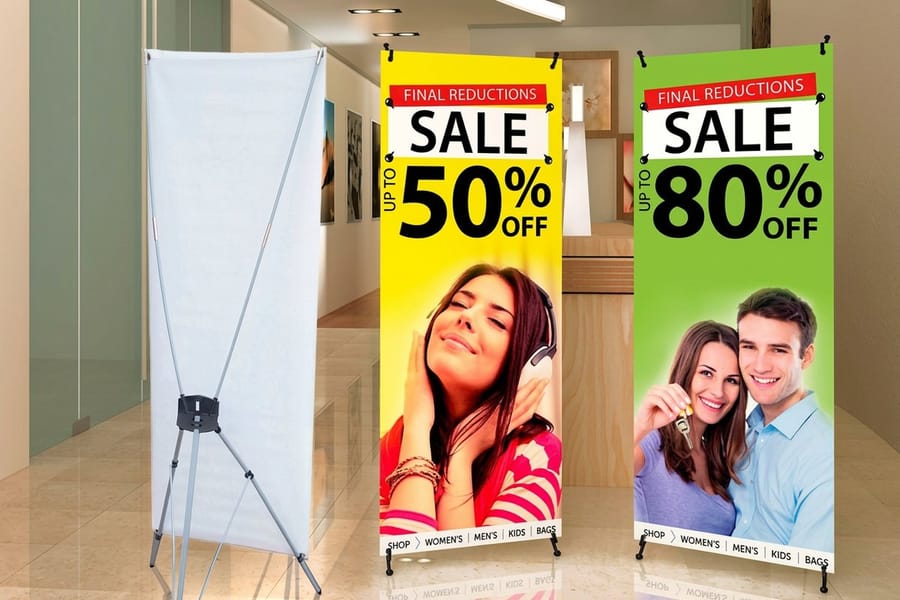
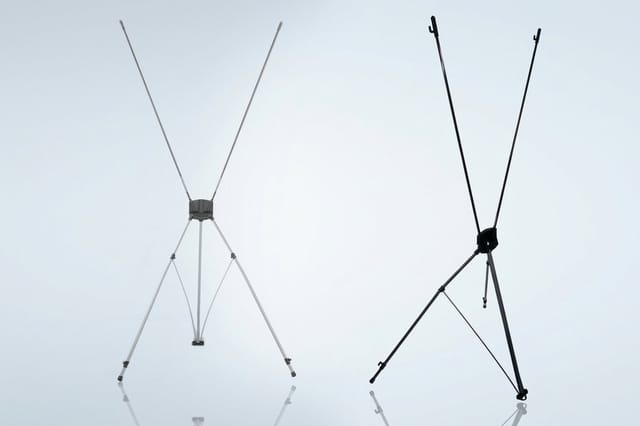
| X-Frame banner stands | 24 by 60 in up to 48 by 78 in, 4 sizes | 13oz blockout vinyl, 4 grommets | $91 | The cheapest way to stand a graphic up. Frame folds flat. |
| Double retractable stands | 33 by 81 in per face, two faces | 13oz blockout vinyl | $525 | Corridors and aisles people walk from both directions. |
| Mini retractable banner stands | 8.25 by 12 in up to 15.75 by 32 in, 3 sizes | 10 mil premium vinyl | $49.41 | Counters, reception desks and tabletop displays. |
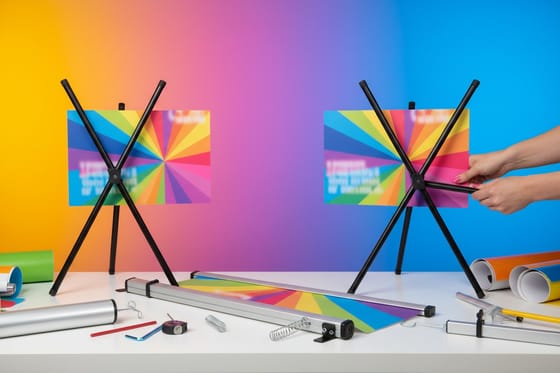
The honest limit on the X-Frame is tension. The banner hangs from four grommets on a folding frame, so it bows a little in the middle and shows every travel crease, which a retractable cassette pulls out as it rises. At $91 against $139 that is a fair trade for a stand you use twice a year, and a poor one for a stand that lives in your lobby. The retractable versus X-Frame comparison puts both side by side.
Standard turnaround on the retractable stands is 3 business days with 2-day, next-day and same-day rush available, and the X-Frame runs 2 business days. Browse the full banner stands printing range to compare hardware, then read how to set a retractable stand up before the banner arrives, so nobody is reading instructions on a show floor.
Wally explains pull up banner layout
Measure from the floor, then design
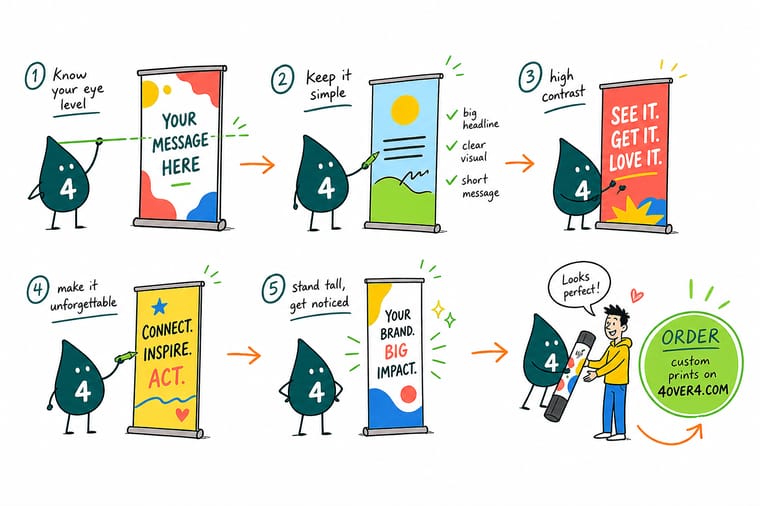
Wally does not start in the design file. He stands the banner up first, runs a tape measure from the floor, and marks three lines: 36 inches, where a table starts hiding things; 44 to 68 inches, where eye level cuts across; and 68 inches up, where the logo goes so it clears everybody's head. Then he draws inside those lines. Three inches at the top and bottom stay empty because the rail and the cassette take them, and an inch at each side stays empty because the graphic drifts as it rolls.
Order retractable banner stands →
Specs and pricing
Stand sizes, materials and starting prices
Configure the three stands most people choose between, with live sizes and starting prices straight from the 4OVER4.COM configurator: vinyl retractables from 24 x 79 inches, fabric retractables from 23 x 66 inches on 9oz polyester, and X-frames from 24 x 60 inches, each from a single stand.

Print it
Order the stand your layout was drawn for
Vinyl retractable stands in 13 sizes, X-frame stands at 24 x 60 to 48 x 78 inches, and mini retractable stands at 8.25 x 12, 11.5 x 16.5 or 15.75 x 32 inches for a counter or a registration table.

Explore more
Where to go next
Four guides and two ranges: what a pull up banner is and how it opens, the five most used sizes, retractable against X-frame, banner fonts at 2 inch cap height, every stand we build, and the whole trade show booth.
By the numbers
Banner stands among 1,000+ printed products
Common Questions
Your pull up banner design questions, answered
What size should a pull up banner be?
A 33 by 79 inch graphic is the default and it fits almost every room. It is wide enough to hold a headline at 2 inch cap height, narrow enough to sit beside a 6 foot table, and it is the size most trade show booth diagrams assume. Retractable banner stands run from 24 up to 59 inches wide with heights of 79, 85 or 92 inches, 13 sizes in all. Go wider than 33 inches only when the banner has to hold a photograph or read from across a hall; go narrower when you are squeezing a stand into a door alcove or a shop aisle.
Where should the headline go on a pull up banner?
Between 44 and 68 inches off the floor. Adult eye level lands between 57 and 65 inches, and a person walking past reads whatever crosses that line. On a 79 inch graphic sitting on a 3 inch base, that band starts about 41 inches up from the bottom edge of the artwork. Put the logo above it in the top 14 inches, put one supporting line or a QR code just below it, and stop there.
How much of the artwork does the stand hide?
Roughly 2 inches at each end. The top of the print wraps the rail that hooks onto the support pole, and the bottom clamps to the leader inside the cassette, so neither strip ever faces the room. Add the base itself, which lifts the visible graphic about 3 inches off the floor. Keep all type 3 inches clear of the top and bottom edges of the file and download the blank template before you start rather than measuring it yourself.
What resolution and color mode should a pull up banner file be?
Build the document at final size in CMYK and place raster images at 100 to 150 ppi at that size. Large format does not need 300 ppi, and a 300 ppi file at 33 by 79 inches is a slow, enormous document for no visible gain. If your software struggles, build at quarter scale at 300 ppi and scale on export. Set large black areas as a rich black around 60C 40M 40Y 100K, because 100K alone prints as a soft charcoal across a panel that size. Export a PDF with fonts outlined.
Should I pick vinyl or fabric for a retractable banner?
Pick by the lighting, not the budget. 13oz blockout vinyl is opaque, sharp and the standard choice at $139 per stand for the 24 by 79 inch budget size. Under booth spotlights or lobby downlights it also throws a hot reflection straight back at whoever is reading. Retractable fabric banner stands print on 9oz coated polyester with a matte weave that kills that glare and start at $159.85. Fabric also travels better, since a crease relaxes out of polyester and a hard kink in vinyl does not.
Can I put a QR code on a pull up banner?
Yes, and keep it between 36 and 48 inches off the floor. Lower than that and people crouch, which most of them will not do at a busy event. Size the code at 3 inches square or larger, leave the quiet zone around it clear of artwork, and test it printed rather than on screen. A code sitting in the bottom 12 inches of a stand is scanned by nobody, because that band is behind a table for the whole show.
Get Started
Order an X-frame stand, printed in 2 business days
Pick a size, choose blockout vinyl or matte fabric, and we print the graphic and ship it with the stand as one kit.
Legal Disclaimer
Gold Standard guarantees apply to all standard orders placed through 4over4.com. Price match requires verifiable proof of a competitor's published price for an equivalent product with matching specifications and turnaround time. Satisfaction guarantee covers manufacturing defects and print quality issues. Contact support with order number and documentation.
