
Step and Repeat Sizes That Fit Your Guest Count and Your Ceiling


Four faces cover almost every event. Each size holds a certain number of people, a camera only keeps a narrow band of the artwork, and the ceiling height decides the order before the guest list does.
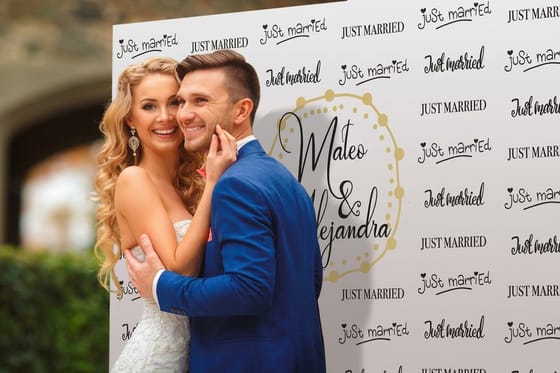
The standard step and repeat sizes are 8' x 8', 8' x 10', 10' x 10' and 8' x 20', written height first, and 8' x 8' is what most events order. Choose the width by how many people stand in one photo: an adult takes about two feet of face, so eight feet holds two with margin, ten feet holds four, and twenty feet suits a red carpet line rather than a group shot. Choose the height by the room, since a frame needs clearance above the print and an eight-foot backdrop will not stand under an eight-foot ceiling.
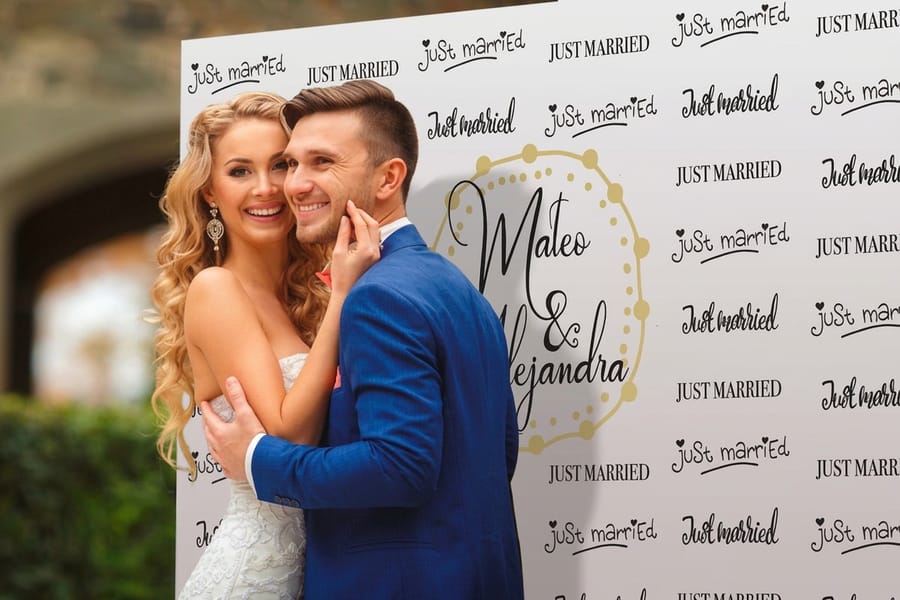
Quick answer
Pick the width for the people, the height for the room
Width follows the guest count and height follows the ceiling. Two feet of backdrop per adult plus a foot of margin past each outside shoulder is the whole calculation, which is why 8' x 8' handles two people, 8' x 10' handles four and 8' x 20' is really a red carpet rather than a group shot. Height is the constraint nobody checks: the artwork that reaches the camera sits between three and seven feet off the floor, and the frame under an eight-foot print needs a ceiling taller than eight feet to stand up at all.
The Four Step and Repeat Sizes You Will Actually Be Quoted
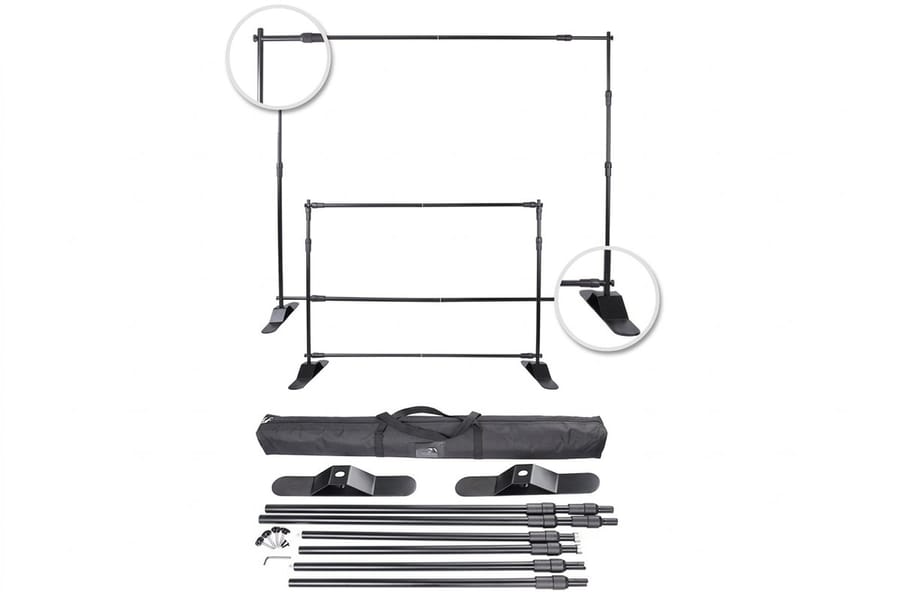
Nearly every step-and-repeat order in the country lands on one of four faces. The trade writes height first, which trips up more first-time buyers than any other detail: an 8' x 10' is eight feet tall and ten feet wide, not the reverse.
| Size | Face | People in frame | Where it belongs |
|---|---|---|---|
| 8' x 8' | Square, 64 sq ft | 2 comfortably, 3 crowded | The default. Fills a portrait-orientation shot, fits a ten-foot ceiling, moves in one bag. |
| 8' x 10' | Same height, 2 ft wider | 3 to 4 | Group shots at the same ceiling height. The cheapest upgrade when photos keep coming out cramped. |
| 10' x 10' | Square, 100 sq ft | 4 to 5 | Ballrooms and stages, where an eight-foot wall reads as undersized behind a riser. |
| 8' x 20' | Wall length | 8 or more, or a moving line | Red carpets and sponsor walls where guests walk past rather than pose as one group. |
The one that gets ordered for the wrong reason is the 8' x 20'. It photographs well only when people keep moving along it. Put three guests in front of twenty feet of logo wall and the subjects sit small in a wide, mostly empty frame, and you also need two people and a clear twenty-two feet of floor to assemble it. If the guest list is under a hundred, the extra width usually buys nothing.
Custom sizes cost the same per square foot as the standard ones, because step-and-repeat banners are printed to order rather than cut from stock. Measure the wall and order that number.
Choosing the Width by Guest Count, Shoulder by Shoulder

Width is arithmetic, not taste. An adult standing square to a camera takes up close to two feet, and about two and a half once an arm goes around the person beside them. Add a foot of printed face past each outside shoulder so the photographer has margin to crop without catching a curtain, a door frame or the frame's own upright.
- Two people, always the same two. 8' x 8'. A founder and a guest, a couple, an award winner and a presenter.
- Three or four at a time. 8' x 10'. Small teams, families, sponsor handshakes. Same ceiling requirement as the 8' x 8'.
- Four or five, on a stage. 10' x 10'. The extra two feet of height stops the backdrop from disappearing behind a riser and a lectern.
- A line that keeps moving. 8' x 20'. Guests step in, get shot, step off. Nobody stands centered for long.
The number that surprises people is how quickly a group outgrows a backdrop. Six people shoulder to shoulder need about fourteen feet before margins, which is why large groups at an 8' x 10' end up shot in two waves rather than one. If your event runs on a schedule, two shorter backdrops in different corners move a queue faster than one twenty-foot wall.
Once the width is set, the repeat has to match it. Our guide to designing step-and-repeat artwork covers logo sizing and the offset rows that keep a brand visible when a body blocks one column.
The Venue Decides More Than the Guest List Does

Height is where orders go wrong. A telescopic frame carries the print on a crossbar with feet beneath it, so the assembled unit always stands taller than the banner itself. An eight-foot print will not go up under a flat eight-foot ceiling, and the offices and restaurants that host smaller events are full of eight-foot ceilings. Measure floor to ceiling at the exact spot the backdrop will stand, then subtract for the hardware. Soffits, sprinkler heads and track lighting take inches that never appear on a floor plan.
Depth matters almost as much. A photographer shooting a full-height backdrop on a normal lens needs roughly as much clear floor in front of it as the backdrop is wide, so a ten-foot face wants about ten feet of standing room and a twenty-foot wall wants a corridor. Push a large backdrop into a narrow hallway and the only way to get it all in frame is to shoot it at an angle, which flattens the logos on one side.
Three venue checks that take a minute each and save a reprint:
- Lighting behind the wall. Fabric is slightly translucent. A window or a bright sconce behind the backdrop will show through it, which is exactly when 13oz. Smooth Blockout Vinyl is worth the extra weight.
- Air movement. A vent aimed at a solid banner makes it breathe on camera. Outdoors, a solid face acts as a sail, and mesh banners from $75 let the wind pass through instead of taking the frame over.
- Getting it in the room. Frames pack into a case, prints roll into a tube. The question is whether the assembled twenty-foot unit can be built where it stands, because it will not turn a corner once it is up.
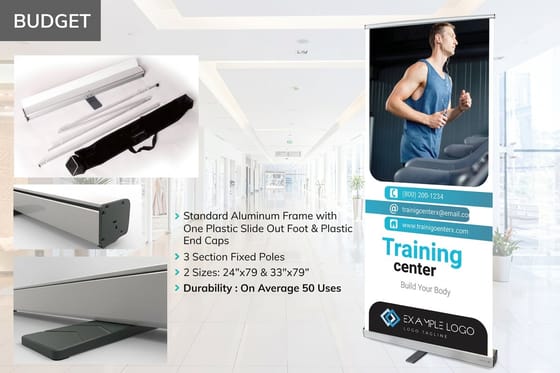
If the room is tight or the event moves between venues, a pair of retractable banner stands from $139 flanking a smaller backdrop covers more brand area than one oversized wall, and either half can be repositioned in seconds. The banner stands category lists the hardware sizes we stock.
Vinyl or Fabric, and What Holds the Thing Up

The size question and the material question get answered together, because a bigger face means more surface for a flash to bounce off. We print step-and-repeat banners on 13oz. Smooth Blockout Vinyl or 9oz. Wrinkle Free Fabric, with pole pockets top and bottom so a rod slides straight through, and a stand available as an add-on.
Fabric is the camera-friendly pick. The surface is soft and low-glare, so a flash diffuses across it rather than returning a bright hot spot in the middle of your logo. It is light, it packs down without a permanent crease, and it is the material photographers ask for by name. The trade-off is that it is slightly translucent and less resistant to a rough load-in.
Blockout vinyl is the usual pick. It is opaque, so nothing behind it prints through, and it survives a season of shows that fabric would not. It is heavier, and gloss is the price you pay: position lighting to the sides rather than straight on and the hot spots mostly disappear.
Step-and-repeat banners start at $217.50. If the job is a plain event banner rather than a photo wall, vinyl banners from $79 and fabric banners from $57.20 cover the same materials at a smaller size, and the vinyl banner category lists the finishing options. For a sanity check on width and drop before you commit, set your file up from the blank template library and read the banner material comparison alongside our backdrop sizing and setup guide.
Wally sizes the photo wall
Two feet per guest, and check the ceiling first

Wally counts shoulders before he counts dollars. Two feet of backdrop per adult, a foot of margin past the outside shoulders, and the width picks itself: eight feet for two people, ten for four, twenty only when guests walk past instead of posing. Then he measures floor to ceiling, because a frame stands taller than the print it holds, and an eight-foot backdrop has no chance under an eight-foot ceiling. Last, he keeps the logos packed inside the band from three to seven feet up, since that is the only stripe a camera keeps.
Configure a step-and-repeat banner →Specs and pricing
Backdrop sizes, materials, and starting prices
Compare the backdrop and the hardware side by side, with live size choices and starting prices straight from the 4OVER4.COM configurator.



Print it
Order the backdrop your room can actually hold

Explore more
Where to go next

By the numbers
Photo walls sized to a guest count and a ceiling
Common Questions
Your step and repeat sizing questions, answered
What is the most common step and repeat size?
8 feet tall by 8 feet wide. It is the size most events end up ordering because it fills a photograph behind two or three people without dominating a room, it fits through a normal double door once rolled, and it stands under a ten-foot ceiling with room for the frame. The next step up, 8 by 10, keeps the same height and buys two more feet of width, which is the cheapest way to make group shots easier without changing anything about the venue.
How many people fit in front of an 8 foot step and repeat?
Two comfortably, three if they stand close. An adult facing a camera squarely occupies about two feet of width, and a little more once an arm goes around a shoulder. You also want roughly a foot of printed backdrop past the outside shoulders so the photographer is not fighting to keep a wall edge or a curtain out of the frame. That arithmetic gives you two people with margin at eight feet, four at ten, and a line of eight or more at twenty.
How tall should a step and repeat banner be?
Eight feet is the working default. Most step-and-repeat photos are cropped somewhere between mid-thigh and the waist, so the artwork that actually reaches the camera lives roughly three to seven feet off the floor. A ten-foot-tall backdrop only earns the extra cost when the frame sits on a stage, when the photographer shoots low and wide, or when the venue is large enough that an eight-foot wall looks undersized in the room.
Will an 8 foot backdrop fit in a room with 8 foot ceilings?
No. A telescopic frame carries the print on a crossbar with feet under it, so the assembled unit stands taller than the banner. In a room with a flat eight-foot ceiling you need a shorter print, commonly six or seven feet tall as a custom size, or a frame you can set below full extension. Measure floor to ceiling at the exact spot the backdrop will stand, because dropped soffits, ductwork and light fixtures cost inches that a floor plan never shows.
Should I order vinyl or fabric for a step and repeat?
Fabric for cameras, vinyl for abuse. 9oz. Wrinkle Free Fabric has a soft, low-glare surface, so a flash lands on it and diffuses instead of bouncing back as a hot spot, and it packs into a bag without creasing. 13oz. Smooth Blockout Vinyl is opaque and far more durable, which matters for a backdrop that travels to a dozen shows a year or gets set up outdoors. Both are available on our step-and-repeat banners in an 8 by 8, an 8 by 10 or a custom size.
How big should the logos be and how far apart?
Size the logo so a whole one sits between two shoulders, then repeat it closer together than a person is wide. Around eight to twelve inches across is the usual landing zone for a wordmark, and offsetting each row by half a repeat means the logo a guest blocks in one row is visible in the row above. The failure case is a small number of very large logos: one person steps in front and the shot has no readable brand in it at all.
Can I order a step and repeat in a size that is not on the list?
Yes. Step-and-repeat banners are built to order rather than pulled from stock, so a custom width to match a specific wall, alcove or sponsor lineup costs the same per square foot as a standard size. Order the exact wall width rather than buying an 8 by 10 and folding the extra behind the frame, because a folded edge shows as a shadow line in photographs.
Get Started
Size the wall in the step-and-repeat configurator
Pick 8 by 8, 8 by 10 or a custom width, choose blockout vinyl or wrinkle free fabric, add pole pockets and a stand, and we print it in time for the doors to open.
Legal Disclaimer
Gold Standard guarantees apply to all standard orders placed through 4over4.com. Price match requires verifiable proof of a competitor's published price for an equivalent product with matching specifications and turnaround time. Satisfaction guarantee covers manufacturing defects and print quality issues. Contact support with order number and documentation. On-time delivery rate based on tracked orders 1999 to 2026. Individual results may vary based on shipping carrier performance.
