
Railroad Warning Signs Explained by Type, Placement and Material


The signs at a grade crossing, in the order a driver meets them, plus who is allowed to install each one and which material survives a rail corridor.
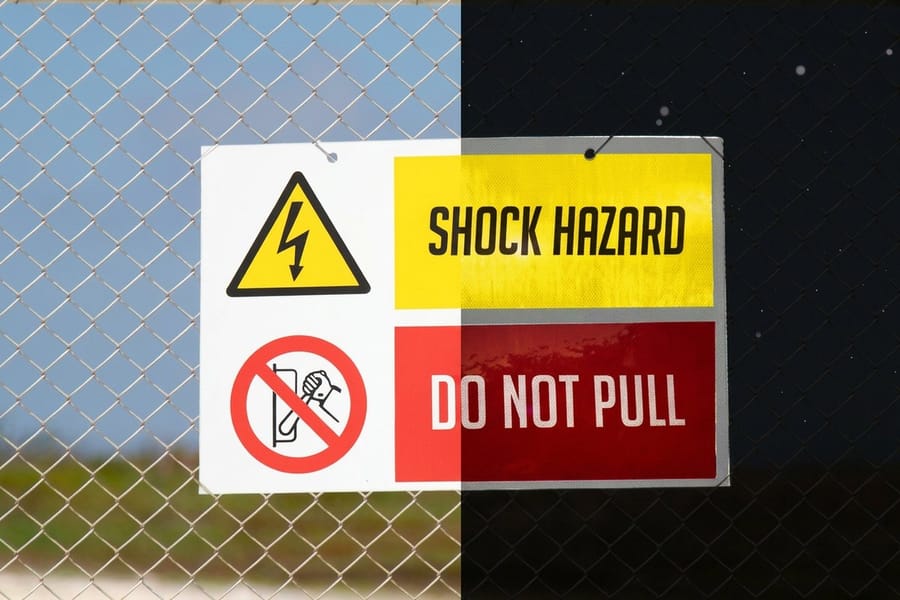
Railroad warning signs split into two groups: the round yellow advance warning sign that tells a driver a crossing is coming, and the regulatory signs at the track itself, the white crossbuck with a YIELD or STOP beneath it and a plaque when more than one line crosses. On a public road the road authority and the railroad own that hardware and its placement. On private track, a plant siding, a yard gate or a dock apron, the property owner buys and installs it, and reflective aluminum is the material that stays legible there for years.
Quick answer
Warning first, regulation at the rail, aluminum underneath both
A crossing is signed in a sequence, and the sequence is the whole design. The round yellow RXR sign warns from far enough back that a driver can slow. The pavement marking repeats it where the eyes already are. The crossbuck, the YIELD or STOP and the track-count plaque sit at the rail and issue the actual instruction, set back so a stopped vehicle is clear of the train. Public crossings are installed by the road authority and the railroad. Private sidings and yards are yours, and there the choice that matters is reflective aluminum aimed at the approaching lane rather than squared to the track.
Every Sign You Meet at a Crossing, and What Each One Is Doing
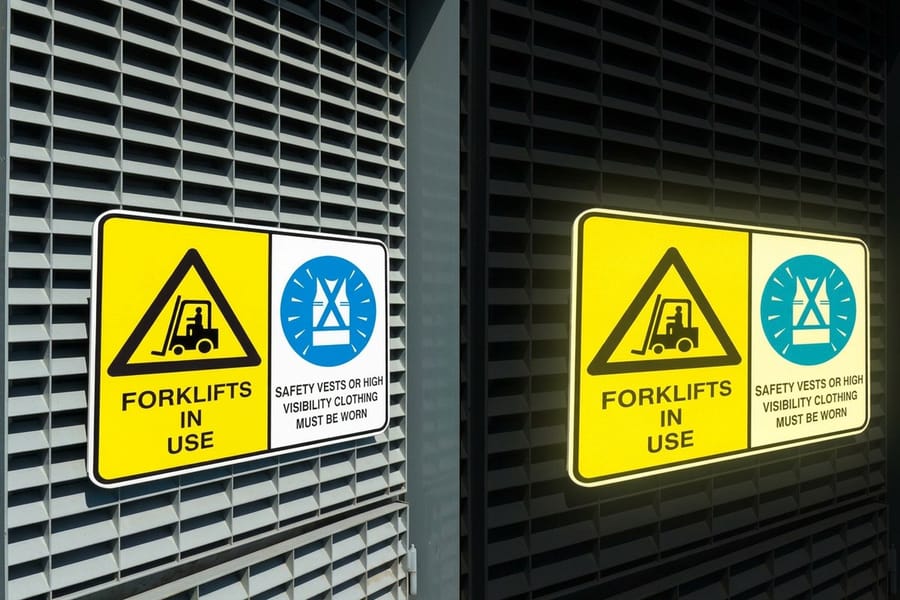
Sort them by color before you sort them by message. Yellow is a warning and asks the driver to prepare. White and red are regulatory and tell the driver what they must do. Mixing the two up is how facilities end up with a sign that looks official and instructs nobody.
| Sign | Code | What it looks like | What it is telling the driver |
|---|---|---|---|
| Grade crossing advance warning | W10-1 | Yellow circle, black RXR, black outer ring | A crossing is ahead. The circle is the only round warning sign in ordinary use, which is the point. |
| Crossbuck | R15-1 | Two white blades in an X reading RAILROAD CROSSING | Yield to rail traffic. Since 2009 this is a regulatory sign, not a landmark. |
| Number of tracks plaque | R15-2P | Small white plaque with a numeral, under the crossbuck | More than one track. A second train can be hidden behind the first. |
| Yield or Stop | R1-2 or R1-1 | Standard red yield triangle or red octagon | The right-of-way instruction the crossbuck alone was not delivering. |
| Do not stop on tracks | R8-8 | White regulatory rectangle, black legend | Do not let a queue leave you sitting on the rail. |
| Low ground clearance | W10-5 | Yellow diamond, humped crossing symbol | A long trailer or lowboy can ground out on the hump and stall on the rail. |
| Emergency notification | I-13 | Small panel with a crossing number and a phone number | Who to call, and which crossing they are being called about. |
Two more turn up often enough to know. An Exempt plaque tells bus and hazmat drivers they do not have to make the mandatory stop at that crossing, and a No Train Horn sign marks a quiet zone where the locomotive will not sound its horn on approach. That second one changes driver behavior more than people expect, because the crossing is now silent until the train is visible.
On private property you are not bound to this catalog, but you should borrow from it. Drivers read shape and color faster than words, and a yard sign that copies the recognized designs gets obeyed by a delivery driver who has never been on your site before. Our guide to durable outdoor sign materials covers what to print those on.
Placement, and the Part Nobody Tells You About Who May Install It
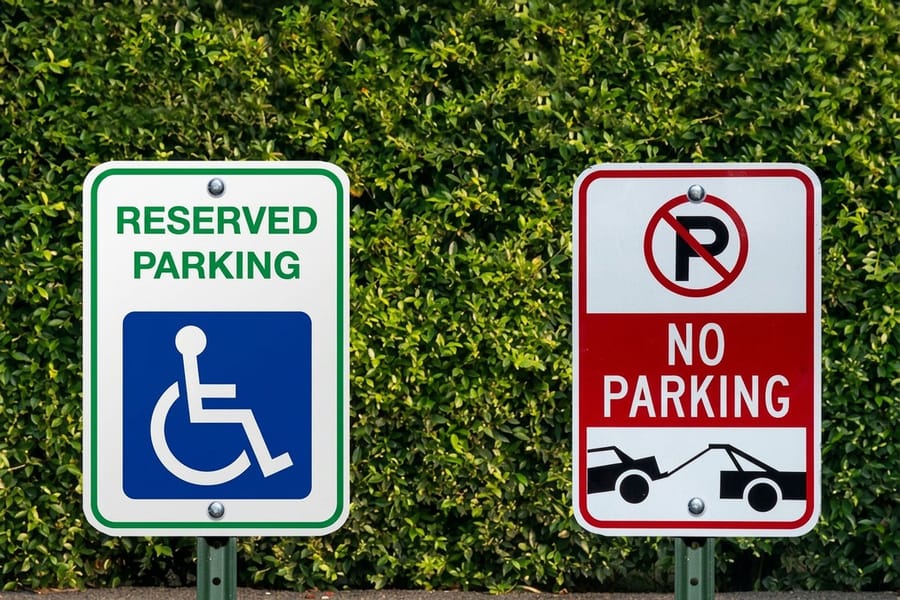
The order along the approach is fixed and worth memorizing: advance warning sign first, pavement marking next, then the crossbuck assembly set back from the nearest rail. Each element buys the driver a decision point, and moving one closer to the track removes the reaction time that element existed to provide.
Three placement rules do most of the work. The advance warning sign goes far enough back that a driver traveling at the posted speed can slow before reaching the track, so faster approaches need it further out. The crossbuck assembly sits back from the nearest rail rather than beside it, so a stopped vehicle at the sign is clear of the train envelope. And the sign face is aimed at the approaching lane, not squared to the track, which matters most at a skewed crossing where the road meets the rail at an angle.
Now the part that saves money and trouble. At a public crossing you do not get to choose any of this. The road authority owns the roadside furniture, the railroad owns what sits on its right of way, and a sign you install there can be pulled and can weaken your position rather than strengthen it. If a public crossing near your site is under-signed, the route is a request to the road authority and the railroad, not a purchase order.
Where a purchase order is exactly right: a spur crossing your own yard, a dock apron that vehicles cross to reach a bay, a gate onto rail-served property, and the internal traffic signs around all of it. Those are yours. Post them, keep them legible, and photograph them once a year. If you also need to keep the public off the track itself, the wording rules in our no trespassing sign guide apply to railroad property the same way they apply to a fence line.
Materials and Reflectivity, and Where Each One Stops Working
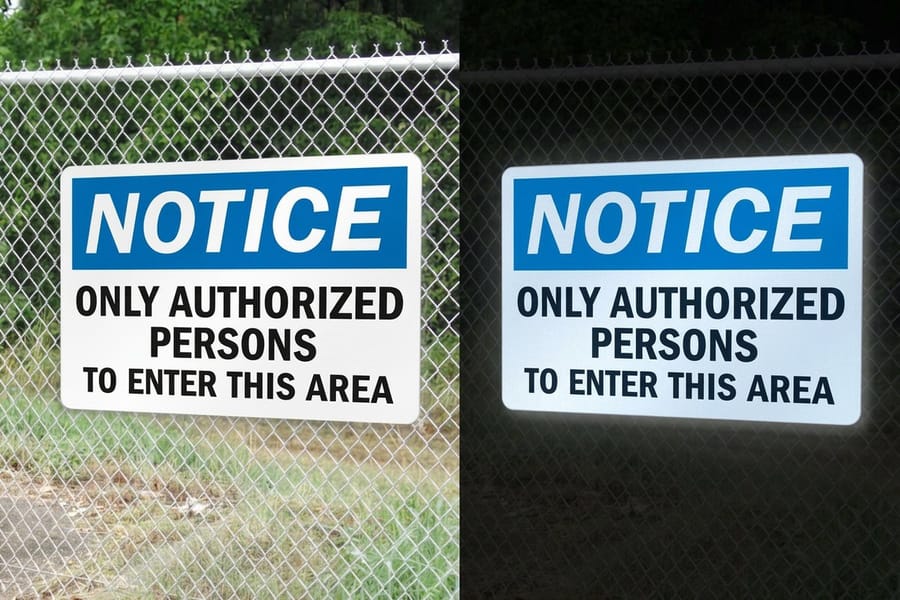
Retroreflective sheeting is not paint with glitter in it. It is a layer of glass beads or microprisms that sends light back along the path it arrived on, which is why a sign blazes for the driver whose headlights lit it and looks flat gray to a pedestrian standing ten feet to the side. Nothing about it needs power, and nothing about it survives being aimed at the wrong lane.
Two angles decide whether it works. Entrance angle is how far off square the light arrives, and it is the one that bites at a skewed crossing or a sign mounted parallel to the track. Cheap glass bead sheeting drops off hard as that angle opens. Prismatic sheeting holds a usable return much further out, which is the real reason to pay for it. Observation angle is the small separation between headlight and driver eye, and it matters most in a high cab, where the driver sits well above the beam.
| Substrate | Outdoor service life | Fails by | Right job for it |
|---|---|---|---|
| Aluminum | Years, and it does not rust | Bolt holes tearing when the gauge is too thin for the span | Permanent crossing, siding and yard signage that must stay legible |
| PVC and plastic panel | Seasons to a few years | Sagging in heat, brittleness in cold | Sheltered indoor and semi-outdoor signs, dock interiors, walls |
| Corrugated plastic | Months | UV cracking along the flutes, wind shredding the edges | Temporary closures, construction phases, event routing |
| Vinyl decal on a clean surface | Years on a good substrate | Lifting at the edges once the surface is chalked or oily | Equipment, gates, painted steel, anything already flat and rigid |
The honest trade-off is that reflectivity is not free and is not always earned. Reflective aluminum signs start at $41.02 against $36 for plain aluminum signs, a gap that pays for itself on any unlit approach and buys nothing on a sign that lives under a dock light burning all night. Spend the difference where headlights are the only light source, and put plain aluminum everywhere else.
One more limit worth stating plainly. Reflective sheeting does not compensate for a dirty sign. Rail corridors throw grit and brake dust, and a film of that on the face kills return faster than five years of UV. Wiping the faces is a maintenance task, not a nicety.
What to Order for a Private Crossing, Siding or Yard
Start from where the vehicle is when it needs the information, not from a list of sign names. Walk each approach at driving height and mark the point where a driver must already know a track is coming. That is where the sign goes, and everything else follows from it.
- Approach warning, one per direction. Reflective, post-mounted, aimed at the lane. This is the one that has to work at night in rain, so it is the one that gets the prismatic sheeting.
- At the rail, a stop or yield instruction. Copy the recognized regulatory look so an unfamiliar driver obeys it without reading it twice.
- Track count where more than one line crosses. The single most useful sign on a multi-track siding, because a stopped train hides a moving one.
- A contact placard. Site name, crossing location and a number that reaches someone who can stop rail movements. A driver whose trailer has grounded on your spur needs a phone number, not a warning.
- Equipment and gate markings. Reflective stickers from $29 and standard decals from $39.61 handle the things a rigid panel cannot bolt to.
- Warning labels on the machinery around the track. Pinch points, coupler areas, derail levers and gate mechanisms need small durable legends rather than signs. Standard warning labels start at $23.88 and premium warning labels at $29.16 for the ones that live in weather and diesel.
For sizing, err large on the approach and modest at the rail. A driver reads the approach sign at speed and the rail sign at a crawl, so the panel that needs the extra area is the far one. Post-mounted panels in an open yard should take the heavier aluminum gauge rather than the thinner one, because wind loading in a flat rail corridor is worse than it looks on a calm afternoon.
If your site also needs vehicle control around the crossing, parking signs from $30 print on the same aluminum and mount on the same posts, which keeps one hardware standard across the yard. Set your artwork up at final size on the correct panel dimensions using the blank template library, and browse the full signs and banners range when you are ready to specify the whole site at once.
Wally explains crossing signs
Round and yellow warns, white and red instructs
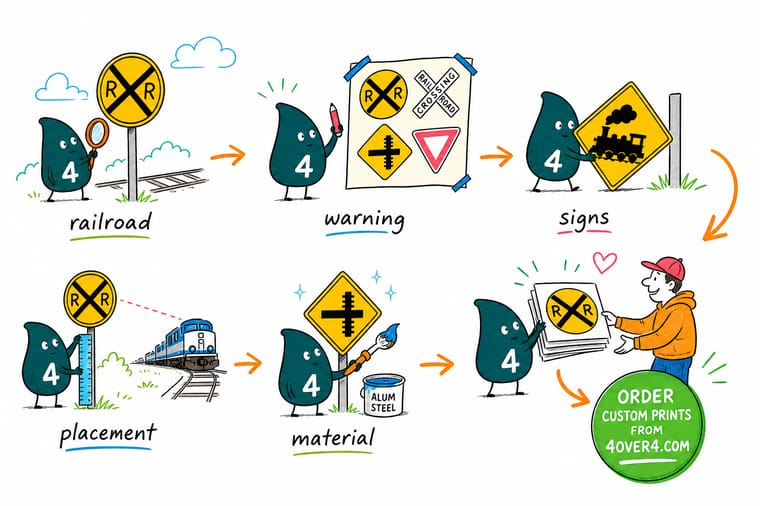
Wally walks the approach the way a driver drives it. The round yellow sign comes first, far enough back to slow down. The paint on the road repeats it. Then the crossbuck with a YIELD under it, sitting back from the rail so a stopped truck is out of the train's way. He aims each face at the lane, not at the track, because reflective sheeting throws light straight back at the headlights that hit it and goes dull the moment it is turned away. On public roads the road authority puts these up. On Wally's own siding, he prints them himself, on aluminum, because plastic gives up long before the track does.
Order reflective aluminum signs →Specs and pricing
Sign sizes, materials and starting prices
Compare the panels that suit a crossing, a siding or a yard, with live configuration choices and starting prices straight from the 4OVER4.COM configurator.

Print it
Sign the crossing so it still reads in five years

Explore more
Where to go next


By the numbers
The sign shop behind a railroad warning run
Common Questions
Your railroad sign questions, answered
Are railroad warning signs required by law?
At a public grade crossing, yes, and the rules come from two places. The Manual on Uniform Traffic Control Devices sets the sign designs, sizes and placement, and federal regulation requires an Emergency Notification System sign at public crossings carrying the crossing inventory number and a phone number for the railroad. On private track there is no federal sign mandate, but the same designs are used anyway because drivers already know what they mean, and because a facility that signs its siding properly is in a far better position after an incident than one that did not.
Can I buy and install my own railroad crossing sign?
On your own property, yes. In the public right of way, no. The road authority and the railroad control what goes up at a public crossing, and a privately installed sign there can be removed and can create liability rather than reduce it. Where private purchase makes sense is a plant siding, a warehouse dock that crosses rail, a yard gate, a spur through a parking area, and internal signs telling drivers and forklift operators to stop before the rail.
Why is the advance warning sign round instead of a diamond?
Because shape carries meaning at a distance, before the legend is readable. Almost every warning sign in the MUTCD is a yellow diamond. The grade crossing advance warning sign is a yellow circle, which makes it identifiable in headlights or fog from further out than the RXR letters inside it. That is also why copying the circle for anything other than a rail crossing is a bad idea.
What aluminum thickness should a railroad warning sign be?
Small signs mounted flat on a wall or a gate are fine at the thinner gauges. Anything post-mounted, anything over roughly 18 by 24 inches, and anything in an open windy yard should move up to the heavier gauge, because a thin panel in wind oil-cans, flexes at the bolt holes and eventually tears out around them. The failure is almost never the sheeting. It is the mounting holes in a panel that was too thin for the span.
How long does reflective sheeting actually last outdoors?
Sheeting classes differ more in service life than in first-night brightness. Basic engineering grade fades and loses return over a handful of years in strong sun. Prismatic sheeting holds usable brightness roughly twice as long. Either way, retroreflectivity dies gradually rather than all at once, so the practical test is to drive the approach at night once a year with your low beams on and replace anything that no longer lights up at the distance it used to.
Does a reflective sign help if the crossing has no lighting?
That is exactly where it earns the money. Retroreflective sheeting returns light along the path it arrived on, so a headlight beam comes back to the driver behind it rather than scattering. No power, no fixture, no pole. The catch is angle. A sign turned sharply away from the approach loses return, badly on cheaper glass bead sheeting, and a skewed crossing is precisely the geometry where that happens, which is why the sign should be aimed at the approaching lane and not simply squared to the track.
What does the number on the metal tag at a crossing mean?
It is the crossing inventory number, a unique identifier for that specific crossing, and it appears on the Emergency Notification System sign with a toll-free railroad number. If a vehicle is stuck on the track or a signal is malfunctioning, that number tells the railroad exactly which crossing to stop trains for. Private crossings do not carry one by default, which is a good argument for posting your own contact and location placard at a siding so a driver in trouble has someone to call.
Get Started
Start a reflective crossing sign in the sign configurator
Pick your panel size, choose reflective or plain aluminum, and we print signs that hold their legend and their brightness through years of weather.
Legal Disclaimer
Gold Standard guarantees apply to all standard orders placed through 4over4.com. Price match requires verifiable proof of a competitor's published price for an equivalent product with matching specifications and turnaround time. Satisfaction guarantee covers manufacturing defects and print quality issues. Contact support with order number and documentation. On-time delivery rate based on tracked orders 1999 to 2026. Individual results may vary based on shipping carrier performance.
