
Getting a Printing Order Placed Tax Exempt Without a Refund Request


Resellers and nonprofits lose the exemption on timing, not eligibility. Here is what the certificate has to contain, which one you need, and why it has to be on file before you pay.
Send a completed exemption certificate for the state the order ships to, confirm it is recorded on your account, and place the order only after that. The certificate is a resale certificate if you are reselling the print, or a state issued exempt organization certificate if the buyer itself is exempt. It has to name 4OVER4.COM as the seller, carry your state number, describe the property, and be signed. Once the charge settles with tax on it, the fix stops being a setting and becomes a refund claim.
Quick answer
Certificate on file first, order second
An exemption is applied at checkout or it is claimed back later, and later is a different process entirely. Get the current certificate for the destination state, fill in every field including the seller name and the description of property, send it, and wait for confirmation that it sits on your account. Then order, and read the tax line before you pay. Resellers claim resale, qualifying organizations claim their state exemption, and the IRS determination letter does neither.
What a Valid Exemption Certificate Has to Show
A certificate is not accepted because you are exempt. It is accepted because the document itself is complete, and a printer who accepts an incomplete one is the party the state comes after later. That is why the missing signature on your form is not a formality anyone can wave through.
Whatever the state form is called, an accepted certificate carries the same six things: the purchaser name, the purchaser address, the registration or exemption number issued by that state, the seller name written out as 4OVER4.COM, a description of the property being purchased, and a signature with a date. Two of those cause almost every rejection. The seller field gets left blank because the buyer is reusing a scan of an older certificate, and the purchaser name is the trading name rather than the registered legal entity on the account.
Match the purchaser name to your billing name exactly. If your account says Marisol Reyes Studio LLC and the certificate says Marisol Reyes Beauty, the two do not tie together and the claim fails a later audit even though both are you. The same applies to the address: a certificate showing a home address against an account billing to a shop address invites a question you do not want asked eighteen months from now.
On description of property, be broad but honest. Resellers ordering a mix of standard labels, cards and apparel through the year should write something like printed goods for resale rather than listing one job, so the certificate keeps working across reorders.
Resale Certificate or Exempt Organization Certificate: Which One You Actually Need

These two get used interchangeably in conversation and they are not interchangeable on paper. A resale certificate says the goods are not being consumed by you, so the tax gets collected further down the chain when you sell them. An exempt organization certificate says the buyer itself sits outside sales tax by law.
| Claim | Who uses it | What it covers | What kills it |
|---|---|---|---|
| Resale certificate | Print brokers, design studios, promo distributors, retailers | Printed goods you resell to a client, at any markup | Using it for your own marketing material, or a number registered in a state you are not shipping to |
| Exempt organization certificate | Nonprofits, churches, schools, libraries holding a state exemption number | Purchases made by and paid for by the organization itself | Paying with a personal card, or sending the IRS determination letter instead of the state form |
| Government purchase order | Federal, state, county and municipal buyers | Direct purchases billed to the agency | An employee paying personally and seeking reimbursement |
| Multistate form | Resellers buying for delivery into several states | Resale claims across the states that accept the uniform form | Assuming every state accepts it, several do not |
The line that trips resellers is the one about their own material. If you are a studio ordering make up artist business cards at $17.57 to hand to your own clients as a gift, you are the end user and the purchase is taxable. Order the same cards to invoice a salon that hired you, and it is a resale. Same product, same price, different answer, and the difference is who consumes it.
Nonprofits hit a different wall. Federal recognition and state sales tax exemption are separate applications with separate paperwork, and a handful of states do not exempt nonprofit purchases at all. If your organization is buying custom t-shirts at $21.96 for a fundraiser, confirm you hold the state document before you assume the order arrives untaxed.
Send It Before Checkout, Not After the Charge Settles

Everything about this topic comes down to sequence. Tax is calculated at checkout from the ship-to address and whatever exemption is already recorded on the account. Nothing about your organization is visible to that calculation unless the certificate is on file first.
The practical order of operations is short. Get the current certificate for the destination state as a PDF. Fill in every field, including the seller and the description of property. Send it and wait for confirmation that it has been recorded against your account, not just received. Then place the order and check the tax line before you pay, because that line is the only proof the exemption applied.
Once the charge settles, the picture changes completely. The seller reports and remits that tax on a periodic return, so by the time you notice, the money has usually left for the state. Some states let a seller credit you and adjust a later filing. Others send you to a refund claim form and a queue. Neither takes minutes.
Reorders are where people relax and get caught. A blanket certificate holds until it expires or your registration changes, but a single-purchase certificate covers exactly one job. Before a repeat run of outdoor banners at $79 or a seasonal box of greeting cards at $56.02, check that the certificate on the account is the blanket kind and still current. Our guide to ordering large banner printing covers the spec side of that same reorder.
Where Exemptions Fail: Ship-To States, Drop Shipments and Stale Numbers

Most rejected claims are geography problems, not eligibility problems. Sales tax follows the delivery address, so a New York resale number covers a New York delivery and says nothing useful about a pallet going to Arizona. Resellers who serve clients nationally end up maintaining a small file of certificates, one per state where they are registered and regularly ship.
Drop shipping adds a second layer. When we print for you and ship straight to your customer, three parties are in the transaction, and the state at the delivery end decides whose paperwork it will accept. Several states, California and Massachusetts among them, have historically been strict about honoring a resale number issued by another state on a drop shipment, which can leave you needing registration in the destination state or accepting the tax. Check the destination rule before you quote the job, because tax that surfaces after you have priced the work comes out of your margin.
Two smaller failures worth guarding against. First, expiry: Florida issues a new Annual Resale Certificate every year, so a certificate on file from last year is not a certificate. Second, entity changes: converting from a sole proprietorship to an LLC, or changing the registered name, invalidates a certificate in the old name even though the business is the same people at the same address.
If you resell a mixed catalog, keep the tax file and the product file in the same place. The reseller who has a current certificate for every ship-to state is the one who can quote a-frame signs or an acrylic print at a firm number instead of a number plus whatever tax turns out to be. The rest of the ordering mechanics live in our printing basics guides, and the file and quantity side of a specific job is covered in how to order booklet printing and blueprint printing sizes and paper.
Wally files the certificate
Paper first, press second
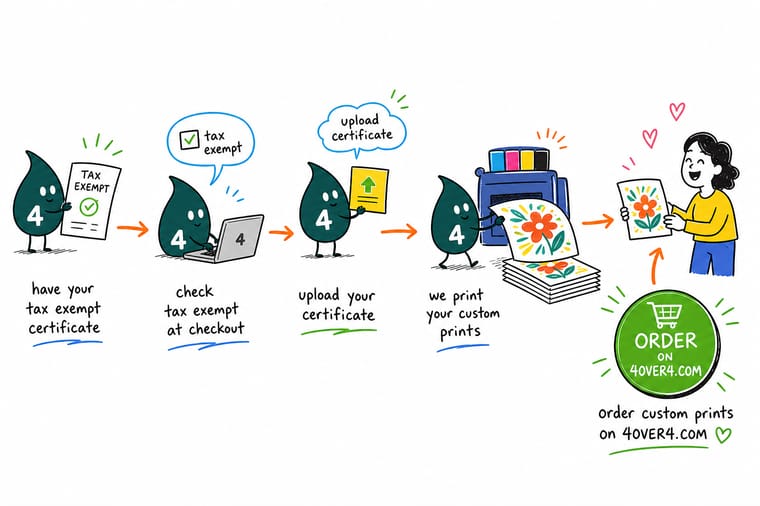
Wally checks four boxes before he lets an order through untaxed: the certificate is the right one for the state the boxes are shipping to, the seller line says 4OVER4.COM, the purchaser name matches the account exactly, and it is signed and dated. He also looks for the blanket box, because a single-purchase certificate means doing this again on your next reorder. Send it, wait for him to confirm it is on the account, then check the tax line at checkout before you pay.
Order labels for resale →Specs and pricing
Reseller staples, sizes, and starting prices
The products resellers reorder most often, with live configuration choices and starting prices straight from the 4OVER4.COM configurator.



Print it
Order with the exemption already applied


Explore more
Where to go next




By the numbers
A print partner resellers keep coming back to
Common Questions
Your tax exemption questions, answered
What qualifies you to be tax-exempt?
For a printing order, one of two things. You are reselling the printed goods to a client, which makes the purchase exempt under a resale certificate registered in the state the order ships to. Or the buyer itself is exempt by state law, such as a nonprofit, church, school, library, or government body that holds that state's exemption certificate and pays with the organization's own funds. An IRS 501(c)(3) letter alone does not qualify an order, because sales tax is a state matter with its own paperwork.
Can you write off printer ink?
That is an income tax question, not a sales tax one, and the two are separate. Ink, toner, paper, and printed marketing you buy for your business are ordinary business expenses that generally reduce taxable income when you file, whether or not sales tax was charged on them. A resale or exemption certificate only removes sales tax at checkout. Keep the receipts and confirm the treatment with your accountant, since the rules on supplies versus equipment differ.
How do I place a printing order tax exempt?
Send a valid, fully completed exemption certificate for the state the order ships to, get confirmation that it is attached to your account, and only then place the order. The document is either a resale certificate, if you are reselling the printed goods, or an exempt organization certificate issued by the state to a qualifying nonprofit, school, church or government body. It must name 4OVER4.COM as the seller, carry your registration or exemption number, describe the property being bought, and be signed and dated. Once that is on file, checkout should stop adding tax on shipments to that state.
Does my 501(c)(3) determination letter make my order tax exempt?
No, and this is the single most common mix-up. The IRS determination letter concerns federal income tax. Sales tax is administered state by state, and most states issue a separate document to nonprofits after a separate application. New York, for example, issues form ST-119.1 with a six-digit EX number, and that is the paper a seller can accept. A few states do not exempt nonprofit purchases at all, so a valid federal letter still results in a taxed order there.
I already paid the tax. Can I get it refunded?
Sometimes, and it is slower than doing it up front. Once a period closes, the seller has generally reported and remitted that tax to the state, so it is no longer sitting in an account waiting to be reversed. Some states let the seller issue a credit and adjust a later return, others require the buyer to file a refund claim directly with the revenue department using their own form. Either way you are looking at paperwork and weeks rather than a checkbox, which is why sellers push so hard for the certificate first.
Do I need to send a certificate for every order?
Not if you file a blanket certificate. Most state forms have a box marking the document as a blanket certificate covering all qualifying purchases from that seller, rather than a single transaction. Tick it and the certificate stays on the account until it expires or your registration changes. Some states do put a clock on it: Florida reissues its Annual Resale Certificate every year, so a Florida-based reseller needs to send the current one each January.
I am shipping to customers in several states. Whose rules apply?
The destination state governs each shipment. A New York resale certificate does not cover a box going to a customer in Texas. If you drop ship print to buyers across the country, expect to keep a certificate on file for every state where you have both a registration and regular deliveries. A few states are strict about accepting an out-of-state registration number on a drop shipment, so check that state before assuming your home paperwork travels with the freight.
Does the exemption cover shipping and rush charges?
Usually it follows the goods. In states where delivery charges on taxable goods are themselves taxable, an exempt sale generally makes the associated freight exempt too, because the charge takes the character of the item it delivers. Rush and turnaround fees behave the same way. Mixed orders are where it gets messy: if part of the shipment is exempt and part is not, some states want the freight split proportionally rather than exempted in full.
What gets a certificate rejected?
Four things account for most of it. The purchaser name does not match the name on the account and the billing details. The seller field is blank, which makes the document unusable for that transaction. The registration number is missing, expired, or belongs to a different state than the delivery address. Or the description of property is left empty when the state form requires it. Fill all four in and a certificate is normally accepted the same day it arrives.
Get Started
Ready to order with the exemption already on file?
Send the certificate for the state your boxes ship to, confirm it is recorded on your account, then configure the job and watch the tax line come back at zero.
Legal Disclaimer
Gold Standard guarantees apply to all standard orders placed through 4over4.com. Price match requires verifiable proof of a competitor's published price for an equivalent product with matching specifications and turnaround time. Satisfaction guarantee covers manufacturing defects and print quality issues. Contact support with order number and documentation. On-time delivery rate based on tracked orders 1999 to 2026. Individual results may vary based on shipping carrier performance.
