
How to Make a Large Acrylic Sign That Mounts Flat and Reads Sharp


The size ceiling on a single panel, the thickness that keeps a big sheet flat, where the standoff holes go, and the one thing a white-backed acrylic sign will never do.
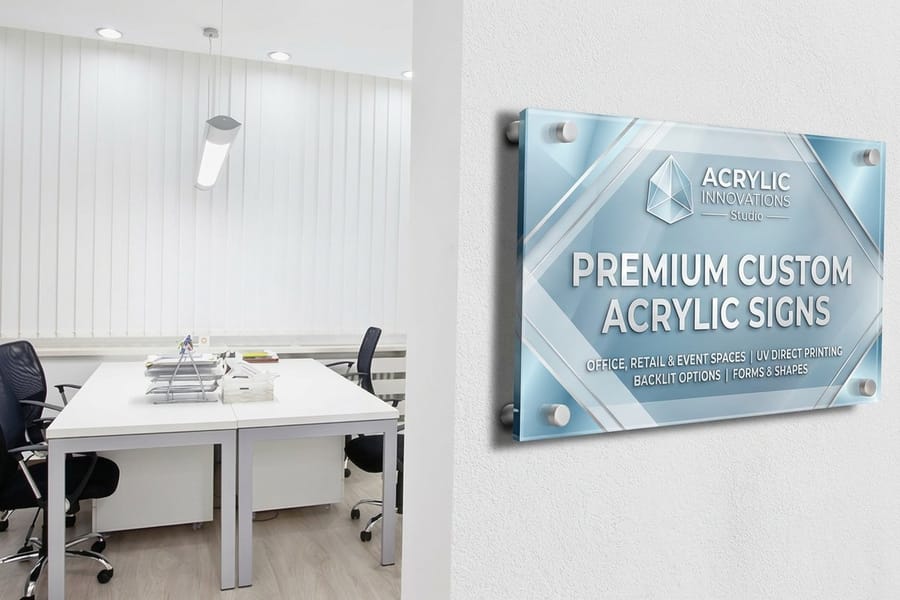
To make a large acrylic sign, build the artwork at full size in CMYK, print it on clear gloss vinyl bonded to a 1/4 inch plexiglass panel with a white vinyl layer behind it, then hang the panel on four standoffs set about an inch in from each corner. The largest single acrylic panel we print is 24 by 36 inches. Past that, split the artwork across two panels with a deliberate seam, or move to aluminum sign panels at 30 by 40 inches or aluminum wall graphics at any size you enter.
Quick answer
A quarter inch of plexiglass, four standoffs, and a hard ceiling at 24 by 36
A large acrylic sign is one rigid panel, not a printed sheet on a board. The graphic prints on clear gloss vinyl that bonds to the front of a 1/4 inch plexiglass panel, a white adhesive vinyl layer behind it keeps the color opaque against the wall, and four standoffs hold the finished panel off the surface so the edges catch light. Our largest acrylic size is 24 by 36 inches, so plan a bigger wall as two panels with a designed seam, or print it on metal instead.
Build a Large Acrylic Sign in Five Steps
Nothing here is complicated, but the order matters. Every step you skip early turns into a compromise at the wall.
- Measure the wall, then subtract. Stand where people will read it and mark the panel outline in tape. A 24 by 36 inch sign that looked huge on screen usually looks correct on a reception wall and small in an atrium. The tape tells you which of the three sizes you actually want.
- Set the document to the finished size. Full scale, CMYK, images placed at 150 ppi. Keep live text and logo edges at least an inch inside the trim so nothing sits in the standoff zone or crowds the polished edge.
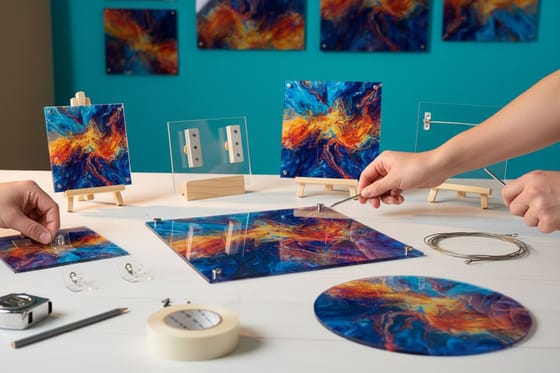
- Decide the mount before you approve the art. Four standoffs, an adhesive mount, or an easel. Each one changes what the corners of your layout are allowed to contain, and this is the decision people leave until the panel is already printed.
- Order the panel and the turnaround together. Acrylic signs run four business days standard, with three-day, two-day and next-day rush available when an opening date is fixed. Rush changes the price, not the build.
- Drill and hang, or stick and level. If you are drilling, use a bit ground for acrylic and back the panel with scrap so the exit side does not chip. If you are taping, clean the wall with alcohol and let it dry, because dust under adhesive is the single most common reason a heavy panel comes off a wall.
Working from a correctly sized layout saves the whole first round. Our blank template library has print-ready sizes to start from, and the custom sign guide covers the same path for the rest of our sign materials.
How Big One Acrylic Panel Can Actually Go
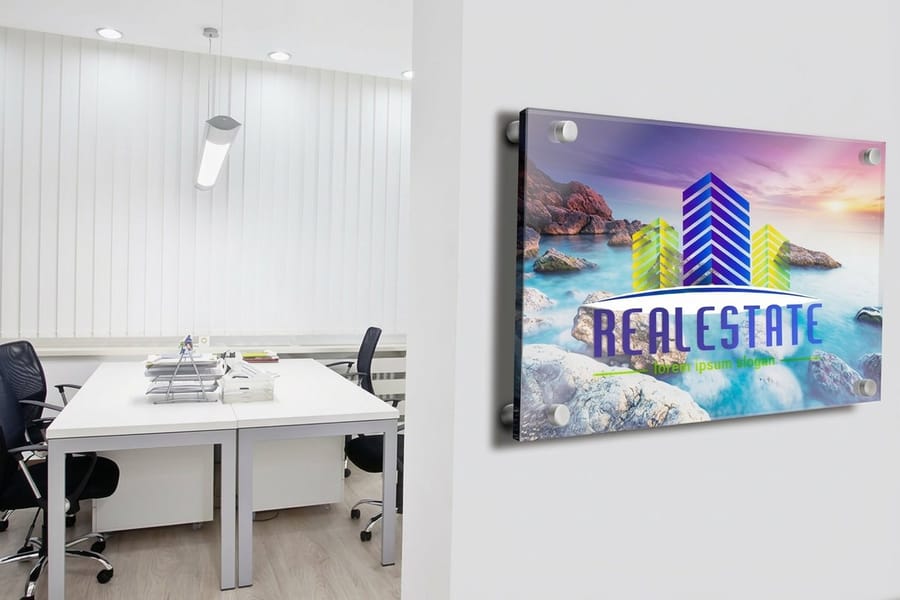
This is where most large sign projects meet reality. The largest acrylic sign we print is 24 by 36 inches, in three stock sizes plus a custom size made to order inside that same ceiling. There is no acrylic option here that covers a 5 foot wall in one piece.
That limit is not arbitrary. Rigid panels get heavy and fragile at the same rate they get big, and a 1/4 inch sheet much past 3 feet becomes awkward to ship undamaged and awkward to hang alone. So the question stops being how large the acrylic goes and becomes which material carries the size you need.
| Product | Largest size | Material | Starts at |
|---|---|---|---|
| Acrylic Signs | 24 x 36 in | 1/4 in plexiglass, clear gloss vinyl face, white vinyl backing | $152.72 |
| Acrylic Prints | 24 x 36 in | Same 1/4 in panel build, tuned for photographic work | $152.72 |
| Aluminum Sign Panels | 30 x 40 in | 1/8 in aluminum, 2.5 mil gloss or matte laminate | $29 |
| Aluminum Signs | 24 x 36 in | .040 in rust-proof aluminum, optional drilled holes | $36 |
| Aluminum Wall Graphics | Any size you enter | 8 mil aluminum foil vinyl, interior walls | $29 |
Read the last row twice. If the goal is a genuinely large wall statement rather than a rigid panel specifically, aluminum wall graphics are printed to the exact width and height you type in, on a metallic-faced material that still catches light. When you want a rigid board and a bit more size than acrylic allows, aluminum sign panels reach 30 by 40 inches on 1/8 inch metal.
The multi-panel route is the other honest answer, and it can look better than one enormous sheet. Split the artwork so the seam falls at a natural break, keep the standoff spacing identical on both panels, and hang them with a consistent gap. A two-panel wall reads as designed. A single oversized panel with a bow in it reads as a mistake.
Standoff Mounting: Holes, Spacing and the Wall Behind Them
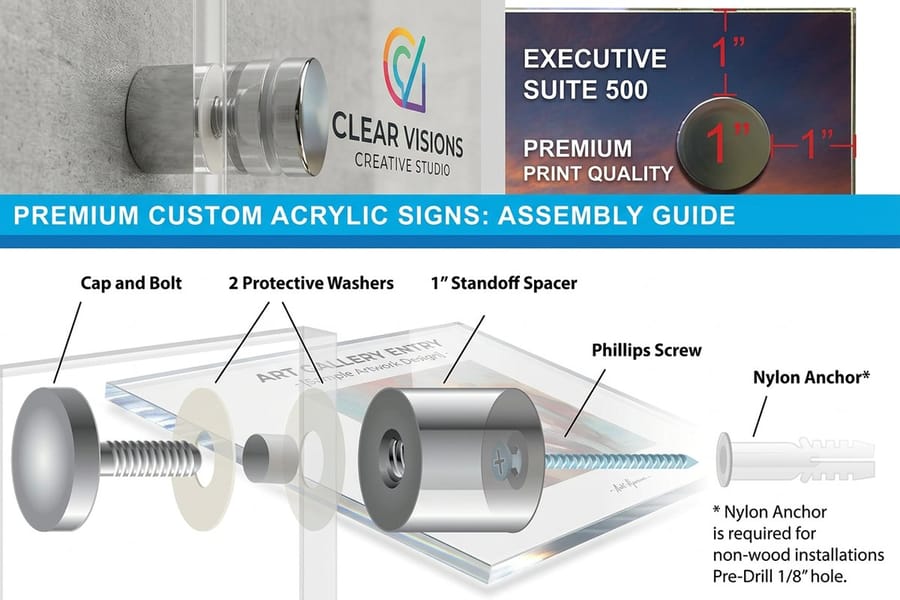
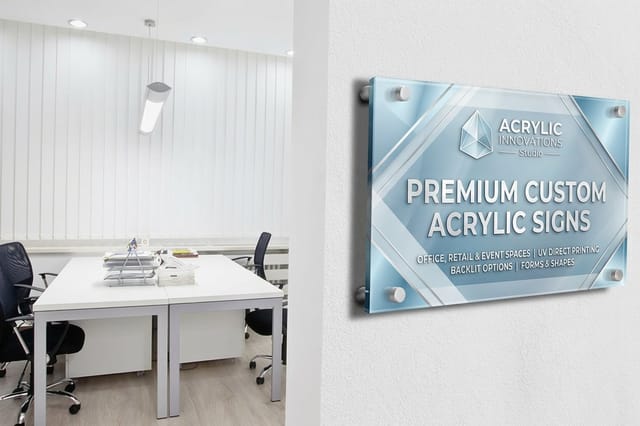
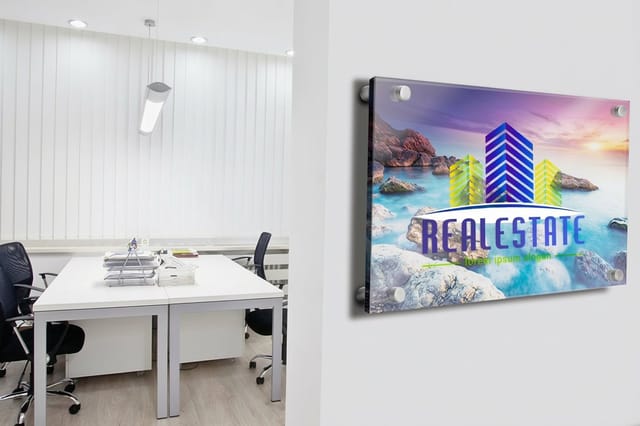
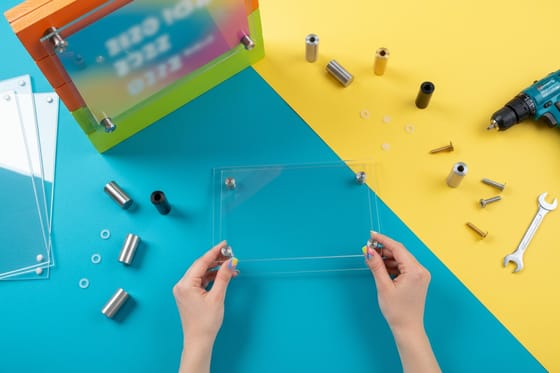
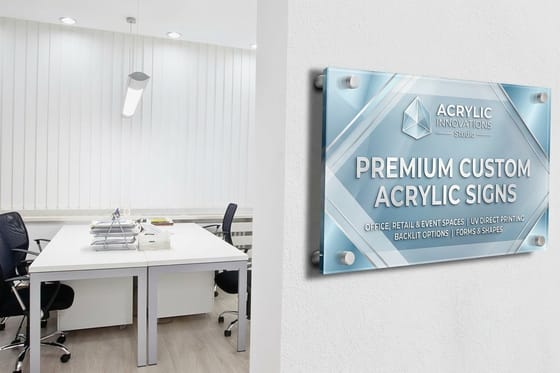
Standoffs are what make an acrylic panel look installed rather than stuck up. The barrel screws into a wall anchor, the panel sits on the barrel, and a cap threads through the panel to hold it. The panel ends up floating a short distance off the wall, and that gap is doing the visual work.
Four standoffs handle a 24 by 36 panel, one near each corner, roughly an inch to an inch and a half in from each edge. Set them closer than that and you are drilling near the weakest part of the sheet. Set them much further in and the corners start to look unsupported even though they are fine. Past 36 inches on the long side, add a standoff at the middle of each long edge rather than moving the corner ones outward.
The wall matters more than people expect. Drywall needs a toggle or a threaded anchor rated for the panel weight, not a plastic plug, since the load hangs off the wall rather than pressing into it. Masonry and tile need a masonry bit and a sleeve anchor. Wood studs need nothing more than a screw of the right length, which is why installers hunt for a stud before they measure anything else.
Drilling acrylic is the step worth paying someone else for. A standard twist bit grabs the material and chips the exit side, and a chip on a clear panel is visible from across a room. A local fabricator will drill four holes in minutes. If that is not practical, mount without holes: our guide to hanging acrylic walks through cleats, adhesive standoffs and tape, and how standoff signage works covers the hardware itself in detail.
Backlighting, Glare, and Where Acrylic Is the Wrong Call
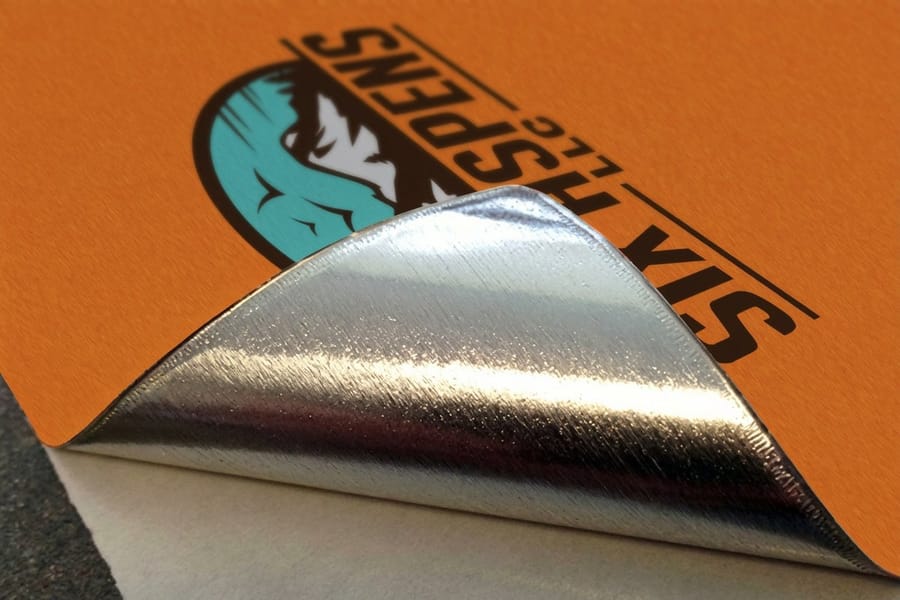
People ask about backlighting more than any other question on large acrylic, so here is the straight version. Our acrylic signs carry a white adhesive vinyl layer behind the print, and that layer exists to block light so the artwork stays solid and opaque against whatever color the wall is painted. A backlight needs to shine through exactly that layer. It cannot.
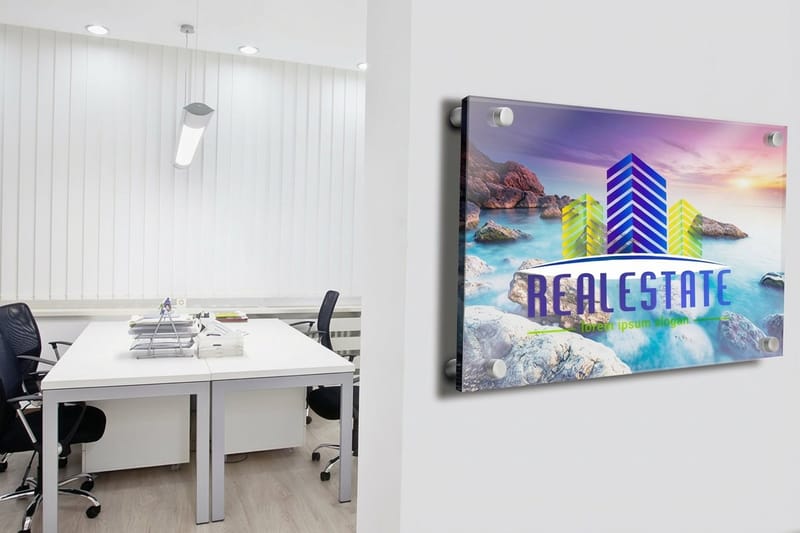
A standoff mount is what gets you the effect people are usually picturing anyway. The panel floats off the wall, room light passes behind it, and the polished edges pick up a bright line. It reads as depth and quality. It is not a glow, and a page that promises you one from a white-backed panel is selling you something the build cannot do.
Glare is the real trade-off with a gloss face. A glossy acrylic panel opposite a window or under a spotlight will mirror both, and a viewer standing in the wrong spot reads the reflection instead of your message. Sight down the wall before you commit to a position. If the only available spot faces a window, a matte-laminated aluminum sign panel will be far easier to read, and it costs less.
Skip acrylic entirely for permanent outdoor signs, for anything that has to be moved often, and for temporary messaging where a rigid premium panel is money spent on a week of use. For those, look at the metal options in our aluminum signs range. For the lobby wall, the reception desk and the storefront interior, acrylic is worth what it costs, and the full lineup sits in the acrylic printing collection next to acrylic prints for photographic work.
Wally explains large acrylic signs
One panel, four standoffs, and a real size limit
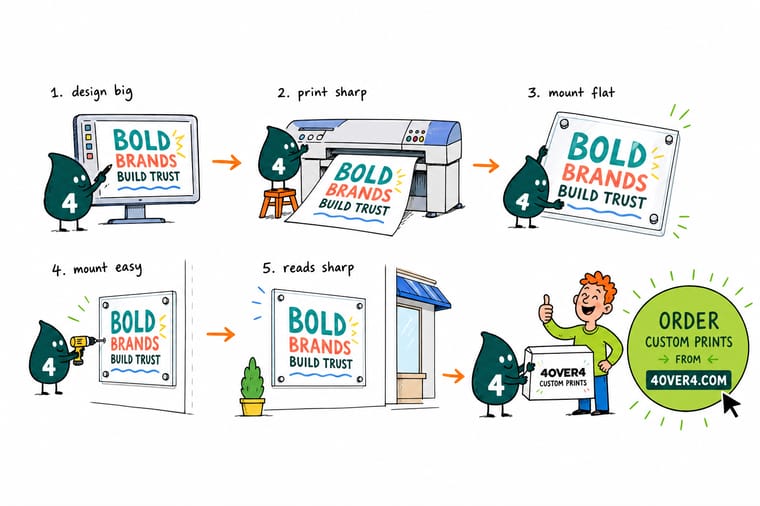
Wally measures the wall first and tapes the outline, because a 24 by 36 panel reads bigger on screen than on a reception wall. He builds the file at full size, keeps the logo an inch clear of the corners so a standoff cap never lands on it, and picks the mount before he approves the art. Then he marks four holes about an inch in from each edge. When someone asks him to backlight it, he turns the panel over and points at the white vinyl: that layer is there to block light, and it is very good at its job.
Configure your acrylic sign →Specs and pricing
Panel sizes, materials, and starting prices
Compare the acrylic panel against the rigid metal alternative, with live configuration choices and starting prices straight from the 4OVER4.COM configurator.



Print it
Order the panel that fits your wall

Explore more
Where to go next


By the numbers
Large format printing you can count on at 4OVER4
Common Questions
Your large acrylic sign questions, answered
How large can a single acrylic sign panel be?
At 4OVER4.COM the largest acrylic sign is 24 by 36 inches. The configurator offers three stock sizes, 16 by 24, 20 by 30 and 24 by 36, and a custom size made to order up to that same 24 by 36 ceiling. If your wall needs more coverage than that, the two honest routes are a multi-panel layout where the seam falls somewhere deliberate in the artwork, or a different substrate. Aluminum sign panels run to 30 by 40 inches, and aluminum wall graphics are printed to whatever width and height you type into the configurator.
Do acrylic signs arrive with standoff holes drilled?
No. The acrylic sign configurator sets size, quantity and turnaround, so the panel ships as a solid sheet with no holes. That leaves you two mounting paths. Have a local fabricator or glass shop drill four holes with a bit made for acrylic, which cuts cleanly instead of grabbing and chipping, or skip drilling entirely and use adhesive standoffs or heavy VHB tape on a flat, sealed wall. Drilled standoffs are stronger and look sharper. Adhesive is faster and does not commit you to hole positions.
How thick should a large acrylic sign be?
A quarter inch is the working thickness for anything at lobby scale, and it is what our panels are built on. Thinner acrylic at 1/8 inch is fine for a small desk plate but flexes noticeably once the span between two mounting points passes about 18 inches, and that flex shows up as a wave in the reflection, which is the first thing anyone notices on a glossy surface. Thicker than a quarter inch buys edge depth rather than strength, and it adds real weight to hang.
Can you backlight an acrylic sign?
Not this build. The white adhesive vinyl behind the print is there to stop light passing through so the color reads solid from the front, and that is exactly the layer a backlight needs to shine through. For a genuine glow you need a translucent print with no blockout backing and an even light source behind it, which is a different product entirely. What a standoff mount does give you is a shadow line: the panel floats off the wall, ambient light passes behind it, and the edge catches. That reads as depth, not illumination.
What resolution should the artwork be for a 24 by 36 panel?
Build the document at 100 percent of the finished size and place images at 150 ppi at that scale. Wall signage is read from three feet and further, so the 300 ppi habit from business cards only inflates the file with detail nobody stands close enough to see. If your software struggles with a full-size canvas, build at 25 percent and place images at 600 ppi, which lands at the same effective resolution. Convert type to outlines and supply CMYK so the color you approve is the color that separates.
How much does a large acrylic sign cost?
Acrylic signs start at $152.72 for a single 16 by 24 inch panel, and the per-sign price drops as the run grows, up to 100 pieces. Size and turnaround move the number, and the configurator shows the total before checkout. For comparison inside our own lineup, aluminum sign panels start at $29 for an 11 by 17 and aluminum wall graphics start at $29 at a size you set yourself. Acrylic costs more because the panel body, the gloss face and the white backing are doing work that a single sheet of metal cannot.
Will an acrylic sign hold up outdoors?
Acrylic itself tolerates weather, but the assembly is built for interior life: reception walls, lobbies, retail interiors, trade show easels. Outdoors, the real enemies are thermal movement in the panel and water finding the edges of the vinyl layers. For an exterior sign that has to survive a full year of sun and rain without anyone thinking about it, print on metal instead. Aluminum signs use .040 inch rust-proof stock and aluminum sign panels use 1/8 inch aluminum with a gloss or matte laminate over the print.
Get Started
Ready to put your name on a panel that reads permanent?
Pick your size, choose the turnaround your opening date needs, and we build the panel on 1/4 inch plexiglass with a gloss face and a white backing that keeps every color solid.
Legal Disclaimer
Gold Standard guarantees apply to all standard orders placed through 4over4.com. Price match requires verifiable proof of a competitor's published price for an equivalent product with matching specifications and turnaround time. Satisfaction guarantee covers manufacturing defects and print quality issues. Contact support with order number and documentation. On-time delivery rate based on tracked orders 1999 to 2026. Individual results may vary based on shipping carrier performance.
