
How to Design a Product Back Label That Scans, Sticks and Complies


The back panel is the one a buyer checks, a scanner reads and an inspector questions. Here is what has to go on it, how small the type can legally get, and how to lay it out so the barcode still reads on a curved bottle.
Design a back label by placing the required blocks first: the ingredient or content list in descending order by weight, the allergen or warning line, net quantity, the business name and address, the barcode, and a blank rectangle for the lot and date code. Only then divide up whatever space is left for brand copy. Required statements cannot be smaller than 1/16 inch measured on a lowercase o, the barcode needs nine module widths of empty margin on each side, and on a bottle under roughly three inches across it should be rotated 90 degrees so the curve does not squeeze the bars.
Quick answer
Obligations first, brand copy with what is left
A back label is laid out from the required information outward, not from the design inward. Set the content list, allergen or warning line, net quantity, business name and address, barcode and lot code panel at their real sizes, and the panel will tell you how much room brand copy has. Required statements stay at or above 1/16 inch measured on a lowercase o, set dark on light and ideally in black only. The barcode keeps nine module widths of empty space each side, prints at 80 percent of full size or larger, and turns 90 degrees on a narrow cylinder so the curve stops distorting the bars.
Everything That Has to Fit on the Back Panel
A back label is a container for obligations. The front sells; the back has to satisfy a regulator, a retailer and a customer who is holding the pack at arm's length in bad light. Start by listing what is mandatory for your category, because that list, not your layout, sets the panel size.
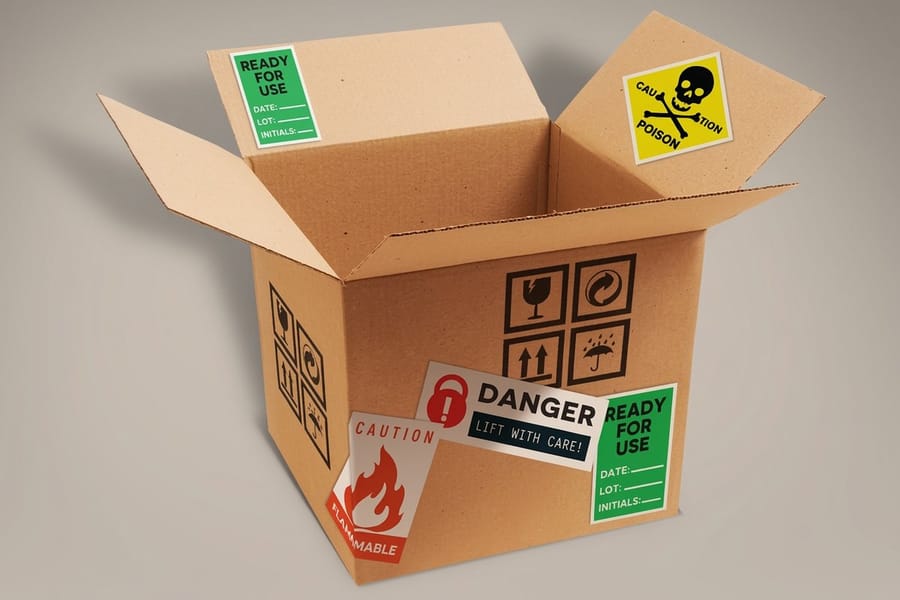
For a packaged food the block runs: ingredient list in descending order by weight, the allergen statement covering the nine major allergens that now include sesame, net quantity of contents in both US customary and metric, and the name and place of business of the manufacturer, packer or distributor. Nutrition Facts joins them on most products, with calories set far larger and bolder than everything around it. Cosmetics swap in an ingredient list in INCI names, descending down to one percent and in any order below that. Cleaning and industrial products carry warning and first aid copy, which is what premium warning labels exist for. Alcohol has its own mandatory statements with their own minimum type size, covered in our beer label compliance guide.
Then add the two things people forget. A barcode, which needs its own protected area rather than a spare corner. And a blank rectangle, usually white, for the lot number and best-before date that gets coded on after the labels arrive. If that blank area is missing, the coder prints over your artwork and the date becomes unreadable. Matte laminate holds thermal and inkjet coding; gloss beads it up.
Write the copy out at full length before you draw anything. A back panel that has been designed and then asked to absorb an extra allergen line is a back panel that gets redrawn.
Type Size, Contrast, and the Legal Block
The rule everyone quotes is 1/16 inch, measured on the height of a lowercase o rather than on the point size in your type panel. In practice that is close to 6 point in most faces, and it is a floor, not a target. Copy that only just clears it will be legal and still hard to read.
Three settings decide whether small type survives the press. Contrast first: dark ink on a light background, never the reverse. White 6 point copy knocked out of a solid closes up when ink spreads even slightly, and the block reads as a grey smudge. Second, the typeface. A face with open counters and even stroke weight holds at 6 point; a high contrast display face with hairline strokes loses the thin parts. Third, leading. Small type set solid becomes a texture. Give it a point or more of extra line spacing and the same copy suddenly scans.
| Setting | Works at 6 point | Fails at 6 point |
|---|---|---|
| Contrast | Dark ink on white or a pale tint. | White type reversed out of a solid or a photo. |
| Typeface | Open counters, even strokes, a real small text face. | Hairline serifs, condensed display faces, script. |
| Leading | A point or more above the type size. | Set solid, which turns the block into texture. |
| Color build | One dark ink, ideally 100 percent black. | A four colour build, where any misregister blurs the edge. |
That last row matters more than it looks. Small text built from cyan, magenta, yellow and black relies on four plates landing exactly on top of each other. Set legal copy in black only and it stays crisp no matter what the press does that morning.
Give the Barcode Room, Then Turn It the Right Way
Scanners do not read bars. They read the transitions between dark and light, which is why the empty space around a code matters as much as the code itself. A UPC carries a quiet zone of nine module widths on each side, roughly a tenth of an inch at full size, and that space has to be genuinely empty. A background tint, a border rule, or a decorative flourish creeping into it is the single most common reason artwork comes back from a retailer.
Size next. A full size UPC is about 1.47 inches wide by 1.02 inches tall, and it can legitimately be scaled between 80 and 200 percent. Below 80 percent the bars get narrow enough that ink spread starts eating the difference between a thin bar and a thick one. Print the bars dark on light, and avoid red or warm pink for the bars entirely, because a red laser scanner sees red as white and reads nothing at all.
Then think about the container. A flat box or a pouch takes a barcode in the normal reading direction without trouble. A bottle does not. On a cylinder under roughly three inches across, the curve compresses the bars that wrap around it, and the compression falls hardest on the outer ones. Rotating the code 90 degrees, so the bar widths run up the length of the bottle instead of around it, takes the curve out of the measurement entirely. Our barcode sticker guide goes further into sizes and symbologies.
Sizing the Panel to the Container
Designers size back labels on an artboard and discover the problem on the filling line. Do the arithmetic on the container first, because a cylinder gives you less usable width than the tape measure suggests.
Circumference is a little over three times the diameter. A 1.75 inch bottle has about 5.5 inches of band. Take out a 2.5 inch front label and a small gap on each side and the back panel is nearer 2.5 inches wide than the 3 you had in mind. On top of that, a label wrapping a small diameter starts to curve away from the eye at the edges, so anything within about a quarter of an inch of the left and right edges reads at an angle.
The one label or two labels question follows from the same numbers. Two labels look cleaner and let you use different stocks front and back, but they have to be applied in register with each other, and on a narrow round bottle that alignment is what drifts. A single wrap-around removes the registration problem and introduces a seam you have to place deliberately. For anything non-cylindrical, a die-cut label lets the shape follow the panel, though every custom shape costs more and eats into usable area at the corners.
Whatever you choose, build the file with 1/8 inch of bleed and keep every piece of copy 1/8 inch inside the cut line. Cutting has a small amount of drift, and a thin border running close to the die is the fastest way to make that drift visible. Our bleed and trim guide covers the setup, and you can start from a correctly sized layout in the blank template library.
Choosing the Stock and Finish for the Back
Front and back labels do not have to be the same material, and on a lot of products they should not be. The front is an image. The back is a document that has to stay readable through whatever the pack goes through.
Paper face stock is the default and the cheapest. Premium product labels start at $29.16 and standard labels at $23.88, and for a dry good on a shelf that is the whole decision. It stops being the right answer the moment moisture is involved. A refrigerated bottle sweats, a bathroom product gets handled with wet hands, and paper lifts at the corners before it does anything else. Premium waterproof labels start at $84.68 on a synthetic face that shrugs that off.
Clear stock is the third option and the one that needs the most thought. Premium clear labels start at $86.17 and give the no-label look that suits a spirit, a serum or a clean liquid. The catch is contrast on exactly the copy that cannot afford to lose it. Print a white block behind the legal panel, or keep the clear stock on the front and run the back on white. The material selection guide walks through face stocks and adhesives in more depth.
Finish is the last call and it is not decorative here. Gloss laminate looks sharp and resists a coder, so a gloss back label and an inkjet date stamp is a fight. Matte takes the code, hides fingerprints, and reads better under a shop light. For products destined for a shipping box rather than a shelf, premium packaging labels and the wider label printing range cover the same specs at case scale. Compare the whole set on the company labels guide if you are speccing product, packaging and asset labels together.
Wally explains the back panel
Legal block, barcode, date code, then the brand
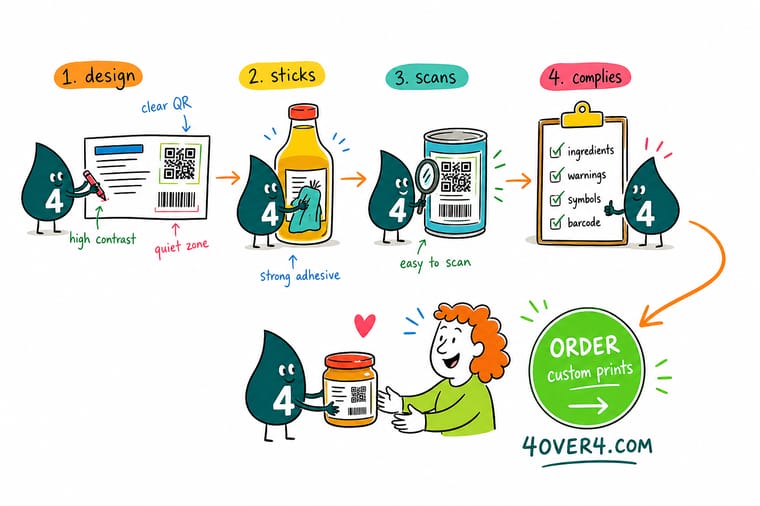
Wally builds a back label in that order every time. Ingredients heaviest first, the allergen line right under them, net quantity in both units, and who made it. Then he draws the barcode with an empty margin nine modules wide on each side, and leaves a white rectangle for the lot and date code the filler will print later. Only then does he ask what is left for the story copy. On a narrow bottle he turns the barcode 90 degrees, because the curve squeezes bars that wrap around it and the scanner stops reading.
Order premium product labels →Specs and pricing
Label sizes, stocks and starting prices
Compare the label stocks a back panel usually lands on, with live size and quantity choices and starting prices straight from the 4OVER4.COM configurator.

Print it
Order labels that hold up on the shelf
Explore more
Where to go next
By the numbers
Label printing you can count on at 4OVER4
Common Questions
Your back label questions, answered
What has to appear on a product back label?
For a packaged food sold in the United States: the ingredient list in descending order by weight, the allergen statement covering the nine major allergens, the net quantity of contents in both US customary and metric units, and the name and place of business of the manufacturer, packer or distributor. Nutrition Facts sits there too on most foods. Cosmetics carry an ingredient list in INCI names, descending to one percent and in any order below that. Household and industrial products carry their warning and first aid copy. On top of the required items, leave a blank rectangle for the lot and date code, because that gets applied after printing.
How small can the type on a back label be?
No required statement can be smaller than 1/16 inch measured on the height of a lowercase o, which lands near 6 point in most typefaces. That is a legal floor, not a design target. Six point copy only survives if it is set positive, dark on a light background, with generous leading and a face that keeps its counters open at small sizes. Reversed white type at 6 point is the setting that fails most often, because ink spread closes the thin strokes and the block turns into a grey bar.
Should the barcode go on the front or the back label?
The back, almost always. Retail scanning cares about a flat, clean, unprinted area rather than a prominent one, and the back panel has space the front does not want to give up. Keep the nine module quiet zone on each side genuinely empty, print the bars dark on a light background, and never put a red or pink bar on a light background because red laser scanners read red as white. A full size UPC is roughly 1.47 by 1.02 inches, and shrinking it below 80 percent of that is where scan rates start to drop.
Do I need a separate back label or one wrap-around label?
Do the arithmetic on the container first. Circumference is a shade over three times the diameter, so a 1.75 inch bottle gives you about 5.5 inches of usable band. Take out the front panel and any gap and the back panel is often narrower than people assume. Two separate labels look cleaner but have to be applied in register with each other, and on a small round bottle that alignment is the thing that goes wrong. A single wrap-around solves the registration problem at the cost of a visible seam.
Are clear labels a bad idea for a back label?
Not a bad idea, just a decision with a cost. Clear stock gives the no-label look, and it is the right call for a spirit or a clean liquid where you want to see through. The problem is contrast: 6 point legal copy sitting over a dark or moving product is hard to read, and readable is a requirement here. The usual fix is a white underprint block behind the legal panel only. Premium clear labels start at $86.17, against $29.16 for premium product labels on white stock, so it is worth deciding which panel genuinely needs the effect.
Does a back label need to be waterproof?
It depends on what the pack goes through, not on what the product is. Anything that is refrigerated, iced, kept in a bathroom, or squeezed with wet hands will lift or wrinkle a paper label at the corners first. A synthetic face stock takes that. Premium waterproof labels start at $84.68 against $29.16 for the paper premium product labels, so the sensible test is whether condensation or handling will touch the label before the product is used up. Dry goods on a shelf do not need it.
Get Started
Ready to print a back label that passes on the first try?
Pick a paper, waterproof or clear face stock, set the legal block at size, and we print labels that scan at the register and stay put in a cold case.
Legal Disclaimer
Gold Standard guarantees apply to all standard orders placed through 4over4.com. Price match requires verifiable proof of a competitor's published price for an equivalent product with matching specifications and turnaround time. Satisfaction guarantee covers manufacturing defects and print quality issues. Contact support with order number and documentation. On-time delivery rate based on tracked orders 1999 to 2026. Individual results may vary based on shipping carrier performance.
