
How to Design a Branded Business Tablecloth That Reads Across the Aisle


Sofia is our design and templates voice, built from the knowledge of our production team, with over 20 years in printing.
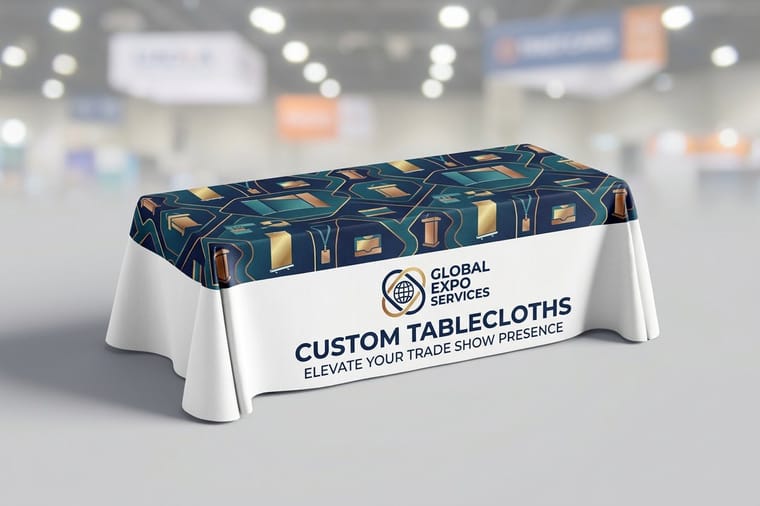
A branded business tablecloth, the printed table cover at your booth, has about 14 usable inches of height and two seconds of attention. The logo has one place to sit, one size range, and a file built for dye sublimation.
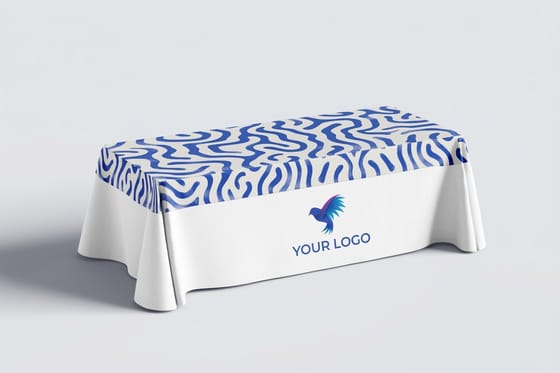
Center the logo on the front panel between 6 and 20 inches below the tabletop, set it at 3 to 5 inches of cap height, and add one short line at 2 inches. The top 6 inches of a 30 inch drop are lost to the table lip and stacked flyers, and the bottom 10 inches sit behind chairs and standing visitors. Build the file at full size and 150 dpi with vector logos, remember that dye sublimation has no white ink and cannot match metallics, and keep all artwork 2 inches clear of hems and seams.
Quick answer
Fourteen inches of fabric do all the work
A branded table cover is designed for the band between 6 and 20 inches below the tabletop, because that is the only part of a 30 inch drop an aisle reliably sees. The logo sits centered in that band at 3 to 5 inches of cap height, with one short line under it at 2 inches and the website moved to the short side panels. Everything else is background. To heat transfer a logo to a tablecloth, we print it by dye sublimation: the dye goes onto transfer paper, then heat turns it to gas and bonds it into the polyester, so the logo sits in the cloth and survives folding and washing. For a round demo table, a 36 inch round table cover comes in 28 inch standard or 42 inch bar height. The file is built full size at 100 to 150 dpi with vector type, and dye sublimation onto polyester means white is the bare fabric, saturated colors land slightly softer, and metallic inks are not available at all.
Design the Band the Aisle Actually Sees
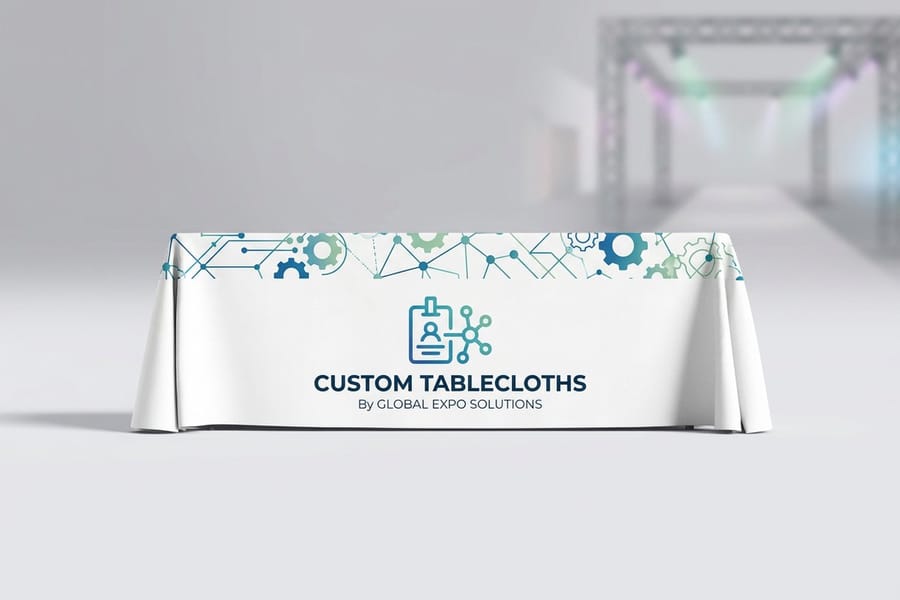
Start by throwing away most of the panel. A standard trade show table is 30 inches high, so a full drape cover gives you a front face roughly 72 inches wide by 30 inches tall on a 6 ft table, or 96 by 30 on an 8 ft. Almost half that height never gets read.
The top 6 inches or so are compromised by the table edge itself: the lip casts a shadow under most booth lighting, and it is where flyer stacks, a card holder and a laptop lid end up sitting. The bottom 10 inches are worse. That zone is behind chairs, product cases, a wheeled bag and the legs of whoever is standing at your table, which is exactly the situation your cover exists for. What survives is a band about 14 inches tall, starting roughly 6 inches below the tabletop.
Put the logo there and nothing else fights it. One short line underneath, set smaller, is the most any cover should carry. If you have a second message, it belongs on a retractable banner stand at eye level rather than crammed into fabric that is half hidden. The table cover sizing and fit guide works through the flat dimensions and the drop measurement in detail if you are still deciding on the style.
One more habit worth adopting: hold all artwork at least 2 inches clear of the hems and the seams. Covers are cut and sewn, and a logo that runs into a corner seam gets folded across a stitched edge.
Sizing the Logo and Type for Ten Feet of Aisle
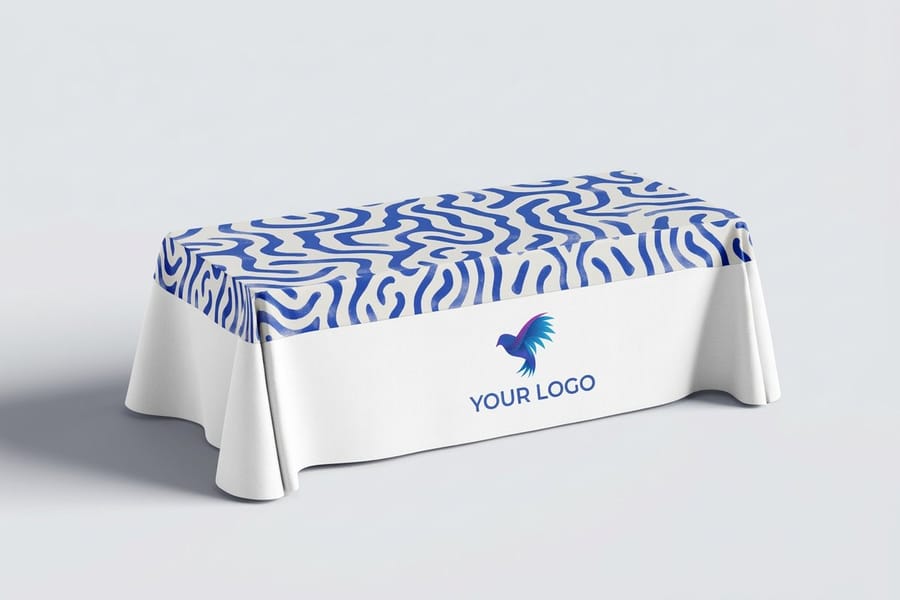
The mistake almost everyone makes is designing on a screen where the whole cover fits in a window and looks balanced. Nobody sees it that way. They see it in profile, at an angle, from across an aisle, for about two seconds.
Use the signage rule of thumb: roughly one inch of capital letter height for every ten feet of viewing distance. Trade show aisles typically run eight to twelve feet wide, so one inch caps is the absolute floor for anything you expect people to read while walking. In practice, set the company name or logotype at 3 to 5 inches of cap height and the single supporting line at 2 inches. Anything set at half an inch is decoration, not communication.
| Element | Cap height | Where it goes | Why |
|---|---|---|---|
| Logo or logotype | 3 to 5 in | Centered, 6 to 20 in below the top edge | The only thing read from the aisle. Give it room on both sides. |
| What you do, one line | 2 in | Directly under the logo | Five words at most. Read second, if at all. |
| Website | 2 in | Short side panels | Photographed or remembered. Keeps the front clean. |
| Phone, address, socials | Leave off | On the printed collateral instead | Nobody transcribes small print from fabric at walking pace. |
Contrast decides legibility more than size does. A mid tone logo on a mid tone background disappears under the flat, even lighting of a hall, no matter how large it is. Dark background with a light mark, or the reverse, and check it by shrinking your layout to thumbnail size on screen: if the mark stops reading at two inches wide on a monitor, it will not hold at ten feet either.
Building the File for Dye Sublimation on Polyester
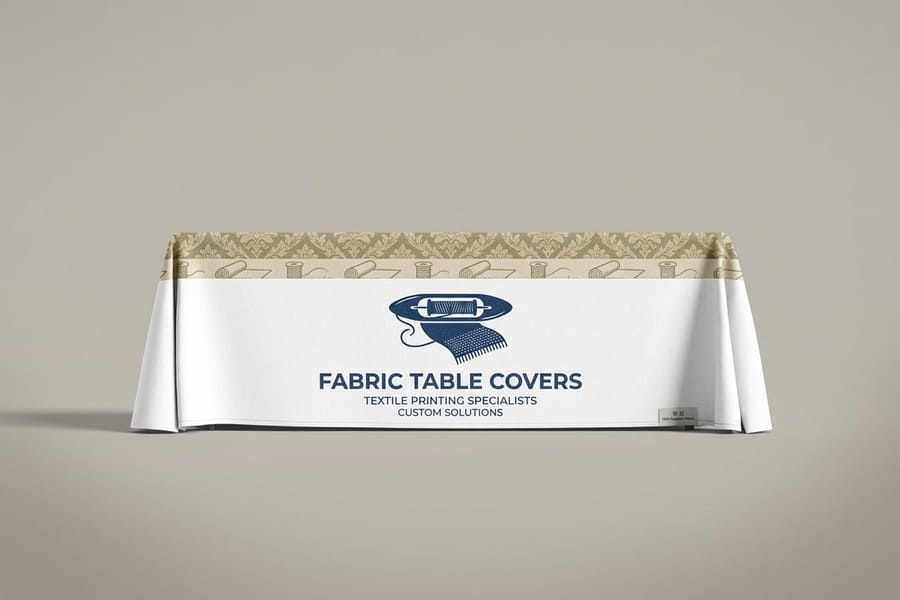
Printed table covers are dye sublimated. The dye is printed onto transfer paper, then heat turns it to gas and bonds it into the polyester fiber, so the color is in the cloth rather than on it. That is why the print does not crack along fold lines and why the cover can be washed, and it also sets three rules for your file.
- There is no white ink. Every white area in your design is the undyed fabric. That is fine on a white base cloth and impossible on a colored one, so a design with white lettering needs a printed background behind it, edge to edge.
- Color lands softer than a coated proof. Dye in fiber scatters light differently than ink on gloss stock. Saturated brand colors reproduce slightly less punchy, and metallics and true spot Pantones cannot be matched at all. A metallic gold comes back as a flat tan.
- Scale is the resolution problem. Build at full size and 100 to 150 dpi, or quarter size and 400 to 600 dpi. Keep logos and type as vector so they stay crisp when the file is output at 72 inches wide.
Choose the background color with the venue in mind rather than the screen. Mid to dark tones hide the creases polyester carries out of the shipping fold, and they hide the coffee ring somebody will leave on day one. A pale gray cover looks elegant in the mockup and shows every fold line under hall lighting. Our fabric comparison guide covers how polyester, stretch and vinyl differ once they are on a table, and the blank template library gives you a correctly sized starting document so you are not calculating the drop by hand.
When the layout is done, look at it as a rectangle 30 inches tall and mask off the top 6 and the bottom 10. If what remains still says who you are, the design works. If the logo was straddling the masked zone, move it up.
Sides, Stretch Corners, and Changing the Message Between Shows
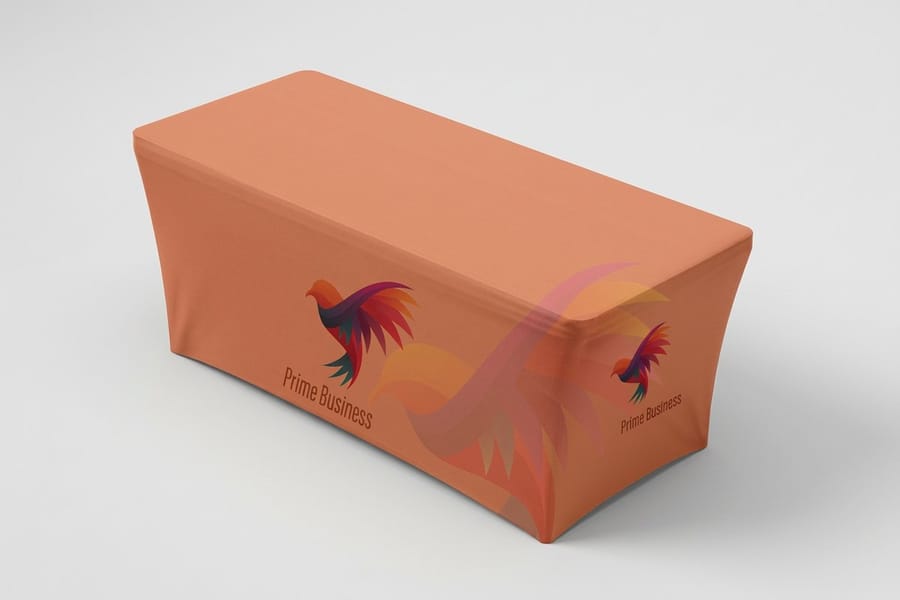
The two short ends of a 6 ft cover are 30 inches wide each, and they face the aisle at every approach angle except head on. Repeat the logo or set the website there. The back panel is usually the one you can skip, which is why an open back throw exists: three printed sides, less fabric, and a gap for your chairs and boxes. If the booth is an island with traffic on all four sides, that saving stops making sense and you want the full drape.
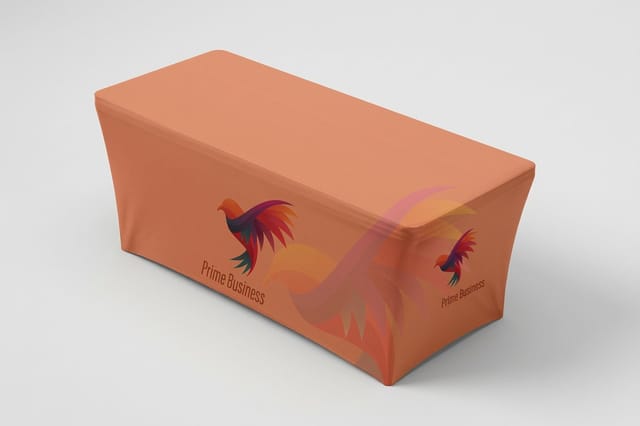
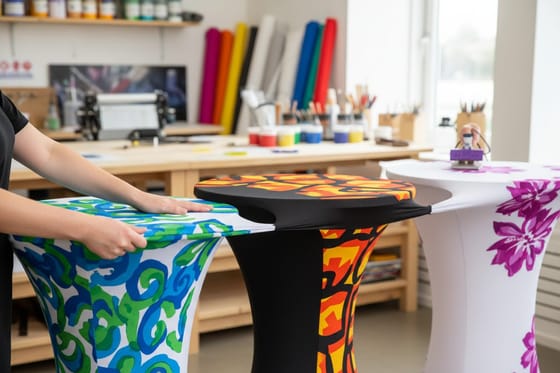
Style changes what your artwork can do. A draped cover hangs straight and keeps geometry honest, so patterns, borders and edge to edge layouts hold their shape. A stretch table cover looks tighter and more modern, but the fabric is pulled hardest at the corners and along the top edge, which pulls printed shapes with it. Circles go oval, thin lettering thins further, and any repeating grid loses its rhythm. Keep detail centered on the front face of a stretch cover and let the edges carry flat color. For a draped cut, start from a fabric table cover on 9oz polyester, and for an oval table, the Oval Table Covers story shows finished covers.
| Style | Starting price | What the artwork can do | Best for |
|---|---|---|---|
| Standard tablecloths | $225.00 | Full drape, geometry stays true, patterns and borders hold. | The default booth cover, and any design with structure. |
| Table throws | $225.00 | Three or four printed panels, front face is the hero. | Standard 6 ft and 8 ft show tables with the back against a wall. |
| Stretch table covers | $250.00 | Centered marks only, corners distort detail. | A tight, modern look where the logo sits in the middle. |
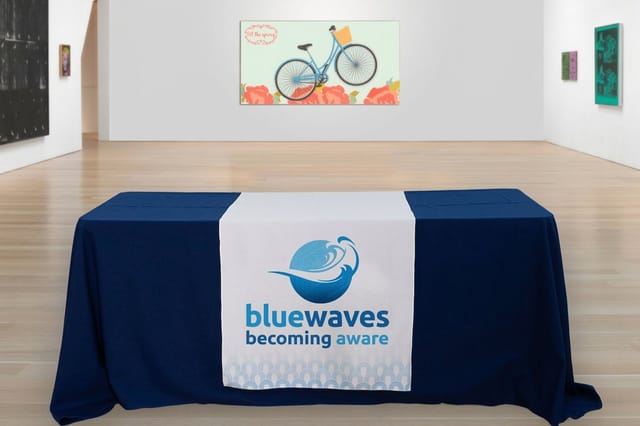
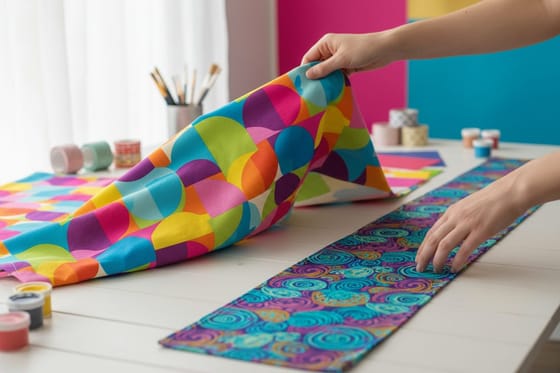
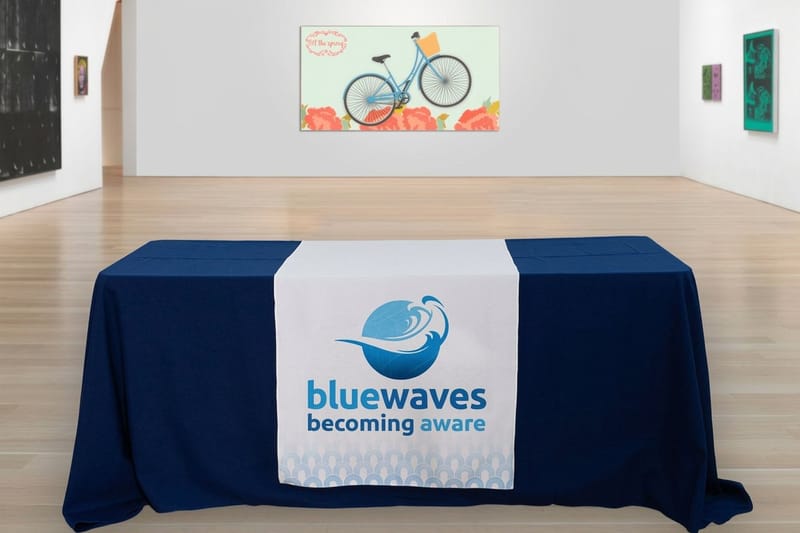
| Table runners | $97.76 | A narrow vertical strip over a plain cloth. | Swapping the message per show without reprinting the cover. |
That last row is the one exhibitors underuse. Print the cover with your identity and nothing time sensitive, then run a table runner down the front carrying this show's offer, the new product name or the booth number. Reprinting a runner costs a fraction of reprinting the cover, and your brand piece stays in service for years. Browse the full range at table covers printing, and if you are still choosing between a cover and a hanging banner, the table banners guide lays out the difference.
Wally explains the table cover read band
Six inches down, fourteen inches tall, one logo
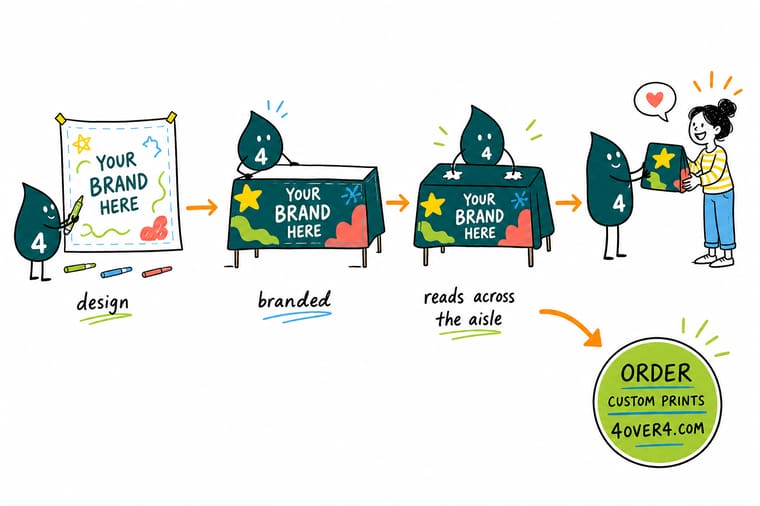
Wally drapes the cover, then crouches in the aisle to look at it the way a visitor will. The top of the panel is behind the table lip and a stack of flyers. The bottom is behind a chair and somebody's tote bag. What is left is a strip about 14 inches tall, so that is where the logo goes, big enough to read at three inches of cap height, with one short line under it. The website moves to the side panels. Everything else is just color.
Configure a custom tablecloth →%22%2F%3E%3Ccircle%20cx%3D%2249%22%20cy%3D%2220%22%20r%3D%2224%22%20fill%3D%22%232dd4bf%22%20opacity%3D%220.15%22%2F%3E%3Ccircle%20cx%3D%2254%22%20cy%3D%2227%22%20r%3D%22-3%22%20fill%3D%22%232dd4bf%22%20opacity%3D%220.1%22%2F%3E%3Crect%20x%3D%2279%22%20y%3D%22-9%22%20width%3D%2234%22%20height%3D%2220%22%20rx%3D%224%22%20fill%3D%22%232dd4bf%22%20opacity%3D%220.08%22%20transform%3D%22rotate(44%2080%2030)%22%2F%3E%3C%2Fsvg%3E)
Specs and pricing
Table cover styles, sizes and starting prices
Compare the drape, fitted and stretch options side by side, with live configuration choices and starting prices straight from the 4OVER4.COM configurator. Draped tablecloths come at 84 x 126.5 inches for a 6 ft table or 84 x 150.5 for an 8 ft table on 9oz premium polyester with 1 inch hems, stretch covers on 8.8oz tension fabric, all from a single cover with 4 business days of production.
Print it
Print the cover your booth is remembered by
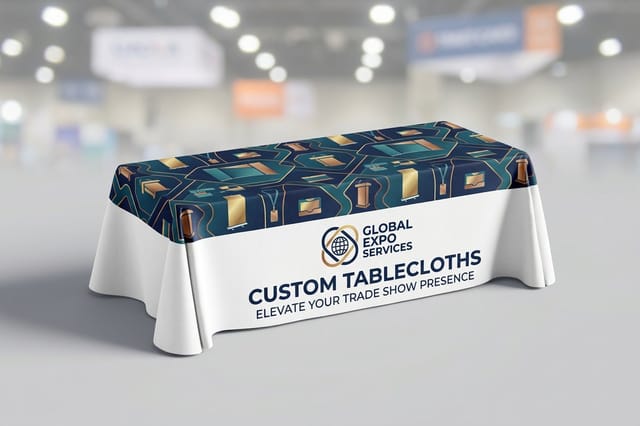
A draped tablecloth for a 6 ft or 8 ft table, a stretch cover on tension fabric for a fitted look, and table runners from 24 x 72 to 60 x 90 inches when a strip across a plain cloth is enough.

Explore more
Where to go next
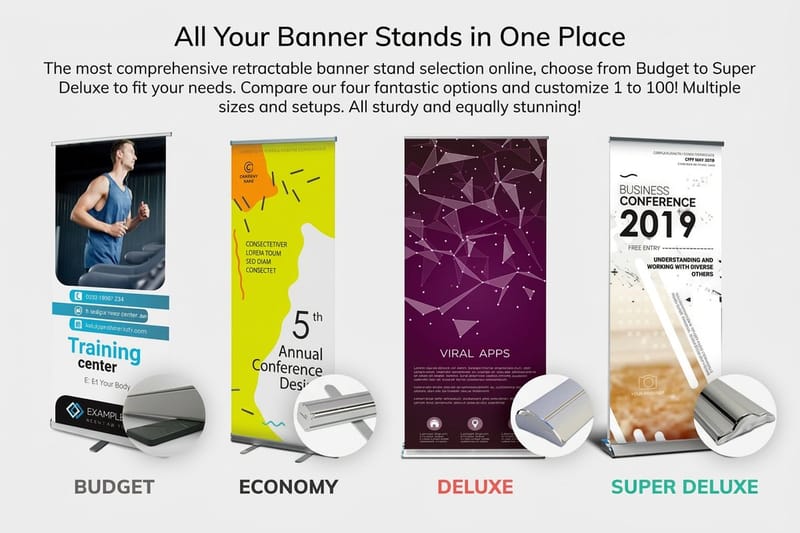
Four guides, the table cover range and one product: drop and print area for the venue table, polyester against stretch against vinyl, covers against runners, booth layout, every cover style, and the retractable banner that carries the rest of the message.
By the numbers
Trade show tablecloths inside 1,000+ products
Common Questions
Your tablecloth design questions, answered
Where should the logo go on a branded business tablecloth?
Centered on the front panel, roughly 6 to 20 inches down from the tabletop edge on a standard 30 inch drop. Higher than that and the table lip plus the literature people stack on the edge cuts into it. Lower and it hides behind chairs, product cases and the legs of anyone standing at your booth. That leaves about 14 usable inches of height, which is enough for a logo with a 3 to 5 inch cap height and one short line under it. On an 8 ft cover you get 96 inches of width, so resist the urge to fill it. Wide empty space on either side of a single mark reads as confidence and stays legible from an angle.
What resolution does a table cover file need?
Build the artwork at full size and 100 to 150 dpi, or at quarter size and 400 to 600 dpi, whichever your machine can handle. A 6 ft cover at full scale is a 72 inch wide document, which is a large file at 150 dpi, so quarter scale is often the practical route. Logos and type should be vector, placed rather than rasterized, because they are the elements a viewer actually resolves. A photo that looks fine on a business card will be reproduced at roughly ten times that size on a table cover, and every soft edge in it shows.
Will my brand colors match exactly on a printed tablecloth?
Close, not identical, and it is worth knowing why before you approve a proof. Dye sublimation puts dye into polyester fiber rather than laying ink on a coated surface, so saturated colors read slightly softer and warm tones can shift a touch. There is no white ink, so anything white in your design is the bare fabric. Metallics and true spot Pantone colors cannot be reproduced, and a metallic gold in a logo will come back as a flat mustard or tan. If your identity depends on one exact color, send the reference with the order so we can match as closely as the process allows, and expect the fabric to read a shade quieter than the same file on a printed brochure.
Should I put my website and phone number on a table cover?
Put the website on it, skip the phone number. Nobody dials a number they read while walking past a booth, but a short domain is remembered or photographed. Set the URL at 2 inch caps or larger and place it on the short side panels rather than the front, where it competes with the logo. If you need a call to action on the front, make it a benefit rather than contact details, because whoever wants to reach you will take a card or a flyer from the table anyway.
Can I use a detailed design on a stretch table cover?
Only in the middle of the front face. A stretch cover works by pulling four way stretch fabric taut over the table and hooking under the corners, and that tension pulls the printed area out of shape wherever the fabric is stretched hardest, which is at the corners and along the top edge. Circles become ovals, tight lettering thins out, and a repeating pattern loses its grid. A centered logo on a solid or gradient background survives it well. If your design has edge to edge structure, a draped throw keeps the geometry honest.
Do I need to design the back and the sides?
The sides yes, the back usually not. On a 6 ft table the two short ends are 30 inches wide and they face the aisle at every angle except straight on, so they are seen more often than most people expect. A repeat of the logo or the URL there is worth the trouble. The back panel faces a curtain or the aisle behind you and is normally hidden by your own staff and storage, which is why open back throws exist and why they cost less fabric to make. If the booth is an island with traffic on all four sides, design the back like a second front.
How do I get the creases out before the doors open?
Hang the cover the night before if the venue allows it, or drape it over the table as soon as you unpack. Polyester releases fold lines with time and a little warmth, and a handheld steamer clears the stubborn ones in a few minutes. Never press a hot iron directly onto a dye sublimated panel. Darker and mid tone backgrounds hide residual creasing far better than pale ones, which is a real design decision rather than a laundry problem: a white or light gray cover shows every fold line and every coffee ring under booth lighting.
Get Started
Order a printed tablecloth from $225.00
Pick the drape, upload artwork built for the read band, and we print it into polyester so the color never cracks along a fold.
Legal Disclaimer
Gold Standard guarantees apply to all standard orders placed through 4over4.com. Price match requires verifiable proof of a competitor's published price for an equivalent product with matching specifications and turnaround time. Satisfaction guarantee covers manufacturing defects and print quality issues. Contact support with order number and documentation.
