
How to Size Space and Apply Boat Name Lettering the Right Way


Boat lettering is part rulebook, part craft. Your registration numbers have to meet US size and contrast rules, your name lettering has to be sized and spaced to read from the dock, and all of it has to be cut from marine-grade vinyl that survives sun and spray.
Applying boat lettering means meeting the US display rules, sizing and spacing the letters to read clearly, and using marine-grade vinyl. Registration numbers must be plain block letters at least 3 inches tall, in a color that contrasts the hull, on both sides of the forward half. Boat names run larger on the transom. Clean the surface, position with the hinge method, squeegee firmly, then peel the transfer tape.
Start here
Three inch numbers, then the name
Boat lettering is vinyl graphics applied to a hull: the required registration numbers and the boat name. The numbers must meet US display rules for height, style, and contrast, while the name is sized and spaced for legibility. Both are cut from marine-grade vinyl and applied with the hinge method for straight, bubble-free results. The diagram below shows where each element goes and how tall it has to be.
What boat lettering actually covers
Boat lettering is two jobs in one. The first is the required registration marking, the state-issued number that every powered vessel must display. The second is the boat name and hailing port, the personal touch on the transom that most owners care about most. Both are made the same way, from adhesive vinyl cut to shape, but the rules that govern them differ.
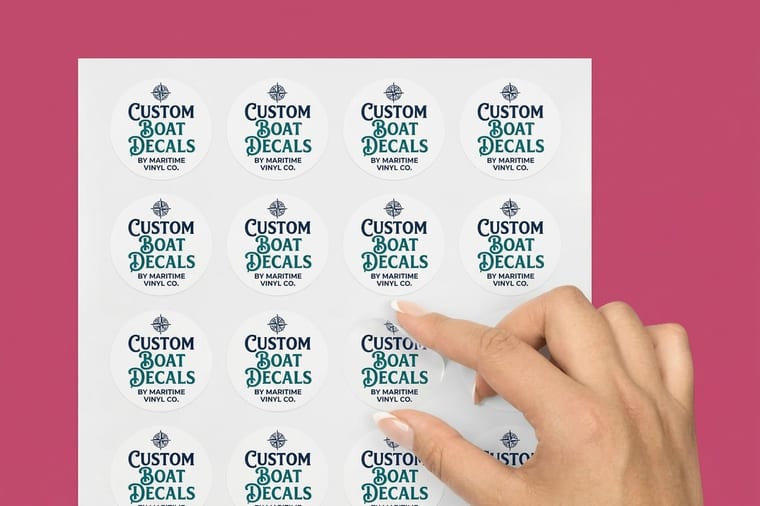
Get the distinction right from the start, because it changes your material and layout decisions. Registration numbers are about compliance and legibility under inspection, so they favor plain, high-contrast block type. The name is about style, so it can carry a script or a custom font, as long as it still reads clearly. Our custom boat decals and decals cover both jobs, and the wider decals range handles related graphics like registration stripes and cove lines.
If you want the layout dialed in before you order, our online design tool lets you set the exact letters, font, and color, so you approve the look on screen before any vinyl is cut.
US registration lettering rules

Federal and state rules set clear requirements for how your registration number is displayed. The number must be painted or applied as plain block characters at least 3 inches high, read from left to right, and stand in a color that clearly contrasts the hull, so light letters on a dark hull or dark letters on a light hull. It has to appear on both sides of the forward half of the vessel, and nothing may crowd or obscure it.
Spacing matters to the law too. The letters and numbers that make up the registration are separated into groups, and a space equal to the width of a letter, or a hyphen, must sit between the groups. So a number reads as three clean clusters rather than one long run. Only the current registration and validation stickers should sit near it.
Documented vessels follow a parallel rule for the name. The boat name and hailing port must be marked together on the stern in clearly legible letters at least 4 inches high. Check your state boating agency for any local specifics, then set your registration lettering to the strictest requirement so a single design works everywhere you launch.
Sizing and spacing the name for legibility

Unlike the registration number, the boat name has no fixed height, so legibility is your guide. On most recreational boats the name runs between 6 and 12 inches tall on the transom, scaled to the width of the stern and the distance you want it read from. A good rule is to make the name tall enough to read comfortably from a slip or two away, then check it against a taped mock-up before you commit.
Spacing is what keeps a large name from turning into a smear at a distance. Give each letter a little breathing room, tighten or loosen the kerning so no two letters collide or drift apart, and keep any tagline or hailing port on its own clear line. A script font needs extra care, since connected letters can fill in and lose their shape when read from far away.
Lay the name out to the transom's real dimensions, not a generic rectangle, so it sits centered and balanced once applied. When you are happy with the size and spacing, order it as custom boat lettering cut to your exact specification.
Choosing marine-grade vinyl that lasts

Vinyl is where a boat graphic lives or dies. Cast vinyl is the marine standard: it is thin, highly conformable, and holds UV-stable pigment that resists fading for years of sun exposure. Calendered vinyl is thicker and cheaper but shorter-lived, and it can shrink or lift over time, which is why serious boat lettering uses cast film with a marine-rated adhesive built to grip through salt, spray, and temperature swings.
Match the film to the surface and the finish you want. A conformable cast vinyl follows the gentle curves and rivets of a hull without tenting, and a clear over-laminate or UV-resistant film adds another layer of protection against abrasion and fading. For registration numbers, a high-contrast solid color keeps you compliant, while the name can use metallic, reflective, or specialty films for a custom look.
4OVER4 cuts boat lettering from durable outdoor vinyl designed for exactly this environment, the same material family behind our custom car decals and other vehicle graphics. If moisture and weather are a concern for related signage, the decals collection lists the weatherproof options.
Applying the lettering step by step

Application is a clean-surface job first and a patience job second. Wash the area with soapy water, then wipe it down with denatured or isopropyl alcohol so no wax, grease, or salt film is left behind. Any contamination under the vinyl becomes a bubble or a lifted edge later. Let the surface dry completely and work out of direct midday heat, which makes the adhesive grab too fast.
Position the lettering with masking tape, step back, and confirm it is level and centered against the transom or hull line. Then use the hinge method: run a strip of tape across the middle of the design, fold one half back, peel away its backing, and squeegee that half down from the center outward. Remove the tape, repeat on the other half, and press every letter firmly.
Finish by slowly peeling the transfer tape back at a sharp angle so the vinyl stays on the hull, not the tape. Go slowly around fine letters and script tails. Smooth any small bubbles toward the nearest edge with the squeegee, and give the adhesive a day to cure before the boat sees heavy spray.
Wally squeegees it straight the first time
Legal numbers, a readable name, marine vinyl
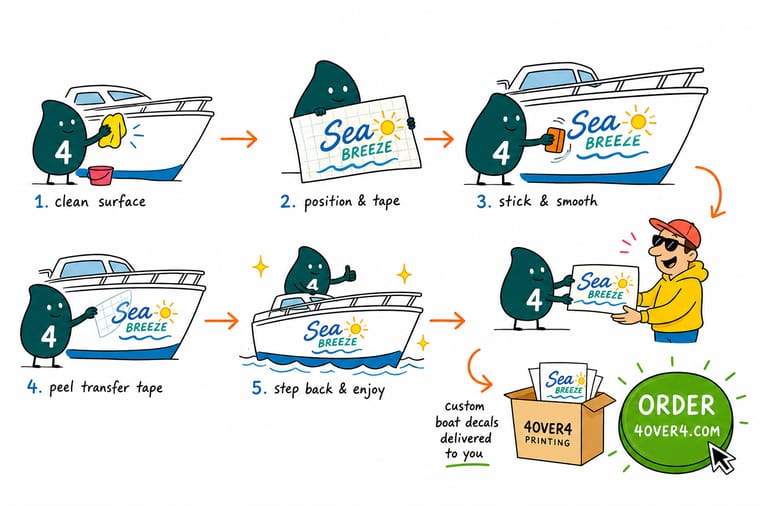
Wally keeps two rules in mind: the registration number is plain block type at least 3 inches tall in a contrasting color on both sides, and the name is sized 6 to 12 inches to read from the dock. Clean the hull, hinge the vinyl, squeegee from the center out, then peel the tape slow. Order it in marine-grade cast vinyl and 4OVER4 cuts it to your exact spec.
Order boat lettering →Quick reference
Boat lettering spec at a glance
The numbers that keep you legal and the choices that keep the name readable and long-lasting.
| Element | Target | Why it matters |
|---|---|---|
| Registration number | Plain block, at least 3 in tall | Required US display standard for powered vessels; must read left to right. |
| Contrast | Color that stands off the hull | Light on dark or dark on light keeps the number legible under inspection. |
| Placement | Both sides, forward half | Rules require the number on each side of the front half of the boat. |
| Group spacing | Letter-width space or hyphen | Separates the number groups so the registration reads as distinct clusters. |
| Boat name | 6 to 12 in on the transom | Sized for legibility from a slip away; documented vessels need 4 in minimum. |
| Vinyl | Cast, UV-stable, marine adhesive | Conforms to curves and resists sun, salt, and spray for years. |
| Application | Clean surface, hinge method | A spotless surface and a taped hinge give straight, bubble-free results. |
Step by step
Apply boat lettering in 7 steps
- Confirm the legal requirements Set your registration number to plain block letters at least 3 inches tall in a contrasting color, and note any state-specific rules before you design.
- Lay out the name to the transom Size the name 6 to 12 inches tall to the real width of the stern, with even spacing so it reads clearly from a distance.
- Order the lettering in marine vinyl Choose cast, UV-stable vinyl with a marine adhesive so the graphic survives sun, salt, and spray.
- Clean the surface completely Wash with soapy water, wipe with alcohol, and dry fully so no wax or salt film is trapped under the vinyl.
- Position and tape it level Hold the lettering in place with masking tape, step back, and confirm it is centered and level against the hull line.
- Apply with the hinge method Hinge the design with a center tape line, peel and squeegee one half from the center out, then repeat on the other half.
- Peel the transfer tape and cure Remove the transfer tape slowly at a sharp angle, smooth any bubbles to the edge, and let the adhesive cure before heavy use.
Specs and pricing
Boat decal specs and live pricing
Once your letters, size and color are set, material and quantity are what is left. Boat decals run 25 for $93.37, which is $3.73 each.

| Quantity | Price Per Unit | Total |
|---|---|---|
| 25 | $3.73 | $93.37 |
| 50 | $1.91 | $95.56 |
| 100 | 100.0¢ | $99.95 |
| 200 | 56.3¢ | $112.59 |
| 300 | 41.4¢ | $124.13 |
| 400 | 33.9¢ | $135.65 |
| 500 | 29.2¢ | $146.10 |
| 600 | 26.4¢ | $158.17 |
Order it
Order your boat lettering at 4OVER4

See it in use
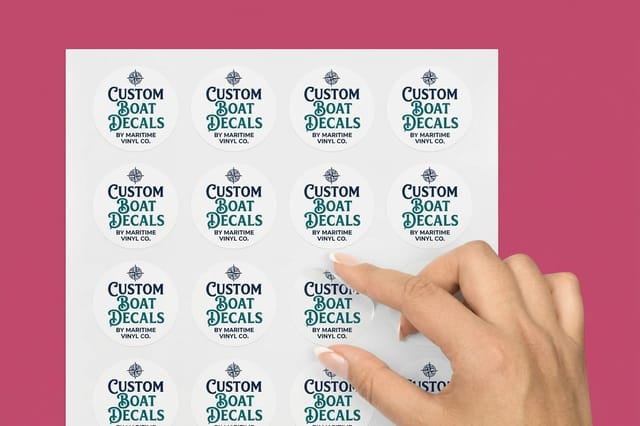
Boat lettering and hull decals our customers ordered








Explore more
Where to go next





By the numbers
Vinyl decal orders, by product count and delivery record
Common Questions
Common questions about boat lettering
What is boat lettering?
Boat lettering is adhesive vinyl applied to a hull, covering two things: the state-issued registration number every powered vessel must display, and the boat name and hailing port on the transom. The registration marking follows strict US rules for height, style, and contrast, while the name is a more personal graphic sized for legibility. Both are cut from marine-grade vinyl and applied with a squeegee, most often using the hinge method for straight, bubble-free placement.
What height does my registration number have to be?
Start with the two jobs separately. For the registration number, choose a plain block font at least 3 inches tall in a color that contrasts your hull, since that keeps you compliant. For the name, pick a font that still reads clearly at 6 to 12 inches on the transom, and choose a vinyl finish, solid, metallic, or reflective, that fits the look you want. In every case, specify cast marine-grade vinyl with a UV-stable pigment and a marine adhesive so the graphic lasts.
What does boat lettering cost and how is it priced?
Boat lettering price scales with the size of the lettering, the material and finish you choose, and the quantity. Larger names use more vinyl, specialty films like metallic or reflective cost more than a standard solid color, and ordering both sides plus the transom name together affects the total. You set the size and options in the configurator and the price updates live as you adjust it, so you can balance size and finish against your budget before ordering.
What sizes and finishes are available for boat lettering?
Registration numbers are cut to at least the required 3 inch height, while boat names commonly run from 6 to 12 inches tall depending on the width of your transom and how far away you want them read. Finishes include standard solid-color vinyl for compliant registration marks, plus metallic, reflective, and specialty films for names. All of it is cut from durable outdoor vinyl designed to conform to a hull and resist sun, salt, and spray. The live specs on the product page show the exact options.
How long does boat lettering take to print and ship?
Turnaround depends on the size of the lettering, the finish, and the quantity you order, with specialty films taking a little longer than standard solid colors. Each product page shows the production and shipping choices at checkout so you can pick a timeline that fits when you plan to apply the graphics. Because the vinyl is cut in-house, you can order the registration numbers and the transom name together and apply them in one session.
Can I apply boat lettering myself?
Yes. Most boat lettering ships as pre-cut vinyl on a transfer tape, which makes DIY application straightforward if you work carefully. Clean the surface thoroughly with soapy water and then alcohol, dry it fully, position the design with masking tape until it is level, and use the hinge method to squeegee it down one half at a time. Peel the transfer tape slowly at a sharp angle, smooth any bubbles to the edge, and let the adhesive cure for a day before the boat sees heavy spray.
Get Started
Ready to letter your boat the right way?
Set your registration numbers and name, choose durable marine-grade vinyl, and order it cut to your exact size and color. Boat decals run 25 for $93.37 on White Vinyl Permanent at 4OVER4.
Legal Disclaimer
Gold Standard guarantees apply to all standard orders placed through 4over4.com. Price match requires verifiable proof of a competitor's published price for an equivalent product with matching specifications and turnaround time. Satisfaction guarantee covers manufacturing defects and print quality issues. Contact support with order number and documentation. On-time delivery rate based on tracked orders 1999 to 2026. Individual results may vary based on shipping carrier performance.
