
How Gift Card Carriers Attach, Mail and Sell the Card


The backer behind every gift card on a rack. Here is what a carrier is for, the three ways a card attaches to one, the sizes that fit a rack or a #10 envelope, and the postage rule the plastic triggers.
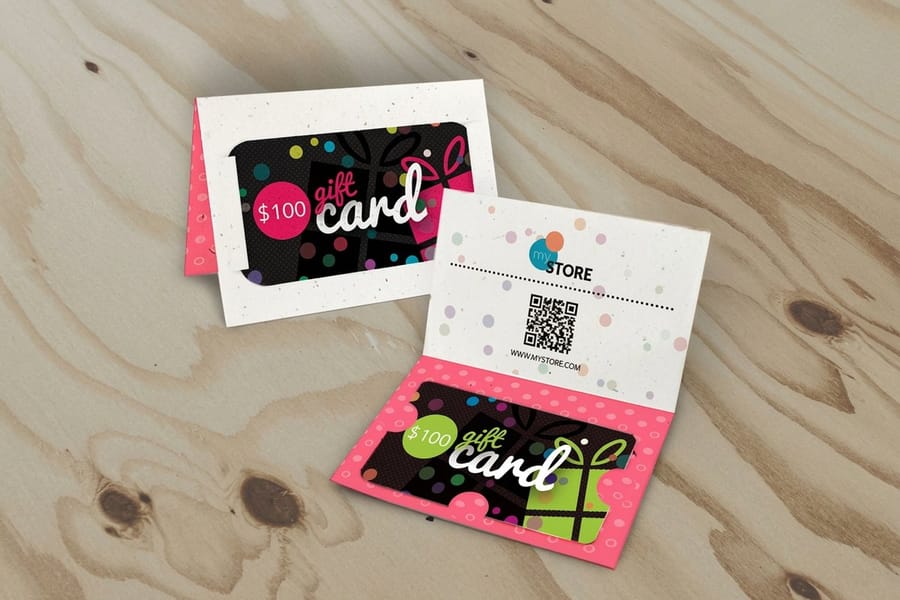
A card carrier is the printed paperboard backer a gift card or plastic card is mounted on, so the card can hang in a rack, travel safely in the mail, and carry the terms, activation and balance-check text that will not fit on the card face. The card attaches one of three ways: four die-cut corner slits, a fugitive glue dot, or a tuck pocket. Carriers are commonly 4 by 6 inches for a rack or 3.5 by 8.5 inches for a #10 envelope, and the rigid card inside makes a mailed piece nonmachinable.
Quick answer
The backer does the display, the shipping and the fine print
The carrier exists because a CR80 card has no room and no rigidity. It gives the card a rack format, holds it still in a box or an envelope, and provides the panel where terms, activation and balance-check text can be read. Attachment is the first decision: slits leave no residue but loosen in transit, a fugitive glue dot survives the mail but needs an uncoated patch to bond to, and a tuck pocket protects the card while hiding its barcode. Everything else, size, stock, hang hole and postage, follows from that choice.
What a Card Carrier Actually Does
Strip a gift card program down and the card is a very small piece of plastic with a number on it. Everything else has to live somewhere, and that somewhere is the carrier.
It does four jobs. It gives the card a display format, because a loose CR80 card cannot hang on a peg or stand in a counter rack. It stabilizes the card in transit, which matters more than people expect once a box of 500 has been thrown on a truck. It provides the legal and practical text: terms, expiration language, the balance-check URL, the activation line, the customer service number. And it carries the brand at a readable size, which a card face at 3.375 by 2.125 inches simply cannot do while also holding a stripe, a barcode and a denomination.
The fourth job is the one that gets undersold. A rack of naked plastic cards reads as a utility. A rack of printed carriers with a card seated in the middle reads as a product, and it lets you say what the card is for. That is why gift card holders exist as a separate line item rather than a packaging afterthought.
How the Card Attaches, and What Each Method Costs You

This is the decision that shapes the whole job, and it has to be made before the die is drawn. There are three real options.
| Attachment | How it holds | Where it fails | Best for |
|---|---|---|---|
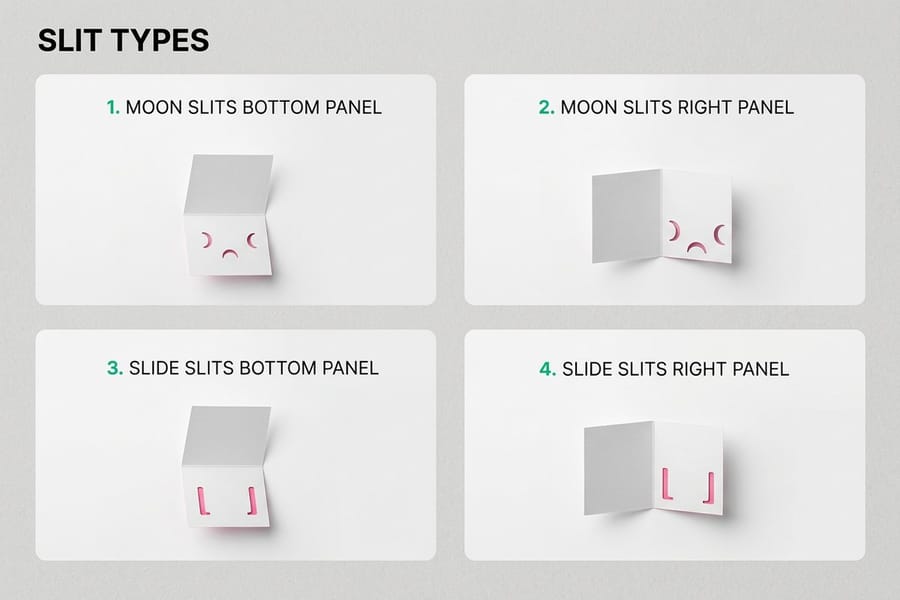
| Four corner slits | Die-cut diagonal slits at the card corners grip the card with no adhesive at all. | Corners relax under vibration, so cards can work free in a shipping carton. | Retail racks and counter displays where the card is removed at the point of sale. |
| Fugitive glue dot | A removable adhesive dot bonds the card to the carrier and peels clean afterward. | Fails on coated stock: it lets go early, or holds so well it lifts the varnish. | Anything mailed, and any card that has to survive an unattended delivery. |
| Tuck pocket or sleeve | A folded and glued pocket the card slides into, covering part or all of the face. | Hides the barcode and the stripe, and adds a fold plus a glue seam to the cost. | Premium presentation, and cards activated before they reach the customer. |
The glue dot trap is worth spelling out because it produces the most reprints. Aqueous gloss and UV coating are both designed to stop things sticking to the sheet, which is exactly what you do not want under an adhesive dot. Specify a varnish knockout, an unvarnished patch about an inch square where the dot will land, and the dot bonds to raw board instead of to a release layer. Skip that step and you get one of two failures: cards rattling loose in the box, or a customer peeling the card off and taking a visible square of coating with it.
Slits have a quieter trap. Cut them too tight and the card creases the board on insertion; cut them a hair loose and they hold nothing. Ask for a physical sample with your actual card thickness in it, because a slit sized for a 20 mil card behaves differently with a 30 mil one from 30mil white plastic cards.
Sizes, Stock and the Hang Hole
Carrier size follows the display or the envelope, not the card. The card footprint is the only fixed dimension in the layout, and it is CR80: 3.375 by 2.125 inches, with a 1/8 inch corner radius.
- 4 by 6 inch rack carrier. The workhorse for peg racks and counter stands. Big enough for a headline and terms, small enough that a full rack does not look chaotic.
- 3.5 by 8.5 inch mailer insert. Sized to slide into a #10 envelope with room to spare. This is the format for a card that arrives in the post with a letter.
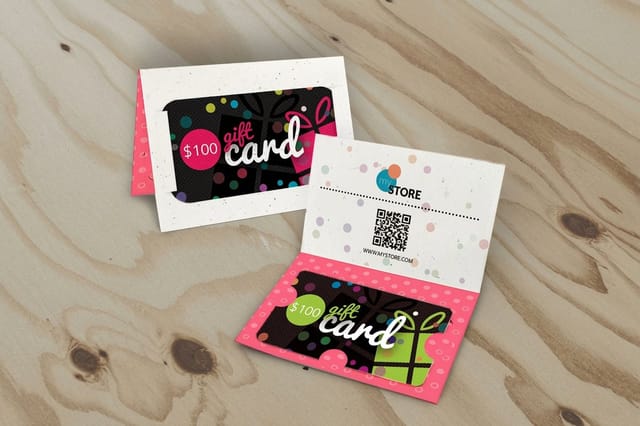
- 5 by 7 inch folded carrier. Printed flat at 10 by 7 and folded, so the card mounts on an inside panel and the message gets a full page. Reads like a greeting card, which is the point when the card is a gift rather than a promotion.
- 2.5 by 3.75 inch sleeve. A pocket rather than a backer. Protects the card face, holds almost no copy.
Stock is the other half of the decision. Fourteen point cardstock is fine for anything that goes in an envelope. Sixteen point earns its money on a hanging rack carrier, because a 14pt board with a 30 mil card hanging off center will curl within a week under store lighting, and a curled carrier looks like old stock. If the carrier hangs, it needs a die-cut hang hole, either a round hole or a euro slot, placed above the card footprint and no closer than a quarter inch to the top trim, or the hole tears out.
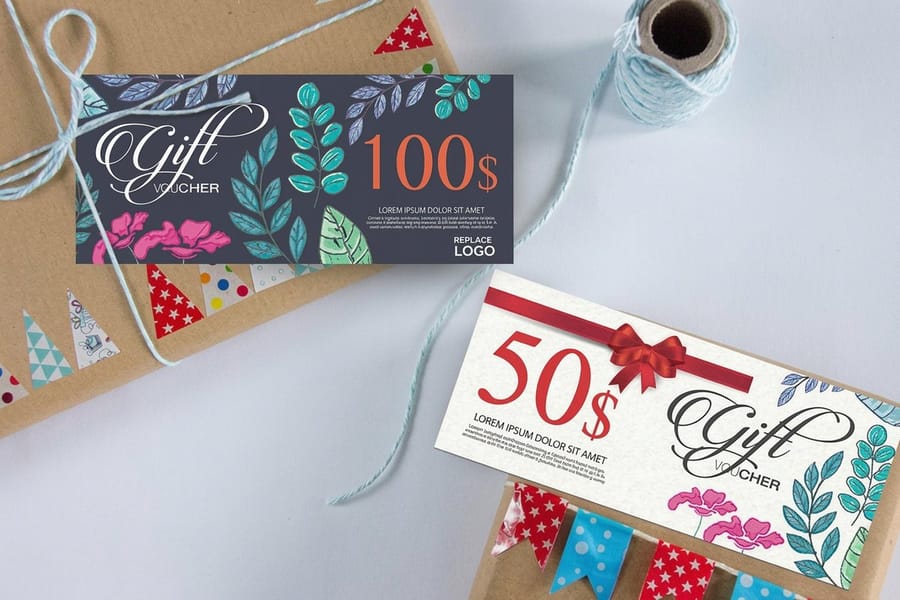
Not every program needs plastic at all. A numbered paper certificate on heavy stock does the same commercial job at a fraction of the cost, and gift certificates start at $42.84 against $226.11 for plastic gift cards. Plastic wins when the card is meant to be kept in a wallet and used repeatedly. Paper wins when it is redeemed once and thrown away. Sizes and layouts for both live in the blank template library, and the card side is covered in detail in our gift card size and dimensions guide.
Mailing a Carrier, and What Belongs on the Back

The moment a rigid card is attached, the mailing rules change. USPS classes a letter containing a rigid item as nonmachinable, which means it is sorted by hand and carries a surcharge on top of the letter rate. That surcharge moves with each rate case, so get the current number from the post office before you commit to a quantity rather than trusting a figure you read somewhere.
What you cannot do is mail the carrier bare, as a self-mailer or postcard, with the card attached. The card creates uneven thickness, the piece fails machinability, and the card face arrives scratched from the sorting equipment even when it does go through. Put it in an envelope. A 3.5 by 8.5 inch carrier in a #10 is the default pairing, and printed envelopes let you brand the outside so the piece is not mistaken for a bill. Everything else about envelope sizing is in the envelope printing range.
The back of the carrier is where the compliance text lives, and it is the panel most people design last and regret. It needs the terms, the balance-check URL or phone number, the activation instructions if the card is not live on arrival, and the expiration language. Federal law under the CARD Act sets a floor of five years from the date of issue for gift certificates and store gift cards, and several states go further than that, so the wording is worth checking rather than copying from a competitor. Our guide to gift certificate expiration rules covers where the federal floor ends and state law takes over.
One more thing that catches people out: keep every die line, slit and pocket fold clear of the magnetic stripe and the barcode quiet zone. A fold that crosses a stripe kills the card. The stripe and barcode guide has the clearances.
How to Order a Matched Card and Carrier, Step by Step
Six steps, in this order. The order matters, because steps two and three are impossible to change once the die is cut.
- Pick the attachment first. Slits, glue dot or pocket. Everything downstream, including the die drawing and the coating spec, follows from this one choice.
- Set the carrier trim and place the card footprint. Choose the display or envelope format, then drop a 3.375 by 2.125 inch rectangle where the card sits, with about a sixteenth of an inch of clearance around it.
- Draw the die line on its own layer. Slit positions, pocket fold and hang hole go in a named spot color with no fill, set to overprint, so they are unmistakably cut marks and not artwork.
- Knock the coating out under the glue dot. One unvarnished square, roughly an inch, marked on the coating layer. Skip this and the dot fails one way or the other.
- Write the back panel. Terms, balance-check line, activation instructions, expiration language, customer service contact. Set it at 7 point or larger so it is readable rather than merely present.
- Order the card and the carrier together, and proof one physically. Same run means one color build across both. Before a five thousand piece order, get a short run in your hands and put a real card in a real slit.
If the card side of the program is still open, the gift card printing range covers standard, holographic and paper options, and holographic gift cards hold a foil pattern under the print that a carrier window can frame deliberately. For cards that live in a wallet rather than a rack, a plastic card sleeve replaces the carrier entirely once the card has been handed over.
Wally explains card carriers
Slits, a glue dot, or a pocket, and each one gives something up
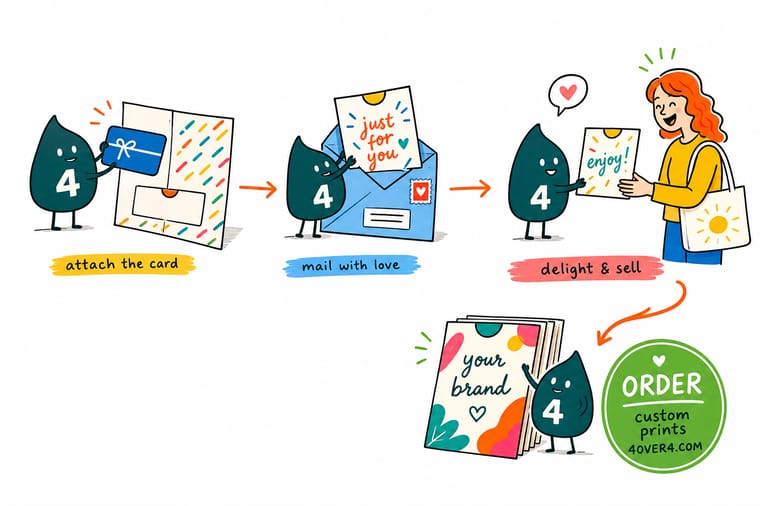
Wally mounts the card three ways. The corner slits leave nothing behind on the card face, but shake the box hard enough and the card walks out. The glue dot holds all the way through the mail, as long as he knocked the varnish out underneath it first. The tuck pocket looks the best and hides the barcode, so the cashier has to pull the card out to scan it. He picks the attachment before he draws the die, because the slits and the fold are cut in the same pass as the trim.
Order gift card holders →Specs and pricing
Carriers, cards and certificates, with live starting prices
Configure the carrier and the card side by side, with sizes, stock and starting prices straight from the 4OVER4.COM configurator.
Print it
Order the card and its carrier in one run

Explore more
Where to go next



By the numbers
Card and carrier printing you can count on at 4OVER4
Common Questions
Your card carrier questions, answered
What is a card carrier?
A card carrier is the printed paperboard backer that a gift card, loyalty card or membership card is attached to before it goes on a rack or into an envelope. It does four jobs the card cannot do for itself: it gives the card a hanging or standing format for retail display, it holds the card flat and still during shipping, it provides room for the terms, the balance-check URL and the activation instructions, and it carries the branding at a size a customer can actually read from three feet away. Carriers are also called card holders, card backers or gift card mailers depending on which part of the trade you ask.
What size should a gift card carrier be?
There is no single standard, because the size follows the display or the envelope rather than the card. Four common formats cover almost everything: a 4 by 6 inch rack carrier with a hang hole, a 3.5 by 8.5 inch insert sized to slide into a #10 envelope, a 5 by 7 inch folded carrier printed flat at 10 by 7, and a small 2.5 by 3.75 inch sleeve. What is fixed is the card footprint inside it. A CR80 card is 3.375 by 2.125 inches, and the cutout or slit spacing should allow about a sixteenth of an inch of clearance on each side so the card drops in without buckling the board.
Should I use slits or a glue dot?
Use slits when the card will be handled in store and taken off the carrier at the counter, because there is no adhesive to leave a mark on a gloss card face. Use a fugitive glue dot when the carrier is going in the mail, because a slit-mounted card in a jostled envelope can walk its way out of the corners. If you use a dot, tell the printer to knock the coating out where it lands. A dot on a fully coated carrier either lets go in the box or takes a patch of varnish with it when the customer removes the card.
Can you mail a gift card carrier in a regular envelope?
Yes, and that is the normal way to do it, but the rigid card makes the piece nonmachinable so it takes a surcharge above the standard letter rate. The surcharge changes with each USPS rate case, so confirm the current figure before you budget a mailing of any size. What you cannot do is mail the carrier bare as a postcard with a card stuck to it. The uneven thickness fails machinability, and an unprotected card face arrives scuffed. A 3.5 by 8.5 inch carrier in a #10 envelope is the standard combination.
Does the barcode have to show through the carrier?
It depends on where the card is scanned. If the cashier activates the card at the register while it is still mounted, the barcode or the magnetic stripe has to be exposed, which rules out a pocket that covers the lower half of the card. If the card is removed first, or if the activation barcode is printed on the carrier itself and matched to the card during production, a full pocket is fine. Decide this before artwork, because it determines whether the pocket fold sits above or below the stripe.
Can I print the card and the carrier together?
Yes, and matching them in one production run is the point of ordering both from the same printer. At 4OVER4.COM, gift card holders start at $170.03 and plastic gift cards start at $226.11, so a matched pair is a single conversation about one color build rather than two orders you hope will agree. If you want the same idea on paper instead of plastic, gift certificates start at $42.84 and print on cardstock with sequential numbering.
Get Started
Ready to print the card and the carrier together?
Pick the attachment, set the trim, and we print the carrier and the card in one run so the color matches and the slits fit the card you actually ordered.
Legal Disclaimer
Gold Standard guarantees apply to all standard orders placed through 4over4.com. Price match requires verifiable proof of a competitor's published price for an equivalent product with matching specifications and turnaround time. Satisfaction guarantee covers manufacturing defects and print quality issues. Contact support with order number and documentation. On-time delivery rate based on tracked orders 1999 to 2026. Individual results may vary based on shipping carrier performance.
