
Small Banner Sizes and Where Each One Works


Five sizes cover nearly every small banner job. Each size holds a certain amount of copy, reads from a certain distance, and lives or dies on its finishing.
Small banners run from 24 by 36 inches up to 3 by 8 feet, and the five common sizes are 24 x 36, 24 x 48, 24 x 72, 36 x 72 and 36 x 96 inches. Choose between them by viewing distance rather than by wall space: allow about 1 inch of capital letter height for every 10 feet the reader stands away, then take the banner that holds that headline on one line. Below 24 by 36 inches a vinyl panel sags and a rigid sign works better.
Quick answer
Size follows the reader, and the reader is standing somewhere specific
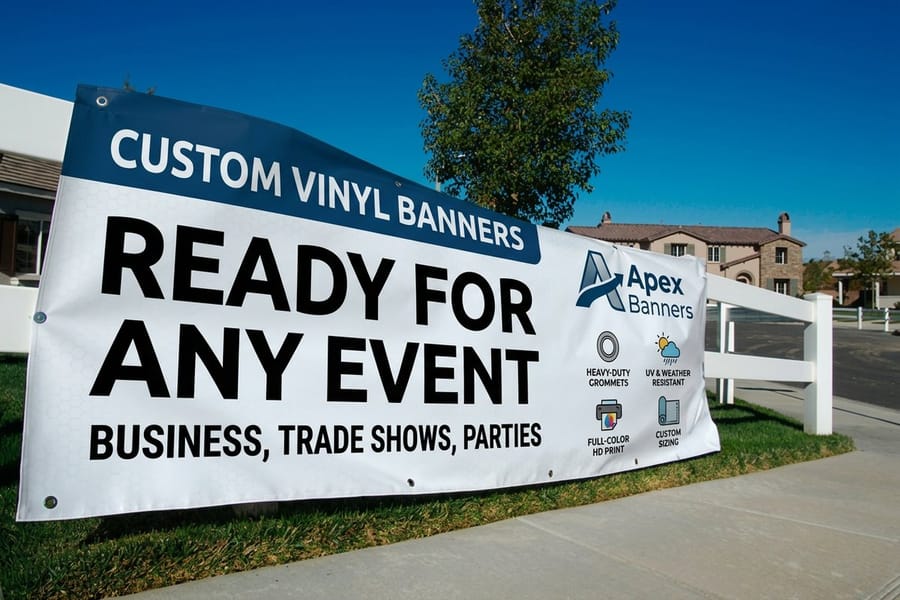
The headline decides the banner, not the wall. Measure how far away your reader stands, allow roughly 1 inch of capital letter height per 10 feet of that distance, and pick the smallest size that carries the resulting headline on a single line. A 2 inch cap and a 24 by 36 inch panel covers a tabletop or a doorway. A 4 inch cap and a 24 by 48 inch panel covers a fence or a booth wall. A 6 inch cap and a 36 by 72 inch panel covers a storefront read from across a parking lot.
The Small Banner Sizes People Actually Order
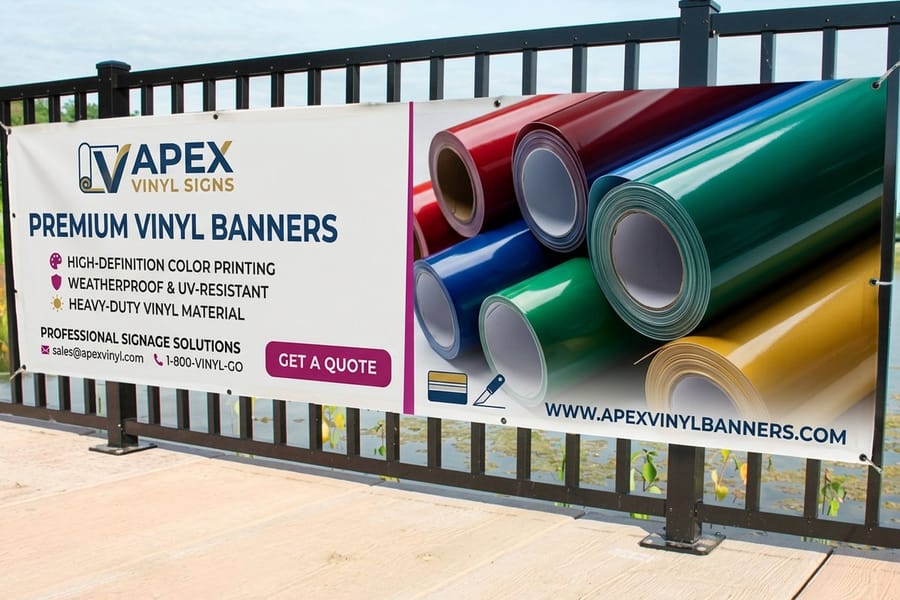
Five sizes cover almost every small banner job. They are not arbitrary: each one is a width our roll stock cuts cleanly and a height that hangs without sagging, and each carries a headline of a particular size.
| Size | Area | Headline cap height | Reads from | Where it goes |
|---|---|---|---|---|
| 24 x 36 in | 6 sq ft | 2 to 3 in | 20 to 30 ft | Tabletop stand, interior doorway, market stall front. |
| 24 x 48 in | 8 sq ft | 3 to 4 in | 30 to 40 ft | Fence panel, booth back wall, retail window. |
| 24 x 72 in | 12 sq ft | 3 to 4 in | 30 to 40 ft | Above a doorway, along a table front, on a balcony rail. |
| 36 x 72 in | 18 sq ft | 5 to 6 in | 50 to 60 ft | Storefront, lawn frame, sponsor wall. |
| 36 x 96 in | 24 sq ft | 6 to 8 in | 60 to 80 ft | The top of the small range, facing a parking lot. |
Notice how the reading distance roughly doubles between the first row and the fourth while the price does not. Square footage triples from 6 to 18, and that is the honest cost driver, but the useful jump in visibility is far larger than the jump in spend. If you are hesitating between two sizes for an outdoor spot, the bigger one is usually the better buy.
Custom sizes are fine too. We cut vinyl banners to the inch, so a 30 by 84 inch panel for an awkward wall costs the same as the nearest standard size with the same area. The standard sizes exist because they fit common mounting points, not because the press insists on them. For the sizes above this range, the banner sizes in inches guide lists the full ladder.
Pick the Size From the Viewing Distance, Not the Wall

Most people measure the wall, order a banner that fills it, then wonder why nobody reads it from the sidewalk. Work the other way around. Stand where your reader will stand, measure that distance, and let it set the type size.
The working rule in signage is about 1 inch of capital letter height for every 10 feet of viewing distance. A 2 inch cap reads at 20 feet. A 4 inch cap reads at 40. That is a legibility floor, not a comfort figure, so if the reader is moving past in a car or glancing while walking, give yourself half again as much height.
Now flip it into a banner size. A 4 inch cap needs roughly 6 inches of vertical room once you allow for descenders and breathing space above and below, and a headline of five or six words at that height runs 40 to 44 inches wide. That is a 24 by 48 inch banner, and it is why that size dominates fence and booth work.
The trade off nobody admits: when the copy does not fit, the instinct is to shrink the type. Do not. A banner with three lines of 1.5 inch text reads from 15 feet, which means it is invisible to everyone driving past and only works for someone already at your table. Cut the message to one promise and one action, and if the promise genuinely will not fit, add width. Our banner font guide covers which typefaces hold up at these sizes, and where and how you hang it changes the effective distance as much as the size does.
Small Banners Indoors: Stands, Tables and Doorways
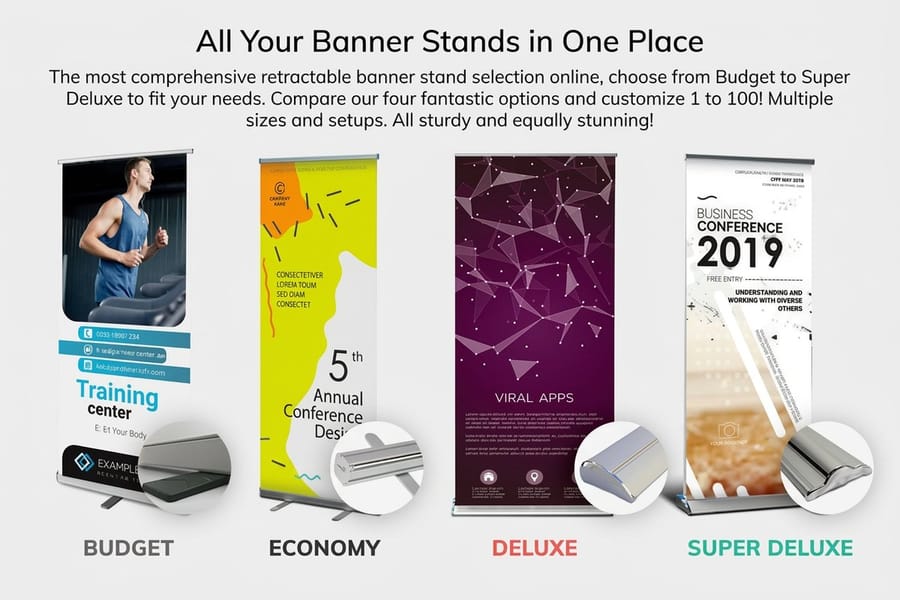
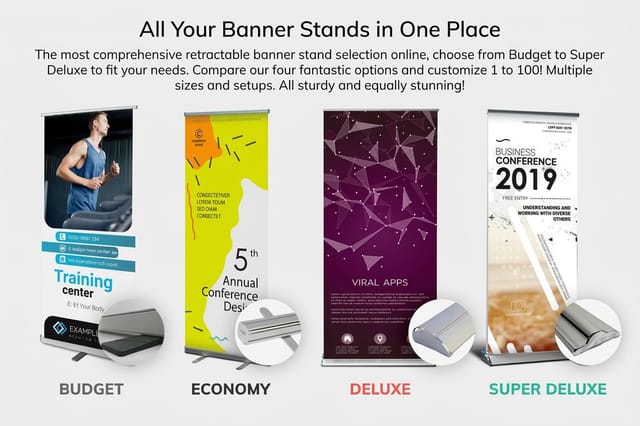
Indoors the rules change, because the hardware decides the size before you do. A retractable stand has a fixed cassette width, and the graphic is cut to that cassette. The common floor unit is about 33 inches wide by 80 inches tall, and narrower 24 inch versions exist for tight aisles and corridor placements.
That vertical shape is not a smaller version of a wall banner. It is a column, read from 10 to 20 feet by someone walking towards you, so the layout works top down: logo and headline in the top third at eye level, supporting detail in the middle, contact and a call to action at the bottom. Anything in the bottom 8 inches sits behind the base or gets blocked by whoever is standing at the table, so leave that strip quiet.
On the table itself there are two small formats. A 24 by 72 inch panel with grommets covers the front of a standard 6 foot table and ties to the frame. A tabletop retractable sits on the surface behind the products, and it needs a much shorter message because the reader is already standing in front of you. Two words and a logo is often the right answer there.
Indoor jobs also let you drop the scrim vinyl. There is no wind, so a lighter fabric banner hangs with less curl and no glare under spotlights, which matters when the piece appears in photographs. Compare the options in the banner material guide, or start from a correctly sized layout in the blank template library. Retractable banner stands arrive with the graphic already fitted to the hardware.
Hems, Grommets and Wind on a Small Panel
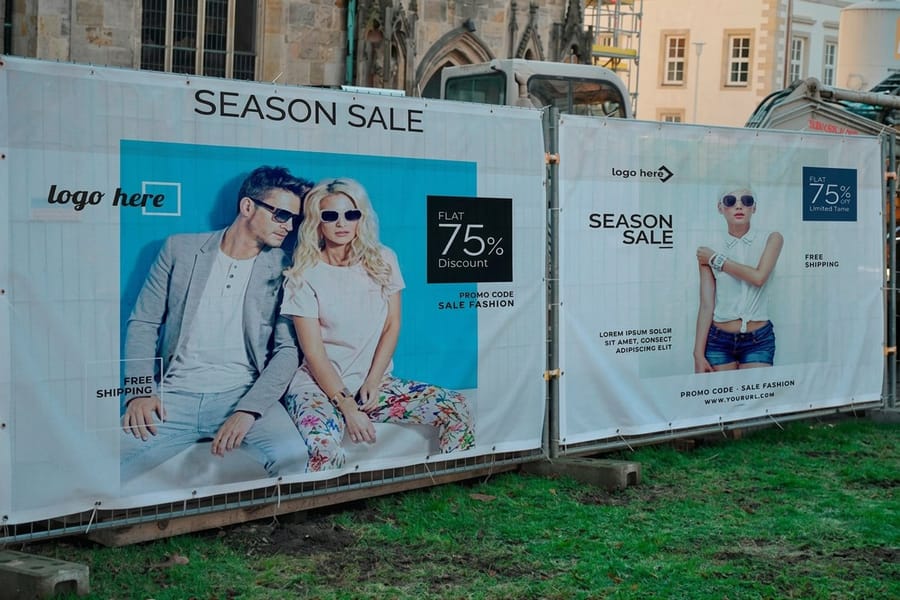
A small banner fails at its edges long before the print fades. Three finishing decisions decide whether it lasts a season or a weekend.
Hem. A 1 inch hem folded and welded around all four sides doubles the vinyl where the tension goes. It costs almost nothing and it is the difference between a grommet that holds and a grommet that pulls straight through the material.
Grommets. Every 2 feet along each edge, with one in each corner. That gives a 24 by 48 inch banner 6 grommets and a 36 by 72 inch banner 10. Spacing them wider looks tidier on the bench and scallops badly once the wind gets behind the panel. If the banner ties to a crossbar instead, ask for a 3 inch pole pocket on the top edge and skip the top row.
Material. At this size, solid scrim vinyl is almost always right. Wind load rises with area, so 8 square feet on a fence barely registers where 32 square feet in the same spot bows the posts. Mesh banners pay off when the panel is large or the wind is constant, and the cost is that the open weave lets some light through, so solid color reads a shade lighter. For a street pole, pole banners come with pockets top and bottom instead of grommets, which is the correct fitting for that bracket.
Keep all live text 2 inches inside the trim on every side. The hem fold takes an inch, grommets sit inside that, and a headline that ends a quarter inch from the edge will have a brass ring punched through the last letter. Detailed spacing rules sit in the grommet guide, and if you are pricing a run, banner prices explained breaks down what the square footage actually buys. Browse the full range in banner printing or narrow straight to vinyl banner printing.
Wally sizes a small banner
Measure the distance first, then cut the vinyl
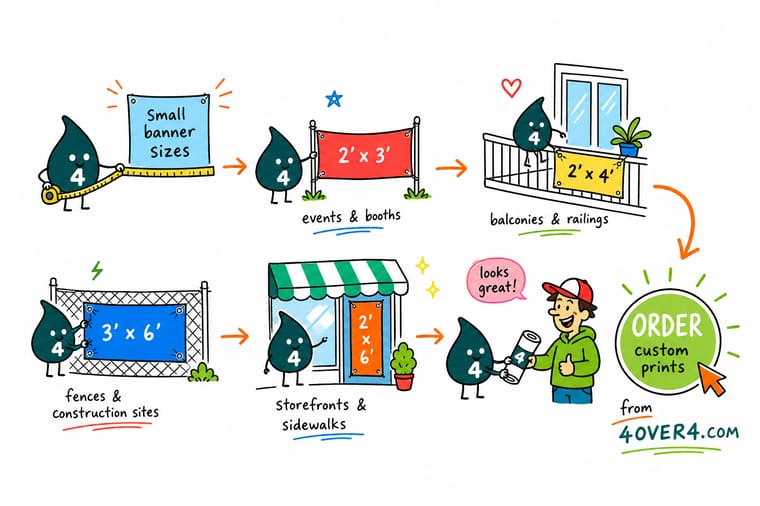
Wally does not start at the wall. He walks to where the customer will actually be standing, counts the feet, and allows about one inch of capital letter for every ten of them. A 4 inch headline means roughly 6 inches of vertical room, which lands him on a 24 by 48 inch banner with grommets every 2 feet. If the words will not fit at that height, he cuts words, never type. Then he keeps everything 2 inches inside the trim so the hem fold and the brass rings do not eat a letter.
Order a custom size vinyl banner →Specs and pricing
Small banner options, sizes and starting prices
Set the size, the finishing and the quantity below and the price updates live from the 4OVER4.COM configurator, including custom cuts down to the inch.


Print it
Order a small banner that reads from where people stand
Explore more
Where to go next




By the numbers
Small vinyl, mesh and pole banners
Common Questions
Your small banner questions, answered
What counts as a small banner?
In practice, anything from 24 by 36 inches up to about 3 by 8 feet. The lower end is set by physics rather than taste: below roughly 2 by 3 feet a vinyl banner has too little weight to hang straight, sags in the middle, and curls at the corners, so a rigid yard sign or a foam board panel holds its shape better and reads cleaner. The upper end is where hems, grommet counts, and wind start behaving like large format work.
How big should the text be on a 2 by 4 foot banner?
Give the headline a capital letter height of 3 to 4 inches and put it on one line. That reads from about 30 to 40 feet, which is the range a 24 by 48 inch banner is built for. Supporting detail such as a phone number or a date can drop to about 1.5 inches, but understand that it only reads from roughly 15 feet, so it is for the person who already walked over. If the copy will not fit at those sizes, cut words rather than shrinking type.
What size banner fits a standard 6 foot table?
The front face of a folding 6 foot table is about 72 inches wide and 29 inches tall, so a 2 by 6 foot banner covers it with a little to spare and hangs flat. Order grommets along the top edge and hold it with clips or zip ties through the table frame. If you want the cloth look instead of vinyl, a fitted table cover prints edge to edge and needs no hardware at all.
Do small banners need mesh outdoors?
Usually not. Mesh exists to let wind through a large panel, and at 8 or 12 square feet there is not enough sail area for that to matter on a normal fence or wall. The exception is a spot with steady wind, such as a rooftop rail, a construction fence on an open lot, or a coastal frontage. Bear in mind the trade off: the weave leaves part of the surface open, so colors read slightly lighter and fine detail softens compared with solid vinyl.
What resolution should a small banner file be?
Build it at full size at 100 pixels per inch, or at quarter size at 300 pixels per inch and let us scale it. Banners are read from feet away, not inches, so 100 ppi at final size is plenty and it keeps the file manageable. Keep logos and type as vector, set the document to CMYK, and hold all live text at least 2 inches inside the trim so the hem fold and the grommets never eat a letter.
How much does a small banner cost?
At 4OVER4.COM vinyl banners start at $79, mesh banners at $75, and retractable banner stands at $139 with the graphic included. Price moves with square footage first and finishing second, so the jump from 2 by 4 to 3 by 6 feet costs more than adding grommets or a pole pocket to either one. If you need several of the same size, run them together rather than ordering one at a time.
Get Started
Pole banners cost $97.76 each, four business days
Pick a standard size or type in your own to the inch, choose your hems and grommets, and we print it on scrim vinyl that hangs flat and holds its color outdoors.
Legal Disclaimer
Gold Standard guarantees apply to all standard orders placed through 4over4.com. Price match requires verifiable proof of a competitor's published price for an equivalent product with matching specifications and turnaround time. Satisfaction guarantee covers manufacturing defects and print quality issues. Contact support with order number and documentation. On-time delivery rate based on tracked orders 1999 to 2026. Individual results may vary based on shipping carrier performance.
