
Mounted Wall Art Explained From Foam Core to Dibond


The board under the print decides how long the piece lasts. Each substrate behaves differently, the mounted sizes are fixed, your file needs a pixel count, and framed and canvas answer different rooms.
Mounted wall art is a print bonded flat to a rigid board so it hangs as one panel with no frame and no glass. The board is what you are really choosing: foam core is light and cheap and dents easily, gatorboard has hard veneer faces at the same 3/16 inch caliper, and 3 mm Dibond is thinner than both yet the only one that stays dead flat at 24 by 36. 4OVER4.COM mounts prints and posters on foam core from $39.99, in sizes from 8 by 10 to 24 by 36.

Quick answer
A print, a board, and no glass in between
Mounting bonds the print to a rigid panel and trims it flush, so the piece hangs flat with nothing in front of the image. That buys you low weight, no reflections and a clean modern edge. It costs you UV protection and a hard surface, which is why the substrate choice matters more than the finish choice. Foam core suits indoor art and short-run signage, gatorboard suits graphics that travel, and aluminum composite suits large panels that must never bow.
Foam Core, Gatorboard and Dibond, and Why the Middle Layer Matters
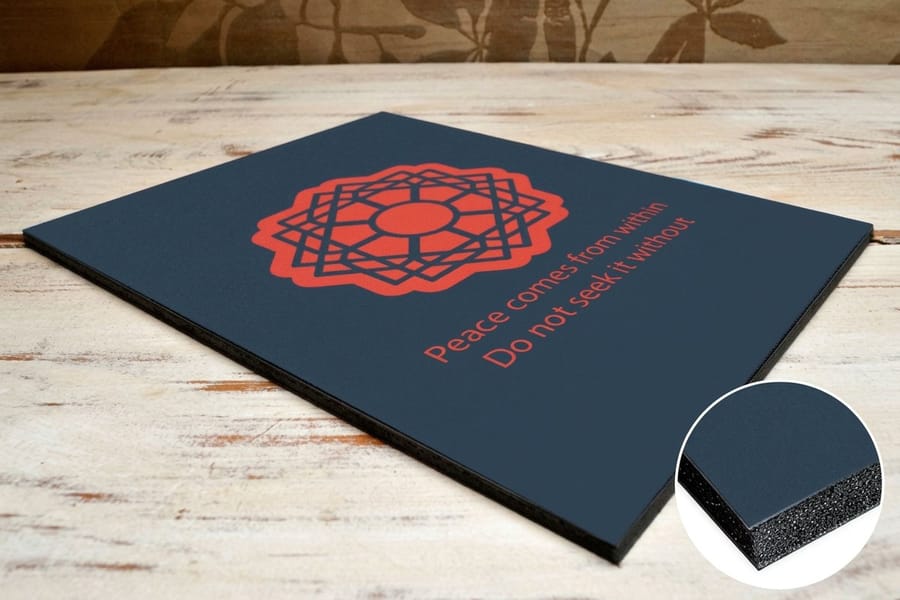
Every mounting substrate is a sandwich: two faces around a core. The faces take the print and the abuse, the core provides the thickness, and the combination of the two is what decides whether your panel is still flat in three years.
Foam core is 3/16 inch of extruded polystyrene foam between two paper liners. It is the lightest and cheapest of the three, it cuts cleanly, and it weighs so little that a 16 by 20 hangs on two adhesive strips. Its weakness is the paper: a fingernail leaves a permanent dent, a dropped corner crushes, and in a humid room the liners take up moisture and pull the panel into a curve.
Gatorboard keeps the same 3/16 inch caliper but swaps the paper for a wood-fiber veneer over a denser extruded foam. That one change is the whole story. The faces are hard enough to resist a knock, the panel takes screws at the edge, and it survives being packed, shipped, hung, taken down and hung again. It costs more and it is heavier, and it is what trade show crews reach for when the same graphic has to appear at six events.
Dibond is the trade name most people use for aluminum composite: two thin aluminum skins bonded either side of a polyethylene core, 3 mm thick in total. Read that against the diagram above, because it is counterintuitive. Dibond is thinner than either foam board and it is the only one of the three that will not bow on a 24 by 36 panel, because the stiffness comes from the metal skins rather than from bulk. The trade is weight and price, and it is heavy enough that you plan the hanging hardware before you order.
4OVER4.COM mounts prints and posters on foam core, which is the right substrate for indoor art, office walls, portfolio pieces and retail signage that lives inside. If your job is genuinely permanent, structural, or exposed to weather, that is a rigid sign rather than mounted wall art, and the aluminum sign range is the better starting point. Ordering the wrong one of these two is the most common and most expensive mistake on this whole topic.
The Sizes We Print and the Pixel Count Each One Needs

Wall art is one of the few print jobs where the file requirement is pure arithmetic. Take the finished size in inches, multiply each side by 150, and that is the pixel dimension your image needs. Nothing else in the chain can rescue a file that starts below it.
| Finished size | Pixels at 150 ppi | Pixels at 300 ppi | Product it sits in |
|---|---|---|---|
| 8" x 10" | 1200 x 1500 | 2400 x 3000 | Mounted Prints and Mounted Posters |
| 11" x 14" | 1650 x 2100 | 3300 x 4200 | Mounted Prints |
| 11" x 17" | 1650 x 2550 | 3300 x 5100 | Mounted Posters |
| 16" x 20" | 2400 x 3000 | 4800 x 6000 | Mounted Prints and Foam Core |
| 18" x 24" | 2700 x 3600 | 5400 x 7200 | Mounted Posters |
| 24" x 36" | 3600 x 5400 | 7200 x 10800 | Mounted Posters |
Use the 150 column. It is the honest working number for a piece viewed from three feet or more, and it is why a 24 by 36 does not need the monstrous 7200 by 10800 file the 300 ppi column implies. Reserve 300 ppi for small pieces people hold up to their face, and note that a phone photo at 4032 by 3024 pixels comfortably fills a 16 by 20 at 150 ppi but falls short of a 24 by 36.
Beyond resolution, three things go wrong often enough to be worth naming. Build the file in CMYK or supply a tagged RGB profile, because an untagged file gets guessed at and skin tones are where the guess shows. Keep any text or logo at least a quarter inch inside the trim, since a mounted panel is cut flush and there is no frame lip to hide a tight edge. And supply the file at the finished ratio: an 8 by 10 image cropped to fill a 24 by 36 loses a third of its height, so decide the crop yourself rather than leaving it to the trimmer. Our guide to image resolution for printing covers the pixel maths in more depth, and the blank template library gives you a correctly sized canvas to start from. For the larger wall sizes, Mounted Posters is the product that carries 18 by 24 and 24 by 36.
Mounted, Framed or Canvas, and How to Pick Between Them
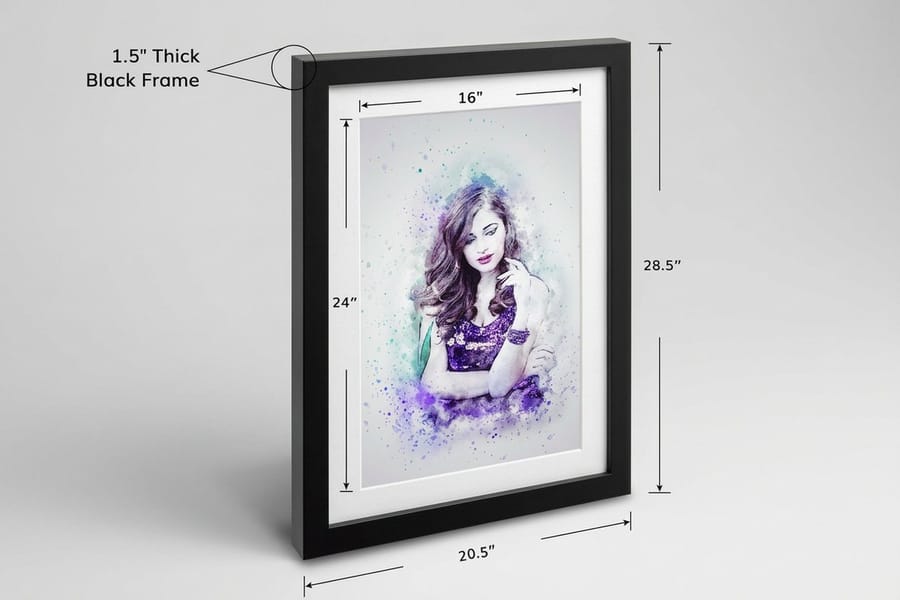
These three get compared constantly and they are genuinely different objects, not three price tiers of the same thing. The quick version: mounted is the flat modern one, framed is the formal one that protects the print, canvas is the textured one that reads as a painting.
| Format | What you get | Starting price | The catch |
|---|---|---|---|
| Mounted | Print bonded flat to a rigid board, trimmed flush, no frame or glass. | $39.99 | No UV protection and the surface is exposed to knocks. |
| Framed | Print in a finished frame, ready to hang, with the frame carrying the weight. | $87.86 | Roughly double the cost, heavier, and glazing reflects room lighting. |
| Stretched canvas | Canvas wrapped over a wooden stretcher bar with a visible edge depth. | $59.00 | Weave texture softens fine type, so it flatters photos and fights logos. |
Choose mounted when the image is the point and the wall is busy already. It sits flat, casts almost no shadow, and a row of mounted panels reads as one clean set in a way that mixed frames never do. It is also the format that survives a gallery hang, a client presentation and a booth wall without anyone worrying about broken glass.
Choose framed posters when the piece is going somewhere formal, or when it needs to last decades in a lit room. The frame is not decoration alone: it holds the print off the wall, gives the paper somewhere to move, and puts glazing between the ink and the sunlight. That is the real argument for a frame, and it is the one thing mounting cannot do.
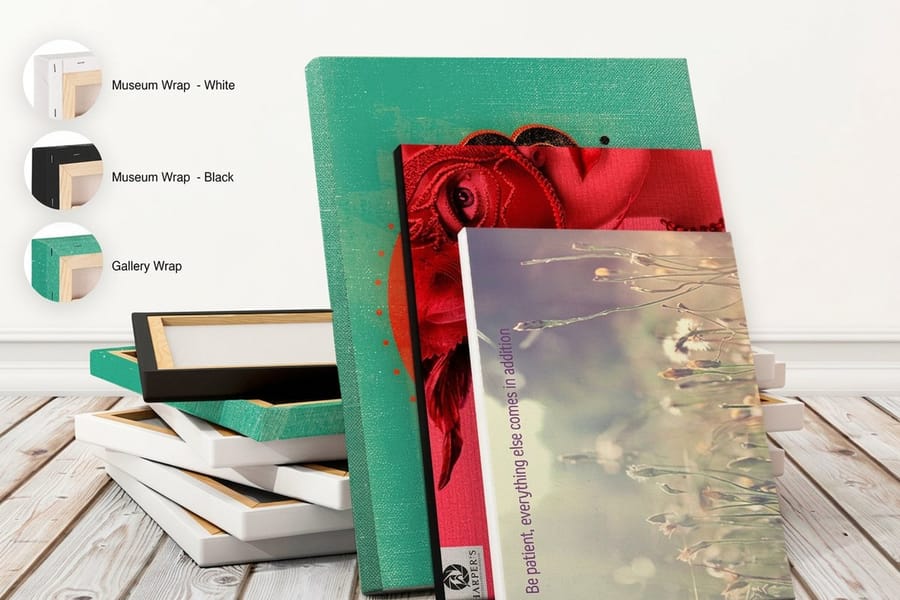
Choose stretched canvas when you want the image to read as artwork rather than as a print. The weave adds depth to photographs and painted work, the wrapped edge means it looks finished from an angle, and there is no glass at all. The limit is detail: fine serif type and thin logo strokes break up on the weave, so a canvas is the wrong home for a wordmark. Our guides on what canvas prints are and how to frame canvas prints go deeper into that choice.
What Mounted Wall Art Costs and How to Order It
Mounted Prints start at $39.99 for an 8 by 10 and run through 11 by 14 and 16 by 20. Mounted Posters also start at $39.99 and carry the bigger wall sizes, up to 24 by 36. If you specifically want the single 16 by 20 board on its own, Foam Core is $49.99. Prices move with the size and the options you pick, and the configurator on each product page shows the real number before you commit.
The configurator gives you four things to decide. Paper type comes in three choices, and the practical split is matte for artwork and anything hung under downlights, gloss for photographic work that wants punch. Mounting is its own option group. Lamination is the 3 mil gloss film, single sided, worth adding on anything that gets handled. Proof options let you approve a digital proof before the job runs, which is the cheapest insurance on the page when the crop is tight.
Two ordering habits save the most grief. First, order one piece before you order twelve. Color on a mounted panel reads differently under warm gallery lighting than it does on your calibrated monitor, and a single sample tells you whether to lift the midtones before the full run. Second, decide the hanging method at the same time as the size. A 16 by 20 foam core panel is light enough for adhesive strips, an 18 by 24 wants four points rather than two, and a 24 by 36 hung on adhesive alone will eventually find the floor.
Browse the full range in the mounting collection or on the mounted prints category, and if the wall plan is still open, arranging a gallery wall without nails and getting art onto the wall cover the hanging side properly.
Wally explains mounting
One print, one board, no frame and no glass
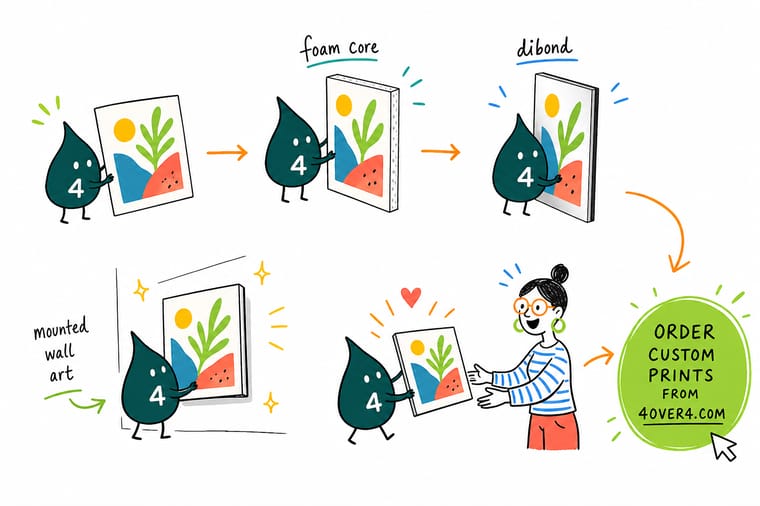
Wally rolls the print down onto the board, presses the air out, and trims the edge flush. Now it is one panel: light enough for two adhesive strips, flat enough to sit tight to the wall, and free of the glazing that bounces a ceiling light straight back at you. He picks foam core for indoor art, and he is honest about the trade. There is nothing in front of the ink, so keep it out of direct sun and keep thumbnails off the surface.
Order mounted prints →Specs and pricing
Mounted sizes, options, and starting prices
Foam core, mounted posters, mounted prints and stretched canvas all ship in 3 to 4 business days, so the substrate decides the look rather than the wait.



Print it
Put the image on the wall this week


Explore more
Where to go next

By the numbers
Twenty five years of mounting, by the count
Common Questions
Your mounted wall art questions, answered
What is mounted wall art?
Mounted wall art is a printed image bonded flat to a rigid board so it hangs as a single panel with no frame and no glass. The print is laminated onto the substrate under pressure, the edges are trimmed flush, and the finished piece goes straight on the wall. It is the standard way galleries, offices and trade show booths put an image up quickly, because it is lighter than a framed print, it cannot break, and it has no glazing to throw reflections back at the viewer.
What is the difference between mounted prints and mounted posters?
The size range, mostly. Mounted Prints at 4OVER4.COM are the small and mid wall sizes, 8 by 10, 11 by 14 and 16 by 20, and they suit portrait work, certificates and desk-height art. Mounted Posters run 8 by 10, 11 by 17, 18 by 24 and 24 by 36, which is the range you want for retail signage, event graphics and anything meant to be read from across a room. Both start at $39.99 and both offer the same three paper choices, the same mounting option group and the same optional 3 mil gloss lamination.
Does mounted wall art warp or bow over time?
Foam core can, and humidity is usually the reason. Paper facers absorb moisture and expand slightly while the foam core does not, which pulls the panel into a gentle curve. It shows most on large pieces hung on an exterior wall or in a bathroom. Anything at 24 by 36 or larger that has to stay perfectly flat for years belongs on gatorboard or an aluminum composite panel rather than 3/16 inch foam. For a print that lives indoors on a dry interior wall, foam core stays flat for a long time.
Is 150 dpi enough for a 24 by 36 mounted print?
Yes for wall art, and it is the number to design around. At 150 dpi a 24 by 36 needs a 3600 by 5400 pixel file, and a viewer standing three or four feet back cannot resolve more detail than that. Push to 300 dpi only for pieces people examine at arm's length, such as an 8 by 10 portrait. Below about 100 dpi at final size you start to see soft edges on type, and no amount of sharpening or AI upscaling puts back detail the camera never captured.
Can mounted wall art go outside?
Not on foam core. The paper facers wick water, the adhesive lets go, and one rain event ends the panel. Short covered outdoor use with a laminate is survivable for a few days, which is why event crews accept it for weekend work. For anything genuinely outdoor and permanent, use a rigid weatherproof substrate instead and look at our aluminum and rigid sign options rather than a mounted paper print.
Should I add gloss lamination to a mounted print?
Add it if the piece will be handled, moved between events, or hung where people brush past it. The 3 mil gloss film takes the scuffs, fingerprints and light scratches that would otherwise mark the print surface, and it deepens the blacks noticeably on photographic images. Skip it if the artwork is matte by intent or if the wall faces a bright window, because gloss reflects a hard light source almost as badly as framed glass does.
Get Started
Choose a substrate in the mounted print configurator
Pick the size, choose matte or gloss stock, add the laminate if the piece will be handled, and we mount it flat and trim it flush.
Legal Disclaimer
Gold Standard guarantees apply to all standard orders placed through 4over4.com. Price match requires verifiable proof of a competitor's published price for an equivalent product with matching specifications and turnaround time. Satisfaction guarantee covers manufacturing defects and print quality issues. Contact support with order number and documentation. On-time delivery rate based on tracked orders 1999 to 2026. Individual results may vary based on shipping carrier performance.
