
Jewelry Tags Explained for Makers and Retail Brands


Sizes, stocks, holes, strings and pricing, plus what belongs on each side of the card. Everything a jewelry brand needs to turn a small printed tag into the thing that closes the sale while nobody is standing at the display.
Jewelry tags are small printed cards that hang from a piece and carry its brand, materials, size, price and barcode. They typically run from 1 x 2 inches up to 2 x 3.5 inches on 14PT stock or heavier, attach through a punched hole with cord or elastic, and print flat or folded when a second panel is needed. Cost is driven by quantity, size, stock, finish and turnaround, so most brands print one seasonal run rather than reordering monthly.
Start here
Jewelry tags in one paragraph
A jewelry tag is a thick, small printed card attached to a piece by cord, elastic or a die-cut collar, carrying the brand on one side and the price, SKU, materials and care detail on the other. Sizes track the item, from roughly 1 x 2 inches for rings and studs up to 2 x 3.5 inches for necklaces and boxed pieces. Stock weight matters more than decoration, because a tag that curls or tears makes a fine piece look cheap. Folded tags buy a second panel without a bigger footprint, and pricing falls steeply with run size.
Why the tag decides whether a piece sells itself
A shopper picks up a silver pendant at a market stall, turns it over, and finds nothing. No price, no metal, no maker name. Nine times out of ten they put it back down rather than interrupt whoever is running the booth. The piece did not fail. The missing tag did.
A jewelry tag answers the three questions every buyer has in the first five seconds: what is it made of, who made it, and what does it cost. Get those onto a small printed card and you remove the friction between admiring a piece and buying it. That is why a standard hang tag earns its keep faster than almost any other piece of print a jewelry brand orders. It works in a retail case, on a market table, inside a shipped box and in a wholesale sample kit, and it does the same job in all four places without anyone standing next to it.
What jewelry tags are and the jobs they do

A jewelry tag is a small, thick printed card attached to a piece by cord, elastic, a plastic barb or a fold that hooks over the item. It is not packaging and it is not a label. It travels with the piece from the workbench to the display to the customer's hand, and it is usually the last thing removed before the jewelry is worn.
Most tags carry four layers of information. Brand comes first, because the tag is often a customer's only take-home reminder of who you are. Product detail comes second: metal, plating, stone, carat, chain length or ring size. Commercial detail comes third: price, SKU, barcode. Care and provenance come last, and this is where a second panel earns its place, which is exactly what a folded hang tag gives you without making the outside of the tag any bigger.
There is also a display variant worth knowing. Earring and stud pairs often sit on a flat card rather than hanging from one, and pieces sold in bottle-style gift packaging use a collar tag that slips over the neck of the container, which is the same shape as a bottle neck hang tag. If you are weighing this format against the big online printers, our earring card comparison lays out the stock and finish differences side by side.
Jewelry tag sizes that fit rings, earrings and necklaces

Size is the first decision and the one most makers get wrong. The tag should read clearly and still let the jewelry lead. A tag that towers over a delicate ring reads as a price sticker on a gift, and it makes the piece look less valuable than it is.
As a working rule, rings and studs take the smallest tags, roughly 1 x 2 inches, often with rounded corners so nothing catches on fabric. Bracelets and pendants sit comfortably at about 1.5 x 2.5 inches. Necklaces, statement pieces and anything sold in a box can carry a tag up to 2 x 3.5 inches, which is business-card territory and gives you room for a real brand mark. Folded formats keep the same outside footprint while doubling the printable area, which is the trick when you need care instructions and a barcode on the same tag.
Before you settle, cut your candidate sizes out of scrap card and hang them on your actual pieces. Two minutes of that will teach you more than any size chart, and it prevents the single most expensive mistake in tag printing, which is ordering a thousand of the wrong footprint.
Stocks, thickness and finishes that survive handling
Jewelry tags get handled constantly. Customers flip them, staff sort them, and they ride around in trays and pouches. Thin stock loses that fight within days. A 14PT card is the sensible floor, 16PT is the comfortable standard, and heavier uncoated boards are worth the upgrade for a fine-jewelry line where the tag is part of the perceived value.
Finish is a brand decision with a practical edge. Matte and soft-touch read as premium, hide fingerprints and photograph well for social posts. Gloss makes color pop and wipes clean, which suits colorful fashion pieces. Spot UV and foil give you a small, sharp moment of shine that pairs naturally with metal. Uncoated is the one to pick if anyone writes on the tag by hand, because coated stock repels pen ink and smears.
One rule that saves reprints: choose the finish before you finalize the artwork. Fine hairlines and small reversed type that look crisp on screen can fill in on a heavily textured uncoated stock, and deep colors shift when a matte coating goes over them. Design for the surface you are actually printing on. Our overview of different types of printing is a useful primer on why the same file behaves differently across processes.
Holes, strings and how the tag attaches
The attachment is part of the design, not an afterthought. A punched hole placed too close to the edge tears out the first time a customer tugs it. Keep the punch center at least a quarter inch in from any trimmed edge, and keep type and logos a comfortable distance away from it so nothing gets cropped or covered by the knot.
Cord choice sends a signal. Waxed cotton reads as handmade and artisan. Fine satin ribbon reads as gift and bridal. Clear elastic loops disappear entirely, which is what you want on a piece whose lines should not be interrupted. Metal ball chain and small safety pins suit heavier items that get tried on repeatedly. Match the cord tone to the metal of the piece and the tag stops looking like an accessory to the accessory.
For sealed or boxed gift items, the collar format skips string entirely and slides over the neck of the container, holding position without adhesive. That is the appeal of the bottle neck tag shape for jewelry sold in tubes, vials and slim gift boxes, and it keeps the tag readable while the packaging stays sealed.
What to print on a jewelry tag, front and back
Treat the tag as two audiences on two sides. The front belongs to the customer and should carry your brand mark, the piece name or collection, and nothing else competing for attention. The back belongs to the transaction: price, SKU, barcode, metal and stone description, ring size or chain length, and country of origin if you sell into markets that require it.
A few specifics are worth being strict about. Print the price large enough to read in dim case lighting, because squinting kills momentum. Give a barcode a clean white margin on all sides and never place it across a fold or a coated shine, or scanners will fight it. Leave a small blank area if staff hand-write sizes or discounts, and make sure that area is uncoated. Keep care copy short: one line about avoiding water, perfume and abrasives does more than a paragraph nobody reads.
- Front: brand mark, collection or piece name, one optional decorative element.
- Back or inner panel: price, SKU or barcode, materials, size or length, care line.
- Optional: a short provenance line, a social handle, or a QR that opens the product page.
If you are selling internationally, presentation conventions matter more than most makers expect, and the notes in our piece on card etiquette around the world apply almost directly to how a tag is offered and read.
How to design and order jewelry tags step by step
The path from idea to a box of finished tags is short if you take the steps in the right order. Most reprints happen because someone designed before they measured, or approved before they proofed.
- Measure your smallest piece. Pick the tag size that sits beside it without dominating it, and mock it up in scrap card first.
- Choose the format. One panel if you only need brand and price. A folded tag if care copy, materials and a barcode all have to fit.
- Pick stock and finish. Go 14PT or heavier, and stay uncoated on any area that will be written on by hand.
- Lay out both sides. Brand on the front, transaction detail on the back, with generous margins and no critical element near the trim.
- Place the hole. Mark the punch position in your file, keep it clear of type, and check the knot will not cover anything you need read.
- Set up the file correctly. Full bleed, CMYK, high-resolution artwork, fonts outlined, and a separate layer for any die or fold line.
- Proof at real size. Print your file at 100 percent on office paper, cut it out, and hang it on a real piece before you commit.
- Order the full season. Per-tag cost drops steeply with quantity, so print the run you will genuinely use in six months.
Once the tags land, the rest of the collateral follows the same brand system. Makers who wholesale usually pair a tagged line with a printed catalog, and our page on service catalogs covers how that piece is built.
What jewelry tags cost and how fast they print
Tag pricing is set by five levers: quantity, size, stock weight, finish and turnaround. Quantity is by far the strongest of them. A run of a few hundred tags carries the same setup work as a run of a few thousand, so the per-piece cost falls quickly once you commit to a real season of inventory rather than a handful.
At 4OVER4 a standard hang tag run starts at $64.81, folded hang tags start at $95.56 because of the extra scoring and folding step, and bottle neck hang tags start at $108.75 for the die-cut collar. Specialty finishes such as foil and spot UV add a pass and a little time. Turnaround is chosen at configuration, and the clock starts when your file clears prepress, so approving artwork early in the day is the cheapest speed upgrade available.
The practical advice for a small jewelry brand is to print one generous run with the variable fields left open. Keep price and SKU off the printed tag, or leave an uncoated blank for them, and you can reprice a collection without reprinting a single card. Full details on every service behind an order are on our benefits page.
Wally explains jewelry tags
The smallest print job in your brand, doing the biggest job on the table
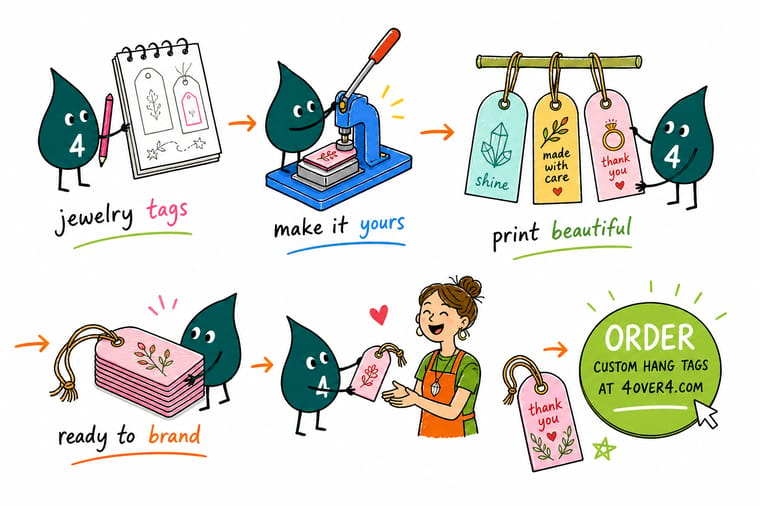
Wally sizes a tag against the piece first, never the other way around. Then he asks what has to fit: price alone stays on one panel, while materials, care and a barcode earn a fold. He picks stock heavy enough to stay flat in a tray, keeps the punch well away from the trim, and matches the cord to the metal. Last, he prints the whole season at once, because the per-tag price rewards it.
Design and print hang tags →Infographic
The 7 jewelry tag decisions at a glance
One frame, seven choices. Save it, print it, and run through it before you upload artwork for your next tag order.
No single decision carries a tag on its own. Size and stock set how it feels in the hand, the hole and cord decide whether it survives, and the content decides whether it sells.
Specs and pricing
Hang tag specs and live pricing
When your artwork is ready, the numbers below are the ones that matter. Pick a size, a stock and a run quantity, and the per-tag cost settles quickly.

| Quantity | Price Per Unit | Total |
|---|---|---|
| 50 | 50.5¢ | $25.27 |
| 100 | 28.6¢ | $28.56 |
| 200 | 15.9¢ | $31.86 |
| 300 | 12.4¢ | $37.35 |
| 400 | 10.2¢ | $40.64 |
| 500 | 8.79¢ | $43.94 |
| 600 | 8.24¢ | $49.43 |
| 700 | 7.53¢ | $52.73 |
Print it
Tag formats for every jewelry display


See it in use
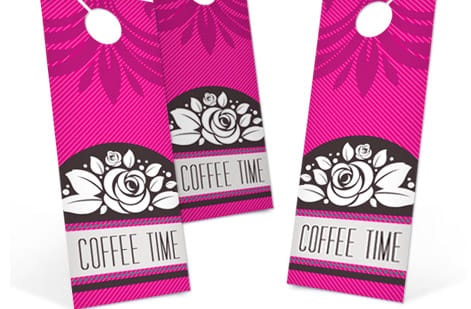
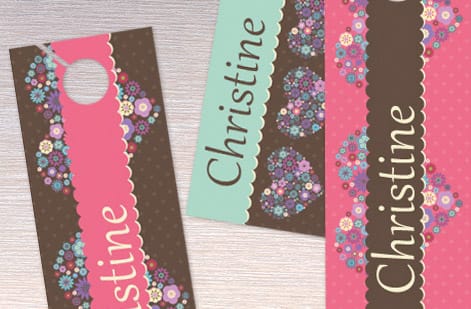
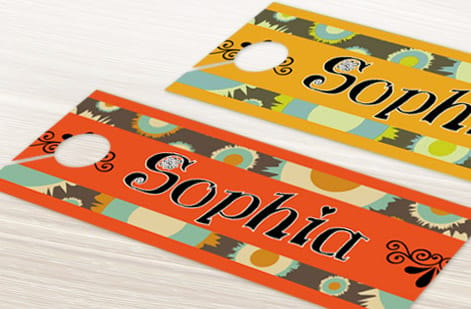
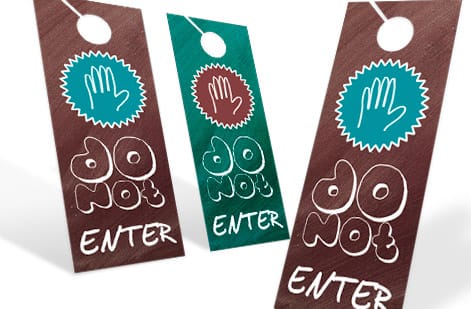
Real hang tag work, printed in-house



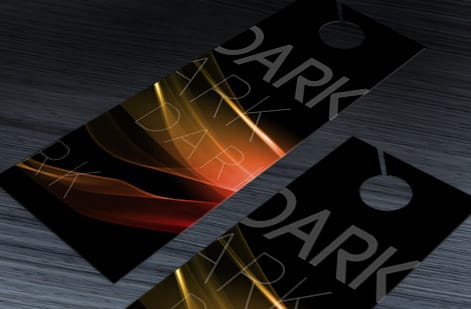
Explore more
Where to go next


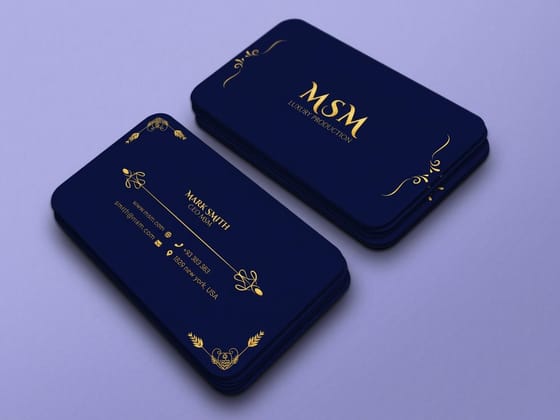



By the numbers
Printing you can count on at 4OVER4.COM
Common Questions
Common questions about jewelry tags
What is a jewelry tag?
A jewelry tag is a small printed card that attaches to a ring, necklace, bracelet or pair of earrings and carries the information a buyer needs before they ask a question. That usually means price, metal, stone or material, size, and a SKU or barcode for your own inventory. Most are printed on thick card stock, punched with a small hole, and tied on with cord, elastic or a plastic barb. In a retail case or a craft-fair display, the tag is the only thing speaking for the piece.
How do I choose the right jewelry tags?
Start from the piece and work outward. Measure the smallest item you sell and pick a tag that sits beside it rather than in front of it. Then decide how much has to fit: price alone needs very little room, while metal, stone, care and a barcode usually push you to a folded tag with a second panel. Finally choose a stock heavy enough to stay flat in a tray. If you are unsure, order one run of a plain standard tag and one run of a folded tag and see which your customers actually read.
What do jewelry tags cost and how are prices set?
Price is driven by quantity, size, stock weight, finish and turnaround, not by how complex your artwork is. At 4OVER4 standard hang tags start at $64.81 for a run, folded hang tags start at $95.56, and bottle neck tags start at $108.75. The per-tag cost falls sharply as the run grows, which is why most jewelry brands print a season at a time instead of reordering every month.
What sizes, stocks and finishes are available for jewelry tags?
Common jewelry tag sizes run from roughly 1 x 2 inches up to 2 x 3.5 inches, with square and rounded-corner shapes available for earring and pendant displays. Stocks range from 14PT and 16PT card through heavier uncoated and textured options that take pen ink for handwritten prices. Finishes include matte, gloss, soft-touch and spot UV, plus foil accents when the tag has to match a luxury line. Uncoated stock is the practical pick when staff write on the tag.
How long do jewelry tags take to print and ship?
Production is quoted in business days and starts once your file passes prepress, not when you place the order. Standard hang tags move quickly, while folded tags and specialty finishes add a step for scoring, folding or coating. Choose your turnaround in the configurator before checkout, then add transit time for your address. Approving artwork early in the day is the single easiest way to gain a day.
Do jewelry tags need a hole and a string, or can I use stickers?
Both work, and they solve different problems. A punched tag with cord or elastic suits rings, bracelets and necklaces because it moves with the piece and survives being picked up dozens of times. Adhesive labels suit flat display cards and sealed boxes, but they leave residue on metal and lift on curved surfaces. Most brands run tags for the pieces and keep labels for packaging.
Should the price go on the front or the back of the tag?
Put the brand and the piece name on the front and the price on the back or the inside panel of a folded tag. Shoppers pick a piece up because it looks right, then turn the tag over to check the number. Hiding the price entirely frustrates people and slows your sales floor, so it should always be findable in one flip, printed large enough to read in dim case lighting.
Get Started
Ready to tag your collection properly?
Upload your artwork, pick a stock heavy enough to survive the display case, and print a full season of jewelry tags in one run at 4OVER4.COM.
Legal Disclaimer
Gold Standard guarantees apply to all standard orders placed through 4over4.com. Price match requires verifiable proof of a competitor's published price for an equivalent product with matching specifications and turnaround time. Satisfaction guarantee covers manufacturing defects and print quality issues. Contact support with order number and documentation. On-time delivery rate based on tracked orders 1999 to 2026. Individual results may vary based on shipping carrier performance.
