Table of Contents
- Home
- content hub
- What Is Direct Mail Marketing in a Digital Age
 Share and earn
What Is Direct Mail Marketing in a Digital Age

Oct 29, 2025292 views
Oct 29, 2025292 views
Direct mail marketing is simply the practice of sending physical promotional materials—like postcards, letters, or catalogs—straight to a potential customer's mailbox. Think of it as a tangible, one-on-one conversation with your audience in a space that’s way less crowded than a digital inbox.
Understanding Direct Mail in the Modern Era
In an age where we're all drowning in fleeting digital ads, direct mail carves out a unique space by delivering a physical brand experience. It’s not about ditching your digital efforts; it’s about making them stronger. This strategy cuts through all the online noise, offering something real that customers can hold, feel, and remember.
The real power here comes from its ability to create a multisensory connection. Unlike an email that’s gone with a single click, a well-designed mail piece can sit on a kitchen counter or a desk for days, acting as a constant brand reminder. That physical presence builds a sense of legitimacy and trust that digital messages often struggle to match.
The Three Pillars of Success
Every truly effective direct mail campaign is built on three core components. When they work together, they drive real results. Getting these pillars right is the first step toward launching a campaign that actually connects with your audience and delivers a solid return.
This infographic breaks down what those three essential pillars are for any direct mail strategy.
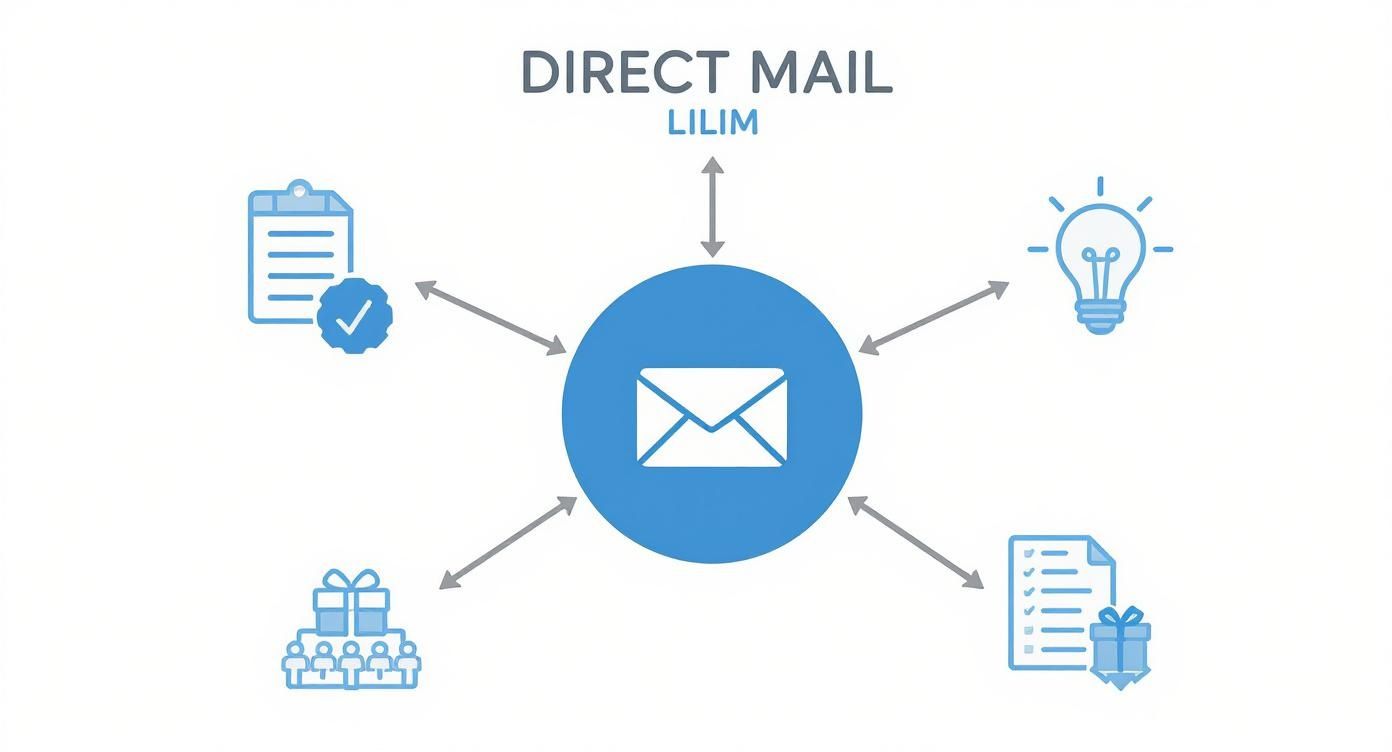
As you can see, success really hinges on getting your mailing list, your offer, and your creative execution perfectly aligned.
The List: This is all about who you're talking to. A highly targeted list makes sure your message reaches the people most likely to be interested in your product or service. You can learn more about zeroing in on specific neighborhoods with our guide on Every Door Direct Mail (EDDM).
The Offer: This is why they should care enough to act. A compelling offer—like a can't-miss discount, a free trial, or an exclusive invitation—gives people a clear and immediate reason to respond.
The Creative: This is how you grab their attention and don't let go. From eye-catching design and persuasive copy to the very format of the mailer itself, strong creative makes your message impossible to ignore.
The data backs this up, time and time again. This tangible approach yields impressive engagement. Direct mail campaigns typically achieve response rates between 3% and 5%, which absolutely dwarfs email's average of just 0.6%. You can dig deeper into why direct mail still works in a digital world on Triadex Services. That stark difference really highlights just how effective it continues to be.
The Hidden Advantages of Physical Mail
In a world cluttered with digital noise, why does something as old-school as a piece of physical mail still pack such a punch? It’s all about the tangible experience. You can’t physically hold an email, but you can touch and feel a well-designed mailer. That sensory connection creates a much stronger and more personal bond with a brand than a fleeting digital ad ever could.
This physicality builds an incredible amount of trust right off the bat. We've all become a bit skeptical of our overflowing inboxes and potential digital scams. But a physical piece of mail? That feels legitimate. It takes a real investment to create and send, which signals to the person holding it that the message is worth paying attention to and the brand is credible. It lays a foundation of trust before they even think about visiting your website.

Driving Real Engagement
One of the biggest wins for direct mail is its uncanny ability to reach specific, high-value groups of people who might be less plugged-in online. Think of it as a direct line into someone's home, completely bypassing the digital gatekeepers like ad blockers and spam filters. Your message lands right in their hands, guaranteed.
For example, a local boutique can send postcards with a can't-miss in-store offer to households in nearby zip codes, driving immediate foot traffic. Or a B2B company trying to get a decision-maker's attention can send a "dimensional mailer"—a small package with a gift or sample inside. Good luck ignoring that when it lands on your desk, unlike the hundred other emails you got that day. These tactile moments stick with people and spark action.
The numbers don't lie. Direct mail sees a household open rate of 80–90%, which absolutely dwarfs email's average of 20–30%. And when you get personal, the results are even better—customized mailers can boost response rates by as much as 135%.
Unlocking a Better Return
All that engagement naturally leads to a fantastic return on your investment. When 71% of consumers say direct mail feels more personal than online messages, it’s easy to see why it connects on a deeper level. This positive vibe isn't just a feeling; it translates into real dollars, with some campaigns pulling in an ROI as high as 161%.
A huge part of its effectiveness is its staying power. A sharp-looking postcard or a professional letter in a branded envelope can sit on a kitchen counter or desk for days. This keeps your brand front and center in a way a digital ad just can't, making it a seriously powerful and trackable tool for growth. If you want to make sure your mail gets noticed, take a look at our options for custom printed business envelopes.
Building Your First Direct Mail Campaign
Launching your first campaign can feel like a massive undertaking, but it doesn't have to be. The secret is breaking it down into a clear, step-by-step process that makes the whole thing manageable. Think of it like assembling furniture—each piece connects to the next, slowly building a solid structure.
The key is to work through it methodically, starting with your core strategy and ending with a final analysis. This roadmap will walk you through the entire journey, making sure you cover all the bases for a successful launch.
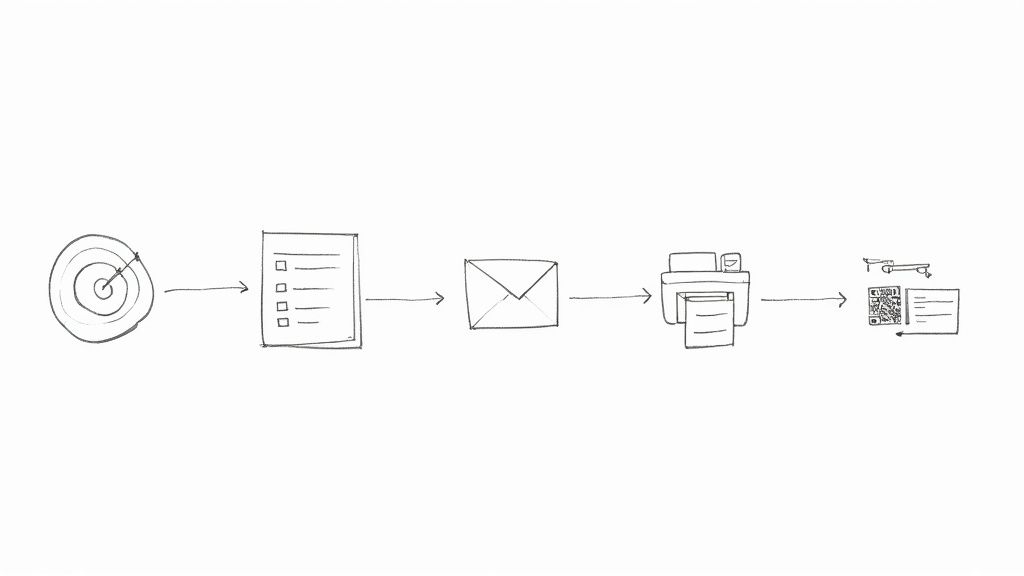
Step 1: Define Your Goals and Budget
Before you even think about design, you need to be crystal clear on what you’re trying to achieve. Are you hoping to drive more foot traffic to your new coffee shop? Generate qualified leads for your sales team? Or maybe re-engage customers who haven't purchased in a while? Your goal is the foundation for every other decision you'll make.
Once you know your "why," it’s time to set a realistic budget. This isn't just about printing costs; you need to account for everything from acquiring your mailing list and design work to the final postage. Getting your numbers straight from the beginning prevents any nasty surprises down the road and keeps the project on track.
Step 2: Build a Highly Targeted Mailing List
Let’s be honest: your mailing list is the single most important factor in your campaign's success. You could have the most brilliant offer in the world, but sending it to the wrong audience is like shouting into the void—a complete waste of money.
You can build your list from your existing customer database (a goldmine!) or purchase a targeted list based on specific demographics, locations, or even past purchase behaviors.
A well-curated list ensures your message lands in the hands of people who are most likely to actually care. As you build your direct mail campaign, understanding the broader landscape of lead generation marketing is essential for maximizing your results.
Step 3: Design a Compelling Mail Piece
Now for the fun part. Your design has mere seconds to grab someone's attention as they sift through their mail. Go for a bold headline, striking visuals, and clear, concise copy. Less is often more here.
Most importantly, your call to action (CTA) needs to be impossible to miss. Tell recipients exactly what you want them to do next, whether that’s visiting a specific website, scanning a QR code, or bringing a coupon into your store. Don't make them guess.
Step 4: Partner with Printing and Mailing Services
With your design finalized, you need a reliable partner to bring it to life. Professional printing is non-negotiable; it ensures your mailer looks polished and credible, not like something you ran off on your office printer.
Many companies now offer all-in-one solutions that handle both the printing and the mailing, which can save you a ton of time and logistical headaches. A good partner also helps you navigate the surprisingly complex world of postal regulations. Exploring expert direct mail services is a great way to make this part of the process smooth and error-free.
Step 5: Track and Measure Your Results
So, did it work? You won't know unless you track your results. Tracking is the only way to figure out if your campaign was a success and what you can improve next time. The easiest way to measure your return on investment is to include a unique element on your mailer that you can trace back to the campaign.
Here are a few simple but effective methods:
- Unique Promo Codes: Assign a special discount code that's only used for this mailer.
- Custom URLs (PURLs): Direct recipients to a specific landing page on your website built just for them.
- QR Codes: Give smartphone users an easy way to scan and go directly to your offer page.
By keeping an eye on these metrics, you can accurately calculate your response rate and ROI. This isn't just about grading this campaign; it's about gathering valuable intel to make your next one even better.
To help you stay organized, here's a simple checklist to guide you from start to finish.
Direct Mail Campaign Launch Checklist
| Phase | Key Task | Success Metric |
|---|---|---|
| 1. Strategy & Planning | Define clear campaign goals (e.g., generate 50 new leads). | Goal is specific and measurable. |
| Set a comprehensive budget for all campaign elements. | Budget approved and allocated. | |
| 2. Audience & List | Build or acquire a highly targeted mailing list. | List demographics match target customer profile. |
| Clean and segment the mailing list for personalization. | Open/response rate by segment. | |
| 3. Creative & Design | Develop compelling copy with a strong Call to Action (CTA). | A/B test results on CTA performance. |
| Create an eye-catching design that reflects your brand. | Design is approved by all stakeholders. | |
| 4. Production & Logistics | Select a reliable printing and mailing service provider. | Quotes received and partner chosen. |
| Finalize mail piece format (postcard, letter, etc.). | Final proof approved for printing. | |
| 5. Tracking & Launch | Set up tracking mechanisms (promo codes, PURLs, QR codes). | Tracking links and codes are tested and working. |
| Schedule the mail drop date with your provider. | Mail drop confirmed. | |
| 6. Measurement | Monitor response rates and track conversions. | Response Rate, Conversion Rate, Cost Per Acquisition. |
| Calculate the final Return on Investment (ROI). | Final ROI is positive and meets/exceeds goals. |
Following these steps methodically turns a daunting project into a series of achievable tasks, setting you up for a campaign that not only reaches mailboxes but also drives real business results.
Real-World Examples of Direct Mail Success
It's one thing to talk about direct mail in theory, but seeing it in action is what really gets the ideas flowing. Companies today are getting some incredible results by sending something real and tangible—a message that simply can’t be ignored in a crowded inbox.
Let's look at a few examples of how brands are making it work.
Winning Back Lost Sales
An e-commerce brand was struggling with a classic problem: abandoned shopping carts. To re-engage these would-be customers, they started sending personalized postcards 48 hours after someone left the site. The card featured a picture of the exact product left behind, a friendly nudge, and a small, time-sensitive discount to seal the deal.
That simple, physical reminder led to a 14% cart recovery rate, blowing their email-only campaigns out of the water. If you're looking to run a similar play, you can get started with high-quality, custom postcards for your business.
From Mailbox to Major Deals
Over in the B2B space, a software company needed to get past the digital gatekeepers protecting busy C-suite executives. Cold emails were getting deleted on sight. So, they tried something different: a "dimensional mailer," which is really just a fancy term for a small, branded box. Inside was a high-quality coffee mug and a simple note that read, "Let's grab a virtual coffee and discuss how we can save your team 20 hours a week."
This clever approach didn’t just bypass the noise—it landed directly on the desks of the people who make the decisions. The campaign pulled in a 25% meeting booking rate and was directly credited with closing two deals worth six figures each.
Finally, think about a local dental clinic that wanted to bring in new patients from the surrounding neighborhoods. They kept it simple and sent a postcard with a can't-miss offer: "Free Teeth Whitening Kit for New Patients." The design was clean, the offer was front and center, and the call to action was crystal clear—call to book your appointment. The result? A 30% jump in new patient bookings over just two months.
These stories aren't just one-offs; they're part of a bigger picture. The direct mail industry is booming, with the average number of pieces sent by companies expected to nearly double from 34.9 million to 67.3 million annually between 2024 and 2025. You can dig into more of this data in Lob's 2025 State of Direct Mail report.
Connecting Direct Mail with Your Digital Strategy
Direct mail shouldn't be an island. Its real power comes alive when you pair it with your digital marketing channels.
Think of it as building a bridge between the physical and digital worlds for your customers. You're not just repeating the same message; you're creating a seamless experience where each channel makes the other one stronger.
For example, a simple postcard can become an interactive gateway. Slap a QR code or a custom URL on it, and you can guide people straight to a landing page built specifically for that campaign. This not only makes it dead simple for them to respond but also gives you a crystal-clear way to track who's engaging with your mailer and what actions they're taking.
Creating a Unified Customer Journey
Modern automation platforms have made this kind of integration easier than ever. You can now use what someone does online—their digital behavior—to trigger a piece of physical mail. This creates timely, super-relevant touchpoints that really grab their attention.
Suddenly, your direct mail isn't just a standalone campaign. It's a responsive, intelligent part of your customer's journey.
Here are a few proven tactics that work like a charm:
- Retargeting Website Visitors: Someone browses a product on your site but leaves without buying? A few days later, a postcard lands on their doorstep with a special offer for that exact item. It's surprisingly effective.
- Re-engaging Inactive Subscribers: Got a list of email subscribers who haven't opened anything in months? A compelling mail piece with an exclusive "we miss you" discount can be just the thing to rekindle that relationship.
- Automated Welcome Campaigns: The moment a customer makes their first online purchase, you can automatically trigger a welcome postcard. A simple thank you note and a coupon for their next order goes a long way.
The whole strategy is about creating a conversation that flows naturally between different channels. A physical mail piece can drive digital action, and a digital action can trigger a physical follow-up.
To really nail this integration and get the most bang for your buck, it helps to understand a complete multi-channel marketing approach. You can also bring in tech like variable data printing services to personalize each mailer based on the digital data you have, making every single piece feel like it was made just for them.
When you connect all these dots, you're not just sending mail—you're building a smarter, more effective marketing machine.
Of course. Here is the rewritten section, crafted to sound completely human-written and natural, following all the specified requirements.
Frequently Asked Questions About Direct Mail
Even when you’re sold on the benefits, a few practical questions always pop up before launching a direct mail campaign. Getting these cleared up is the key to moving forward confidently and building a strategy that actually delivers.
Let's dive into the most common ones.
How Much Does a Direct Mail Campaign Cost?
This is the big one, and the honest answer is: it varies. The final cost really boils down to four key pieces: your mailing list, the design work, printing, and postage. For a straightforward postcard campaign, you’re likely looking at a range of $0.50 to $3.00 per piece, all in.
Sure, that’s more than hitting ‘send’ on an email blast, but the conversation changes when you look at response rates. Direct mail often pulls in significantly higher engagement, making it a smart investment, especially when you’re promoting high-value products or services. The trick is to budget for all four components from the get-go to avoid any surprises down the line.
How Can I Measure the ROI of My Campaign?
Tracking the return on your direct mail investment is simpler than you’d think, and it's absolutely essential for proving its worth. The secret is to build a bridge from your physical mailer to your digital world with a unique, trackable element on every piece.
By giving each campaign its own tracking method, you can directly link website visits, calls, or sales back to your mailers. This gives you a crystal-clear picture of your ROI.
Here are a few proven ways to do it:
- Unique Promo Codes: Create a special discount code that’s only used for the mail campaign.
- QR Codes: Send people to a specific landing page where you can track traffic with your analytics tools.
- Dedicated Phone Numbers: Use a call-tracking number to see exactly how many inbound leads came from that mailer.
Is Direct Mail Effective for B2B Marketing?
Absolutely. In the B2B space, decision-makers are drowning in emails. A well-timed piece of direct mail can be the perfect way to slice through that digital noise. It's especially powerful for account-based marketing when you have your sights set on high-value prospects.
Think about it: sending a thoughtfully designed, personalized mailer or a small, clever package to a C-suite executive is almost guaranteed to get more attention than yet another cold email in their inbox. It’s a tangible gesture that shows you’ve invested time and effort into connecting with them. This is how you open doors, land meetings, and build the kind of relationships that digital-only tactics just can't replicate.
Ready to create a direct mail campaign that gets noticed? 4OVER4 offers high-quality printing for everything from postcards to custom mailers, helping you bring your vision to life. Explore our printing solutions and start your project today!
More from

13
When you’re ready to invest in an A-frame sign, the first question you'll ask is, "What size do I need?" It usually comes down
 Emma Davis
Mar 13, 2026

113
The real secret to mastering your direct mail budget isn't complicated. It comes down to one simple fact: a standard 4" x 6&q
Emma Davis
Mar 12, 2026

63
Tear-off flyers are a classic for a reason. They’re a tangible marketing tool, designed with perforated, removable tabs at the bottom. Each
Emma Davis
Mar 11, 2026

112
Printing stickers at home is a seriously fun and rewarding project. It boils down to four main parts: designing your image, picking the right
Emma Davis
Mar 10, 2026

103
Ever seen a logo that seems to float right on the glass of a jar or bottle? That’s the work of transparent label stickers.
Emma Davis
Mar 9, 2026

59
Picture this: your product’s beautiful label gets smudged and runny during shipping, or a gorgeous event banner fades to nothing after just
Emma Davis
Mar 8, 2026

58
In a sea of options, your product's packaging and labeling are its first, and often only, chance to make a real connectio
Emma Davis
Mar 7, 2026

89
Ever tried to print a hundred high-quality flyers on your home office printer? You probably ran out of ink, dealt with paper jams, and ended u
Emma Davis
Mar 6, 2026