What You Need to Know About Postcard Stamps and Sizing
Your postcard's physical dimensions - not the stamp's size - determine how much postage you'll pay. A standard USPS postcard stamp covers cards between 3.5" x 5" and 4.25" x 6". Go bigger, and you're paying First-Class letter rates. 4OVER4.COM has helped 150,000+ businesses print postcards that hit the sweet spot for mailing savings, backed by 25+ years of printing know-how. Get the size right, and your postage stays low.
Why Postcard Stamp Size Actually Matters for Your Mailings

Here's the thing most people get wrong: the physical size of a postage stamp is irrelevant. What matters is whether your postcard qualifies for the cheaper postcard-rate stamp or gets bumped to a pricier First-Class letter rate. That difference adds up fast when you're mailing hundreds - or thousands - of cards.
This postcard stamp size guide breaks down the exact USPS dimensions your postcard needs to meet, what happens when you go oversized, and how to avoid paying more than you should. Whether you're sending direct mail campaigns or event invitations, understanding these rules saves real money. 4OVER4.COM prints postcards across 1,000+ products in our catalog, all designed to meet postal standards.
If you're working on other print projects, check out our guide on How To Fold A Brochure for folding techniques. Need help with stamp maintenance? Our How To Clean Rubber Stamps guide has you covered. And if you want to start designing right away, browse our Design Templates for ready-to-use layouts.
USPS Postcard Dimensions, Stamp Rates, and Mailing Rules Explained
How USPS Classifies Your Postcard
The United States Postal Service doesn't care what you call your mail piece. It cares about measurements. A postcard qualifies for the discounted postcard-rate stamp only if it falls within a strict range of height, length, and thickness. Miss any one of those specs, and USPS reclassifies your card as a letter - which costs more to mail.
For 2025-2026, the USPS postcard rate is $0.56 per piece. The First-Class letter rate sits at $0.73. That's a $0.17 difference per card. Mail 1,000 postcards and you're looking at $170 in extra postage just because your card was a quarter-inch too tall. That's money you could spend on better paper stock or a second mailing.
Standard postcard dimensions must fall between these ranges:
- Height: Minimum 3.5 inches, maximum 4.25 inches
- Length: Minimum 5.0 inches, maximum 6.0 inches
- Thickness: Minimum 0.007 inches, maximum 0.016 inches
Your card also needs to be rectangular with an aspect ratio (length divided by height) between 1.3 and 2.5. Anything outside these numbers gets reclassified. Square postcards? Those get a surcharge too. For more creative print projects that don't go through the mail, you might enjoy our How To Make Flyers guide.
Standard Postcard Sizes That Qualify for Postcard-Rate Stamps
Most printed postcards fall into a few common sizes. Not all of them qualify for the postcard stamp rate. Here's what you need to know about each one.
4" x 6" postcards are the most popular size for direct mail. They fit comfortably within USPS postcard dimensions at 4 inches tall and 6 inches long. This is the go-to for marketing campaigns, appointment reminders, and event announcements. A single postcard-rate stamp in the top right corner is all you need.
3.5" x 5" postcards hit the minimum size requirements. They're compact, cost-effective, and work well for thank-you notes, save-the-dates, and quick promotional messages. These also qualify for the postcard rate.
4.25" x 5.5" postcards sit right at the maximum height. They still qualify for postcard-rate postage since both dimensions fall within the allowed range. This size gives you a bit more design real estate without crossing into letter territory.
"We switched from 5x7 postcards to 4x6 for our restaurant's weekly specials mailings. Saved us almost $200 a month in postage alone. The 4OVER4.COM print quality on 16pt stock still looks sharp at the smaller size."
- Marcus L., restaurant owner ★★★★★
When Your Postcard Needs a Letter Stamp Instead
Go beyond 4.25" x 6" and your postcard is no longer a postcard in the eyes of USPS. It's a letter. That means you'll need a First-Class letter stamp instead of a postcard stamp.
Common oversized postcard dimensions include:
- 5" x 7" postcards: A popular choice for real estate agents and photographers. Looks great, but requires letter-rate postage at $0.73 per piece.
- 6" x 9" postcards: Maximum size for letter-rate postage. These jumbo cards grab attention in the mailbox but cost more to send.
- 6" x 11" postcards: These fall into the "flat" category and cost even more - typically around $1.19 or higher depending on weight.
The trade-off is real. Bigger postcards get noticed more in the mailbox. But the extra postage eats into your budget. For most small businesses, the 4" x 6" size hits the sweet spot between visibility and cost. If you're exploring creative direct mail options, take a look at our 3D Postcards that make a big impression at standard postcard sizes.
Where to Place the Stamp on Your Postcard
Stamp placement isn't just tradition - it's a USPS requirement. The stamp goes in the upper right corner of the address side of your postcard. This is non-negotiable if you want your mail processed by automated sorting machines.
USPS sorting equipment scans the upper right area for postage. If your stamp is in the wrong spot, your postcard could get delayed, returned, or hit with additional handling fees. Here's what the address side of your postcard needs:
- Stamp area: Upper right corner, with enough clearance from the edge
- Return address: Upper left corner
- Recipient address: Center-right area, at least 5/8 inch from the bottom edge
- Barcode clear zone: Bottom 5/8 inch of the card must stay clear for postal barcodes
The left half of the address side can include a brief message or additional branding. But keep the right half clean and reserved for addressing and postage. For more print and mail tips, visit our Faq Hub where you'll find dozens of practical guides.
Blank Templates


Thickness Rules and Paper Stock Considerations
Thickness trips people up more than you'd expect. USPS requires postcards to be at least 0.007 inches thick (about the thickness of a standard index card) and no more than 0.016 inches. Most commercial postcard stocks fall right in this range.
A 14pt cardstock measures roughly 0.014 inches - right in the sweet spot. It's sturdy enough to survive the mail without bending, and thin enough to stay under the maximum. This is the most common weight for direct mail postcards.
16pt cardstock comes in around 0.016 inches, sitting right at the maximum. It feels more premium in the hand - about the thickness of a credit card. Most postal facilities accept 16pt without issue, but it's technically at the limit.
Go thicker than 16pt and you risk surcharges or reclassification. Ultra-thick stocks like 32pt are fantastic for hand-delivered postcards, event handouts, or in-store displays. But they're too thick for standard postcard-rate mailing. If you're interested in pairing your postcards with other printed materials, our guide on How To Make Envelopes shows you how to create custom packaging.
"I ordered 14pt postcards from 4OVER4.COM for a real estate campaign. They mailed perfectly with standard postcard stamps - no issues at the post office. The matte finish looked clean and professional."
- Diana R., real estate agent ★★★★★
Bulk Mailing and Postcard Stamps: What Changes at Scale
Sending postcards one at a time? A postcard-rate stamp works fine. But when you're mailing 200+ pieces, you've got better options.
USPS Marketing Mail (formerly Standard Mail) offers discounted rates for bulk mailings of 200 or more identical pieces. Rates can drop to around $0.30-$0.40 per piece depending on how you sort and prepare the mail. You won't use individual stamps for these - instead, you'll use a permit imprint or metered postage.
To qualify for Marketing Mail rates, your postcards still need to meet the standard size requirements. The same dimension rules apply. You'll also need to sort by ZIP code and deliver to a Business Mail Entry Unit (BMEU).
For smaller batches, precanceled stamps or meter strips can speed up the process. Some businesses use online postage services like Stamps.com or Pitney Bowes to print postage directly onto the card or a label. If you're creating unique promotional materials alongside your postcards, check out our guide on Custom Magnets Faq for another direct mail add-on that gets results.
International Postcard Mailing
Sending postcards internationally from the U.S.? The rules shift. As of 2025, international postcard postage costs $1.65 per piece. The same USPS size requirements apply for the postcard classification, but you'll need an international-rate stamp or the equivalent postage value.
International postcards still need to be rectangular, between 3.5" x 5" and 4.25" x 6", and within the thickness range. The stamp goes in the same upper right corner. Allow 7-21 business days for international delivery depending on the destination country.
If you're ready to design postcards that meet all these requirements, browse the template options below for sizing inspiration.
Postcard Mailing Mistakes That Cost You Money
Even experienced mailers slip up. Here are the most common errors that lead to returned mail, surcharges, or delays - and how to avoid them.
- Designing at 4.5" x 6.25" and assuming it's "close enough." It's not. Even a fraction of an inch over 4.25" x 6" bumps your card to letter rate. Always design to the exact finished trim size.
- Using ultra-thick paper for mailed postcards. That gorgeous 32pt stock feels amazing, but it exceeds the 0.016-inch thickness maximum. Save it for hand-delivered pieces.
- Putting the stamp on the wrong side. The stamp goes on the address side, upper right corner. Sounds obvious, but when you're designing the "front" of a postcard, it's easy to forget which side is which.
- Forgetting the barcode clear zone. The bottom 5/8 inch of the address side must be blank. Text, graphics, or dark backgrounds in this area can cause processing errors.
- Assuming all square cards get postcard rates. Square mail pieces always incur a non-machinable surcharge, regardless of size. Stick to rectangular formats.
4OVER4.COM designs all standard postcard templates to meet USPS mailing specifications, so you start with the right dimensions from the beginning.
Postcards Built to Meet Postal Standards
Now that you've got the postcard stamp size guide down, pick the right product for your mailing. 4OVER4.COM offers postcards in every standard mailing size, printed on stocks that fall within USPS thickness requirements. Try our Free Business Cards to experience the print quality firsthand before ordering postcards.
| Requirement | Minimum | Maximum |
|---|---|---|
| Height | 3.5 inches | 4.25 inches |
| Length | 5.0 inches | 6.0 inches |
| Thickness | 0.007 inch | 0.016 inch |
Looking for sustainable options? Our Green Printing line includes recycled postcard stocks that still meet postal specs. And if you want to test 4OVER4.COM quality risk-free, grab a set of Free Business Cards - same premium printing, zero cost.
- 5.5" x 8.5"
- 6" x 9"
- 6" x 11"
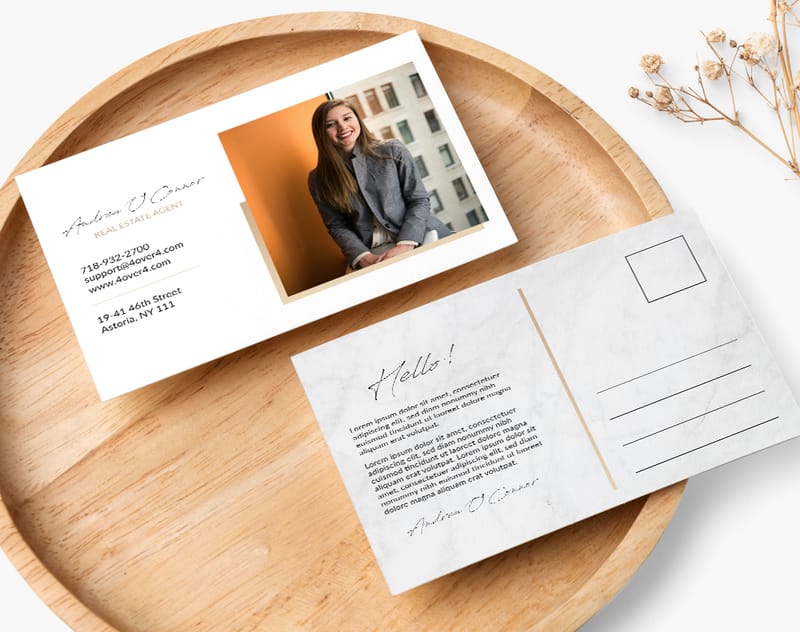
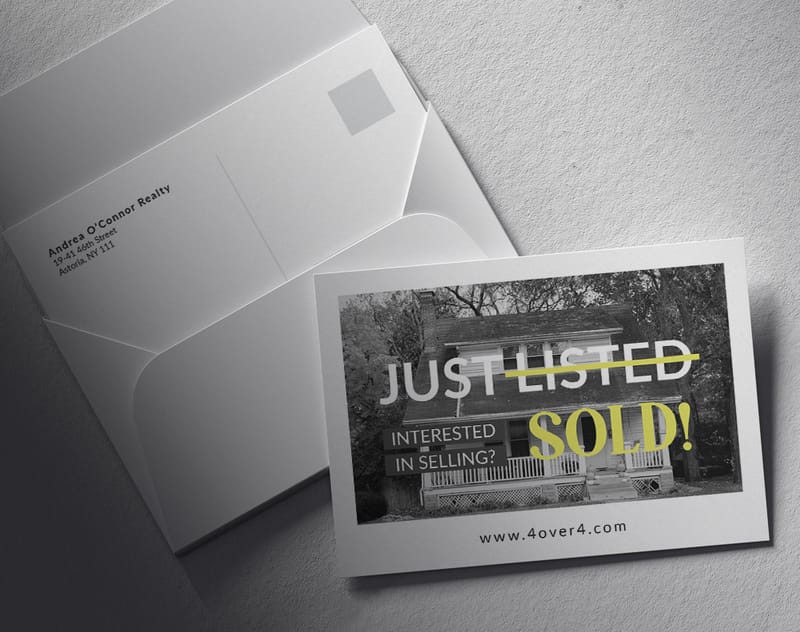
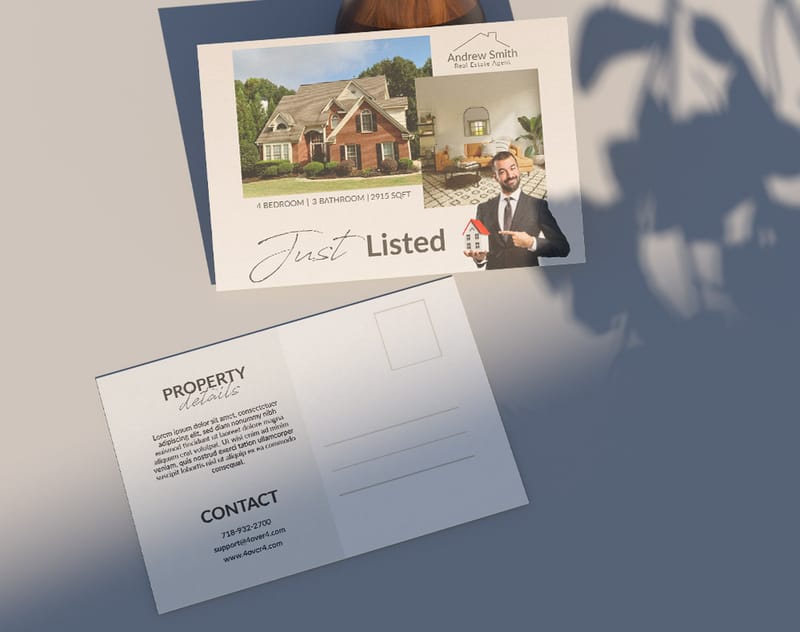
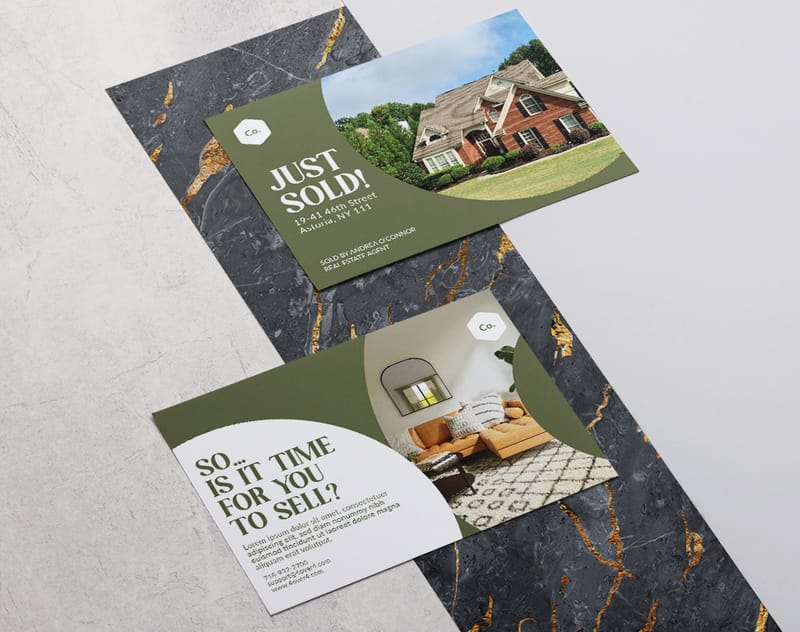
Here's a closer look at the postcard options and what real customers have to say.
Free Postcard Stamp Size Templates

Your Postcard Stamp and Size Questions, Answered
What size postcard qualifies for a postcard-rate stamp?
Your postcard must measure between 3.5" x 5" (minimum) and 4.25" x 6" (maximum) with a thickness of 0.007" to 0.016". Cards within this range qualify for the USPS postcard-rate stamp at $0.56. The card must also be rectangular with an aspect ratio between 1.3 and 2.5.
Can I use a regular Forever stamp on a postcard?
Yes. A Forever stamp covers First-Class letter postage, which is more than the postcard rate. You'll overpay by about $0.17 per card, but it'll get delivered. For budget-conscious mailings, buy postcard-specific stamps to save on every piece.
Does the physical size of the stamp matter?
No. The stamp's physical dimensions don't affect anything. What matters is the stamp's postage value and that it's placed in the upper right corner of the address side. Whether you use a standard-size stamp, a commemorative stamp, or metered postage, the result is the same.
What happens if my postcard is slightly oversized?
USPS reclassifies it as a letter. You'll need a First-Class letter stamp ($0.73) instead of a postcard stamp ($0.56). If it's a lot oversized - beyond 6.125" x 11.5" - it becomes a "flat" and costs even more. Always measure your finished, trimmed postcard before buying postage.
Is 16pt cardstock too thick for mailing postcards?
16pt cardstock measures approximately 0.016 inches, which sits right at the USPS maximum thickness for postcards. Most post offices accept 16pt without issues. However, 4OVER4.COM recommends 14pt stock for high-volume direct mail campaigns to stay comfortably within the limit and avoid any processing hiccups.
How do I mail postcards in bulk at a lower rate?
USPS Marketing Mail offers discounted rates for mailings of 200+ identical pieces. Rates drop to roughly $0.30-$0.40 per card depending on sorting and preparation. You'll need a USPS Marketing Mail permit and must sort by ZIP code. Your postcards still need to meet standard size requirements to qualify for the postcard classification.
"Ordered 2,500 postcards from 4OVER4.COM for a grand opening mailer. The 14pt uncoated stock mailed perfectly with postcard stamps - not a single one came back. Great quality for the price."
- Tanya W., boutique owner ★★★★★